
Nonfiction

After Certainty
How to Live and Judge When Understanding is not Enough
By Kevin Steffensen
How to live and judge once explanation reaches its limits—judgment, responsibility, and participation without replacement frameworks.
How to live and judge once explanation reaches its limits—judgment, responsibility, and participation without replacement frameworks.
Offered under open publishing terms (CC BY-SA). Download formats are free where available; purchase links support print editions.
- Type
- Nonfiction · monograph
- Author
- Kevin Steffensen
- Published
- January 2026
- Chapters
- 15 chapters
- Formats
- EPUB, PDF, DOCX
On these shelves
Also in Core After Certainty
View all 6 →
Curiosity Before Certainty
How Curiosity Helps Us Understand a Complex World

Trust Beyond Similarity
How Trust Remains Possible Across Difference

What We Cannot See
Bias, Judgment, and the Limits of Perspective
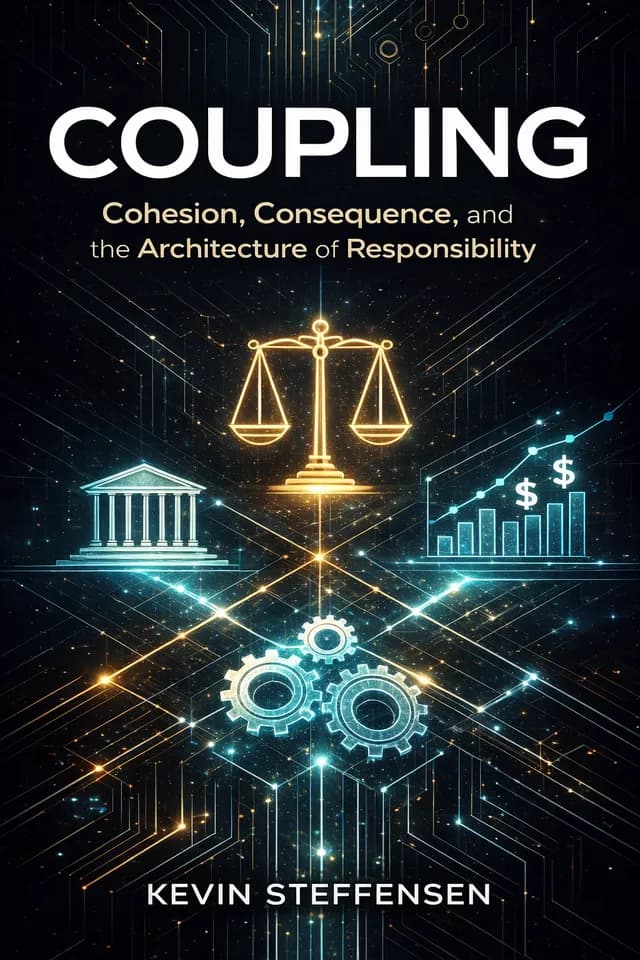
Coupling
Cohesion, Consequence, and the Architecture of Responsibility
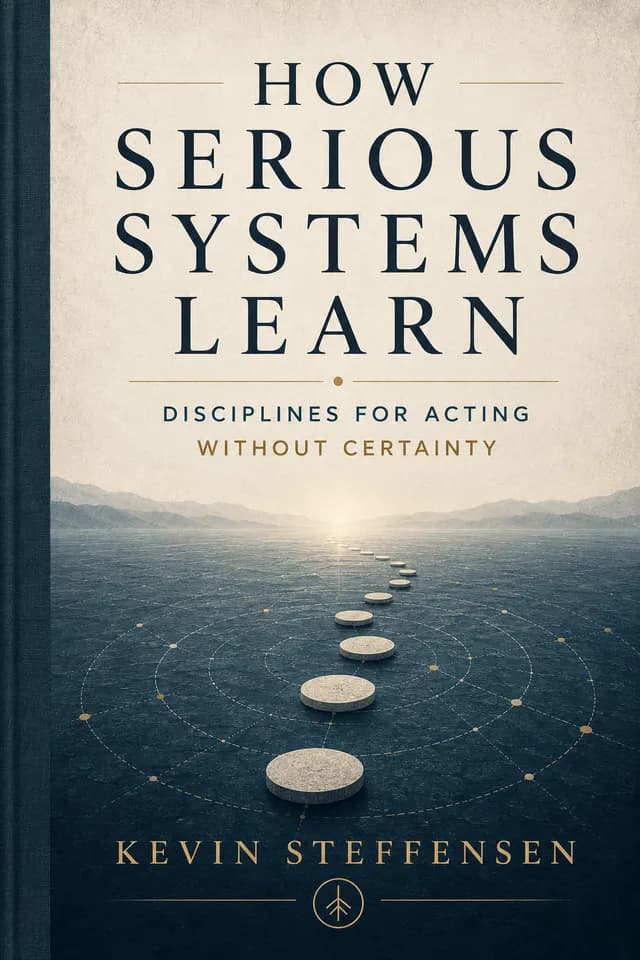
How Serious Systems Learn
Disciplines for Acting Without Certainty


The question this book explores
How do we live and judge when understanding is not enough?
Why this book exists
After Certainty is the project’s namesake orientation: judgment, responsibility, and participation once explanation reaches its limits and replacement frameworks will not save us.
Who it is for
Readers ready for the capstone thesis — including those arriving from curiosity, perspective, trust, or systems doorways.
What it is not
- It does not install a new totalizing certainty in place of the old one.
- It does not claim that abandoning certainty means abandoning standards.
Central ideas
A curated handful of concepts and patterns this book develops — not the full inventory.
Concept
Agency
In this book: Names the practical stake of the capstone: capacity to act and affect outcomes once explanation no longer guarantees control—so participation stays possible without a replacement framework.
Explore the conceptConcept
Accountability
In this book: Anchors judgment after certainty as exposure to consequence rather than correctness theater; distinguishes answerability from mastery of the field.
Explore the conceptConcept
Authority
In this book: Clarifies operational power that still steers action when understanding is incomplete—so leadership and legitimacy remain live questions, not solved by better theory alone.
Explore the conceptConcept
Abstraction
In this book: Marks the drift the book resists: mediation that scales systems while concealing encounter; the work keeps returning judgment to contact with effects.
Explore the conceptConcept
Coherence Maintenance
In this book: Names the ongoing labor of keeping enough governable agreement—who decides, what counts—without installing a new totalizing certainty.
Explore the conceptPattern
Explanation Replaces Response
In this book: Introduces the failure mode where more framing reorganizes harm instead of reducing it—central to why understanding alone is not enough.
Explore the patternPattern
Blame Compresses Complexity
In this book: Dramatizes the cheap relief of locating fault when the field is too complex for a single cause; the book treats this as a temptation after certainty fails.
Explore the patternPattern
Attention Restores Contact
In this book: Applies the restorative move: attention reintroduces consequence where abstraction would hide it—practice rather than a new doctrine.
Explore the pattern
Inside this book
How the book is organized — parts, chapters, and what each section investigates.
About 104 min of reading across 15 sections in 4 parts.
Part I — Letting Go
4 sections
Part I — Letting Go
4 sectionsShow summaryHide summary
Clarity has arrived without relief. People tighten their hold on correctness, explanation, admiration, and moral sorting—responses that began as care—because uncertainty is expensive and they still need somewhere to stand. The part asks what must be released when those grips are asked to carry more than they can.
Central questionWhat must we release when familiar forms of certainty start carrying more than they can?
Show summaryHide summary
Two siblings argue about a tree that no longer exists until remembering becomes defending who still counts as worth listening to. Correctness begins as coordination with reality, then hardens into identity—so revision starts threatening coherence rather than improving the account. Letting go of correctness is not abandoning truth; it is refusing to treat being right as the end of moral tension.
Central questionWhat happens when being right becomes an identity that can no longer revise?
Show summaryHide summary
An excellent map leaves travelers still lost—every road marked except the question of where to go now. Explanation orients after confusion, then quietly inherits responsibilities that belong to action, care, and judgment. Under pressure it becomes endless motion without arrival, a respectable way of postponing what remaining uncertainty still requires.
Central questionWhen does more explanation stop clarifying and start displacing what must be done?
Show summaryHide summary
A beloved teacher’s story adjusts itself around a first complaint until trust becomes insulation from scrutiny. Heroes concentrate hope and villains gather harm into a face—both make the moral world legible, and both can protect communities from examining participation, incentives, and proximity. Releasing archetypes is not relativism; it is keeping trust open to proportioned inquiry after admiration has settled.
Central questionCan trust survive scrutiny once admiration has made someone untouchable—or unforgivable?
Part II — What Can Still Be Practiced
4 sections
Part II — What Can Still Be Practiced
4 sectionsShow summaryHide summary
After correctness, explanation, and moral sorting each fail to finish uncertainty, the desire for certainty returns in smaller forms—one more conversation, one more decision, one more carefully worded message. The bridge refuses replacement frameworks and points toward judgment that can revise, responsibility that persists without control, and speech answerable to effects.
Central questionWhat can still be practiced once familiar certainties weaken without a replacement certainty?
Show summaryHide summary
Someone finally makes the appointment — a decision enters the calendar while worry, waiting, and consequence continue — showing judgment that acts without claiming finality. Restraint schedules the visit without treating the result as the end of the story; indecision postpones because being wrong feels unbearable. Revisability keeps judgment in contact with consequences rather than converting exhaustion into premature close.
Central questionHow do we decide when the situation will continue after the decision?
Show summaryHide summary
A daughter keeps driving over on Tuesdays—disagreements intact, aging unfinished, presence chosen without the fantasy that agreement restores mastery. Responsibility is reframed as responsiveness and participation after control thins: remaining answerable without becoming consumed, and without treating ineffectiveness as permission to withdraw.
Central questionWhy remain responsible for what you can no longer control?
Show summaryHide summary
A carefully drafted message returns instantly as “That is not what I said,” and more words widen the distance. Language travels faster than meaning; clarifications multiply surfaces for conflict. The chapter shifts the question from persuasion to proportion—what effects words will have once they leave control—without treating silence as the only alternative.
Central questionWhat should speech do when more words make misunderstanding larger?
Part III — Living With Limits
4 sections
Part III — Living With Limits
4 sectionsShow summaryHide summary
Even after practice begins, readers may still wait for the framework that lets responsibility start only after uncertainty disappears. Some conditions—scale, abstraction, incomplete understanding, human particularity—remain irreducible. Hoping they will vanish becomes its own postponement of living inside them.
Central questionWhat remains possible when some limits belong to the conditions of living together?
Show summaryHide summary
A test result sits on the kitchen table—numbers fixed, questions multiplied—while rain remains forecast without arriving on schedule. Uncertainty is not always a bridge to later clarity; it can be a place people must inhabit. The discipline is refusing invented certainty, acting while unfinished, and treating revision as contact with reality rather than inconsistency.
Central questionHow do we act when more information will not remove what we still have to live inside?
Show summaryHide summary
A class photo becomes a person again when someone points to the boy who drowned—attention restoring contact without new information. Large systems must abstract to coordinate; the danger is treating the green dashboard as sufficient when one harm is too small to move the metric. Attention does not scale easily or stop the rollout; it refuses replacement logic that averages people out of moral view.
Central questionHow do we keep particular people visible inside systems that must abstract to function?
Show summaryHide summary
Explanations of a relationship keep improving while the relationship does not; the question shifts from why this is happening to whether another explanation would change what care requires. Stopping interpretation is discernment, not ignorance—seeing enough of a visible pattern to act, while keeping judgment revisable afterward.
Central questionWhen does further understanding stop changing what care now requires?
Other sections
3 sections
Other sections
3 sectionsShow summaryHide summary
Understanding keeps arriving—better diagnoses, clearer patterns—while the tension remains. The introduction separates successful explanation from what explanation cannot finish, and asks what participation looks like once misunderstanding is treated as a lasting condition rather than a temporary deficit of information.
Central questionHow do we keep participating once understanding alone cannot settle the tension?
Show summaryHide summary
Understanding improves and the weight remains. “Enough” names participation without the shelter of final settlement—enough judgment to act, enough uncertainty to stay honest, enough humility to revise—without treating guarantees as the price of caring. Belonging appears in ordinary presence; what we leave behind outruns control.
Central questionWhat counts as enough to continue when understanding will not finish the work?
Show summaryHide summary
Stabilizers—correctness, explanation, admiration, speech, judgment, responsibility, attention—begin as ways to navigate uncertainty, then drift when overburdened under scale and pressure. The appendix pairs recurring drifts with counter-disciplines and names irreducible conditions so readers can recognize patterns already met in the chapters.
Central questionHow do moral stabilizers drift—and what counter-disciplines remain viable afterward?
Where it fits
Suggested reading order and nearby volumes — not a mandatory sequence.
Read before
Read next
Continue exploring
- Next book — Coupling
- Start with a question — How can we act responsibly before certainty arrives?
Updates
Reading trails featuring this book
Editorial paths that include this book as one stop in a longer sequence.
Full related inventoryShowHide
Complete concept, pattern, and thinker lists for readers who want the full semantic map.
Major concepts
Concept
Abstraction
Abstraction is mediation away from direct encounter: compression of complexity as systems scale, valued when it preserves accountability signal at the boundaries where behavior can still be redesigned
View Concept →
Concept
Abstraction
Abstraction is mediation away from direct encounter: compression of complexity as systems scale, valued when it preserves accountability signal at the boundaries where behavior can still be redesigned
Concept
Accountability
Accountability names whether consequence still reaches the people who can respond. It becomes important when scale, narrative, or abstraction thins contact between action and effect. It helps preserve correction and proportionate answerability, but can fail when moral sorting replaces sustained contact with outcomes. It differs from responsibility because accountability emphasizes exposure to consequence; responsibility includes the ongoing obligation to account even when control is partial.
View Concept →
Concept
Accountability
Accountability names whether consequence still reaches the people who can respond. It becomes important when scale, narrative, or abstraction thins contact between action and effect. It helps preserve correction and proportionate answerability, but can fail when moral sorting replaces sustained contact with outcomes. It differs from responsibility because accountability emphasizes exposure to consequence; responsibility includes the ongoing obligation to account even when control is partial.
Concept
Agency
Agency names whether a person or institution can actually move the scene, not only be named on the org chart. It becomes important when speech, responsibility, or moral weight outrun real leverage. It helps preserve honest coordination by distinguishing who can act from who must only absorb consequence, but can fail when low agency is mistaken for bad faith or when structural limits are narrated as personal failure. It differs from responsibility because responsibility can remain assigned when agency has thinned; it differs from judgment because agency is capacity to act, not the evaluative practice of deciding well.
View Concept →
Concept
Agency
Agency names whether a person or institution can actually move the scene, not only be named on the org chart. It becomes important when speech, responsibility, or moral weight outrun real leverage. It helps preserve honest coordination by distinguishing who can act from who must only absorb consequence, but can fail when low agency is mistaken for bad faith or when structural limits are narrated as personal failure. It differs from responsibility because responsibility can remain assigned when agency has thinned; it differs from judgment because agency is capacity to act, not the evaluative practice of deciding well.
Concept
Authority
Authority names who can coordinate action when full agreement is impossible. It becomes important whenever groups must move before every perspective aligns. It helps preserve direction and collective capacity, but can fail when operational power outruns justified recognition or visible consequence. It differs from legitimacy because authority is the capacity to steer; legitimacy is whether that capacity reads as earned and revisable enough to coordinate trust rather than performative compliance.
View Concept →
Concept
Authority
Authority names who can coordinate action when full agreement is impossible. It becomes important whenever groups must move before every perspective aligns. It helps preserve direction and collective capacity, but can fail when operational power outruns justified recognition or visible consequence. It differs from legitimacy because authority is the capacity to steer; legitimacy is whether that capacity reads as earned and revisable enough to coordinate trust rather than performative compliance.
Concept
Authorization
Authorization names permission that persists beyond the moment of granting—it becomes normalized, repeatable, and transferable across contexts. Unlike one-off adaptation to crisis, authorization creates standing exceptions that outlive the urgency that made them necessary. Unlike authority, which is about who can coordinate, authorization is about what actions remain permitted after the original justification has faded. People continue acting through permissions left ambiguous, normalized exceptions outlive the pressures that produced them, and insight becomes permission to delay required response. When authorization operates well, it preserves necessary flexibility; when it fails, crisis permissions become standard operating procedure and harm is attributed to the system rather than choosers.
View Concept →
Concept
Authorization
Authorization names permission that persists beyond the moment of granting—it becomes normalized, repeatable, and transferable across contexts. Unlike one-off adaptation to crisis, authorization creates standing exceptions that outlive the urgency that made them necessary. Unlike authority, which is about who can coordinate, authorization is about what actions remain permitted after the original justification has faded. People continue acting through permissions left ambiguous, normalized exceptions outlive the pressures that produced them, and insight becomes permission to delay required response. When authorization operates well, it preserves necessary flexibility; when it fails, crisis permissions become standard operating procedure and harm is attributed to the system rather than choosers.
Concept
Bureaucracy
Bureaucracy extends permanence into practice—rules replacing discretion, procedures replacing judgment, roles replacing relationships. At industrial scale it functions as moral infrastructure, coordinating strangers through files, stamps, and queues that must still recognize a name long enough for life to continue. Bureaucracy makes expectations visible and portable—the same form, the same stamp, the same queue number tomorrow—so thousands can coordinate without knowing one another's names. The room feels like Tuesday before the first form is stamped; box seven rather than box four determines whether a lease continues. No one feels cruel; no one feels fully responsible either. Bureaucracy coordinates while meaning quietly thins, systems function without anyone tracing harm, and the machinery keeps its appointments whether or not it still fits the lives it was meant to serve.
View Concept →
Concept
Bureaucracy
Bureaucracy extends permanence into practice—rules replacing discretion, procedures replacing judgment, roles replacing relationships. At industrial scale it functions as moral infrastructure, coordinating strangers through files, stamps, and queues that must still recognize a name long enough for life to continue. Bureaucracy makes expectations visible and portable—the same form, the same stamp, the same queue number tomorrow—so thousands can coordinate without knowing one another's names. The room feels like Tuesday before the first form is stamped; box seven rather than box four determines whether a lease continues. No one feels cruel; no one feels fully responsible either. Bureaucracy coordinates while meaning quietly thins, systems function without anyone tracing harm, and the machinery keeps its appointments whether or not it still fits the lives it was meant to serve.
Concept
Circulation
Circulation is transmission and reproduction through systems: how norms, habits, and design choices move, repeat, and amplify
View Concept →
Concept
Circulation
Circulation is transmission and reproduction through systems: how norms, habits, and design choices move, repeat, and amplify
Concept
Coherence Maintenance
The ongoing work required to keep a system governable: enough agreement about who decides, what happened, and what must change next for learning to remain possible. Coherence maintenance becomes expensive as independently evolving boundaries multiply. Systems sometimes pay for it through clear ownership and timely feedback; they sometimes pay through coordination substitutes that preserve throughput while thinning corrective capacity.
View Concept →
Concept
Coherence Maintenance
The ongoing work required to keep a system governable: enough agreement about who decides, what happened, and what must change next for learning to remain possible. Coherence maintenance becomes expensive as independently evolving boundaries multiply. Systems sometimes pay for it through clear ownership and timely feedback; they sometimes pay through coordination substitutes that preserve throughput while thinning corrective capacity.
Concept
Constraints
Constraints names the present-tense architecture of what can be done—rules, budgets, timelines, approvals, and technical ceilings. Good constraints channel behavior toward learning and accountability; poor constraints hide tradeoffs or displace consequence. It differs from constraint because constraints describes limits inside an operating system; constraint describes the originating pressure that once made a moral order necessary.
View Concept →
Concept
Constraints
Constraints names the present-tense architecture of what can be done—rules, budgets, timelines, approvals, and technical ceilings. Good constraints channel behavior toward learning and accountability; poor constraints hide tradeoffs or displace consequence. It differs from constraint because constraints describes limits inside an operating system; constraint describes the originating pressure that once made a moral order necessary.
Concept
Correction
Correction names the lived work of narrowing the gap between what was assumed and what is actually happening. It becomes important whenever systems, beliefs, or coordination can drift while still feeling operational. It helps preserve shared reality and learning, but can fail when every correction spawns new framing instead of updated contact with conditions. It differs from repair because correction updates belief and behavior; repair addresses damaged standing and trust. It differs from revisability because correction is the act; revisability is the designed capacity to keep correcting.
View Concept →
Concept
Correction
Correction names the lived work of narrowing the gap between what was assumed and what is actually happening. It becomes important whenever systems, beliefs, or coordination can drift while still feeling operational. It helps preserve shared reality and learning, but can fail when every correction spawns new framing instead of updated contact with conditions. It differs from repair because correction updates belief and behavior; repair addresses damaged standing and trust. It differs from revisability because correction is the act; revisability is the designed capacity to keep correcting.
Concept
Distance
Distance names separation between decision and consequence, between action and its effects, between authority and those it governs. It becomes important as coordination extends beyond direct relational encounter—as scale grows and abstraction layers multiply. Distance makes harm harder to trace, feedback slower to arrive, and responsibility harder to locate. It helps coordination reach across space and time, enabling larger and more complex forms of collective action, but it thins the connection between choosers and those who live with the outcomes. As distance opens, action and reflection no longer meet in the same place; decisions travel while bodies receive the consequences; institutions record outcomes in ways that differ from how people experience them. Distance becomes built into the architecture of moral life at scale—not as failure but as structure. The question it raises is: how far does decision travel before consequence is felt? Who can see the full chain between policy and harm? Distance differs from mediation (routing through intermediaries) in that distance is the gap itself, while mediation is what fills or crosses the gap.
View Concept →
Concept
Distance
Distance names separation between decision and consequence, between action and its effects, between authority and those it governs. It becomes important as coordination extends beyond direct relational encounter—as scale grows and abstraction layers multiply. Distance makes harm harder to trace, feedback slower to arrive, and responsibility harder to locate. It helps coordination reach across space and time, enabling larger and more complex forms of collective action, but it thins the connection between choosers and those who live with the outcomes. As distance opens, action and reflection no longer meet in the same place; decisions travel while bodies receive the consequences; institutions record outcomes in ways that differ from how people experience them. Distance becomes built into the architecture of moral life at scale—not as failure but as structure. The question it raises is: how far does decision travel before consequence is felt? Who can see the full chain between policy and harm? Distance differs from mediation (routing through intermediaries) in that distance is the gap itself, while mediation is what fills or crosses the gap.
Concept
Effectiveness
Effectiveness names what gets amplified, deferred, or mistaken for control when people look to leadership—not the same as morality or intent. It marks the capacity to produce intended movement, but not the same as goodness, justification, or accountability. Care is expected to visibly matter, responsibility is resisted when results are not steerable, symbolic action stands in for effectiveness. The question effectiveness raises—what good is responsibility without visible improvement? Where is effectiveness demanded as moral proof? What integrity remains when outcomes do not change? Effectiveness can become a trap when it substitutes for presence, when KPIs replace moral contact, when ineffectiveness is read as futility and responsibility is abandoned when results lag. The counterbalance—separate responsibility from visible success, value presence and notice over control, act without effectiveness as moral reassurance.
View Concept →
Concept
Effectiveness
Effectiveness names what gets amplified, deferred, or mistaken for control when people look to leadership—not the same as morality or intent. It marks the capacity to produce intended movement, but not the same as goodness, justification, or accountability. Care is expected to visibly matter, responsibility is resisted when results are not steerable, symbolic action stands in for effectiveness. The question effectiveness raises—what good is responsibility without visible improvement? Where is effectiveness demanded as moral proof? What integrity remains when outcomes do not change? Effectiveness can become a trap when it substitutes for presence, when KPIs replace moral contact, when ineffectiveness is read as futility and responsibility is abandoned when results lag. The counterbalance—separate responsibility from visible success, value presence and notice over control, act without effectiveness as moral reassurance.
Concept
Feedback
Feedback names how systems stay in contact with their own effects. It becomes important whenever action and consequence are separated by time, scale, or abstraction. It helps preserve learning, correction, and trust in ongoing coordination, but can fail when dashboards stay green while lived harm accumulates off the ledger. It differs from trust because feedback is the returning signal itself; trust is the bridge that lets people act before every signal arrives. It differs from correction because feedback is what returns; correction is the work of updating in response.
View Concept →
Concept
Feedback
Feedback names how systems stay in contact with their own effects. It becomes important whenever action and consequence are separated by time, scale, or abstraction. It helps preserve learning, correction, and trust in ongoing coordination, but can fail when dashboards stay green while lived harm accumulates off the ledger. It differs from trust because feedback is the returning signal itself; trust is the bridge that lets people act before every signal arrives. It differs from correction because feedback is what returns; correction is the work of updating in response.
Concept
Finite perspective
Finite perspective names the condition under which all sight in this project begins. It becomes important whenever someone speaks as if their view were complete, neutral, or uninfluenced by position. It helps preserve humility, integration, and honest disagreement, but can fail when partial sight is treated as moral failure or when institutions demand omniscience from individuals. It differs from bias because finite perspective names the structural condition of partiality; bias names the selective work performed within it. It differs from trust because trust extends action beyond firsthand sight without pretending the extension erases partiality.
View Concept →
Concept
Finite perspective
Finite perspective names the condition under which all sight in this project begins. It becomes important whenever someone speaks as if their view were complete, neutral, or uninfluenced by position. It helps preserve humility, integration, and honest disagreement, but can fail when partial sight is treated as moral failure or when institutions demand omniscience from individuals. It differs from bias because finite perspective names the structural condition of partiality; bias names the selective work performed within it. It differs from trust because trust extends action beyond firsthand sight without pretending the extension erases partiality.
Concept
Harm
Harm names where cost lands when influence is exercised—who absorbs it, who is kept in view, and what displacement is treated as acceptable. It marks the lived consequence of action, authority, design, or coordination. The visibility dimension matters—who is harmed in particular, not on average? Can they name it? Can they respond? Does the system register it or treat it as acceptable loss? Harm continues while interpretation expands, briefings make harm legible without smaller, people can still tell when something is doing harm. The question harm raises—is harm unchanged outside while we analyze inside? When does naming harm substitute for reducing it? The failure mode—harm persists while moral work feels complete, delays continue after excellent postmortems, harm becomes statistical at scale. The restoration path—return to particular harms and people, check effects outside the room after briefings, stop when outcomes for people are unchanged, pair analysis with named remedy attempts, accept harm as inevitable without abandoning response.
View Concept →
Concept
Harm
Harm names where cost lands when influence is exercised—who absorbs it, who is kept in view, and what displacement is treated as acceptable. It marks the lived consequence of action, authority, design, or coordination. The visibility dimension matters—who is harmed in particular, not on average? Can they name it? Can they respond? Does the system register it or treat it as acceptable loss? Harm continues while interpretation expands, briefings make harm legible without smaller, people can still tell when something is doing harm. The question harm raises—is harm unchanged outside while we analyze inside? When does naming harm substitute for reducing it? The failure mode—harm persists while moral work feels complete, delays continue after excellent postmortems, harm becomes statistical at scale. The restoration path—return to particular harms and people, check effects outside the room after briefings, stop when outcomes for people are unchanged, pair analysis with named remedy attempts, accept harm as inevitable without abandoning response.
Concept
Incentives
Incentives are the reward and penalty patterns that influence behavior over time. Incentives include formal metrics, promotion logic, political pressures, funding structures, and social recognition patterns. Incentives do not determine behavior by themselves, but they strongly bias what actors optimize for.
View Concept →
Concept
Incentives
Incentives are the reward and penalty patterns that influence behavior over time. Incentives include formal metrics, promotion logic, political pressures, funding structures, and social recognition patterns. Incentives do not determine behavior by themselves, but they strongly bias what actors optimize for.
Concept
Interpretation
Interpretation names the ongoing work of deciding what something means enough to coordinate on. It becomes important whenever shared action depends on more than immediate perception—across time, distance, conflict, or institutional scale. It helps preserve continuity between experience and obligation, but can fail when interpretation hardens into category and stops tracking changing conditions. In the authority arc, sacred authority compresses interpretation while writing and law later externalize it so disputes can be settled without shared presence. It differs from private understanding because interpretation must be able to coordinate judgment or contest authority in shared space; it differs from meaning because interpretation is the active reconstruction, not only what gets stabilized.
View Concept →
Concept
Interpretation
Interpretation names the ongoing work of deciding what something means enough to coordinate on. It becomes important whenever shared action depends on more than immediate perception—across time, distance, conflict, or institutional scale. It helps preserve continuity between experience and obligation, but can fail when interpretation hardens into category and stops tracking changing conditions. In the authority arc, sacred authority compresses interpretation while writing and law later externalize it so disputes can be settled without shared presence. It differs from private understanding because interpretation must be able to coordinate judgment or contest authority in shared space; it differs from meaning because interpretation is the active reconstruction, not only what gets stabilized.
Concept
Judgment
Judgment names the capacity to decide when understanding is incomplete but harm, coordination, or responsibility will not wait. It becomes important whenever action must proceed under partial information and real consequence. It helps preserve proportionality, answerability, and room for revision, but can fail when judgment hardens into dogma, paralysis, or punitive finality. It differs from certainty because judgment accepts incomplete sight; it differs from preference because judgment weighs consequence beyond taste; it differs from optimization because judgment keeps contestability and human proportion in view; it differs from rule-following because judgment must still respond when rules lag reality.
View Concept →
Concept
Judgment
Judgment names the capacity to decide when understanding is incomplete but harm, coordination, or responsibility will not wait. It becomes important whenever action must proceed under partial information and real consequence. It helps preserve proportionality, answerability, and room for revision, but can fail when judgment hardens into dogma, paralysis, or punitive finality. It differs from certainty because judgment accepts incomplete sight; it differs from preference because judgment weighs consequence beyond taste; it differs from optimization because judgment keeps contestability and human proportion in view; it differs from rule-following because judgment must still respond when rules lag reality.
Concept
Legibility
Legibility names the degree to which work, contribution, harm, or signal can be perceived and evaluated by those at distance—especially by those who grade, fund, allocate resources, or make promotion decisions. It becomes important because visibility shapes what gets valued, rewarded, and sustained. What becomes legible can be measured, managed, and integrated into formal systems; what remains illegible often goes unrecognized even when it is essential. Legibility helps coordination at scale by making expectations clear, progress trackable, and accountability visible. But uneven legibility is not the same as uneven value; legibility is a visibility structure, not a measure of worth. Legibility becomes dangerous when it substitutes for trust rather than serving it, when dashboards calm funders while field coordination narrows, when metrics answer anxiety rather than shared questions, when legibility demands consume the work they were meant to track. The question legibility raises is: is legibility serving trust or substituting for it? What work becomes invisible when only counted activity feels real?
View Concept →
Concept
Legibility
Legibility names the degree to which work, contribution, harm, or signal can be perceived and evaluated by those at distance—especially by those who grade, fund, allocate resources, or make promotion decisions. It becomes important because visibility shapes what gets valued, rewarded, and sustained. What becomes legible can be measured, managed, and integrated into formal systems; what remains illegible often goes unrecognized even when it is essential. Legibility helps coordination at scale by making expectations clear, progress trackable, and accountability visible. But uneven legibility is not the same as uneven value; legibility is a visibility structure, not a measure of worth. Legibility becomes dangerous when it substitutes for trust rather than serving it, when dashboards calm funders while field coordination narrows, when metrics answer anxiety rather than shared questions, when legibility demands consume the work they were meant to track. The question legibility raises is: is legibility serving trust or substituting for it? What work becomes invisible when only counted activity feels real?
Concept
Legitimacy
Legitimacy names the standing that lets authority coordinate without constant coercion. It becomes important when scale, abstraction, or time separate decision-makers from lived consequence. It helps preserve trust and willing participation, but can fail when smooth operation is mistaken for moral standing or when scrutiny is treated as disloyalty. It differs from alignment because legitimacy still invites proportionate inquiry; alignment can bind through belonging signals alone.
View Concept →
Concept
Legitimacy
Legitimacy names the standing that lets authority coordinate without constant coercion. It becomes important when scale, abstraction, or time separate decision-makers from lived consequence. It helps preserve trust and willing participation, but can fail when smooth operation is mistaken for moral standing or when scrutiny is treated as disloyalty. It differs from alignment because legitimacy still invites proportionate inquiry; alignment can bind through belonging signals alone.
Concept
Meaning
Meaning names what must remain recognizable for life together to continue. It becomes important whenever coordination outruns immediate shared presence. It helps preserve continuity across time, distance, and conflict, but can fail when inherited meaning outlives the conditions that once made it workable. In Before Certainty Arrives, meaning is what moral systems stabilize once coordination survives constraint; writing preserves meaning when oral tradition fractures at scale. In How Meaning Moves, meaning is also what people reconstruct through contact, completion, and the movement of language under pressure. It differs from interpretation because meaning is what gets held steady; interpretation is the active work of reconstruction.
View Concept →
Concept
Meaning
Meaning names what must remain recognizable for life together to continue. It becomes important whenever coordination outruns immediate shared presence. It helps preserve continuity across time, distance, and conflict, but can fail when inherited meaning outlives the conditions that once made it workable. In Before Certainty Arrives, meaning is what moral systems stabilize once coordination survives constraint; writing preserves meaning when oral tradition fractures at scale. In How Meaning Moves, meaning is also what people reconstruct through contact, completion, and the movement of language under pressure. It differs from interpretation because meaning is what gets held steady; interpretation is the active work of reconstruction.
Concept
Responsibility
Responsibility names what continues after action—the obligation to remain responsive to what one's choices set in motion. It becomes important when systems scale beyond any one person's control but moral weight still accumulates. It helps preserve sustained answerability, but can fail when responsibility collapses into futility or when symbolic gestures replace contact with effects. It differs from accountability because responsibility names the enduring relation; accountability names whether consequence still reaches those who can respond.
View Concept →
Concept
Responsibility
Responsibility names what continues after action—the obligation to remain responsive to what one's choices set in motion. It becomes important when systems scale beyond any one person's control but moral weight still accumulates. It helps preserve sustained answerability, but can fail when responsibility collapses into futility or when symbolic gestures replace contact with effects. It differs from accountability because responsibility names the enduring relation; accountability names whether consequence still reaches those who can respond.
Concept
Scale
Scale names what happens when coordination extends beyond the range of direct relationship—when groups, institutions, systems, or problems grow large enough that no one person can see the whole picture, when distance opens between decisions and consequences, when strangers must act together without kinship or shared memory. Scale becomes important because it enables reach, continuity, repeatability, and collective capacity that small groups cannot achieve; it makes large projects, long-term infrastructure, and complex coordination possible. But scale can also thin what holds moral life together at human range: context becomes harder to preserve, consequence becomes harder to trace, feedback slows and weakens, answerability diffuses across roles and distance. At scale, systems often operate on aggregates rather than particulars, on categories rather than persons, on procedures rather than judgment. Responsibility can shift from relational accountability to role compliance, where doing the job correctly feels sufficient even when outcomes are troubling. The question scale raises is: what changes when no one sees the whole picture? Where is scale eroding the capacity to see people rather than just patterns? Scale differs from size in that scale is about the structural changes coordination requires, not just numerical growth.
View Concept →
Concept
Scale
Scale names what happens when coordination extends beyond the range of direct relationship—when groups, institutions, systems, or problems grow large enough that no one person can see the whole picture, when distance opens between decisions and consequences, when strangers must act together without kinship or shared memory. Scale becomes important because it enables reach, continuity, repeatability, and collective capacity that small groups cannot achieve; it makes large projects, long-term infrastructure, and complex coordination possible. But scale can also thin what holds moral life together at human range: context becomes harder to preserve, consequence becomes harder to trace, feedback slows and weakens, answerability diffuses across roles and distance. At scale, systems often operate on aggregates rather than particulars, on categories rather than persons, on procedures rather than judgment. Responsibility can shift from relational accountability to role compliance, where doing the job correctly feels sufficient even when outcomes are troubling. The question scale raises is: what changes when no one sees the whole picture? Where is scale eroding the capacity to see people rather than just patterns? Scale differs from size in that scale is about the structural changes coordination requires, not just numerical growth.
Concept
Stability
Continuity of coordination and expectation that resists disruption; can trade off against contestability when revision paths thin.
View Concept →
Concept
Stability
Continuity of coordination and expectation that resists disruption; can trade off against contestability when revision paths thin.
Concept
System
A system is an organized set of people, processes, rules, and structures that produces repeatable outcomes over time. The term applies across domains: software architectures, teams, firms, agencies, governance structures, and media institutions. The shared criterion is not technology; it is patterned behavior under constraints, incentives, and feedback.
View Concept →
Concept
System
A system is an organized set of people, processes, rules, and structures that produces repeatable outcomes over time. The term applies across domains: software architectures, teams, firms, agencies, governance structures, and media institutions. The shared criterion is not technology; it is patterned behavior under constraints, incentives, and feedback.
Concept
Thinking
Thinking names reflective interpretation, explanation, and deliberation made possible by enough stability, time, and distance from immediate constraint. It becomes important when coordination is secure enough that action can be accompanied by—or followed by—reflection on why, not only what. Thinking is not detached from action; it is a way of slowing response enough for judgment to form, for alternatives to be considered, for consequences to be imagined before they arrive. It helps preserve discernment, learning, and moral reasoning, but it requires conditions: distance from urgent threat, cognitive and social surplus, shared language for deliberation, and enough stability that questioning does not destabilize survival itself. Under severe pressure, coordinated action may precede explanation—people act together before they renegotiate why, and meaning accumulates later, if at all. Roles can precede reasons when constraint is visible; practices can work before they are explained; certainty can coordinate when explanation is too slow for the problem at hand. Thinking thins when scale or urgency removes the conditions it requires—when no one can trace harm, when managed doubt persists far from those who wait, when compliance replaces judgment because discernment has become too costly. The question thinking raises is: what must hold before there is time to think? Where is thinking a capacity scale has not yet removed? The counterbalance is to notice coordination before explanation without calling early arrangements irrational, to recognize thinking as conditioned by structure rather than absent by nature, and to ask what held long enough to live before asking what is true.
View Concept →
Concept
Thinking
Thinking names reflective interpretation, explanation, and deliberation made possible by enough stability, time, and distance from immediate constraint. It becomes important when coordination is secure enough that action can be accompanied by—or followed by—reflection on why, not only what. Thinking is not detached from action; it is a way of slowing response enough for judgment to form, for alternatives to be considered, for consequences to be imagined before they arrive. It helps preserve discernment, learning, and moral reasoning, but it requires conditions: distance from urgent threat, cognitive and social surplus, shared language for deliberation, and enough stability that questioning does not destabilize survival itself. Under severe pressure, coordinated action may precede explanation—people act together before they renegotiate why, and meaning accumulates later, if at all. Roles can precede reasons when constraint is visible; practices can work before they are explained; certainty can coordinate when explanation is too slow for the problem at hand. Thinking thins when scale or urgency removes the conditions it requires—when no one can trace harm, when managed doubt persists far from those who wait, when compliance replaces judgment because discernment has become too costly. The question thinking raises is: what must hold before there is time to think? Where is thinking a capacity scale has not yet removed? The counterbalance is to notice coordination before explanation without calling early arrangements irrational, to recognize thinking as conditioned by structure rather than absent by nature, and to ask what held long enough to live before asking what is true.
Concept
Trust
Trust names the bridge that lets people act together when no one holds the whole scene. It becomes important when verification must extend beyond firsthand sight—through specialists, records, institutions, or repeated experience. It helps preserve participation across partial perspectives, but can fail when trust stops tracking reality and closure feels safer than checking. It differs from certainty because trust accepts incomplete verification; it differs from blind belief because it still depends on signals that can be tested, strained, or withdrawn.
View Concept →
Concept
Trust
Trust names the bridge that lets people act together when no one holds the whole scene. It becomes important when verification must extend beyond firsthand sight—through specialists, records, institutions, or repeated experience. It helps preserve participation across partial perspectives, but can fail when trust stops tracking reality and closure feels safer than checking. It differs from certainty because trust accepts incomplete verification; it differs from blind belief because it still depends on signals that can be tested, strained, or withdrawn.
Concept
Uncertainty
Uncertainty names the condition moral and social systems are built to navigate—the space where coordination must happen before truth is settled, where lives are fragmented and behavior must hold together under incomplete information. It becomes important because human action cannot wait for perfect knowledge; groups must decide, move, and coordinate even when the future is unclear, when disagreement is costly, when explanation cannot travel fast enough to settle disputes before consequences arrive. Uncertainty is not a problem to eliminate but a condition to navigate—the ground on which moral life operates. Certainty emerges as an adaptive response to uncertainty, compressing ambiguity into stable expectations so action can proceed. But uncertainty itself is neither failure nor freedom; it is the default state that requires coordination tools. The After Certainty project explores how to practice judgment, accountability, and responsiveness inside uncertainty rather than demanding that uncertainty be resolved before moral life can begin. The question uncertainty raises is: what uncertainty is this system trying to reduce? Is ambiguity dangerous because the stakes are genuinely high, or because failure now scales? Uncertainty differs from ignorance in that uncertainty is about incomplete information in contexts requiring action, while ignorance is simply lack of knowledge.
View Concept →
Concept
Uncertainty
Uncertainty names the condition moral and social systems are built to navigate—the space where coordination must happen before truth is settled, where lives are fragmented and behavior must hold together under incomplete information. It becomes important because human action cannot wait for perfect knowledge; groups must decide, move, and coordinate even when the future is unclear, when disagreement is costly, when explanation cannot travel fast enough to settle disputes before consequences arrive. Uncertainty is not a problem to eliminate but a condition to navigate—the ground on which moral life operates. Certainty emerges as an adaptive response to uncertainty, compressing ambiguity into stable expectations so action can proceed. But uncertainty itself is neither failure nor freedom; it is the default state that requires coordination tools. The After Certainty project explores how to practice judgment, accountability, and responsiveness inside uncertainty rather than demanding that uncertainty be resolved before moral life can begin. The question uncertainty raises is: what uncertainty is this system trying to reduce? Is ambiguity dangerous because the stakes are genuinely high, or because failure now scales? Uncertainty differs from ignorance in that uncertainty is about incomplete information in contexts requiring action, while ignorance is simply lack of knowledge.
Major patterns
Pattern
Admiration Becomes Insulation
Admiration enables trust, imitation, and moral aspiration toward people who seem to carry more than their share of complexity. Heroic narratives stabilize; contradiction becomes hard to absorb without collapsing the story. - Harm is reframed as tradeoff - Context expands selectively around the admired figure - Accountability weakens to preserve narrative coherence - Scrutiny feels like betrayal of belonging The admired person is protected less by trust than by narrative attachment. A leader's harmful call is debated as "what the role required" while proportionate inquiry is treated as disloyalty.
View Pattern →
Pattern
Admiration Becomes Insulation
Admiration enables trust, imitation, and moral aspiration toward people who seem to carry more than their share of complexity. Heroic narratives stabilize; contradiction becomes hard to absorb without collapsing the story. - Harm is reframed as tradeoff - Context expands selectively around the admired figure - Accountability weakens to preserve narrative coherence - Scrutiny feels like betrayal of belonging The admired person is protected less by trust than by narrative attachment. A leader's harmful call is debated as "what the role required" while proportionate inquiry is treated as disloyalty.
Pattern
Attention Restores Contact
Scale and abstraction pull moral life away from particular harms, people, and tradeoffs that still exist somewhere. Blame and metrics average consequence until distance feels like innocence. - Abstraction rewards summaries over cases - Distance is institutionally produced - Contact is slower than closure - Visibility substitutes for responsiveness Attention reintroduces consequence where abstraction would conceal it—much of staying human at scale is this discipline repeated. A review names affected people and lived outcomes, not only the accountable role on the org chart.
View Pattern →
Pattern
Attention Restores Contact
Scale and abstraction pull moral life away from particular harms, people, and tradeoffs that still exist somewhere. Blame and metrics average consequence until distance feels like innocence. - Abstraction rewards summaries over cases - Distance is institutionally produced - Contact is slower than closure - Visibility substitutes for responsiveness Attention reintroduces consequence where abstraction would conceal it—much of staying human at scale is this discipline repeated. A review names affected people and lived outcomes, not only the accountable role on the org chart.
Pattern
Blame Compresses Complexity
Blame can clarify responsibility and acknowledge harm when systems have produced injury someone must answer for. Villain narratives simplify systems into individuals; structural incentives and shared participation disappear. - Emotional resolution arrives faster than understanding - Learning narrows once a face is assigned - Complexity is traded for moral closure - Scale is experienced as someone else's failure Blame offers relief faster than contact with how the field actually produced the outcome. After a failure, the organization fires one manager while the incentives that shaped everyone's choices stay unnamed.
View Pattern →
Pattern
Blame Compresses Complexity
Blame can clarify responsibility and acknowledge harm when systems have produced injury someone must answer for. Villain narratives simplify systems into individuals; structural incentives and shared participation disappear. - Emotional resolution arrives faster than understanding - Learning narrows once a face is assigned - Complexity is traded for moral closure - Scale is experienced as someone else's failure Blame offers relief faster than contact with how the field actually produced the outcome. After a failure, the organization fires one manager while the incentives that shaped everyone's choices stay unnamed.
Supporting · Corrective
Care Preserves Particulars
Pure discretion can become arbitrary, but pure rule-following can misread the person or case. - Rules protect floors - Particulars require attentive judgment Care keeps the specific person, case, circumstance, and context visible when rules and averages would otherwise erase them.
View Pattern →
Supporting · Corrective
Care Preserves Particulars
Pure discretion can become arbitrary, but pure rule-following can misread the person or case. - Rules protect floors - Particulars require attentive judgment Care keeps the specific person, case, circumstance, and context visible when rules and averages would otherwise erase them.
Supporting · Corrective
Commitment Leaves Room
Systems must act before certainty arrives, but commitments become dangerous when correction threatens identity, legitimacy, sunk cost, or authority. - Action cannot wait for certainty - Closed commitment resists correction Commitment enables coordinated action while preserving room for revision when evidence, conditions, or consequences change.
View Pattern →
Supporting · Corrective
Commitment Leaves Room
Systems must act before certainty arrives, but commitments become dangerous when correction threatens identity, legitimacy, sunk cost, or authority. - Action cannot wait for certainty - Closed commitment resists correction Commitment enables coordinated action while preserving room for revision when evidence, conditions, or consequences change.
Pattern
Correctness Hardens Into Identity
Correctness begins as a tool for coordination—aligning on evidence, reality, and shared understanding under uncertainty. Under pressure, being right matters less for understanding than for preserving coherence and belonging; revision starts feeling like betrayal. - Disagreement is treated as moral threat - Identity fuses with the winning frame - Revision threatens group coherence - Finality relieves the discomfort of not knowing The danger is not error alone; it is the inability to remain revisable. A team treats a challenged forecast as disloyalty rather than as an update to shared reality.
View Pattern →
Pattern
Correctness Hardens Into Identity
Correctness begins as a tool for coordination—aligning on evidence, reality, and shared understanding under uncertainty. Under pressure, being right matters less for understanding than for preserving coherence and belonging; revision starts feeling like betrayal. - Disagreement is treated as moral threat - Identity fuses with the winning frame - Revision threatens group coherence - Finality relieves the discomfort of not knowing The danger is not error alone; it is the inability to remain revisable. A team treats a challenged forecast as disloyalty rather than as an update to shared reality.
Pattern
Explanation Replaces Response
Explanation helps people understand events, reduce confusion, and name causes when situations outrun intuition. Analysis expands while action stalls; understanding becomes satisfying enough to substitute for responsibility. - More context feels like moral progress - Meetings reward comprehension over commitment - Harm is reorganized faster than it is reduced - Urgency is discharged into interpretation At its limit, explanation reorganizes harm rather than reducing it. A fifth working session adds history and incentives while the decision everyone already senses stays unmade.
View Pattern →
Pattern
Explanation Replaces Response
Explanation helps people understand events, reduce confusion, and name causes when situations outrun intuition. Analysis expands while action stalls; understanding becomes satisfying enough to substitute for responsibility. - More context feels like moral progress - Meetings reward comprehension over commitment - Harm is reorganized faster than it is reduced - Urgency is discharged into interpretation At its limit, explanation reorganizes harm rather than reducing it. A fifth working session adds history and incentives while the decision everyone already senses stays unmade.
Pattern
Finality Compensates for Uncertainty
When uncertainty feels intolerable, people reach for closure—harsh judgment, confident speech, or premature alignment. Severity and certainty provide emotional relief where epistemic stability no longer exists. - Ambiguity feels morally unstable - Confidence signals competence - Revision is delayed to preserve calm - Groups reward decisive tone over accurate scope Finality provides relief where certainty no longer exists; insecurity often sits underneath severity. A leader announces an irreversible policy so the room can stop inhabiting doubt together.
View Pattern →
Pattern
Finality Compensates for Uncertainty
When uncertainty feels intolerable, people reach for closure—harsh judgment, confident speech, or premature alignment. Severity and certainty provide emotional relief where epistemic stability no longer exists. - Ambiguity feels morally unstable - Confidence signals competence - Revision is delayed to preserve calm - Groups reward decisive tone over accurate scope Finality provides relief where certainty no longer exists; insecurity often sits underneath severity. A leader announces an irreversible policy so the room can stop inhabiting doubt together.
Supporting · Corrective
Participation Creates Legitimacy
Centralized direction may be faster, but systems imposed without meaningful participation often lose legitimacy and local knowledge. - Speed favors centralized direction - Legitimacy requires consequential voice People are more likely to trust, sustain, and recognize a shared order when they have a consequential role in shaping, contesting, or repairing it.
View Pattern →
Supporting · Corrective
Participation Creates Legitimacy
Centralized direction may be faster, but systems imposed without meaningful participation often lose legitimacy and local knowledge. - Speed favors centralized direction - Legitimacy requires consequential voice People are more likely to trust, sustain, and recognize a shared order when they have a consequential role in shaping, contesting, or repairing it.
Master pattern
Reality Answers Back
Human systems must simplify reality in order to perceive, decide, coordinate, and act. Those simplifications necessarily leave out people, consequences, perspectives, history, and changed conditions. - Simplification is required for coordinated action - What is left out eventually returns - Systems need paths for revision before collapse Every abstraction, institution, decision, and model eventually encounters the reality it only partially captured. Reality answers through failures, exceptions, dissent, unintended behavior, lived experience, or consequences the model did not contain.
View Pattern →
Master pattern
Reality Answers Back
Human systems must simplify reality in order to perceive, decide, coordinate, and act. Those simplifications necessarily leave out people, consequences, perspectives, history, and changed conditions. - Simplification is required for coordinated action - What is left out eventually returns - Systems need paths for revision before collapse Every abstraction, institution, decision, and model eventually encounters the reality it only partially captured. Reality answers through failures, exceptions, dissent, unintended behavior, lived experience, or consequences the model did not contain.
Supporting · Corrective
Responsibility Follows Leverage
Collective explanations can dissolve responsibility, while individual blame can conceal unequal power and structural production. - Leverage is uneven - Blame and collectivity can both obscure capacity The greater a person's or institution's capacity to shape outcomes, prevent harm, benefit from a system, or repair consequences, the greater its responsibility.
View Pattern →
Supporting · Corrective
Responsibility Follows Leverage
Collective explanations can dissolve responsibility, while individual blame can conceal unequal power and structural production. - Leverage is uneven - Blame and collectivity can both obscure capacity The greater a person's or institution's capacity to shape outcomes, prevent harm, benefit from a system, or repair consequences, the greater its responsibility.
Pattern
Responsibility Persists Beyond Control
Outcomes often exceed personal influence, yet participation, attention, and response still matter where contact exists. Innocence becomes an escape from participation when systems feel too large to steer. - Scale makes withdrawal feel rational - Formal authority ends while influence continues - Care is mistaken for omnipotence - Answerability is confused with blame Care survives after control disappears; responsibility is not the same as mastery. An executive who has left a role still shapes what others do through permissions and precedents they normalized.
View Pattern →
Pattern
Responsibility Persists Beyond Control
Outcomes often exceed personal influence, yet participation, attention, and response still matter where contact exists. Innocence becomes an escape from participation when systems feel too large to steer. - Scale makes withdrawal feel rational - Formal authority ends while influence continues - Care is mistaken for omnipotence - Answerability is confused with blame Care survives after control disappears; responsibility is not the same as mastery. An executive who has left a role still shapes what others do through permissions and precedents they normalized.
Pattern
Revisability Preserves Judgment
Judgment remains necessary when certainty weakens; people still must weigh tradeoffs and consequences without a final frame to hide inside. Finality no longer stabilizes judgment, yet paralysis and dogma are both available failures. - New information threatens prior commitments - Groups confuse openness with weakness - Revision must be practiced without infinite deferral - Coherence pressures compete with contact with reality Revisability is what prevents judgment from hardening into dogma. A leader publishes what would change their mind—and acts on the answer when it arrives.
View Pattern →
Pattern
Revisability Preserves Judgment
Judgment remains necessary when certainty weakens; people still must weigh tradeoffs and consequences without a final frame to hide inside. Finality no longer stabilizes judgment, yet paralysis and dogma are both available failures. - New information threatens prior commitments - Groups confuse openness with weakness - Revision must be practiced without infinite deferral - Coherence pressures compete with contact with reality Revisability is what prevents judgment from hardening into dogma. A leader publishes what would change their mind—and acts on the answer when it arrives.
Pattern
Scrutiny Preserves Trust
Trust depends on proportionate inquiry, not on insulating admired figures from the questions their power requires. Admiration otherwise protects narratives from revision; legitimacy closes when contradiction arrives. - Inquiry is cast as cynicism - Coherence is prized over contact - Heroes absorb moral weight the system still distributes - Revision threatens belonging Scrutiny keeps legitimacy open without demanding that every admired figure be recast as a villain. A board asks for evidence and tradeoffs in public, not only reassurance about character.
View Pattern →
Pattern
Scrutiny Preserves Trust
Trust depends on proportionate inquiry, not on insulating admired figures from the questions their power requires. Admiration otherwise protects narratives from revision; legitimacy closes when contradiction arrives. - Inquiry is cast as cynicism - Coherence is prized over contact - Heroes absorb moral weight the system still distributes - Revision threatens belonging Scrutiny keeps legitimacy open without demanding that every admired figure be recast as a villain. A board asks for evidence and tradeoffs in public, not only reassurance about character.
Pattern
Speech Escalates Faster Than Meaning
Speech coordinates concern and public life, but at scale language circulates faster than precision can keep up. Words become signals of allegiance more quickly than vehicles for understanding; nuance collapses under urgency. - Visibility rewards speed over care - Allegiance is read from tone before content - Circulation outruns correction - Presence is replaced by commentary Communication becomes more visible and less precise at the same time; related drifts often follow this pressure. A statement is shared for what it signals about the speaker before anyone asks what it commits them to do.
View Pattern →
Pattern
Speech Escalates Faster Than Meaning
Speech coordinates concern and public life, but at scale language circulates faster than precision can keep up. Words become signals of allegiance more quickly than vehicles for understanding; nuance collapses under urgency. - Visibility rewards speed over care - Allegiance is read from tone before content - Circulation outruns correction - Presence is replaced by commentary Communication becomes more visible and less precise at the same time; related drifts often follow this pressure. A statement is shared for what it signals about the speaker before anyone asks what it commits them to do.
Supporting · Corrective
Understanding Circulates
No one sees the whole situation, yet organizations often treat understanding as something possessed by individuals or authorities. - No single vantage sees the whole - Authority may hoard interpretation Understanding emerges and corrects itself when partial perspectives move among people rather than remaining isolated.
View Pattern →
Supporting · Corrective
Understanding Circulates
No one sees the whole situation, yet organizations often treat understanding as something possessed by individuals or authorities. - No single vantage sees the whole - Authority may hoard interpretation Understanding emerges and corrects itself when partial perspectives move among people rather than remaining isolated.
Related songs
Song
A Perfectly Reasonable Disaster
Psychedelic art-pop parable: Gerald moves a road sign six feet, everyone follows reasonably, and the world forgets its name.
View Song →
Song
A Perfectly Reasonable Disaster
Psychedelic art-pop parable: Gerald moves a road sign six feet, everyone follows reasonably, and the world forgets its name.
Song
Again, Differently
French-house vocoder anthem: returning to the same question and the same person, but nothing identical—again, differently.
View Song →
Song
Again, Differently
French-house vocoder anthem: returning to the same question and the same person, but nothing identical—again, differently.
Song
Nóg
Glacial Icelandic post-rock: a fragile voice chants Nóg—enough—to see, answer, and keep hands open without demanding peace, proof, or a final complete picture.
View Song →
Song
Nóg
Glacial Icelandic post-rock: a fragile voice chants Nóg—enough—to see, answer, and keep hands open without demanding peace, proof, or a final complete picture.
Song
Still We Go
Sunlit Swahili choral anthem: we do not know everything and do not see everything—INATOSHA—and still we go together with open hands and open eyes.
View Song →
Song
Still We Go
Sunlit Swahili choral anthem: we do not know everything and do not see everything—INATOSHA—and still we go together with open hands and open eyes.
Song
The Moon Is Probably Fine
Woozy Mellotron psychedelia: a three a.m. moon scare softens into probably fine—enough uncertain reassurance to leave the curtains open and let the night continue.
View Song →
Song
The Moon Is Probably Fine
Woozy Mellotron psychedelia: a three a.m. moon scare softens into probably fine—enough uncertain reassurance to leave the curtains open and let the night continue.
Song
Wait, What?
Theatrical space-rap battle: Certainty vs Question, with mission-control swagger interrupted every time confidence outruns the evidence.
View Song →
Song
Wait, What?
Theatrical space-rap battle: Certainty vs Question, with mission-control swagger interrupted every time confidence outruns the evidence.
Major thinkers
Person
Alasdair MacIntyre
Moral philosopher of virtue ethics, tradition-constituted practice, and critique of emotivist modern morality.
View Thinker →
Person
Alasdair MacIntyre
Moral philosopher of virtue ethics, tradition-constituted practice, and critique of emotivist modern morality.
Person
Cass R Sunstein
Legal scholar of behavioral economics, group polarization, and how information environments shape belief.
View Thinker →
Person
Cass R Sunstein
Legal scholar of behavioral economics, group polarization, and how information environments shape belief.
Person
Charles Perrow
Sociologist of normal accidents—tight coupling and complex systems where failures cascade.
View Thinker →
Person
Charles Perrow
Sociologist of normal accidents—tight coupling and complex systems where failures cascade.
Person
Charles Taylor
Philosopher of recognition, secular age, and how modern selves seek sources of moral orientation.
View Thinker →
Person
Charles Taylor
Philosopher of recognition, secular age, and how modern selves seek sources of moral orientation.
Person
Dan M Kahan
Legal scholar studying cultural cognition—how group identity shapes risk perception and belief formation.
View Thinker →
Person
Dan M Kahan
Legal scholar studying cultural cognition—how group identity shapes risk perception and belief formation.
Person
Dennis F Thompson
Political theorist of democratic accountability, institutional ethics, and responsibility in public life.
View Thinker →
Person
Dennis F Thompson
Political theorist of democratic accountability, institutional ethics, and responsibility in public life.
Person
Erving Goffman
Sociologist of interaction ritual, face, framing, and the presentation of self in everyday life.
View Thinker →
Person
Erving Goffman
Sociologist of interaction ritual, face, framing, and the presentation of self in everyday life.
Person
Hannah Arendt
Political theorist whose work helps frame authority, judgment, responsibility, violence, and public action.
View Thinker →
Person
Hannah Arendt
Political theorist whose work helps frame authority, judgment, responsibility, violence, and public action.
Person
Herbert A Simon
Nobel laureate in economics; bounded rationality, satisficing, and administrative behavior in organizations.
View Thinker →
Person
Herbert A Simon
Nobel laureate in economics; bounded rationality, satisficing, and administrative behavior in organizations.
Person
Hilary Putnam
Philosopher of meaning, realism, and the collapse of fact-value dichotomies in pragmatic inquiry.
View Thinker →
Person
Hilary Putnam
Philosopher of meaning, realism, and the collapse of fact-value dichotomies in pragmatic inquiry.
Person
James C Scott
Political scientist of state simplification, legibility, and how high-modernist schemes misfire on local knowledge.
View Thinker →
Person
James C Scott
Political scientist of state simplification, legibility, and how high-modernist schemes misfire on local knowledge.
Person
Joan C Tronto
Political ethicist of care, democratic caregiving, and moral boundaries of responsibility.
View Thinker →
Person
Joan C Tronto
Political ethicist of care, democratic caregiving, and moral boundaries of responsibility.
Person
John Dewey
Pragmatist philosopher of inquiry, democracy, and education whose work links experience, habit, and public problem-solving.
View Thinker →
Person
John Dewey
Pragmatist philosopher of inquiry, democracy, and education whose work links experience, habit, and public problem-solving.
Person
Judith Butler
Philosopher of gender performativity, precarity, and how norms shape livable lives.
View Thinker →
Person
Judith Butler
Philosopher of gender performativity, precarity, and how norms shape livable lives.
Person
Judith Shklar
Political theorist of liberalism of fear, cruelty, and putting avoidance of atrocity first.
View Thinker →
Person
Judith Shklar
Political theorist of liberalism of fear, cruelty, and putting avoidance of atrocity first.
Person
Lee Ross
Social psychologists of person perception, situational attribution, and the limits of intuitive psychology.
View Thinker →
Person
Lee Ross
Social psychologists of person perception, situational attribution, and the limits of intuitive psychology.
Person
Martha Minow
Legal scholar of forgiveness, memory, and justice after mass atrocity and historical harm.
View Thinker →
Person
Martha Minow
Legal scholar of forgiveness, memory, and justice after mass atrocity and historical harm.
Person
Maurice Merleau-Ponty
Phenomenologist of embodied perception, habit, and being-in-the-world before objectifying thought.
View Thinker →
Person
Maurice Merleau-Ponty
Phenomenologist of embodied perception, habit, and being-in-the-world before objectifying thought.
Person
Max Weber
Sociologist of bureaucracy, authority types, rationalization, and the iron cage of modern institutions.
View Thinker →
Person
Max Weber
Sociologist of bureaucracy, authority types, rationalization, and the iron cage of modern institutions.
Person
Michael Walzer
Political theorist of just war, complex equality, and thick versus thin moral language.
View Thinker →
Person
Michael Walzer
Political theorist of just war, complex equality, and thick versus thin moral language.
Person
Miranda Fricker
Philosopher of epistemic injustice—testimonial and hermeneutical wrongs that distort who gets heard and what can be named.
View Thinker →
Person
Miranda Fricker
Philosopher of epistemic injustice—testimonial and hermeneutical wrongs that distort who gets heard and what can be named.
Person
Niklas Luhmann
Systems theorist of autopoietic social systems, communication, and functional differentiation.
View Thinker →
Person
Niklas Luhmann
Systems theorist of autopoietic social systems, communication, and functional differentiation.
Person
Pauline Boss
Family therapist and scholar of ambiguous loss—grief without closure when presence and absence blur.
View Thinker →
Person
Pauline Boss
Family therapist and scholar of ambiguous loss—grief without closure when presence and absence blur.
Person
Richard Nisbett
Social psychologists of person perception, situational attribution, and the limits of intuitive psychology.
View Thinker →
Person
Richard Nisbett
Social psychologists of person perception, situational attribution, and the limits of intuitive psychology.
Person
Zygmunt Bauman
Sociologist of liquid modernity—how mobility, fragmentation, and insecurity reshape identity, community, and moral obligation.
View Thinker →
Person
Zygmunt Bauman
Sociologist of liquid modernity—how mobility, fragmentation, and insecurity reshape identity, community, and moral obligation.
Research sources
book
Eichmann in Jerusalem: A Report on the Banality of Evil
Arendt, Hannah. Eichmann in Jerusalem: A Report on the Banality of Evil. New York: Penguin Books, 2006.
View Source →
book
Eichmann in Jerusalem: A Report on the Banality of Evil
Arendt, Hannah. Eichmann in Jerusalem: A Report on the Banality of Evil. New York: Penguin Books, 2006.
book
Responsibility and Judgment
Arendt, Hannah. Responsibility and Judgment. Edited by Jerome Kohn. New York: Schocken Books, 2003.
View Source →
book
Responsibility and Judgment
Arendt, Hannah. Responsibility and Judgment. Edited by Jerome Kohn. New York: Schocken Books, 2003.
book
Modernity and the Holocaust
Bauman, Zygmunt. Modernity and the Holocaust. Ithaca, NY: Cornell University Press, 2000.
View Source →
book
Modernity and the Holocaust
Bauman, Zygmunt. Modernity and the Holocaust. Ithaca, NY: Cornell University Press, 2000.
book
Ambiguous Loss: Learning to Live with Unresolved Grief
Boss, Pauline. Ambiguous Loss: Learning to Live with Unresolved Grief. Cambridge, MA: Harvard University Press, 1999.
View Source →
book
Ambiguous Loss: Learning to Live with Unresolved Grief
Boss, Pauline. Ambiguous Loss: Learning to Live with Unresolved Grief. Cambridge, MA: Harvard University Press, 1999.
book
Frames of War: When Is Life Grievable?
Butler, Judith. Frames of War: When Is Life Grievable? London: Verso, 2009.
View Source →
book
Frames of War: When Is Life Grievable?
Butler, Judith. Frames of War: When Is Life Grievable? London: Verso, 2009.
book
Ethics
Dewey, John. Ethics. 2nd ed. 1932. Reprint, Carbondale: Southern Illinois University Press, 1989.
View Source →
book
Ethics
Dewey, John. Ethics. 2nd ed. 1932. Reprint, Carbondale: Southern Illinois University Press, 1989.
book
Experience and Nature
Dewey, John. Experience and Nature. 1925. Reprint, Mineola, NY: Dover, 1958.
View Source →
book
Experience and Nature
Dewey, John. Experience and Nature. 1925. Reprint, Mineola, NY: Dover, 1958.
book
The Quest for Certainty: A Study of the Relation of
Dewey, John. The Quest for Certainty: A Study of the Relation of Knowledge and Action. New York: Minton, Balch, 1929.
View Source →
book
The Quest for Certainty: A Study of the Relation of
Dewey, John. The Quest for Certainty: A Study of the Relation of Knowledge and Action. New York: Minton, Balch, 1929.
book
Epistemic Injustice: Power and the Ethics of Knowing
Fricker, Miranda. Epistemic Injustice: Power and the Ethics of Knowing. Oxford: Oxford University Press, 2007.
View Source →
book
Epistemic Injustice: Power and the Ethics of Knowing
Fricker, Miranda. Epistemic Injustice: Power and the Ethics of Knowing. Oxford: Oxford University Press, 2007.
book
The Presentation of Self in Everyday Life
Goffman, Erving. The Presentation of Self in Everyday Life. Garden City, NY: Doubleday, 1959.
View Source →
book
The Presentation of Self in Everyday Life
Goffman, Erving. The Presentation of Self in Everyday Life. Garden City, NY: Doubleday, 1959.
article
Cultural Cognition and Public Policy.
Kahan, Dan M. "Cultural Cognition and Public Policy." Yale Law & Policy Review 24 (2006): 149–173.
View Source →
article
Cultural Cognition and Public Policy.
Kahan, Dan M. "Cultural Cognition and Public Policy." Yale Law & Policy Review 24 (2006): 149–173.
book
Social Systems
Luhmann, Niklas. Social Systems. Translated by John Bednarz Jr. Stanford, CA: Stanford University Press, 1995.
View Source →
book
Social Systems
Luhmann, Niklas. Social Systems. Translated by John Bednarz Jr. Stanford, CA: Stanford University Press, 1995.
book
After Virtue: A Study in Moral Theory
MacIntyre, Alasdair. After Virtue: A Study in Moral Theory. 3rd ed. Notre Dame, IN: University of Notre Dame Press, 2007.
View Source →
book
After Virtue: A Study in Moral Theory
MacIntyre, Alasdair. After Virtue: A Study in Moral Theory. 3rd ed. Notre Dame, IN: University of Notre Dame Press, 2007.
book
Phenomenology of Perception
Merleau-Ponty, Maurice. Phenomenology of Perception. Translated by Donald A. Landes. London: Routledge, 2012.
View Source →
book
Phenomenology of Perception
Merleau-Ponty, Maurice. Phenomenology of Perception. Translated by Donald A. Landes. London: Routledge, 2012.
book
Between Vengeance and Forgiveness: Facing History after
Minow, Martha. Between Vengeance and Forgiveness: Facing History after Genocide and Mass Violence. Boston: Beacon Press, 1998.
View Source →
book
Between Vengeance and Forgiveness: Facing History after
Minow, Martha. Between Vengeance and Forgiveness: Facing History after Genocide and Mass Violence. Boston: Beacon Press, 1998.
book
Normal Accidents: Living with High-Risk Technologies
Perrow, Charles. Normal Accidents: Living with High-Risk Technologies. New York: Basic Books, 1984.
View Source →
book
Normal Accidents: Living with High-Risk Technologies
Perrow, Charles. Normal Accidents: Living with High-Risk Technologies. New York: Basic Books, 1984.
book
Reason, Truth, and History
Putnam, Hilary. Reason, Truth, and History. Cambridge: Cambridge University Press, 1981.
View Source →
book
Reason, Truth, and History
Putnam, Hilary. Reason, Truth, and History. Cambridge: Cambridge University Press, 1981.
book
The Person and the Situation
Ross, Lee, and Richard Nisbett. The Person and the Situation. New York: McGraw-Hill, 1991.
View Source →
book
The Person and the Situation
Ross, Lee, and Richard Nisbett. The Person and the Situation. New York: McGraw-Hill, 1991.
book
Seeing Like a State: How Certain Schemes to Improve the Human Condition Have Failed
Scott, James C. Seeing Like a State: How Certain Schemes to Improve the Human Condition Have Failed. New Haven, CT: Yale University Press, 1998.
View Source →
book
Seeing Like a State: How Certain Schemes to Improve the Human Condition Have Failed
Scott, James C. Seeing Like a State: How Certain Schemes to Improve the Human Condition Have Failed. New Haven, CT: Yale University Press, 1998.
article
Putting Cruelty First.
Shklar, Judith N. "Putting Cruelty First." Daedalus 111, no. 3 (1982): 17–38.
View Source →
article
Putting Cruelty First.
Shklar, Judith N. "Putting Cruelty First." Daedalus 111, no. 3 (1982): 17–38.
article
A Behavioral Model of Rational Choice.
Simon, Herbert A. "A Behavioral Model of Rational Choice." Quarterly Journal of Economics 69, no. 1 (1955): 99–118.
View Source →
article
A Behavioral Model of Rational Choice.
Simon, Herbert A. "A Behavioral Model of Rational Choice." Quarterly Journal of Economics 69, no. 1 (1955): 99–118.
book
#Republic: Divided Democracy in the Age of Social Media
Sunstein, Cass R. #Republic: Divided Democracy in the Age of Social Media. Princeton, NJ: Princeton University Press, 2017.
View Source →
book
#Republic: Divided Democracy in the Age of Social Media
Sunstein, Cass R. #Republic: Divided Democracy in the Age of Social Media. Princeton, NJ: Princeton University Press, 2017.
book
Sources of the Self: The Making of the Modern Identity
Taylor, Charles. Sources of the Self: The Making of the Modern Identity. Cambridge, MA: Harvard University Press, 1989.
View Source →
book
Sources of the Self: The Making of the Modern Identity
Taylor, Charles. Sources of the Self: The Making of the Modern Identity. Cambridge, MA: Harvard University Press, 1989.
article
Moral Responsibility of Public Officials: The
Thompson, Dennis F. "Moral Responsibility of Public Officials: The Problem of Many Hands." American Political Science Review 74, no. 4 (1980): 905–916.
View Source →
article
Moral Responsibility of Public Officials: The
Thompson, Dennis F. "Moral Responsibility of Public Officials: The Problem of Many Hands." American Political Science Review 74, no. 4 (1980): 905–916.
book
Moral Boundaries: A Political Argument for an Ethic of Care
Tronto, Joan C. Moral Boundaries: A Political Argument for an Ethic of Care. New York: Routledge, 1993.
View Source →
book
Moral Boundaries: A Political Argument for an Ethic of Care
Tronto, Joan C. Moral Boundaries: A Political Argument for an Ethic of Care. New York: Routledge, 1993.
book
Just and Unjust Wars: A Moral Argument with Historical
Walzer, Michael. Just and Unjust Wars: A Moral Argument with Historical Illustrations. 5th ed. New York: Basic Books, 2015.
View Source →
book
Just and Unjust Wars: A Moral Argument with Historical
Walzer, Michael. Just and Unjust Wars: A Moral Argument with Historical Illustrations. 5th ed. New York: Basic Books, 2015.
book
Economy and Society: An Outline of Interpretive Sociology
Weber, Max. Economy and Society: An Outline of Interpretive Sociology. Vol. 1. Edited by Guenther Roth and Claus Wittich. Berkeley: University of California Press, 1978.
View Source →
book
Economy and Society: An Outline of Interpretive Sociology
Weber, Max. Economy and Society: An Outline of Interpretive Sociology. Vol. 1. Edited by Guenther Roth and Claus Wittich. Berkeley: University of California Press, 1978.