
Concept
Judgment
Judgment names the capacity to decide when understanding is incomplete but harm, coordination, or responsibility will not wait. It becomes important whenever action must proceed under partial information and real consequence.
Judgment names the capacity to decide when understanding is incomplete but harm, coordination, or responsibility will not wait. It becomes important whenever action must proceed under partial information and real consequence. It helps preserve proportionality, answerability, and room for revision, but can fail when judgment hardens into dogma, paralysis, or punitive finality. It differs from certainty because judgment accepts incomplete sight; it differs from preference because judgment weighs consequence beyond taste; it differs from optimization because judgment keeps contestability and human proportion in view; it differs from rule-following because judgment must still respond when rules lag reality.
Recognition signals
- people wait for certainty before they are willing to judge
- judgment is mistaken for harshness when it lacks final closure
- insight no longer delivers relief yet judgment is still required
Questions to ask
- What judgment is warranted before understanding feels complete?
- Where are we using finality to avoid revisability?
- What remains when correctness and explanation no longer settle the question?
Counterbalances
- practice judgment as ongoing practice not verdict
- act under partial visibility with room to revise
- separate seriousness from permanent settlement
Trajectory
Early signals
- judgment still draws boundaries and responds to harm
- people associate judgment with punitive finality
Intensification
- severity rises when uncertainty feels intolerable
- revision threatens coherence when judgment must feel finished
Failure modes
- judgment hardens into dogma or paralysis
- interpretation delays judgment until harm continues
Restoration paths
- keep judgment revisable and proportionate
- name tradeoffs without claiming omniscience
Manifestations
leadership
- executives delay decisions until confidence feels complete
organizations
- reviews punish updates that unsettle prior verdicts
Reading trails featuring this concept
Editorial paths that include this concept as one stop in a longer sequence.
Judgment
Judgment Before Certainty
How to keep thinking, revising, and acting when the full picture has not arrived—and why false certainty is often the greater risk.
7 stops · ~138 min
Follow this trail →Judgment
Protected Judgment Under Speed
How acceleration relocates the constraint on thinking—and what institutions must protect if judgment is to remain possible.
6 stops · ~76 min
Follow this trail →Appears in chapters
- Introduction
- Chapter 1 — The End of Correctness
- Chapter 2 — The Cost of Explanation
- Part II — What Can Still Be Practiced
- Chapter 4 — Judgment Without Finality
- Part III — Living With Limits
- Chapter 7 — The Discipline of Not Knowing
- Chapter 9 — When to Stop Interpreting
And 54 more chapters with this association.
Related books11 books
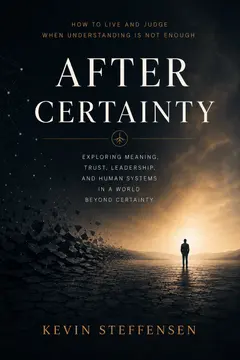
Book
After Certainty
How to Live and Judge When Understanding is not Enough
How to live and judge once explanation reaches its limits—judgment, responsibility, and participation without replacement frameworks.
View book
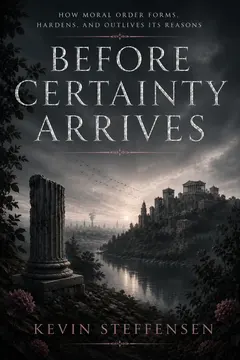
Book
Before Certainty Arrives
How Moral Order Forms, Hardens, and Outlives Its Reasons
How moral order forms, hardens, and outlives its reasons—before certainty feels like the only available posture.
View book
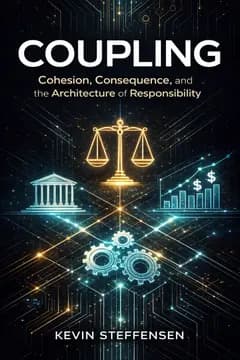
Book
Coupling
Cohesion, Consequence, and the Architecture of Responsibility
A practical framework for seeing where systems are tightly joined, where they drift apart, and how those coupling choices shape accountability over time.
View book
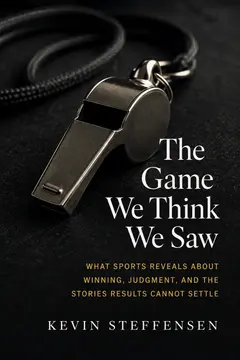
Book
The Game We Think We Saw
What Sports Reveals About Winning, Judgment, and the Stories Results Cannot Settle
Sports gives us some of the clearest outcomes in public life. A score becomes final, a ruling takes effect, and one side advances. But the result cannot fully explain what produced it, why it should count, what it is allowed to justify, who carried its cost, or what the event will eventually mean. The Game We Think We Saw follows those unsettled questions from the scoreboard into the systems, bodies, judgments, and stories surrounding the game.
View book

Book
What We Cannot See
Bias, Judgment, and the Limits of Perspective
Why every perspective is necessarily partial, how individuals make responsible judgments despite those limitations, and why integration allows groups to construct understanding that exceeds any single person's perspective.
View book
Book
When Interpretation No Longer Matters
Authority When Understanding No Longer Governs
When interpretation loses public consequence while understanding persists—and what kinds of authority remain when hearing no longer becomes legitimacy, accountability, or repair.
View book
Book
No Time to Think
How Acceleration Relocates Judgment—and Why Institutions Must Protect It
Speed is not inherently careless, but judgment depends on conditions—time, attention, consequence contact, and stop authority. No Time to Think examines what happens when production accelerates faster than a system's capacity to understand, verify, integrate, maintain, and care for what it produces—and how institutions can design responsible speed.
View book
Book
The Case That Does Not Fit
How Rules Protect Us—and What Institutions Must Do When They Misread Us
Rules make shared life possible, but every rule is a compression. The Case That Does Not Fit examines what happens when the ignored detail becomes the morally decisive one—and how institutions can preserve both protection from arbitrary judgment and protection from rules that have mistaken a person for someone else.
View book
Book
The Discipline of Uncertainty
Judgment, Restraint, and Decision Quality Under Incomplete Information
Field notes on judgment, restraint, and decision quality when information is incomplete.
View book
Book
Learning to See
Why Humanity Keeps Rediscovering Practices of Wisdom
A comparative inquiry into how scientific, philosophical, psychological, and spiritual traditions develop practices that help people notice more honestly and live with uncertainty—without claiming those traditions are secretly the same.
View book
Book
Reality Pushes Back
What Happens When Our Models Meet the World
A narrative pattern language for the After Certainty corpus. Through ordinary life in one town across roughly fifteen years, twelve supporting patterns— organized by perception, power, time, and contact—show how every useful model leaves something out, and how reality answers through materials, people, and consequences the model did not contain.
View book
Thinkers & sources6 thinkers
Person
Hannah Arendt
Political theorist whose work helps frame authority, judgment, responsibility, violence, and public action.
View Thinker →
Person
Herbert A Simon
Nobel laureate in economics; bounded rationality, satisficing, and administrative behavior in organizations.
View Thinker →
Organization
International Football Association Board
Keeper of football's Laws of the Game, including VAR protocol that separates operable review from inhabitable judgment.
View Thinker →
Person
John Dewey
Pragmatist philosopher of inquiry, democracy, and education whose work links experience, habit, and public problem-solving.
View Thinker →
Person
Richard P. Feynman
Physicist whose Challenger appendix modeled public technical judgment under institutional pressure.
View Thinker →
Person
Ronald A Heifetz
Leadership scholar of adaptive work—mobilizing people to tackle problems that require learning and loss.
View Thinker →
Outgoing dynamics3 relationships
requires
Judgment depends on decisions remaining open to update as conditions and understanding change.
contrasts
Judgment keeps contestability and human proportion in view; optimization maximizes metrics.
preserves
Judgment preserves proportionality by weighing tradeoffs and maintaining room for revision.
Incoming dynamics5 relationships
pressures
Acceleration favors rapid coordination over reflective deliberation.
contrasts
Certainty stabilizes coordination by compressing choice; judgment weighs tradeoffs under uncertainty without pretending to see from nowhere.
preserves
Friction preserves space for deliberation and discernment by slowing automatic action.
contrasts
Agency is capacity to act, not the evaluative practice of deciding well.
contrasts
Revisability keeps decisions attached to reality over time; judgment weighs tradeoffs at the moment of decision.
Neighboring terrain (other connected entities)4 neighbors
concept
Acceleration
Acceleration names urgency becoming structural—pressure that makes speed feel like a moral requirement rather than a tactical choice. It arises when coordination feels fragile and time scarce, when hesitation reads as weakness and dissent as delay the group cannot afford. At its best, acceleration protects survival when deliberation is genuinely too costly; it helps groups respond when the threat is real and immediate. At its worst, it persists after the original pressure has passed, treating every quarrel as existential risk and every pause as failure. Acceleration becomes dangerous when urgency outlives the conditions that first made it necessary—when speed replaces judgment, when dissent is treated as betrayal, and when the machinery of rapid response cannot slow down enough to notice that the threat has changed. It differs from momentum in that acceleration is actively pressured forward, while momentum is continuation without renewed judgment.
concept
Friction
Friction becomes important when speed threatens to bypass discernment—when the pressure for immediate response or continuous flow begins to compress the space where reflection, correction, or challenge might occur. Good friction preserves time and space for deliberation; bad friction is needless obstruction that protects neither coordination nor judgment. Friction can be protective adaptation under real constraint—postponed quarrels when immediate unity matters more than resolving grievance—or it can mark the erosion of judgment when compliance replaces discernment because no one can trace harm in time. Friction thins as scale favors throughput over discernment, as delay begins to read as weakness, and as law or procedure narrows discretion so coordination can persist without constant renegotiation. It differs from contestability in that friction is the slowness itself, while contestability is the capacity to reopen what has been settled.
concept
Optimization
Optimization—automation, reorg, tooling—can remove genuine waste. It can also replace participation with workflow, reducing the human to a step. When optimization is the only allowed improvement, contributors stop offering judgment that does not fit the tool; the system gains throughput on what it measures and loses informal checks no dashboard captures.
concept
Proportionality
Proportionality names the practice of matching the force and scope of a decision to the strength of available evidence and the scale of actual stakes—acting appropriately under incomplete information rather than pretending certainty where it does not exist. It becomes important when action must proceed despite uncertainty, when consequences are significant, and when both overreaction and under-reaction carry costs. Proportionality helps preserve responsible judgment by resisting the extremes: neither treating partial evidence as complete certainty nor using uncertainty as permission to defer action indefinitely. It requires naming what is known and what is not, stating assumptions and triggers explicitly, matching confidence to evidence, and building escalation and de-escalation paths before outcomes arrive. Proportionality can fail in two directions—false certainty that exports harm onto people who needed bounded action, or permanent deferral that uses every gap as excuse to never own a choice. The question proportionality raises is: does the strength of the action match the strength of the evidence? What would need to be true before a stronger move were justified?