Introduction
Skip to chapter textIntroduction
Introduction
Central question: How do we keep participating once understanding alone cannot settle the tension?
Understanding keeps arriving—better diagnoses, clearer patterns—while the tension remains. The introduction separates successful explanation from what explanation cannot finish, and asks what participation looks like once misunderstanding is treated as a lasting condition rather than a temporary deficit of information.
What Remains After Understanding
Clarity kept arriving without rest.
The explanations improved. The patterns became visible. The incentives, histories, and failures grew easier to describe. And yet something remained unsettled.
There is a common story about understanding: if we can understand a situation well enough, the tension will eventually ease. More information will reduce uncertainty. Better explanations will narrow disagreement. The moral weight of a problem will become lighter once its causes are finally visible.
Sometimes this happens. Often it does not.
A difficult conversation ends with both people understanding each other better and neither changing their mind. A meeting can end with everyone agreeing on the diagnosis and nothing happening afterward. A family can explain an old wound perfectly and still reopen it every holiday. An institution can publish an accurate diagnosis of its own failures and continue rewarding the same behavior the following quarter. A book can explain a problem brilliantly and leave the reader carrying it anyway—as if one more draft of understanding could finally make the weight lift.
The explanation succeeds. Something else does not. Some tensions persist not because understanding has failed, but because understanding has reached the edge of what it can do.
Sophisticated analysis often explains problems without changing them. If people understood the harm, they would stop causing it—or so the story goes. If institutions understood their incentives, they would redesign them. If disagreement were only misunderstanding, better communication would resolve it. I once watched a colleague deliver a fifteen-minute diagnosis of an institutional failure that everyone in the room already recognized. The slides were accurate. The incentives were named. People nodded—not with surprise, but with the relieved fatigue of hearing something true said aloud. The next quarter's budget rewarded the same behavior the presentation had just condemned.
At first glance the solution seems obvious—more information, better communication, a stronger framework, a more complete diagnosis. But many situations already contain extraordinary amounts of understanding. The people involved can often explain the problem in detail. They know the incentives. They know the history. They know the tradeoffs. They know what happened and why.
Understanding is present. Relief is not.
That distinction became difficult to ignore. What I kept encountering was not confusion. It was clarity without closure. The explanations became increasingly sophisticated while the underlying tension remained strangely intact.
People stayed. People left. People forgave. People refused forgiveness. Institutions repeated behaviors their own analyses had already identified as harmful. Communities remained divided by disagreements everyone could accurately describe. Understanding kept describing the weight with greater precision while leaving the weight exactly where it was.
The question slowly changed. Not: what else needs to be understood? But: what are we expecting understanding to do?
The answer was uncomfortable. Most of the time I was not waiting for another explanation. I was waiting for release—for the feeling that enough had been seen, enough had been named, enough had been understood. I was waiting for understanding to settle the account, to tell me the situation could finally be treated as resolved, navigable, or complete.
Understanding kept offering orientation. What I wanted was absolution.
That desire is easy to miss because it often disguises itself as seriousness. We call it thoroughness. We call it rigor. We call it refusing to act prematurely. Sometimes those descriptions are accurate. Sometimes they are ways of asking understanding to perform work it cannot perform—to remove uncertainty, to eliminate tension, to free us from responsibilities that remain even after the explanation is complete.
That fantasy is hard to give up because it feels responsible. To want understanding to settle things is not laziness. It is a hope that moral seriousness might eventually become rest. It could not—and the expectation does not disappear simply because we notice its limits. It returns in smaller forms: the hope that one more book, one more framework, one more diagnosis will finally make action clean.
This book begins where that hope begins to weaken—not because understanding has failed, but because understanding has succeeded. The patterns are visible. The explanations are available. The diagnosis is largely complete. And yet something remains.
The question is no longer how to understand. The question is how to live, judge, participate, and remain responsible once understanding is no longer enough.
How do we live and judge when understanding is no longer enough?
That question sits at the center of everything that follows. This book exists because that moment does not go away by itself. It completes a series on formation, stabilization, and tension by asking what can still be practiced once explanation has reached its limits. For the series arc, see How to Read This Book.
What This Book Is Not
This is not a guide for fixing systems. It does not offer strategies, frameworks, or steps for restoring alignment at scale. It does not promise that better communication, better leadership, or better incentives will resolve the tensions it describes. But it is not cynical either. This book does not argue that nothing matters, that judgment is impossible, or that care is naïve. It does not recommend withdrawal, detachment, or moral exhaustion.
It asks something quieter:
How do we continue to participate once we stop pretending that understanding alone can save us?
Misunderstanding as a Permanent Condition
I kept noticing the same failure in different rooms: sincere people explaining the problem to one another while the harm continued. Meaning drifted like weather across a ridge—visible from one side, invisible from another. Signals were misread. Outcomes outran explanation. More information did not repair what scale had already made structural.
That does not mean truth disappears. It means stable alignment becomes harder to sustain—and that remaining responsible inside misunderstanding requires something other than one more framework.1
The Shape of the Book
The book moves in three parts.
The first loosens familiar supports that have gradually become responsible for more than they can carry. The second explores practices that remain possible after those supports weaken. The third turns toward the limits that do not fully yield—conditions that cannot be solved away and must instead be lived inside responsibly.
The book does not build toward resolution. It builds toward orientation—and ends without the closure many readers still expect, because closure would require a confidence it does not claim to possess.
How the Patterns Relate
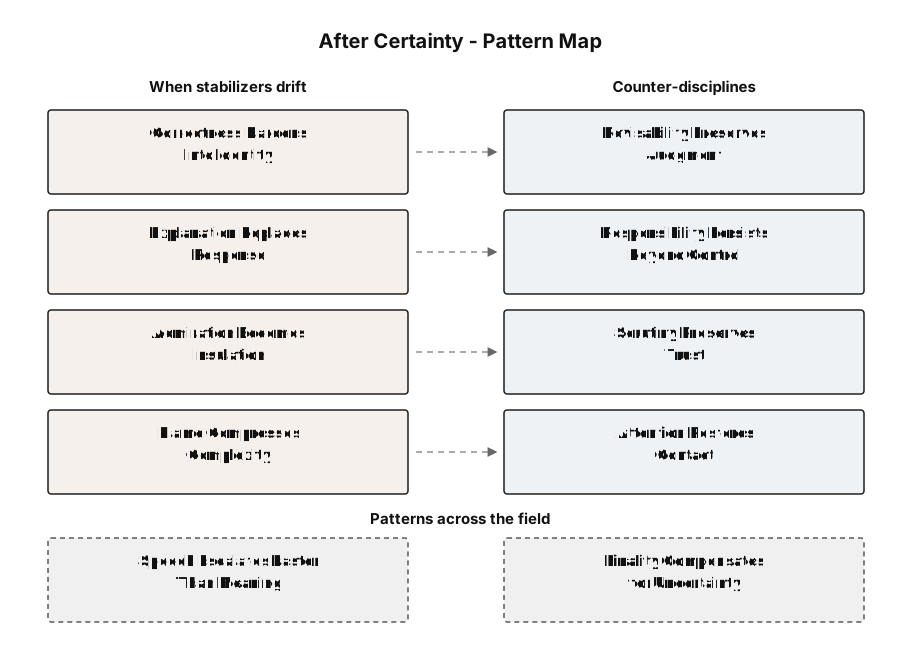
As you read, you will meet a small shared vocabulary of named recognitions—compressions for when stabilizers drift under pressure, for counter-disciplines that help you stay morally responsive once drift begins, for conditions of drift that intensify distortion across the field, and for irreducible conditions that do not fully yield. The labels are portable observation tools, not steps in a method. Full definitions appear in the appendix after you have met them in the chapters.
On first read, treat the figure below as orientation—which titles belong together and how drift pairings relate to the two patterns that shape the whole field—not as a sequence you must memorize.
Who This Book Is For
This book is for readers who have already done the work of understanding—and discovered its limits. For those who no longer believe that being right guarantees moral standing, who sense when explanation has become delay, and who are trying to remain serious without becoming severe, cynical, or withdrawn.
If you are looking for answers, this book will probably disappoint you. If you are looking for a way to remain responsible without pretending certainty still holds, it may help.
Footnotes
-
See Niklas Luhmann, Social Systems, trans. John Bednarz Jr. (Stanford, CA: Stanford University Press, 1995); Charles Perrow, Normal Accidents (New York: Basic Books, 1984). ↩