Song
Mr. Bell Keeps the Weather
Kevin Steffensen
Noir theatrical piano blues: an ex-weatherman hoards broken barometers and storms that never came, warning not to confuse odds with what happens after all.
Gravel baritone, dissonant low-register piano, and room noise make forecasting feel like a crooked moral craft.
Gravel baritone, dissonant low-register piano, and room noise make forecasting feel like a crooked moral craft. Channel Nine wanted when, not the shape of wind; Bell keeps Weather That Did Not Occur because somebody ought to remember almosts. Reality Pushes Back and The Discipline of Uncertainty verify the wall note and could-go-either-way stance. Counterfactual-success and uncertainty name the notebook’s honesty; reality-answers-back fits disagreeing barometers before dawn. The sky does not owe certainty, and confusing probability with aftermath is the institutional error the song refuses to bless.
- Languages
- en
Recordings
- Mr. Bell Keeps the WeatherPrimary
5:38 · chirp-hawk v6
5:17 · chirp-auk v4.5-all
Related patterns2 patterns
Master pattern
Reality Answers Back
Human systems must simplify reality in order to perceive, decide, coordinate, and act. Those simplifications necessarily leave out people, consequences, perspectives, history, and changed conditions. - Simplification is required for coordinated action - What is left out eventually returns - Systems need paths for revision before collapse Every abstraction, institution, decision, and model eventually encounters the reality it only partially captured. Reality answers through failures, exceptions, dissent, unintended behavior, lived experience, or consequences the model did not contain.
View Pattern →
Pattern
Finality Compensates for Uncertainty
When uncertainty feels intolerable, people reach for closure—harsh judgment, confident speech, or premature alignment. Severity and certainty provide emotional relief where epistemic stability no longer exists. - Ambiguity feels morally unstable - Confidence signals competence - Revision is delayed to preserve calm - Groups reward decisive tone over accurate scope Finality provides relief where certainty no longer exists; insecurity often sits underneath severity. A leader announces an irreversible policy so the room can stop inhabiting doubt together.
View Pattern →
Related concepts5 concepts
Concept
Uncertainty
Uncertainty names the condition moral and social systems are built to navigate—the space where coordination must happen before truth is settled, where lives are fragmented and behavior must hold together under incomplete information. It becomes important because human action cannot wait for perfect knowledge; groups must decide, move, and coordinate even when the future is unclear, when disagreement is costly, when explanation cannot travel fast enough to settle disputes before consequences arrive. Uncertainty is not a problem to eliminate but a condition to navigate—the ground on which moral life operates. Certainty emerges as an adaptive response to uncertainty, compressing ambiguity into stable expectations so action can proceed. But uncertainty itself is neither failure nor freedom; it is the default state that requires coordination tools. The After Certainty project explores how to practice judgment, accountability, and responsiveness inside uncertainty rather than demanding that uncertainty be resolved before moral life can begin. The question uncertainty raises is: what uncertainty is this system trying to reduce? Is ambiguity dangerous because the stakes are genuinely high, or because failure now scales? Uncertainty differs from ignorance in that uncertainty is about incomplete information in contexts requiring action, while ignorance is simply lack of knowledge.
View Concept →
Concept
Judgment
Judgment names the capacity to decide when understanding is incomplete but harm, coordination, or responsibility will not wait. It becomes important whenever action must proceed under partial information and real consequence. It helps preserve proportionality, answerability, and room for revision, but can fail when judgment hardens into dogma, paralysis, or punitive finality. It differs from certainty because judgment accepts incomplete sight; it differs from preference because judgment weighs consequence beyond taste; it differs from optimization because judgment keeps contestability and human proportion in view; it differs from rule-following because judgment must still respond when rules lag reality.
View Concept →
Concept
Certainty
Certainty names the compression of choice and ambiguity into stable expectation—roles, law, and moral systems that make behavior predictable enough to coordinate under pressure. It is not truth discovered once and for all, but adaptation hardened under instability. It becomes important when coordination breaks down faster than explanation can travel, when seasons will not wait for debate, when strangers must act together without shared context. Certainty enables collective action by reducing the decision space, making tomorrow recognizable from yesterday, allowing people to act together even when they do not agree on reasons. It becomes dangerous when it outlives the conditions that first made it workable—when compression persists after instability has passed, when revision begins to feel like betrayal, when systems still run while the fit between structure and reality thins. It differs from conviction in that certainty is social and structural, while conviction is personal belief.
View Concept →
Concept
Counterfactual Success
Counterfactual success—disasters avoided—is hard to politicize and hard to feel. Humans remember warnings more vividly than prevented failures. A forecast that helped policymakers prepare liquidity facilities or stress tests can still feel, to the public, like an error if the movie-script crisis did not arrive. Leadership that wants trust after a forecast era must narrate invisible safeguards without sounding defensive— not "be grateful," but "here is what did not break and who still paid while it held."
View Concept →
Concept
Humility
Humility—naming tradeoffs, uncertainty, distributional conflict—is epistemically virtuous and politically costly at scale. Certainty orients anxious publics and protects institutions from looking paralyzed. The outperforming of humility is not proof audiences are childish; it is proof that orientation is scarce and fear is abundant. Under interpretive stress, humility also means acknowledging what summaries omit and who pays for resilience.
View Concept →
Related books3 books

Book
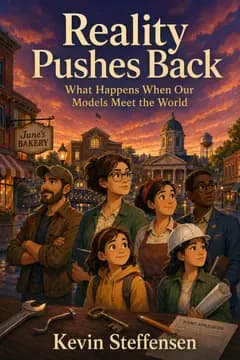
Reality Pushes Back
What Happens When Our Models Meet the World
A narrative pattern language for the After Certainty corpus. Through ordinary life in one town across roughly fifteen years, twelve supporting patterns— organized by perception, power, time, and contact—show how every useful model leaves something out, and how reality answers through materials, people, and consequences the model did not contain.
View book
Book
The Discipline of Uncertainty
Judgment, Restraint, and Decision Quality Under Incomplete Information
Field notes on judgment, restraint, and decision quality when information is incomplete.
View book
Book
Curiosity Before Certainty
How Curiosity Helps Us Understand a Complex World
An argument for disciplined curiosity as a leadership and learning posture when easy certainty hides complexity and weakens judgment.
View book