
Concept
Humility
Humility—naming tradeoffs, uncertainty, distributional conflict—is epistemically virtuous and politically costly at scale. Certainty orients anxious publics and protects institutions from looking paralyzed.
Humility—naming tradeoffs, uncertainty, distributional conflict—is epistemically virtuous and politically costly at scale. Certainty orients anxious publics and protects institutions from looking paralyzed. The outperforming of humility is not proof audiences are childish; it is proof that orientation is scarce and fear is abundant. Under interpretive stress, humility also means acknowledging what summaries omit and who pays for resilience.
Recognition signals
- a governor saying conditions are mixed loses the clip war to a rival saying they broke the economy
- a central bank chair chooses decisive tone over conditional accuracy for evening survival
- agency briefings front-load orientation even when orientation oversells certainty
- leadership that names tradeoffs and distributional conflict sounds paralyzed at scale
- officials mock receipt-test creators while refusing a comparable slice in their own speech
Questions to ask
- Where does naming uncertainty cost more politically than overstating confidence?
- Can leaders map what improved nationally and what remains hard locally without morale performance?
- Who needs coalitions for restraint when opponents moralize uncertainty every news cycle?
Counterbalances
- lead with the slice before the national path; pair every alarm with a monitor for revision
- separate map from morale when conditions are mixed using the two-clock habit
- build coalitions—journalists, mayors, business voices—who reward dimensional honesty
Trajectory
Early signals
- interpretive stress makes every utterance heard as positioning first
- revision looks like flip-flopping even when updating is responsible science
- incentive to be confidently wrong short term while error accountability stays delayed
Intensification
- narrative lock-in pushes leaders to double down rather than re-ground
- certainty performances accelerate the credibility crisis they claim to solve
- performative empathy without structural recognition spends warmth as a genre
Failure modes
- cautious accuracy sounds evasive when audiences want someone to own the story
- restraint is punished when mixed signals read as talking down the economy
- institutions pretend the thin channel is neutral instead of refusing overclaiming
Restoration paths
- mapping—improved nationally, hard in your county, unknown yet—ages better in trust
- leadership as restraint preserves legitimacy long enough for policy to work
- agencies publish distributional tables; press shops treat revision as maintenance not scandal
Manifestations
leadership
- a mayor names port numbers as real and the insurance market crushing residents—both clocks
- a school board refuses to import national cheer into a local decision when classrooms are cold
organizations
- corporate earnings calls demand quarterly certainty that conflicts with shop-floor reality
- central banks face democratic consequences while technical mandates require conditional speech
politics
- a treasury secretary cannot celebrate easing without opponents assembling a montage
- allies and opponents alike attack a county executive who admits a mixed labor market
family
- a parent hears the economy is strong on television and the kid's classroom is cold at home
Appears in chapters
- Chapter 7 — The Discipline of Not Knowing
- Conclusion — Enough
- Acknowledgments
- Chapter 7 — Being Wrong on Purpose
- Chapter 8 — When Failure Is Not an Option
- Chapter 9 — Error as a Design Input
- Part V — After Certainty
- Chapter 15 — What Remains Possible
And 37 more chapters with this association.
Related books3 books
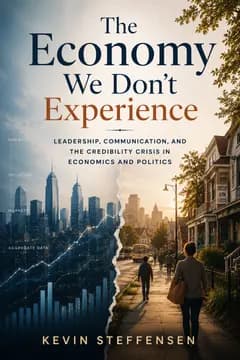
Book
The Economy We Don't Experience
Leadership, Communication, and the Credibility Crisis in Economics and Politics
How the chart and the receipt diverge—and what that gap means for compression, signaling, credibility, and leadership under interpretive stress.
View book
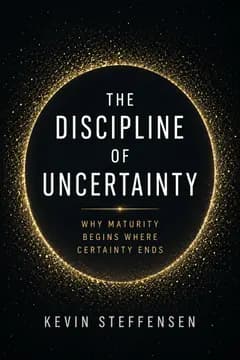
Book
The Discipline of Uncertainty
Judgment, Restraint, and Decision Quality Under Incomplete Information
Field notes on judgment, restraint, and decision quality when information is incomplete.
View book

Book
Learning to See
Why Humanity Keeps Rediscovering Practices of Wisdom
A comparative inquiry into how scientific, philosophical, psychological, and spiritual traditions develop practices that help people notice more honestly and live with uncertainty—without claiming those traditions are secretly the same.
View book
Incoming dynamics1 relationship
preserves
Finite perspective preserves humility by recognizing the structural condition that no view can be complete.