Song
The Truth Got a Side Door
Kevin Steffensen
Early-seventies psychedelic soul-funk: truth slips in barefoot through the side door while your polished speech and shining shoes wait on the front steps.
Wah guitar, clavinet, and call-and-response groove a philosophy of revisable sight. Front-door certainty measures every window, then one detail rearranges the plot; the corner know-it-all looks too far off to see persons.
Wah guitar, clavinet, and call-and-response groove a philosophy of revisable sight. Front-door certainty measures every window, then one detail rearranges the plot; the corner know-it-all looks too far off to see persons. Curiosity Before Certainty and What We Cannot See verify trading what you noticed for what I missed. Contact-keeps-the-read-open and reality-answers-back match leave the door unlocked and truth that does not always knock. Prefer these over stretching sports or romance books—the lyric already teaches humility without needing a scoreboard metaphor.
- Languages
- en
Recordings
- The Truth Got a Side DoorPrimary
4:08 · chirp-hawk v6
5:38 · chirp-auk v4.5-all
Related patterns4 patterns
Pattern
Gaps Invite Completion
An exchange contains ambiguity, omitted detail, or unresolved tension. Open meaning is hard to sustain under practical or emotional pressure. - Uncertainty creates interpretive discomfort - Fast social coordination rewards quick closure - Memory and expectation supply plausible filler Missing meaning rarely stays open for long. Because gaps invite completion, the mind usually supplies missing meaning before the speaker does.
View Pattern →
Pattern
Contact Keeps the Read Open
People return to a difficult exchange with more context and lower reactivity. Early interpretation may be useful but still too rough. - Additional context widens what people can see - Lower emotional charge improves tolerance for ambiguity - Restraint keeps meaning revisable Additional context can sharpen understanding without fully resolving it. Contact keeps the read open when understanding tightens without the story having to close.
View Pattern →
Master pattern
Reality Answers Back
Human systems must simplify reality in order to perceive, decide, coordinate, and act. Those simplifications necessarily leave out people, consequences, perspectives, history, and changed conditions. - Simplification is required for coordinated action - What is left out eventually returns - Systems need paths for revision before collapse Every abstraction, institution, decision, and model eventually encounters the reality it only partially captured. Reality answers through failures, exceptions, dissent, unintended behavior, lived experience, or consequences the model did not contain.
View Pattern →
Pattern
Revisability Preserves Judgment
Judgment remains necessary when certainty weakens; people still must weigh tradeoffs and consequences without a final frame to hide inside. Finality no longer stabilizes judgment, yet paralysis and dogma are both available failures. - New information threatens prior commitments - Groups confuse openness with weakness - Revision must be practiced without infinite deferral - Coherence pressures compete with contact with reality Revisability is what prevents judgment from hardening into dogma. A leader publishes what would change their mind—and acts on the answer when it arrives.
View Pattern →
Related concepts5 concepts
Concept
Uncertainty
Uncertainty names the condition moral and social systems are built to navigate—the space where coordination must happen before truth is settled, where lives are fragmented and behavior must hold together under incomplete information. It becomes important because human action cannot wait for perfect knowledge; groups must decide, move, and coordinate even when the future is unclear, when disagreement is costly, when explanation cannot travel fast enough to settle disputes before consequences arrive. Uncertainty is not a problem to eliminate but a condition to navigate—the ground on which moral life operates. Certainty emerges as an adaptive response to uncertainty, compressing ambiguity into stable expectations so action can proceed. But uncertainty itself is neither failure nor freedom; it is the default state that requires coordination tools. The After Certainty project explores how to practice judgment, accountability, and responsiveness inside uncertainty rather than demanding that uncertainty be resolved before moral life can begin. The question uncertainty raises is: what uncertainty is this system trying to reduce? Is ambiguity dangerous because the stakes are genuinely high, or because failure now scales? Uncertainty differs from ignorance in that uncertainty is about incomplete information in contexts requiring action, while ignorance is simply lack of knowledge.
View Concept →
Concept
Finite perspective
Finite perspective names the condition under which all sight in this project begins. It becomes important whenever someone speaks as if their view were complete, neutral, or uninfluenced by position. It helps preserve humility, integration, and honest disagreement, but can fail when partial sight is treated as moral failure or when institutions demand omniscience from individuals. It differs from bias because finite perspective names the structural condition of partiality; bias names the selective work performed within it. It differs from trust because trust extends action beyond firsthand sight without pretending the extension erases partiality.
View Concept →
Concept
Humility
Humility—naming tradeoffs, uncertainty, distributional conflict—is epistemically virtuous and politically costly at scale. Certainty orients anxious publics and protects institutions from looking paralyzed. The outperforming of humility is not proof audiences are childish; it is proof that orientation is scarce and fear is abundant. Under interpretive stress, humility also means acknowledging what summaries omit and who pays for resilience.
View Concept →
Concept
Correction
Correction names the lived work of narrowing the gap between what was assumed and what is actually happening. It becomes important whenever systems, beliefs, or coordination can drift while still feeling operational. It helps preserve shared reality and learning, but can fail when every correction spawns new framing instead of updated contact with conditions. It differs from repair because correction updates belief and behavior; repair addresses damaged standing and trust. It differs from revisability because correction is the act; revisability is the designed capacity to keep correcting.
View Concept →
Concept
Certainty
Certainty names the compression of choice and ambiguity into stable expectation—roles, law, and moral systems that make behavior predictable enough to coordinate under pressure. It is not truth discovered once and for all, but adaptation hardened under instability. It becomes important when coordination breaks down faster than explanation can travel, when seasons will not wait for debate, when strangers must act together without shared context. Certainty enables collective action by reducing the decision space, making tomorrow recognizable from yesterday, allowing people to act together even when they do not agree on reasons. It becomes dangerous when it outlives the conditions that first made it workable—when compression persists after instability has passed, when revision begins to feel like betrayal, when systems still run while the fit between structure and reality thins. It differs from conviction in that certainty is social and structural, while conviction is personal belief.
View Concept →
Related books3 books

Book
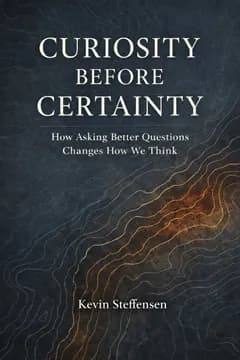
Curiosity Before Certainty
How Curiosity Helps Us Understand a Complex World
An argument for disciplined curiosity as a leadership and learning posture when easy certainty hides complexity and weakens judgment.
View book
Book
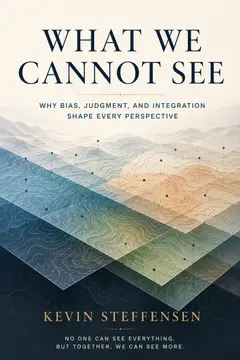
What We Cannot See
Bias, Judgment, and the Limits of Perspective
Why every perspective is necessarily partial, how individuals make responsible judgments despite those limitations, and why integration allows groups to construct understanding that exceeds any single person's perspective.
View book
Book
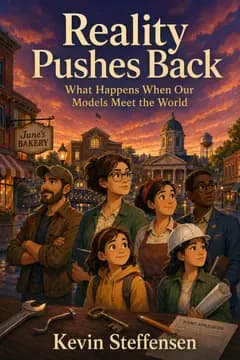
Reality Pushes Back
What Happens When Our Models Meet the World
A narrative pattern language for the After Certainty corpus. Through ordinary life in one town across roughly fifteen years, twelve supporting patterns— organized by perception, power, time, and contact—show how every useful model leaves something out, and how reality answers through materials, people, and consequences the model did not contain.
View book