
Nonfiction
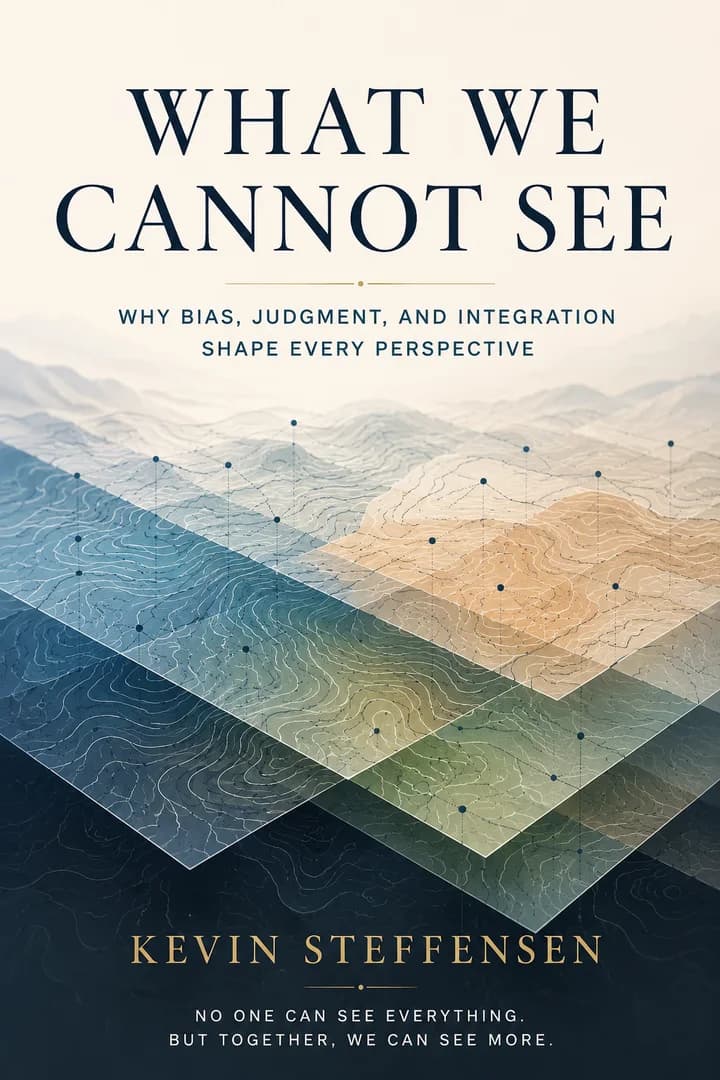
What We Cannot See
Bias, Judgment, and the Limits of Perspective
By Kevin Steffensen
Why every perspective is necessarily partial, how individuals make responsible judgments despite those limitations, and why integration allows groups to construct understanding that exceeds any single person's perspective.
Why every perspective is necessarily partial, how individuals make responsible judgments despite those limitations, and why integration allows groups to construct understanding that exceeds any single person's perspective.
Offered under open publishing terms (CC BY-SA). Download formats are free where available; purchase links support print editions.
- Type
- Nonfiction · monograph
- Author
- Kevin Steffensen
- Published
- 2026
- Chapters
- 19 chapters
- Formats
- EPUB, PDF, DOCX
Also in Core After Certainty
View all 6 →
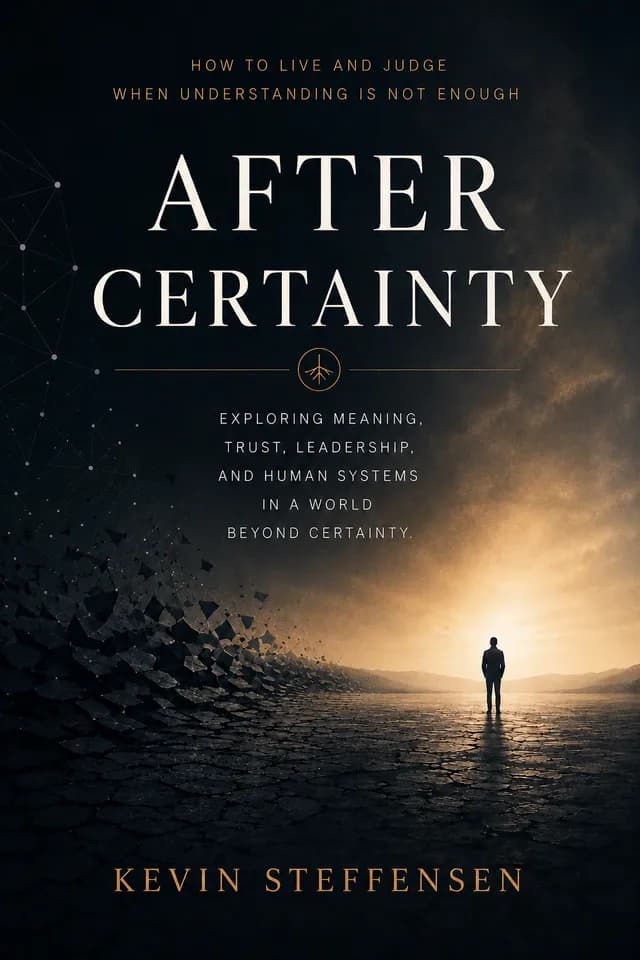
After Certainty
How to Live and Judge When Understanding is not Enough

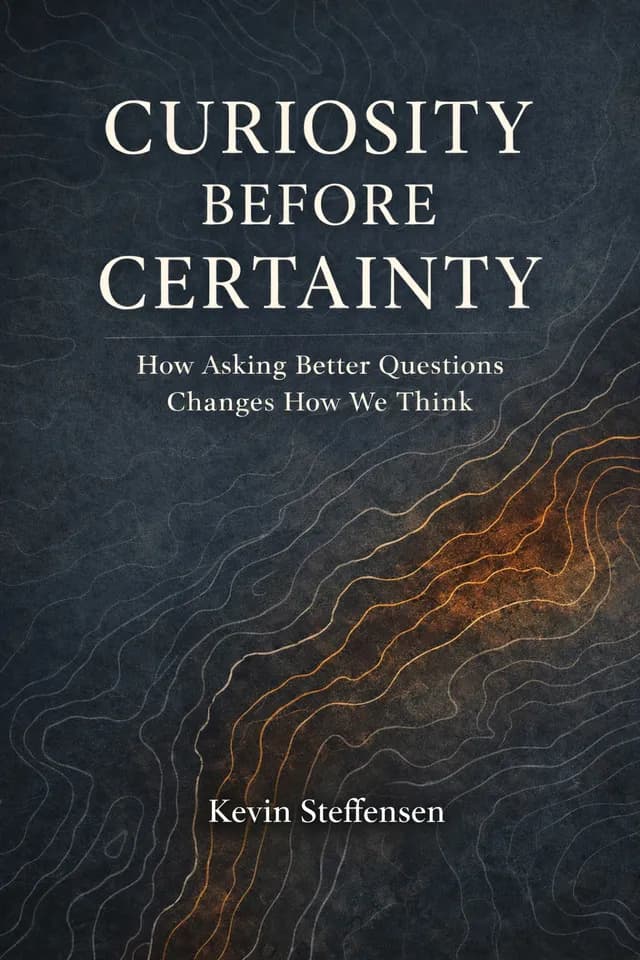
Curiosity Before Certainty
How Curiosity Helps Us Understand a Complex World

Trust Beyond Similarity
How Trust Remains Possible Across Difference

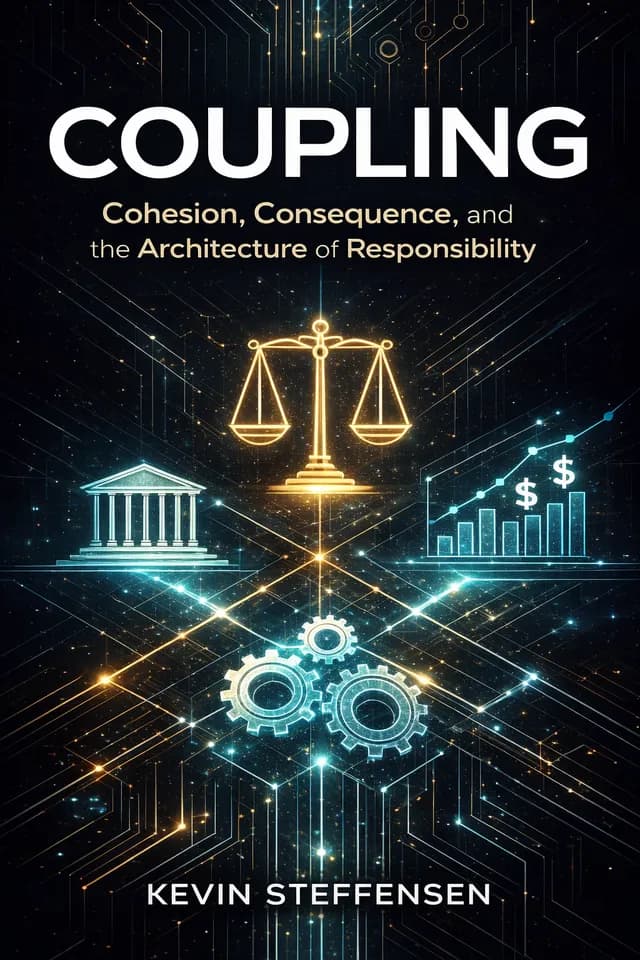
Coupling
Cohesion, Consequence, and the Architecture of Responsibility

How Serious Systems Learn
Disciplines for Acting Without Certainty

The question this book explores
How do we judge responsibly when every perspective is partial?
Why this book exists
What We Cannot See introduces finite perspective, bias, and integration — why no one sees the whole, and why groups still need accountable judgment.
Who it is for
Readers who want a clear map of perspective limits before entering denser systems or leadership books.
What it is not
- It does not treat all viewpoints as equally warranted.
- It does not dissolve individual responsibility into collective process.
Central ideas
A curated handful of concepts and patterns this book develops — not the full inventory.
Concept
Finite perspective
In this book: Opening claim: every view is built from somewhere and never exhaustive—ground for bias, judgment, and integration without relativism.
Explore the conceptConcept
Bias
In this book: Recasts selective attention as the condition that makes finite seeing possible—universal, not only bad faith.
Explore the conceptConcept
Integration
In this book: Names group work of combining partial views into a response none alone could hold—without dissolving individual answerability.
Explore the conceptConcept
Interpretation
In this book: Shows how stories and structures fill what attention cannot hold—partial information reconstructed as meaning.
Explore the conceptConcept
Answerability
In this book: Keeps responsible judgment after limits are admitted: obligation to those affected by decisions made from incomplete sight.
Explore the conceptPattern
Attention Finds a Signal
In this book: Introduces the attention budget: what stands out first shapes what can be noticed next—bias as selective availability.
Explore the patternPattern
Gaps Invite Completion
In this book: Applies how missing perspective rarely stays open—inherited stories and structures rush to fill what we cannot see.
Explore the patternPattern
Revisability Preserves Judgment
In this book: Deepens deciding without certainty: judgment stays responsible only while it can still be updated by other eyes.
Explore the pattern
Inside this book
How the book is organized — parts, chapters, and what each section investigates.
About 105 min of reading across 19 sections in 4 parts.
Part I — Bias: Learning to See Your Own Mind
6 sections
Part I — Bias: Learning to See Your Own Mind
6 sections- The Attention Budget6 min
Part II — Judgment: Learning to Decide
4 sections
Part II — Judgment: Learning to Decide
4 sectionsPart III — Integration: Learning Together
6 sections
Part III — Integration: Learning Together
6 sectionsOther sections
3 sections
Other sections
3 sections- Glossary2 min
Where it fits
Suggested reading order and nearby volumes — not a mandatory sequence.
Read before
Continue exploring
- Next book — Trust Beyond Similarity
Reading trails featuring this book
Editorial paths that include this book as one stop in a longer sequence.
Attention and knowing
Practices of Seeing
From comparative practices that form better knowers, through poetry of decisive attention, into finite perspective and disciplined curiosity.
5 stops · ~125 min
Follow this trail →Measurement and lived experience
The Result and the Experience
From final sporting results that leave meaning unsettled, through economic charts that diverge from lived receipts, into the limits of any single perspective.
4 stops · ~100 min
Follow this trail →Full related inventoryShowHide
Complete concept, pattern, and thinker lists for readers who want the full semantic map.
Major concepts
Concept
Answerability
Answerability names the specific debt owed to people who bear the cost of decisions they did not fully shape. It becomes important when partial sight, temporary fixes, or institutional distance export risk onto those with less leverage. It helps preserve fair process and post-decision revision, but can fail when consultation is token or when good faith substitutes for returning when sight widens. It differs from responsibility because answerability is oriented toward affected parties; responsibility names the broader obligation to account.
View Concept →
Concept
Answerability
Answerability names the specific debt owed to people who bear the cost of decisions they did not fully shape. It becomes important when partial sight, temporary fixes, or institutional distance export risk onto those with less leverage. It helps preserve fair process and post-decision revision, but can fail when consultation is token or when good faith substitutes for returning when sight widens. It differs from responsibility because answerability is oriented toward affected parties; responsibility names the broader obligation to account.
Concept
Attention budget
The finite intake of a mind in real time: what gets processed now, what waits, and what may never arrive without a reroute.
View Concept →
Concept
Attention budget
The finite intake of a mind in real time: what gets processed now, what waits, and what may never arrive without a reroute.
Concept
Bias
Bias names the architecture of partial sight. It becomes important whenever perception, memory, attention, or institutional counting must choose what to include. It helps perception function by narrowing the field enough to act, but can fail when partial sight is mistaken for neutral or complete sight. The same mechanism is called focus when approved and bias when distrusted. It differs from finite perspective because bias names the selective work inside a vantage point; it differs from integration because bias describes what each partial view leaves out, not how partial views combine. In this project, bias connects to judgment, trust, and the structural question of what a person, group, model, or institution is not positioned to see.
View Concept →
Concept
Bias
Bias names the architecture of partial sight. It becomes important whenever perception, memory, attention, or institutional counting must choose what to include. It helps perception function by narrowing the field enough to act, but can fail when partial sight is mistaken for neutral or complete sight. The same mechanism is called focus when approved and bias when distrusted. It differs from finite perspective because bias names the selective work inside a vantage point; it differs from integration because bias describes what each partial view leaves out, not how partial views combine. In this project, bias connects to judgment, trust, and the structural question of what a person, group, model, or institution is not positioned to see.
Concept
Designed friction
Institutional or methodological delay that keeps a partial view from hardening before other partial views can count (peer review, dissent channels, appeal, replication).
View Concept →
Concept
Designed friction
Institutional or methodological delay that keeps a partial view from hardening before other partial views can count (peer review, dissent channels, appeal, replication).
Concept
Finite perspective
Finite perspective names the condition under which all sight in this project begins. It becomes important whenever someone speaks as if their view were complete, neutral, or uninfluenced by position. It helps preserve humility, integration, and honest disagreement, but can fail when partial sight is treated as moral failure or when institutions demand omniscience from individuals. It differs from bias because finite perspective names the structural condition of partiality; bias names the selective work performed within it. It differs from trust because trust extends action beyond firsthand sight without pretending the extension erases partiality.
View Concept →
Concept
Finite perspective
Finite perspective names the condition under which all sight in this project begins. It becomes important whenever someone speaks as if their view were complete, neutral, or uninfluenced by position. It helps preserve humility, integration, and honest disagreement, but can fail when partial sight is treated as moral failure or when institutions demand omniscience from individuals. It differs from bias because finite perspective names the structural condition of partiality; bias names the selective work performed within it. It differs from trust because trust extends action beyond firsthand sight without pretending the extension erases partiality.
Concept
Institutional memory
Institutional memory names what organizations retain and transmit across personnel turnover and generational change—protocols shaped by past failure, stories that carry warnings, habits that encode lessons, procedures that prevent forgotten harm from recurring. It becomes important because individuals leave but institutions continue; what is learned must somehow persist in structure rather than only in personal experience. Institutional memory helps organizations avoid repeating costly mistakes, preserve hard-won knowledge, and maintain continuity through transitions. Archives, law, training programs, handoff documents, and cultural stories all serve as institutional memory— distributing cognition across time so that pain can become structure rather than repetition. But institutional memory can also fail by forgetting selectively, by preserving metrics that outlive the problems they measured, by letting ritual replace inquiry, by making success feel like bureaucracy worth cutting. The question institutional memory raises is: what pain did this institution convert into structure, and what did it forget instead? Where does memory strong enough to learn coexist with revision strong enough to unlearn?
View Concept →
Concept
Institutional memory
Institutional memory names what organizations retain and transmit across personnel turnover and generational change—protocols shaped by past failure, stories that carry warnings, habits that encode lessons, procedures that prevent forgotten harm from recurring. It becomes important because individuals leave but institutions continue; what is learned must somehow persist in structure rather than only in personal experience. Institutional memory helps organizations avoid repeating costly mistakes, preserve hard-won knowledge, and maintain continuity through transitions. Archives, law, training programs, handoff documents, and cultural stories all serve as institutional memory— distributing cognition across time so that pain can become structure rather than repetition. But institutional memory can also fail by forgetting selectively, by preserving metrics that outlive the problems they measured, by letting ritual replace inquiry, by making success feel like bureaucracy worth cutting. The question institutional memory raises is: what pain did this institution convert into structure, and what did it forget instead? Where does memory strong enough to learn coexist with revision strong enough to unlearn?
Concept
Integration
Integration names one of the central constructive moves in this project. It becomes important when reality exceeds any single vantage point and action still must proceed. It helps preserve the intelligence distributed across roles, experiences, and partial archives, but can fail when many voices are displayed without changing the model—or when disagreement is treated as disloyalty rather than information about missing terrain. It differs from compromise because integration seeks a larger understanding, not a split difference; it differs from averaging because partial views are assembled, not flattened into equal weight regardless of grounding.
View Concept →
Concept
Integration
Integration names one of the central constructive moves in this project. It becomes important when reality exceeds any single vantage point and action still must proceed. It helps preserve the intelligence distributed across roles, experiences, and partial archives, but can fail when many voices are displayed without changing the model—or when disagreement is treated as disloyalty rather than information about missing terrain. It differs from compromise because integration seeks a larger understanding, not a split difference; it differs from averaging because partial views are assembled, not flattened into equal weight regardless of grounding.
Concept
Interpretation
Interpretation names the ongoing work of deciding what something means enough to coordinate on. It becomes important whenever shared action depends on more than immediate perception—across time, distance, conflict, or institutional scale. It helps preserve continuity between experience and obligation, but can fail when interpretation hardens into category and stops tracking changing conditions. In the authority arc, sacred authority compresses interpretation while writing and law later externalize it so disputes can be settled without shared presence. It differs from private understanding because interpretation must be able to coordinate judgment or contest authority in shared space; it differs from meaning because interpretation is the active reconstruction, not only what gets stabilized.
View Concept →
Concept
Interpretation
Interpretation names the ongoing work of deciding what something means enough to coordinate on. It becomes important whenever shared action depends on more than immediate perception—across time, distance, conflict, or institutional scale. It helps preserve continuity between experience and obligation, but can fail when interpretation hardens into category and stops tracking changing conditions. In the authority arc, sacred authority compresses interpretation while writing and law later externalize it so disputes can be settled without shared presence. It differs from private understanding because interpretation must be able to coordinate judgment or contest authority in shared space; it differs from meaning because interpretation is the active reconstruction, not only what gets stabilized.
Concept
Judgment
Judgment names the capacity to decide when understanding is incomplete but harm, coordination, or responsibility will not wait. It becomes important whenever action must proceed under partial information and real consequence. It helps preserve proportionality, answerability, and room for revision, but can fail when judgment hardens into dogma, paralysis, or punitive finality. It differs from certainty because judgment accepts incomplete sight; it differs from preference because judgment weighs consequence beyond taste; it differs from optimization because judgment keeps contestability and human proportion in view; it differs from rule-following because judgment must still respond when rules lag reality.
View Concept →
Concept
Judgment
Judgment names the capacity to decide when understanding is incomplete but harm, coordination, or responsibility will not wait. It becomes important whenever action must proceed under partial information and real consequence. It helps preserve proportionality, answerability, and room for revision, but can fail when judgment hardens into dogma, paralysis, or punitive finality. It differs from certainty because judgment accepts incomplete sight; it differs from preference because judgment weighs consequence beyond taste; it differs from optimization because judgment keeps contestability and human proportion in view; it differs from rule-following because judgment must still respond when rules lag reality.
Concept
Machine perspective
Machine perspective names a partial view assembled from data, architecture, and deployment—not oracle, not mere noise, but useful extension that requires answerability. Models read corpora, logs, or scans faster than teams can in the time available, summaries feel like someone already did the second pass, scores substitute for judgment in court or clinic. Hospital chart models summarize visits but invent referrals never made, engagement-optimized rankings become attention budgets at scale, families trust fluent online answers as if firsthand verification were unnecessary. Machine perspective connects to finite perspective (all sight is partial), bias (architecture of partial sight), trust (when to rely on outputs), judgment (when human verification is required), and accountability (who answers for deployment choices). Fluent prose or confident scores arrive faster than human second passes can check, automation bias lets humans stop questioning because syntax looks authoritative, debiasing talk treats partial sight as bug to eliminate rather than design for. What partial view did we just add to the decision—and who is answerable for letting it count? Where does machine sight extend reach, and where does it outrank what it was never built to carry? The restoration path—integrate model output as one sketch among sketches, not the terrain; keep clinicians, tenants, and dissenting engineers in the co-creation loop; require roles that answer for deployment choices.
View Concept →
Concept
Machine perspective
Machine perspective names a partial view assembled from data, architecture, and deployment—not oracle, not mere noise, but useful extension that requires answerability. Models read corpora, logs, or scans faster than teams can in the time available, summaries feel like someone already did the second pass, scores substitute for judgment in court or clinic. Hospital chart models summarize visits but invent referrals never made, engagement-optimized rankings become attention budgets at scale, families trust fluent online answers as if firsthand verification were unnecessary. Machine perspective connects to finite perspective (all sight is partial), bias (architecture of partial sight), trust (when to rely on outputs), judgment (when human verification is required), and accountability (who answers for deployment choices). Fluent prose or confident scores arrive faster than human second passes can check, automation bias lets humans stop questioning because syntax looks authoritative, debiasing talk treats partial sight as bug to eliminate rather than design for. What partial view did we just add to the decision—and who is answerable for letting it count? Where does machine sight extend reach, and where does it outrank what it was never built to carry? The restoration path—integrate model output as one sketch among sketches, not the terrain; keep clinicians, tenants, and dissenting engineers in the co-creation loop; require roles that answer for deployment choices.
Concept
Memory archive
Selective retention and retrieval across time: what stays, what fades, and what returns when another version brings it back.
View Concept →
Concept
Memory archive
Selective retention and retrieval across time: what stays, what fades, and what returns when another version brings it back.
Concept
Proportionality
Proportionality names the practice of matching the force and scope of a decision to the strength of available evidence and the scale of actual stakes—acting appropriately under incomplete information rather than pretending certainty where it does not exist. It becomes important when action must proceed despite uncertainty, when consequences are significant, and when both overreaction and under-reaction carry costs. Proportionality helps preserve responsible judgment by resisting the extremes: neither treating partial evidence as complete certainty nor using uncertainty as permission to defer action indefinitely. It requires naming what is known and what is not, stating assumptions and triggers explicitly, matching confidence to evidence, and building escalation and de-escalation paths before outcomes arrive. Proportionality can fail in two directions—false certainty that exports harm onto people who needed bounded action, or permanent deferral that uses every gap as excuse to never own a choice. The question proportionality raises is: does the strength of the action match the strength of the evidence? What would need to be true before a stronger move were justified?
View Concept →
Concept
Proportionality
Proportionality names the practice of matching the force and scope of a decision to the strength of available evidence and the scale of actual stakes—acting appropriately under incomplete information rather than pretending certainty where it does not exist. It becomes important when action must proceed despite uncertainty, when consequences are significant, and when both overreaction and under-reaction carry costs. Proportionality helps preserve responsible judgment by resisting the extremes: neither treating partial evidence as complete certainty nor using uncertainty as permission to defer action indefinitely. It requires naming what is known and what is not, stating assumptions and triggers explicitly, matching confidence to evidence, and building escalation and de-escalation paths before outcomes arrive. Proportionality can fail in two directions—false certainty that exports harm onto people who needed bounded action, or permanent deferral that uses every gap as excuse to never own a choice. The question proportionality raises is: does the strength of the action match the strength of the evidence? What would need to be true before a stronger move were justified?
Concept
Provisional commitment
Acting on the best partial case while remaining structurally willing to revise when new information arrives.
View Concept →
Concept
Provisional commitment
Acting on the best partial case while remaining structurally willing to revise when new information arrives.
Concept
Revisability
Revisability names the capacity to change course without pretending the first pass was final. It becomes important whenever uncertainty remains after action starts and harm can accumulate while people wait for closure. It helps preserve contact with changing conditions and proportionate response, but can fail when updating is labeled flip-flopping or when institutions punish revisions that unsettle prior verdicts. It differs from correction because revisability is the designed openness; correction is the specific act of noticing mismatch and updating. It differs from judgment because revisability keeps decisions attached to reality over time, not only at the moment of decision.
View Concept →
Concept
Revisability
Revisability names the capacity to change course without pretending the first pass was final. It becomes important whenever uncertainty remains after action starts and harm can accumulate while people wait for closure. It helps preserve contact with changing conditions and proportionate response, but can fail when updating is labeled flip-flopping or when institutions punish revisions that unsettle prior verdicts. It differs from correction because revisability is the designed openness; correction is the specific act of noticing mismatch and updating. It differs from judgment because revisability keeps decisions attached to reality over time, not only at the moment of decision.
Concept
Structure
How organizations assign what must be counted—metrics, mandates, workflows, and tools that coordinate sight at scale and edit what remains off the ledger.
View Concept →
Concept
Structure
How organizations assign what must be counted—metrics, mandates, workflows, and tools that coordinate sight at scale and edit what remains off the ledger.
Concept
Trust
Trust names the bridge that lets people act together when no one holds the whole scene. It becomes important when verification must extend beyond firsthand sight—through specialists, records, institutions, or repeated experience. It helps preserve participation across partial perspectives, but can fail when trust stops tracking reality and closure feels safer than checking. It differs from certainty because trust accepts incomplete verification; it differs from blind belief because it still depends on signals that can be tested, strained, or withdrawn.
View Concept →
Concept
Trust
Trust names the bridge that lets people act together when no one holds the whole scene. It becomes important when verification must extend beyond firsthand sight—through specialists, records, institutions, or repeated experience. It helps preserve participation across partial perspectives, but can fail when trust stops tracking reality and closure feels safer than checking. It differs from certainty because trust accepts incomplete verification; it differs from blind belief because it still depends on signals that can be tested, strained, or withdrawn.
Major patterns
Master pattern
Reality Answers Back
Human systems must simplify reality in order to perceive, decide, coordinate, and act. Those simplifications necessarily leave out people, consequences, perspectives, history, and changed conditions. - Simplification is required for coordinated action - What is left out eventually returns - Systems need paths for revision before collapse Every abstraction, institution, decision, and model eventually encounters the reality it only partially captured. Reality answers through failures, exceptions, dissent, unintended behavior, lived experience, or consequences the model did not contain.
View Pattern →
Master pattern
Reality Answers Back
Human systems must simplify reality in order to perceive, decide, coordinate, and act. Those simplifications necessarily leave out people, consequences, perspectives, history, and changed conditions. - Simplification is required for coordinated action - What is left out eventually returns - Systems need paths for revision before collapse Every abstraction, institution, decision, and model eventually encounters the reality it only partially captured. Reality answers through failures, exceptions, dissent, unintended behavior, lived experience, or consequences the model did not contain.
Supporting · Corrective
Understanding Circulates
No one sees the whole situation, yet organizations often treat understanding as something possessed by individuals or authorities. - No single vantage sees the whole - Authority may hoard interpretation Understanding emerges and corrects itself when partial perspectives move among people rather than remaining isolated.
View Pattern →
Supporting · Corrective
Understanding Circulates
No one sees the whole situation, yet organizations often treat understanding as something possessed by individuals or authorities. - No single vantage sees the whole - Authority may hoard interpretation Understanding emerges and corrects itself when partial perspectives move among people rather than remaining isolated.
Major thinkers
Person
Barbara Mellers
Psychologist studying judgment, forecasting accuracy, and the cultivation of superforecasters.
View Thinker →
Person
Barbara Mellers
Psychologist studying judgment, forecasting accuracy, and the cultivation of superforecasters.
Person
Christopher F. Chabris
Cognitive scientists of inattentional blindness and the limits of confident perception under load.
View Thinker →
Person
Christopher F. Chabris
Cognitive scientists of inattentional blindness and the limits of confident perception under load.
Organization
Columbia Accident Investigation Board
NASA investigative board that examined the Space Shuttle Columbia disaster and organizational causes of failure.
View Thinker →
Organization
Columbia Accident Investigation Board
NASA investigative board that examined the Space Shuttle Columbia disaster and organizational causes of failure.
Person
Daniel J. Simons
Cognitive scientists of inattentional blindness and the limits of confident perception under load.
View Thinker →
Person
Daniel J. Simons
Cognitive scientists of inattentional blindness and the limits of confident perception under load.
Person
Daniel Kahneman
Psychologist of judgment and decision-making—biases, heuristics, and noise in expert choice.
View Thinker →
Person
Daniel Kahneman
Psychologist of judgment and decision-making—biases, heuristics, and noise in expert choice.
Person
Diane Vaughan
Sociologist of the Challenger disaster and normalization of deviance—how risky practices become routine.
View Thinker →
Person
Diane Vaughan
Sociologist of the Challenger disaster and normalization of deviance—how risky practices become routine.
Organization
Federal Aviation Administration and NASA
U.S. aviation regulators and NASA publishing safety reporting, human factors, and accident learning materials.
View Thinker →
Organization
Federal Aviation Administration and NASA
U.S. aviation regulators and NASA publishing safety reporting, human factors, and accident learning materials.
Person
Gary Klein
Psychologist of naturalistic decision making, recognition-primed judgment, and expertise under pressure.
View Thinker →
Person
Gary Klein
Psychologist of naturalistic decision making, recognition-primed judgment, and expertise under pressure.
Person
Gene Kranz
NASA flight director famed for Apollo 13 crisis leadership and failure-is-not-an-option operations culture.
View Thinker →
Person
Gene Kranz
NASA flight director famed for Apollo 13 crisis leadership and failure-is-not-an-option operations culture.
Person
Irving L Janis
Psychologist of groupthink—how cohesive groups suppress dissent and convince themselves their consensus is rational.
View Thinker →
Person
Irving L Janis
Psychologist of groupthink—how cohesive groups suppress dissent and convince themselves their consensus is rational.
Person
Jane Gleeson-White
Writer on accounting history, double-entry bookkeeping, and how numbers organize economic trust.
View Thinker →
Person
Jane Gleeson-White
Writer on accounting history, double-entry bookkeeping, and how numbers organize economic trust.
Person
Jeffrey Kluger
Apollo 13 commander and journalist narrating crisis teamwork and NASA operational learning.
View Thinker →
Person
Jeffrey Kluger
Apollo 13 commander and journalist narrating crisis teamwork and NASA operational learning.
Person
Jim Lovell
Apollo 13 commander and journalist narrating crisis teamwork and NASA operational learning.
View Thinker →
Person
Jim Lovell
Apollo 13 commander and journalist narrating crisis teamwork and NASA operational learning.
Person
John P. A Ioannidis
Physician-scientist famous for Why Most Published Research Findings Are False—meta-research and replication crisis.
View Thinker →
Person
John P. A Ioannidis
Physician-scientist famous for Why Most Published Research Findings Are False—meta-research and replication crisis.
Person
John Snow
Epidemiologist who traced cholera to contaminated water—foundational case of data overturning theory.
View Thinker →
Person
John Snow
Epidemiologist who traced cholera to contaminated water—foundational case of data overturning theory.
Person
Kenneth F. Schulz
Epidemiologist and methodologist studying publication bias and dimensions of methodological quality in research literature.
View Thinker →
Person
Kenneth F. Schulz
Epidemiologist and methodologist studying publication bias and dimensions of methodological quality in research literature.
Person
Nancy G Leveson
Engineer and safety scientist of systems thinking, STAMP, and building software and sociotechnical systems that fail safely.
View Thinker →
Person
Nancy G Leveson
Engineer and safety scientist of systems thinking, STAMP, and building software and sociotechnical systems that fail safely.
Organization
Open Science Collaboration
Large-scale replication consortium testing the reproducibility of psychological science findings.
View Thinker →
Organization
Open Science Collaboration
Large-scale replication consortium testing the reproducibility of psychological science findings.
Organization
President's Commission on the Space Shuttle Challenger Accident
U.S. presidential commission that investigated the Challenger disaster and organizational causes of NASA's failure.
View Thinker →
Organization
President's Commission on the Space Shuttle Challenger Accident
U.S. presidential commission that investigated the Challenger disaster and organizational causes of NASA's failure.
Person
Reto Knutti
Climate scientist studying uncertainty, model ensembles, and challenges combining projections from multiple climate models.
View Thinker →
Person
Reto Knutti
Climate scientist studying uncertainty, model ensembles, and challenges combining projections from multiple climate models.
Person
Sherwin B Nuland
Surgeon-writer on mortality, medical uncertainty, and how professions confront limits of control over life.
View Thinker →
Person
Sherwin B Nuland
Surgeon-writer on mortality, medical uncertainty, and how professions confront limits of control over life.
Person
Steven Johnson
Writer on innovation networks, emergent ideas, and how environments cultivate unexpected combinations.
View Thinker →
Person
Steven Johnson
Writer on innovation networks, emergent ideas, and how environments cultivate unexpected combinations.
Research sources
book
Report of the Columbia Accident Investigation Board
Columbia Accident Investigation Board. Report of the Columbia Accident Investigation Board. 2 vols. Washington, DC: Government Printing Office, 2003.
View Source →
book
Report of the Columbia Accident Investigation Board
Columbia Accident Investigation Board. Report of the Columbia Accident Investigation Board. 2 vols. Washington, DC: Government Printing Office, 2003.
report
Aviation Safety Reporting System (ASRS).
Federal Aviation Administration and NASA. "Aviation Safety Reporting System (ASRS)." Program website. Accessed July 4, 2026. https://asrs.arc.nasa.gov/.
View Source →
report
Aviation Safety Reporting System (ASRS).
Federal Aviation Administration and NASA. "Aviation Safety Reporting System (ASRS)." Program website. Accessed July 4, 2026. https://asrs.arc.nasa.gov/.
book
Double Entry: How the Merchants of Venice Created Modern Finance
Gleeson-White, Jane. Double Entry: How the Merchants of Venice Created Modern Finance. New York: W. W. Norton, 2012.
View Source →
book
Double Entry: How the Merchants of Venice Created Modern Finance
Gleeson-White, Jane. Double Entry: How the Merchants of Venice Created Modern Finance. New York: W. W. Norton, 2012.
article
Why Most Published Research Findings Are False.
Ioannidis, John P. A. "Why Most Published Research Findings Are False." PLoS Medicine 2, no. 8 (2005): e124.
View Source →
article
Why Most Published Research Findings Are False.
Ioannidis, John P. A. "Why Most Published Research Findings Are False." PLoS Medicine 2, no. 8 (2005): e124.
book
Groupthink: Psychological Studies of Policy Decisions and Fiascoes
Janis, Irving L. Groupthink: Psychological Studies of Policy Decisions and Fiascoes. 2nd ed. Boston: Houghton Mifflin, 1982.
View Source →
book
Groupthink: Psychological Studies of Policy Decisions and Fiascoes
Janis, Irving L. Groupthink: Psychological Studies of Policy Decisions and Fiascoes. 2nd ed. Boston: Houghton Mifflin, 1982.
book
The Ghost Map: The Story of London's Most Terrifying Epidemic—and How It Changed Science, Cities, and the Modern World
Johnson, Steven. The Ghost Map: The Story of London's Most Terrifying Epidemic—and How It Changed Science, Cities, and the Modern World. New York: Riverhead Books, 2006.
View Source →
book
The Ghost Map: The Story of London's Most Terrifying Epidemic—and How It Changed Science, Cities, and the Modern World
Johnson, Steven. The Ghost Map: The Story of London's Most Terrifying Epidemic—and How It Changed Science, Cities, and the Modern World. New York: Riverhead Books, 2006.
article
Conditions for Intuitive Expertise: A Failure to Disagree.
Kahneman, Daniel, and Gary Klein. "Conditions for Intuitive Expertise: A Failure to Disagree." American Psychologist 64, no. 6 (2009): 515–526.
View Source →
article
Conditions for Intuitive Expertise: A Failure to Disagree.
Kahneman, Daniel, and Gary Klein. "Conditions for Intuitive Expertise: A Failure to Disagree." American Psychologist 64, no. 6 (2009): 515–526.
book
Thinking, Fast and Slow
Kahneman, Daniel. Thinking, Fast and Slow. New York: Farrar, Straus and Giroux, 2011.
View Source →
book
Thinking, Fast and Slow
Kahneman, Daniel. Thinking, Fast and Slow. New York: Farrar, Straus and Giroux, 2011.
article
Challenges in Combining Projections from Multiple Climate Models.
Knutti, Reto, et al. "Challenges in Combining Projections from Multiple Climate Models." Journal of Climate 23, no. 10 (2010): 2739–2758.
View Source →
article
Challenges in Combining Projections from Multiple Climate Models.
Knutti, Reto, et al. "Challenges in Combining Projections from Multiple Climate Models." Journal of Climate 23, no. 10 (2010): 2739–2758.
book
Failure Is Not an Option: Mission Control from Mercury to Apollo 13 and Beyond
Kranz, Gene. Failure Is Not an Option: Mission Control from Mercury to Apollo 13 and Beyond. New York: Simon & Schuster, 2000.
View Source →
book
Failure Is Not an Option: Mission Control from Mercury to Apollo 13 and Beyond
Kranz, Gene. Failure Is Not an Option: Mission Control from Mercury to Apollo 13 and Beyond. New York: Simon & Schuster, 2000.
article
An Investigation of the Therac-25 Accidents.
Leveson, Nancy G., and Clark S. Turner. "An Investigation of the Therac-25 Accidents." Computer 26, no. 7 (1993): 18–41.
View Source →
article
An Investigation of the Therac-25 Accidents.
Leveson, Nancy G., and Clark S. Turner. "An Investigation of the Therac-25 Accidents." Computer 26, no. 7 (1993): 18–41.
book
Lost Moon: The Perilous Voyage of Apollo 13
Lovell, Jim, and Jeffrey Kluger. Lost Moon: The Perilous Voyage of Apollo 13. Boston: Houghton Mifflin, 1994.
View Source →
book
Lost Moon: The Perilous Voyage of Apollo 13
Lovell, Jim, and Jeffrey Kluger. Lost Moon: The Perilous Voyage of Apollo 13. Boston: Houghton Mifflin, 1994.
article
Identifying and Cultivating Superforecasters as a Method of Improving Probabilistic Predictions.
Mellers, Barbara, et al. "Identifying and Cultivating Superforecasters as a Method of Improving Probabilistic Predictions." Perspectives on Psychological Science 10, no. 3 (2015): 267–281.
View Source →
article
Identifying and Cultivating Superforecasters as a Method of Improving Probabilistic Predictions.
Mellers, Barbara, et al. "Identifying and Cultivating Superforecasters as a Method of Improving Probabilistic Predictions." Perspectives on Psychological Science 10, no. 3 (2015): 267–281.
book
The Doctors' Plague: Germs, Childbed Fever, and the Strange Story of Ignác Semmelweis
Nuland, Sherwin B. The Doctors' Plague: Germs, Childbed Fever, and the Strange Story of Ignác Semmelweis. New York: W. W. Norton, 2003.
View Source →
book
The Doctors' Plague: Germs, Childbed Fever, and the Strange Story of Ignác Semmelweis
Nuland, Sherwin B. The Doctors' Plague: Germs, Childbed Fever, and the Strange Story of Ignác Semmelweis. New York: W. W. Norton, 2003.
article
Estimating the Reproducibility of Psychological Science.
Open Science Collaboration. "Estimating the Reproducibility of Psychological Science." Science 349, no. 6251 (2015): aac4716.
View Source →
article
Estimating the Reproducibility of Psychological Science.
Open Science Collaboration. "Estimating the Reproducibility of Psychological Science." Science 349, no. 6251 (2015): aac4716.
book
Report of the Presidential Commission on the Space Shuttle Challenger Accident
President's Commission on the Space Shuttle Challenger Accident. Report of the Presidential Commission on the Space Shuttle Challenger Accident. 5 vols. Washington, DC: Government Printing Office, 1986.
View Source →
book
Report of the Presidential Commission on the Space Shuttle Challenger Accident
President's Commission on the Space Shuttle Challenger Accident. Report of the Presidential Commission on the Space Shuttle Challenger Accident. 5 vols. Washington, DC: Government Printing Office, 1986.
article
Empirical Evidence of Bias: Dimensions of Methodological Quality Associated with Estimates of Treatment Effects in Controlled Trials.
Schulz, Kenneth F., et al. "Empirical Evidence of Bias: Dimensions of Methodological Quality Associated with Estimates of Treatment Effects in Controlled Trials." JAMA 273, no. 5 (1995): 408–412.
View Source →
article
Empirical Evidence of Bias: Dimensions of Methodological Quality Associated with Estimates of Treatment Effects in Controlled Trials.
Schulz, Kenneth F., et al. "Empirical Evidence of Bias: Dimensions of Methodological Quality Associated with Estimates of Treatment Effects in Controlled Trials." JAMA 273, no. 5 (1995): 408–412.
article
Gorillas in Our Midst: Sustained Inattentional Blindness for Dynamic Events.
Simons, Daniel J., and Christopher F. Chabris. "Gorillas in Our Midst: Sustained Inattentional Blindness for Dynamic Events." Perception 28, no. 9 (1999): 1059–1074.
View Source →
article
Gorillas in Our Midst: Sustained Inattentional Blindness for Dynamic Events.
Simons, Daniel J., and Christopher F. Chabris. "Gorillas in Our Midst: Sustained Inattentional Blindness for Dynamic Events." Perception 28, no. 9 (1999): 1059–1074.
book
On the Mode of Communication of Cholera
Snow, John. On the Mode of Communication of Cholera. 2nd ed. London: John Churchill, 1855.
View Source →
book
On the Mode of Communication of Cholera
Snow, John. On the Mode of Communication of Cholera. 2nd ed. London: John Churchill, 1855.
article
Availability: A Heuristic for Judging Frequency and Probability.
Tversky, Amos, and Daniel Kahneman. "Availability: A Heuristic for Judging Frequency and Probability." Cognitive Psychology 5, no. 2 (1973): 207–232.
View Source →
article
Availability: A Heuristic for Judging Frequency and Probability.
Tversky, Amos, and Daniel Kahneman. "Availability: A Heuristic for Judging Frequency and Probability." Cognitive Psychology 5, no. 2 (1973): 207–232.
book
The Challenger Launch Decision: Risky Technology, Culture, and Deviance at NASA
Vaughan, Diane. The Challenger Launch Decision: Risky Technology, Culture, and Deviance at NASA. Chicago: University of Chicago Press, 1996.
View Source →
book
The Challenger Launch Decision: Risky Technology, Culture, and Deviance at NASA
Vaughan, Diane. The Challenger Launch Decision: Risky Technology, Culture, and Deviance at NASA. Chicago: University of Chicago Press, 1996.