
Handbook
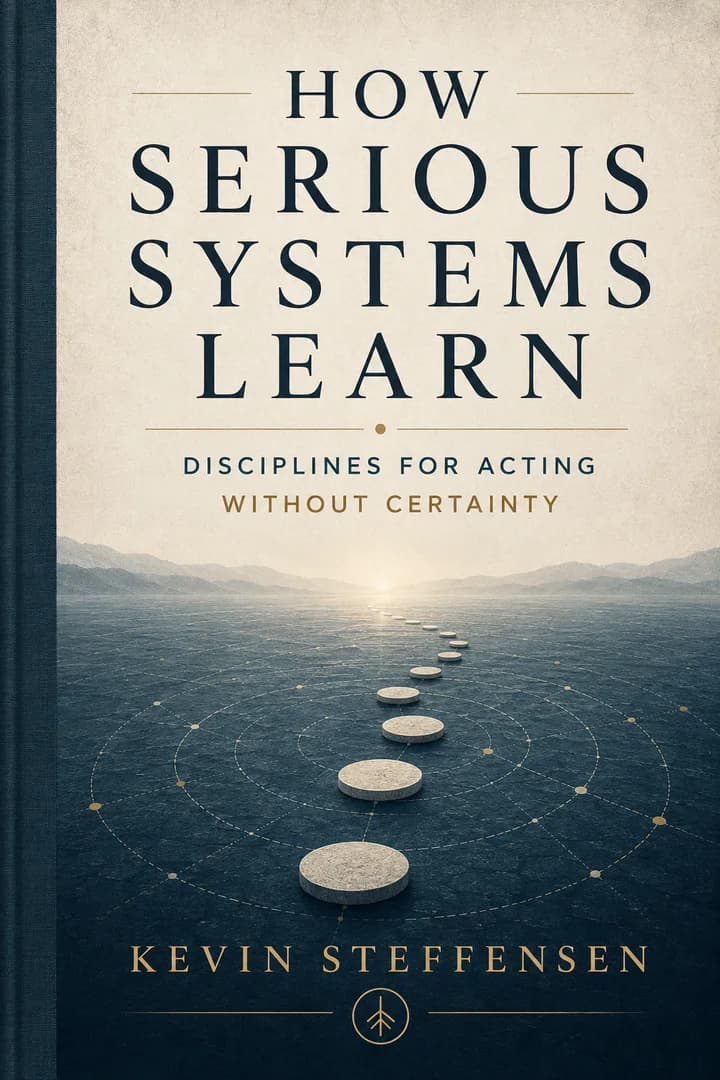
How Serious Systems Learn
Disciplines for Acting Without Certainty
By Kevin Steffensen
A handbook for teams and institutions that need to learn in motion, improve under pressure, and make better decisions without waiting for perfect information.
A handbook for teams and institutions that need to learn in motion, improve under pressure, and make better decisions without waiting for perfect information.
Offered under open publishing terms (CC BY-SA). Download formats are free where available; purchase links support print editions.
- Type
- Handbook
- Author
- Kevin Steffensen
- Published
- 2026
- Chapters
- 25 chapters
- Formats
- EPUB, PDF, DOCX
Also in Core After Certainty
View all 6 →
After Certainty
How to Live and Judge When Understanding is not Enough
Curiosity Before Certainty
How Curiosity Helps Us Understand a Complex World

Trust Beyond Similarity
How Trust Remains Possible Across Difference

What We Cannot See
Bias, Judgment, and the Limits of Perspective
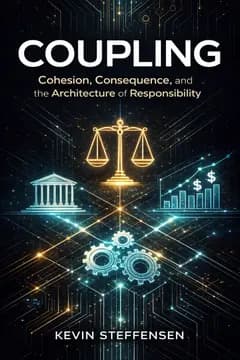
Coupling
Cohesion, Consequence, and the Architecture of Responsibility



The question this book explores
How can serious systems improve under pressure without waiting for perfect information?
Why this book exists
This handbook gathers disciplines for learning in motion — for teams and institutions that must act, revise, and remain answerable when certainty is unavailable.
Who it is for
Leaders, engineers, operators, and institutional practitioners who need practical learning postures rather than abstract theory alone.
What it is not
- It is not a project-management methodology cookbook.
- It does not promise that better process eliminates moral conflict.
Central ideas
A curated handful of concepts and patterns this book develops — not the full inventory.
Concept
Adaptation
In this book: Learning in motion—systems that revise under pressure rather than waiting for perfect prediction.
Explore the conceptConcept
Contestability
In this book: Correction paths that stay open so authority preserves learning instead of sealing myth.
Explore the conceptConcept
Consequence Architecture
In this book: How roles, interfaces, and incentives route what failure teaches back into the system.
Explore the conceptConcept
Feedback
In this book: Signal that must still change decisions; the handbook's core loop for serious learning.
Explore the conceptConcept
Coordination
In this book: Collective action under incomplete information—disciplines that keep shared movement revisable.
Explore the conceptConcept
Institutional memory
In this book: What organizations preserve across incidents and turnover so pain becomes structure without becoming dogma.
Explore the conceptPattern
Feedback Drives Change
In this book: Healthy incident learning—new facts and risk still revise plans after direction is set.
Explore the patternPattern
Learning Collapses
In this book: Failure mode when ground story never reaches decision; distance and filtered reporting thin correction.
Explore the patternPattern
Revisability Preserves Judgment
In this book: Discipline of being wrong on purpose—judgment stays attached to reality after action begins.
Explore the patternPattern
Dissent is Welcomed
In this book: Authority that preserves correction by making early bad news safe enough to raise.
Explore the pattern
Inside this book
How the book is organized — parts, chapters, and what each section investigates.
About 101 min of reading across 25 sections in 6 parts.
Part I — Why Knowing No Longer Governs Outcomes
4 sections
Part I — Why Knowing No Longer Governs Outcomes
4 sectionsShow summaryHide summary
Part I diagnoses modern systems that grow more informed while becoming less corrigible. As knowledge improves, confidence scales, commitments harden, and corrective loops weaken under pressure. The chapters are not against intelligence or data; they show why those tools no longer guarantee responsible action when reversal becomes expensive.
Central questionWhy can systems know more while becoming harder to correct?
Show summaryHide summary
For a long time better information was expected to yield better action—narrower error, sharper judgment, responsible moves under growing understanding. The chapter unsettles that inheritance: knowing can accumulate while the capacity to reverse, interrupt, and learn under pressure declines. Information without corrigibility is not yet seriousness.
Central questionWhy does accumulating knowledge no longer guarantee responsible action?
Show summaryHide summary
Confidence is needed for action, but modern systems often reward decisiveness faster than interruptibility — dashboards and narrative outrunning review, feedback, and dissent. Endless hesitation is drift; uninterruptible confidence is another failure mode. Seriousness keeps commitment revisable when pressure buys closure.
Central questionWhat happens when confidence scales faster than correction?
Show summaryHide summary
Metrics, retrospectives, risk reports, and escalation paths can still exist formally while feedback arrives too late, too weakly, or too diffusely to change decisions. Visible learning mechanisms become evidence that learning remains intact—after the loop has already stopped governing action. Collapse is often quiet before it is catastrophic.
Central questionHow do corrective loops die while their rituals remain on the calendar?
Part II — Disciplines That Survived Reality
6 sections
Part II — Disciplines That Survived Reality
6 sectionsShow summaryHide summary
Part II shifts from diagnosis to operating discipline when certainty cannot be restored and correction cannot be assumed. Five durable responses: constraint that preserves reversibility, feedback speed over forecast confidence, system-level visibility, structured falsification, and high-reliability humility when failure is not an option.
Central questionWhat practices still work when prediction fails and pressure rewards closure?
Show summaryHide summary
Serious systems learn by limiting where action is allowed; unconstrained action is often mistaken for agility. Constraint that preserves reversibility is not bureaucratic drag—it is how institutions keep options open when speed would otherwise burn the map. Discipline here is designed friction in service of corrigibility.
Central questionWhy do serious systems treat constraint as a learning instrument rather than as drag?
Show summaryHide summary
Forecasts and models remain necessary for allocation under incomplete information; the mistake is treating prediction as the primary engine of adaptation when conditions shift faster than models stay valid. Serious systems privilege feedback speed and update cadence over forecast confidence that cannot keep up with the environment.
Central questionHow do systems adapt when conditions change faster than predictions remain valid?
Show summaryHide summary
Local metrics improve while handovers degrade, risk shifts downstream, and customer burden rises—each unit's progress remaining defensible because no one sees the whole transfer. Serious learning requires system-level visibility beyond local dashboards, so optimization in one place is not misread as institutional health.
Central questionWhat do local improvements hide when no one can see the whole transfer of risk?
Show summaryHide summary
Far fewer systems are designed to survive discovering they were wrong than to confirm they were right. Falsification—not confirmation—is the engine of progress under uncertainty. Being wrong on purpose means structuring tests, probes, and dissent so disconfirmation can arrive before identity and commitment make revision impossible.
Central questionHow do serious systems design for discovering they were wrong before it is too late?
Show summaryHide summary
Aviation, intensive care, nuclear operations, and grid control face immediate public consequences where “learn by failing” sounds irresponsible. High-reliability humility still learns—through near-misses, simulation, redundancy, and voice that can stop the line— without treating catastrophe as the tuition. Seriousness here is learning without gambling lives on the experiment.
Central questionHow do high-consequence domains keep learning when catastrophic failure cannot be the curriculum?
Part III — What These Disciplines Share
4 sections
Part III — What These Disciplines Share
4 sectionsShow summaryHide summary
Part III names the common logic beneath diverse methods: treat error as expected, keep action interruptible, protect dissent with operational consequence, and evaluate success by preserved corrigibility rather than short-term coherence. The aim is transferable architecture, not methodological purity.
Central questionWhat commitments do serious disciplines share beneath their different vocabularies?
Show summaryHide summary
The difference between fragile and serious systems is rarely intelligence; it is whether error is planned for as an expected input. Serious systems design for being wrong rather than assuming being right—buffers, detection, and revision paths built in before pride makes mistakes unspeakable.
Central questionWhat changes when error is treated as design input rather than as embarrassment?
Show summaryHide summary
Institutions often treat intervention as implementing a known answer—compliance as success, disconfirmation as noise threatening momentum. Serious action is a probe into partially unknown conditions: framed to learn, interruptible, and judged by what reality returns, not only by whether the plan was followed.
Central questionHow do we keep action as an encounter with reality rather than as proof we already knew?
Show summaryHide summary
Leaders who align incentives and accelerate execution can produce extraordinary short-term performance—and silence correction, narrow contestability, and turn commitment into identity. Authority that preserves correction exercises power so feedback stays alive: interruptible decisions, protected dissent, and consequence architecture that does not punish the messenger.
Central questionHow must power be exercised if feedback and dissent are to survive success?
Part IV — When Disciplines Fail
4 sections
Part IV — When Disciplines Fail
4 sectionsShow summaryHide summary
Part IV examines how serious practices decay after convergence: methods harden into identity, coherence displaces inquiry, and positive outcomes are misread as proof that correction is no longer needed. Disciplines fail not only through neglect but through success that puts the watch to sleep.
Central questionHow do serious methods fail after they have already worked?
Show summaryHide summary
Methods are fragile because they work: visible improvement elevates practice into identity and generalized doctrine. Over time the method is judged by whether it is followed, not by whether it still preserves correction. Myth replaces conditional response—and learning collapses into compliance theater.
Central questionWhen does a working method stop being judged by corrigibility and start being judged by loyalty?
Show summaryHide summary
Coherent accounts align teams and calm stakeholders after uncertainty—relief that often closes inquiry before reality finishes speaking. Tidy explanations convert partial interpretation into stable certainty, then reorganize attention around preserving that certainty. Seduction is not lying; it is premature closure that feels like leadership.
Central questionHow does the relief of a tidy story become an enemy of ongoing correction?
Show summaryHide summary
Success can conceal as much as it reveals: early wins stabilize narratives, reward current design, and make friction and redundancy look unnecessary. The better results look, the harder it becomes to argue for correction capacity that appears unused. Treating success as proof of systemic soundness is how serious systems go to sleep.
Central questionWhy is success often the signal that most endangers ongoing corrigibility?
Part V — After Certainty
3 sections
Part V — After Certainty
3 sectionsShow summaryHide summary
Part V asks what remains possible when certainty can no longer authorize action. Rather than a final framework, it offers a durable posture: responsibility without illusion, authority that stays correctable, and learning as an ongoing way of being rather than a stage before control returns.
Central questionWhat posture remains when certainty can no longer authorize action?
Show summaryHide summary
Two false exits after certainty fails: resignation (nothing responsible can be done) and compensation (perform certainty more aggressively and call it leadership). What remains possible is neither—responsibility without illusion, action that stays interruptible, and authority that does not pretend the map is complete.
Central questionWhat remains possible between resignation and performed certainty?
Show summaryHide summary
A system can install learning rituals and still become incorrigible when pressure rises— measuring feedback while preserving authority patterns that make revision politically impossible. The final question is existential as well as procedural: whether learning is a temporary stage before control, or a way of being that keeps corrigibility alive.
Central questionWhat does it mean for learning to be a way of being rather than a stage before control?
Other sections
4 sections
Other sections
4 sections- Acknowledgments1 min
Show summaryHide summary
Readers, collaborators, and practitioners who work inside systems where certainty failed and responsibility remained shaped the book. Early reviewers and operational leaders challenged claims and insisted on practical clarity under real pressure.
Central questionWho helped keep this argument accountable to systems that cannot afford decorative learning?
- About the Author1 min
Show summaryHide summary
Kevin Steffensen writes about institutional learning and corrigibility—how organizations preserve correction under pressure when prediction fails and outcomes remain high-stakes. The note situates the handbook's voice in operational seriousness rather than motivational certainty.
Central questionWhat stance toward institutions does the author bring to high-stakes learning?
Show summaryHide summary
A one-sentence map of each chapter's contribution to the full argument—from the core diagnosis that knowledge can rise while corrigibility falls, through disciplines and shared architecture, to failure modes and the posture after certainty. Use it for orientation, not as a substitute for the chapters.
Central questionHow does each chapter contribute to the book's argument about serious learning?
Show summaryHide summary
After certainty, commitment shifts from claiming control to preserving corrigibility— systems revisable under pressure, authority interruptible when momentum rewards certainty, consequence visible when abstraction rewards speed. Seriousness is held as operating commitments around action, authority, narrative, and responsibility.
Central questionWhat operating commitments keep corrigibility alive when pressure rewards closure?
Where it fits
Suggested reading order and nearby volumes — not a mandatory sequence.
Read before
Read next
Continue exploring
- Next book — Coupling
Reading trails featuring this book
Editorial paths that include this book as one stop in a longer sequence.
Judgment
Protected Judgment Under Speed
How acceleration relocates the constraint on thinking—and what institutions must protect if judgment is to remain possible.
6 stops · ~76 min
Follow this trail →Systems
Systems That Cannot Correct Themselves
When feedback weakens, exceptions harden, and learning collapses—how institutions drift without anyone choosing decay.
5 stops · ~71 min
Follow this trail →Full related inventoryShowHide
Complete concept, pattern, and thinker lists for readers who want the full semantic map.
Major concepts
Concept
Abstraction
Abstraction is mediation away from direct encounter: compression of complexity as systems scale, valued when it preserves accountability signal at the boundaries where behavior can still be redesigned
View Concept →
Concept
Abstraction
Abstraction is mediation away from direct encounter: compression of complexity as systems scale, valued when it preserves accountability signal at the boundaries where behavior can still be redesigned
Concept
Accountability
Accountability names whether consequence still reaches the people who can respond. It becomes important when scale, narrative, or abstraction thins contact between action and effect. It helps preserve correction and proportionate answerability, but can fail when moral sorting replaces sustained contact with outcomes. It differs from responsibility because accountability emphasizes exposure to consequence; responsibility includes the ongoing obligation to account even when control is partial.
View Concept →
Concept
Accountability
Accountability names whether consequence still reaches the people who can respond. It becomes important when scale, narrative, or abstraction thins contact between action and effect. It helps preserve correction and proportionate answerability, but can fail when moral sorting replaces sustained contact with outcomes. It differs from responsibility because accountability emphasizes exposure to consequence; responsibility includes the ongoing obligation to account even when control is partial.
Concept
Adaptation
Adaptation marks moral life responding to conditions that will not wait—scarcity, violence, scale, displacement. In Before Certainty Arrives, what begins as adaptation can outlive the pressures that first made it necessary. It helps preserve workable coordination under constraint, but can fail when adaptive tools are mistaken for permanent moral truth. It differs from inheritance because adaptation names responsive change; inheritance names what gets carried forward after conditions shift. It differs from drift because adaptation is active response; drift is gradual decoupling while machinery still runs.
View Concept →
Concept
Adaptation
Adaptation marks moral life responding to conditions that will not wait—scarcity, violence, scale, displacement. In Before Certainty Arrives, what begins as adaptation can outlive the pressures that first made it necessary. It helps preserve workable coordination under constraint, but can fail when adaptive tools are mistaken for permanent moral truth. It differs from inheritance because adaptation names responsive change; inheritance names what gets carried forward after conditions shift. It differs from drift because adaptation is active response; drift is gradual decoupling while machinery still runs.
Concept
Authority
Authority names who can coordinate action when full agreement is impossible. It becomes important whenever groups must move before every perspective aligns. It helps preserve direction and collective capacity, but can fail when operational power outruns justified recognition or visible consequence. It differs from legitimacy because authority is the capacity to steer; legitimacy is whether that capacity reads as earned and revisable enough to coordinate trust rather than performative compliance.
View Concept →
Concept
Authority
Authority names who can coordinate action when full agreement is impossible. It becomes important whenever groups must move before every perspective aligns. It helps preserve direction and collective capacity, but can fail when operational power outruns justified recognition or visible consequence. It differs from legitimacy because authority is the capacity to steer; legitimacy is whether that capacity reads as earned and revisable enough to coordinate trust rather than performative compliance.
Concept
Coherence Maintenance
The ongoing work required to keep a system governable: enough agreement about who decides, what happened, and what must change next for learning to remain possible. Coherence maintenance becomes expensive as independently evolving boundaries multiply. Systems sometimes pay for it through clear ownership and timely feedback; they sometimes pay through coordination substitutes that preserve throughput while thinning corrective capacity.
View Concept →
Concept
Coherence Maintenance
The ongoing work required to keep a system governable: enough agreement about who decides, what happened, and what must change next for learning to remain possible. Coherence maintenance becomes expensive as independently evolving boundaries multiply. Systems sometimes pay for it through clear ownership and timely feedback; they sometimes pay through coordination substitutes that preserve throughput while thinning corrective capacity.
Concept
Consequence Architecture
Consequence architecture names professional literacy for systems where generation or scale outruns informal caution. It becomes important when guardrails exist on paper but production paths bypass them, or when postmortems produce action items detached from redesign authority. It helps preserve corrigibility under acceleration, but can fail when organizations prove they cared while the same failure class repeats. It differs from coupling because consequence-architecture is designed structure; coupling is the resulting attachment strength. It differs from cohesion because architecture designs the whole path; cohesion names ownership clarity within one boundary.
View Concept →
Concept
Consequence Architecture
Consequence architecture names professional literacy for systems where generation or scale outruns informal caution. It becomes important when guardrails exist on paper but production paths bypass them, or when postmortems produce action items detached from redesign authority. It helps preserve corrigibility under acceleration, but can fail when organizations prove they cared while the same failure class repeats. It differs from coupling because consequence-architecture is designed structure; coupling is the resulting attachment strength. It differs from cohesion because architecture designs the whole path; cohesion names ownership clarity within one boundary.
Concept
Contestability
Contestability names the condition where dispute can reopen without threatening shared coherence—where challenge does not mean collapse. It becomes important when legitimacy depends on more than coercion, when correction and revision matter for trust and adaptation. It helps preserve the capacity to learn from reality and adjust to changed conditions, but it thins when authority relocates legitimacy beyond ordinary revision—when sacred framing, canon, or procedure makes questioning feel dangerous. Contestability depends on whether revision feels survivable or indistinguishable from rupture. When small groups operate under mutual visibility, authority can be argued for even after it is obeyed. But under pressure—breakdown, threat, or instability—dissent begins to read as moral failure rather than political disagreement, and the range of acceptable interpretation narrows. Contestability thins while inherited certainty still coordinates; systems can run on compliance long after persuasion fades. It marks the moment just before certainty becomes difficult to question at all.
View Concept →
Concept
Contestability
Contestability names the condition where dispute can reopen without threatening shared coherence—where challenge does not mean collapse. It becomes important when legitimacy depends on more than coercion, when correction and revision matter for trust and adaptation. It helps preserve the capacity to learn from reality and adjust to changed conditions, but it thins when authority relocates legitimacy beyond ordinary revision—when sacred framing, canon, or procedure makes questioning feel dangerous. Contestability depends on whether revision feels survivable or indistinguishable from rupture. When small groups operate under mutual visibility, authority can be argued for even after it is obeyed. But under pressure—breakdown, threat, or instability—dissent begins to read as moral failure rather than political disagreement, and the range of acceptable interpretation narrows. Contestability thins while inherited certainty still coordinates; systems can run on compliance long after persuasion fades. It marks the moment just before certainty becomes difficult to question at all.
Concept
Coordination
Coordination names the problem of acting together when lives are fragmented—when people must move collectively across distance, time, strangers, and difference without complete information or full agreement. It becomes important when individual judgment alone cannot sustain the group, when behavior must hold across contexts that no one person can see completely. Coordination helps preserve collective capacity by making expectations predictable, by enabling strangers to act together under shared rules, by allowing large-scale projects that no single person could accomplish. Roles, rituals, law, canon, procedure, and bureaucracy are all coordination technologies—tools for making tomorrow recognizable from yesterday so action can continue. But coordination can become brittle when it suppresses the feedback and variation it needs to stay responsive, when inherited patterns keep moving after fit has thinned, when dissent is treated as disruption rather than signal. Coordination purchased at the cost of revision can continue functioning long after it has stopped serving the purposes that gave it authority. The question coordination raises is: what coordination problem is this tool solving? What breaks if behavior stops being predictable? Coordination differs from alignment in that coordination is about collective movement, while alignment is about shared direction or values.
View Concept →
Concept
Coordination
Coordination names the problem of acting together when lives are fragmented—when people must move collectively across distance, time, strangers, and difference without complete information or full agreement. It becomes important when individual judgment alone cannot sustain the group, when behavior must hold across contexts that no one person can see completely. Coordination helps preserve collective capacity by making expectations predictable, by enabling strangers to act together under shared rules, by allowing large-scale projects that no single person could accomplish. Roles, rituals, law, canon, procedure, and bureaucracy are all coordination technologies—tools for making tomorrow recognizable from yesterday so action can continue. But coordination can become brittle when it suppresses the feedback and variation it needs to stay responsive, when inherited patterns keep moving after fit has thinned, when dissent is treated as disruption rather than signal. Coordination purchased at the cost of revision can continue functioning long after it has stopped serving the purposes that gave it authority. The question coordination raises is: what coordination problem is this tool solving? What breaks if behavior stops being predictable? Coordination differs from alignment in that coordination is about collective movement, while alignment is about shared direction or values.
Concept
Correction
Correction names the lived work of narrowing the gap between what was assumed and what is actually happening. It becomes important whenever systems, beliefs, or coordination can drift while still feeling operational. It helps preserve shared reality and learning, but can fail when every correction spawns new framing instead of updated contact with conditions. It differs from repair because correction updates belief and behavior; repair addresses damaged standing and trust. It differs from revisability because correction is the act; revisability is the designed capacity to keep correcting.
View Concept →
Concept
Correction
Correction names the lived work of narrowing the gap between what was assumed and what is actually happening. It becomes important whenever systems, beliefs, or coordination can drift while still feeling operational. It helps preserve shared reality and learning, but can fail when every correction spawns new framing instead of updated contact with conditions. It differs from repair because correction updates belief and behavior; repair addresses damaged standing and trust. It differs from revisability because correction is the act; revisability is the designed capacity to keep correcting.
Concept
Coupling
Coupling names the strength of the link between what was decided and what later arrives. It becomes important when scale, abstraction, or delay lengthen the chain between decision and lived harm. It helps preserve learning and legitimacy, but can fail when dashboards stay green while frontline frustration grows. It differs from cohesion because coupling tracks action-to-effect attachment; cohesion tracks whether responsibility is clearly held. It differs from consequence-architecture because coupling describes the attachment; consequence-architecture describes intentional design of boundaries, feedback, and escalation.
View Concept →
Concept
Coupling
Coupling names the strength of the link between what was decided and what later arrives. It becomes important when scale, abstraction, or delay lengthen the chain between decision and lived harm. It helps preserve learning and legitimacy, but can fail when dashboards stay green while frontline frustration grows. It differs from cohesion because coupling tracks action-to-effect attachment; cohesion tracks whether responsibility is clearly held. It differs from consequence-architecture because coupling describes the attachment; consequence-architecture describes intentional design of boundaries, feedback, and escalation.
Concept
Distance
Distance names separation between decision and consequence, between action and its effects, between authority and those it governs. It becomes important as coordination extends beyond direct relational encounter—as scale grows and abstraction layers multiply. Distance makes harm harder to trace, feedback slower to arrive, and responsibility harder to locate. It helps coordination reach across space and time, enabling larger and more complex forms of collective action, but it thins the connection between choosers and those who live with the outcomes. As distance opens, action and reflection no longer meet in the same place; decisions travel while bodies receive the consequences; institutions record outcomes in ways that differ from how people experience them. Distance becomes built into the architecture of moral life at scale—not as failure but as structure. The question it raises is: how far does decision travel before consequence is felt? Who can see the full chain between policy and harm? Distance differs from mediation (routing through intermediaries) in that distance is the gap itself, while mediation is what fills or crosses the gap.
View Concept →
Concept
Distance
Distance names separation between decision and consequence, between action and its effects, between authority and those it governs. It becomes important as coordination extends beyond direct relational encounter—as scale grows and abstraction layers multiply. Distance makes harm harder to trace, feedback slower to arrive, and responsibility harder to locate. It helps coordination reach across space and time, enabling larger and more complex forms of collective action, but it thins the connection between choosers and those who live with the outcomes. As distance opens, action and reflection no longer meet in the same place; decisions travel while bodies receive the consequences; institutions record outcomes in ways that differ from how people experience them. Distance becomes built into the architecture of moral life at scale—not as failure but as structure. The question it raises is: how far does decision travel before consequence is felt? Who can see the full chain between policy and harm? Distance differs from mediation (routing through intermediaries) in that distance is the gap itself, while mediation is what fills or crosses the gap.
Concept
Drift
Drift names slow misalignment—meaning drifts as it travels, role compliance replaces discernment, systems continue without admitting conditions have shifted. It becomes important when continuity masks thinning fit and inherited tools coordinate long after they stop persuading. It helps recognize strain before rupture feels sudden, but can fail when drift is mistaken for stability because the machinery still turns. It differs from inheritance because drift emphasizes loss of fit over time; inheritance emphasizes what persists. It differs from normalization because drift is the movement; normalization is drift settling into expected background.
View Concept →
Concept
Drift
Drift names slow misalignment—meaning drifts as it travels, role compliance replaces discernment, systems continue without admitting conditions have shifted. It becomes important when continuity masks thinning fit and inherited tools coordinate long after they stop persuading. It helps recognize strain before rupture feels sudden, but can fail when drift is mistaken for stability because the machinery still turns. It differs from inheritance because drift emphasizes loss of fit over time; inheritance emphasizes what persists. It differs from normalization because drift is the movement; normalization is drift settling into expected background.
Concept
Feedback
Feedback names how systems stay in contact with their own effects. It becomes important whenever action and consequence are separated by time, scale, or abstraction. It helps preserve learning, correction, and trust in ongoing coordination, but can fail when dashboards stay green while lived harm accumulates off the ledger. It differs from trust because feedback is the returning signal itself; trust is the bridge that lets people act before every signal arrives. It differs from correction because feedback is what returns; correction is the work of updating in response.
View Concept →
Concept
Feedback
Feedback names how systems stay in contact with their own effects. It becomes important whenever action and consequence are separated by time, scale, or abstraction. It helps preserve learning, correction, and trust in ongoing coordination, but can fail when dashboards stay green while lived harm accumulates off the ledger. It differs from trust because feedback is the returning signal itself; trust is the bridge that lets people act before every signal arrives. It differs from correction because feedback is what returns; correction is the work of updating in response.
Concept
Governance Coupling
The degree to which formal oversight structures preserve real consequence return to decision-capable authority. Governance coupling weakens when signal is filtered, delayed, or politically insulated, even if nominal accountability mechanisms still exist.
View Concept →
Concept
Governance Coupling
The degree to which formal oversight structures preserve real consequence return to decision-capable authority. Governance coupling weakens when signal is filtered, delayed, or politically insulated, even if nominal accountability mechanisms still exist.
Concept
Harm
Harm names where cost lands when influence is exercised—who absorbs it, who is kept in view, and what displacement is treated as acceptable. It marks the lived consequence of action, authority, design, or coordination. The visibility dimension matters—who is harmed in particular, not on average? Can they name it? Can they respond? Does the system register it or treat it as acceptable loss? Harm continues while interpretation expands, briefings make harm legible without smaller, people can still tell when something is doing harm. The question harm raises—is harm unchanged outside while we analyze inside? When does naming harm substitute for reducing it? The failure mode—harm persists while moral work feels complete, delays continue after excellent postmortems, harm becomes statistical at scale. The restoration path—return to particular harms and people, check effects outside the room after briefings, stop when outcomes for people are unchanged, pair analysis with named remedy attempts, accept harm as inevitable without abandoning response.
View Concept →
Concept
Harm
Harm names where cost lands when influence is exercised—who absorbs it, who is kept in view, and what displacement is treated as acceptable. It marks the lived consequence of action, authority, design, or coordination. The visibility dimension matters—who is harmed in particular, not on average? Can they name it? Can they respond? Does the system register it or treat it as acceptable loss? Harm continues while interpretation expands, briefings make harm legible without smaller, people can still tell when something is doing harm. The question harm raises—is harm unchanged outside while we analyze inside? When does naming harm substitute for reducing it? The failure mode—harm persists while moral work feels complete, delays continue after excellent postmortems, harm becomes statistical at scale. The restoration path—return to particular harms and people, check effects outside the room after briefings, stop when outcomes for people are unchanged, pair analysis with named remedy attempts, accept harm as inevitable without abandoning response.
Concept
Humility
Humility—naming tradeoffs, uncertainty, distributional conflict—is epistemically virtuous and politically costly at scale. Certainty orients anxious publics and protects institutions from looking paralyzed. The outperforming of humility is not proof audiences are childish; it is proof that orientation is scarce and fear is abundant. Under interpretive stress, humility also means acknowledging what summaries omit and who pays for resilience.
View Concept →
Concept
Humility
Humility—naming tradeoffs, uncertainty, distributional conflict—is epistemically virtuous and politically costly at scale. Certainty orients anxious publics and protects institutions from looking paralyzed. The outperforming of humility is not proof audiences are childish; it is proof that orientation is scarce and fear is abundant. Under interpretive stress, humility also means acknowledging what summaries omit and who pays for resilience.
Concept
Institutional memory
Institutional memory names what organizations retain and transmit across personnel turnover and generational change—protocols shaped by past failure, stories that carry warnings, habits that encode lessons, procedures that prevent forgotten harm from recurring. It becomes important because individuals leave but institutions continue; what is learned must somehow persist in structure rather than only in personal experience. Institutional memory helps organizations avoid repeating costly mistakes, preserve hard-won knowledge, and maintain continuity through transitions. Archives, law, training programs, handoff documents, and cultural stories all serve as institutional memory— distributing cognition across time so that pain can become structure rather than repetition. But institutional memory can also fail by forgetting selectively, by preserving metrics that outlive the problems they measured, by letting ritual replace inquiry, by making success feel like bureaucracy worth cutting. The question institutional memory raises is: what pain did this institution convert into structure, and what did it forget instead? Where does memory strong enough to learn coexist with revision strong enough to unlearn?
View Concept →
Concept
Institutional memory
Institutional memory names what organizations retain and transmit across personnel turnover and generational change—protocols shaped by past failure, stories that carry warnings, habits that encode lessons, procedures that prevent forgotten harm from recurring. It becomes important because individuals leave but institutions continue; what is learned must somehow persist in structure rather than only in personal experience. Institutional memory helps organizations avoid repeating costly mistakes, preserve hard-won knowledge, and maintain continuity through transitions. Archives, law, training programs, handoff documents, and cultural stories all serve as institutional memory— distributing cognition across time so that pain can become structure rather than repetition. But institutional memory can also fail by forgetting selectively, by preserving metrics that outlive the problems they measured, by letting ritual replace inquiry, by making success feel like bureaucracy worth cutting. The question institutional memory raises is: what pain did this institution convert into structure, and what did it forget instead? Where does memory strong enough to learn coexist with revision strong enough to unlearn?
Concept
Interpretation
Interpretation names the ongoing work of deciding what something means enough to coordinate on. It becomes important whenever shared action depends on more than immediate perception—across time, distance, conflict, or institutional scale. It helps preserve continuity between experience and obligation, but can fail when interpretation hardens into category and stops tracking changing conditions. In the authority arc, sacred authority compresses interpretation while writing and law later externalize it so disputes can be settled without shared presence. It differs from private understanding because interpretation must be able to coordinate judgment or contest authority in shared space; it differs from meaning because interpretation is the active reconstruction, not only what gets stabilized.
View Concept →
Concept
Interpretation
Interpretation names the ongoing work of deciding what something means enough to coordinate on. It becomes important whenever shared action depends on more than immediate perception—across time, distance, conflict, or institutional scale. It helps preserve continuity between experience and obligation, but can fail when interpretation hardens into category and stops tracking changing conditions. In the authority arc, sacred authority compresses interpretation while writing and law later externalize it so disputes can be settled without shared presence. It differs from private understanding because interpretation must be able to coordinate judgment or contest authority in shared space; it differs from meaning because interpretation is the active reconstruction, not only what gets stabilized.
Concept
Judgment
Judgment names the capacity to decide when understanding is incomplete but harm, coordination, or responsibility will not wait. It becomes important whenever action must proceed under partial information and real consequence. It helps preserve proportionality, answerability, and room for revision, but can fail when judgment hardens into dogma, paralysis, or punitive finality. It differs from certainty because judgment accepts incomplete sight; it differs from preference because judgment weighs consequence beyond taste; it differs from optimization because judgment keeps contestability and human proportion in view; it differs from rule-following because judgment must still respond when rules lag reality.
View Concept →
Concept
Judgment
Judgment names the capacity to decide when understanding is incomplete but harm, coordination, or responsibility will not wait. It becomes important whenever action must proceed under partial information and real consequence. It helps preserve proportionality, answerability, and room for revision, but can fail when judgment hardens into dogma, paralysis, or punitive finality. It differs from certainty because judgment accepts incomplete sight; it differs from preference because judgment weighs consequence beyond taste; it differs from optimization because judgment keeps contestability and human proportion in view; it differs from rule-following because judgment must still respond when rules lag reality.
Concept
Legibility
Legibility names the degree to which work, contribution, harm, or signal can be perceived and evaluated by those at distance—especially by those who grade, fund, allocate resources, or make promotion decisions. It becomes important because visibility shapes what gets valued, rewarded, and sustained. What becomes legible can be measured, managed, and integrated into formal systems; what remains illegible often goes unrecognized even when it is essential. Legibility helps coordination at scale by making expectations clear, progress trackable, and accountability visible. But uneven legibility is not the same as uneven value; legibility is a visibility structure, not a measure of worth. Legibility becomes dangerous when it substitutes for trust rather than serving it, when dashboards calm funders while field coordination narrows, when metrics answer anxiety rather than shared questions, when legibility demands consume the work they were meant to track. The question legibility raises is: is legibility serving trust or substituting for it? What work becomes invisible when only counted activity feels real?
View Concept →
Concept
Legibility
Legibility names the degree to which work, contribution, harm, or signal can be perceived and evaluated by those at distance—especially by those who grade, fund, allocate resources, or make promotion decisions. It becomes important because visibility shapes what gets valued, rewarded, and sustained. What becomes legible can be measured, managed, and integrated into formal systems; what remains illegible often goes unrecognized even when it is essential. Legibility helps coordination at scale by making expectations clear, progress trackable, and accountability visible. But uneven legibility is not the same as uneven value; legibility is a visibility structure, not a measure of worth. Legibility becomes dangerous when it substitutes for trust rather than serving it, when dashboards calm funders while field coordination narrows, when metrics answer anxiety rather than shared questions, when legibility demands consume the work they were meant to track. The question legibility raises is: is legibility serving trust or substituting for it? What work becomes invisible when only counted activity feels real?
Concept
Legitimacy
Legitimacy names the standing that lets authority coordinate without constant coercion. It becomes important when scale, abstraction, or time separate decision-makers from lived consequence. It helps preserve trust and willing participation, but can fail when smooth operation is mistaken for moral standing or when scrutiny is treated as disloyalty. It differs from alignment because legitimacy still invites proportionate inquiry; alignment can bind through belonging signals alone.
View Concept →
Concept
Legitimacy
Legitimacy names the standing that lets authority coordinate without constant coercion. It becomes important when scale, abstraction, or time separate decision-makers from lived consequence. It helps preserve trust and willing participation, but can fail when smooth operation is mistaken for moral standing or when scrutiny is treated as disloyalty. It differs from alignment because legitimacy still invites proportionate inquiry; alignment can bind through belonging signals alone.
Concept
Meaning
Meaning names what must remain recognizable for life together to continue. It becomes important whenever coordination outruns immediate shared presence. It helps preserve continuity across time, distance, and conflict, but can fail when inherited meaning outlives the conditions that once made it workable. In Before Certainty Arrives, meaning is what moral systems stabilize once coordination survives constraint; writing preserves meaning when oral tradition fractures at scale. In How Meaning Moves, meaning is also what people reconstruct through contact, completion, and the movement of language under pressure. It differs from interpretation because meaning is what gets held steady; interpretation is the active work of reconstruction.
View Concept →
Concept
Meaning
Meaning names what must remain recognizable for life together to continue. It becomes important whenever coordination outruns immediate shared presence. It helps preserve continuity across time, distance, and conflict, but can fail when inherited meaning outlives the conditions that once made it workable. In Before Certainty Arrives, meaning is what moral systems stabilize once coordination survives constraint; writing preserves meaning when oral tradition fractures at scale. In How Meaning Moves, meaning is also what people reconstruct through contact, completion, and the movement of language under pressure. It differs from interpretation because meaning is what gets held steady; interpretation is the active work of reconstruction.
Concept
Responsibility
Responsibility names what continues after action—the obligation to remain responsive to what one's choices set in motion. It becomes important when systems scale beyond any one person's control but moral weight still accumulates. It helps preserve sustained answerability, but can fail when responsibility collapses into futility or when symbolic gestures replace contact with effects. It differs from accountability because responsibility names the enduring relation; accountability names whether consequence still reaches those who can respond.
View Concept →
Concept
Responsibility
Responsibility names what continues after action—the obligation to remain responsive to what one's choices set in motion. It becomes important when systems scale beyond any one person's control but moral weight still accumulates. It helps preserve sustained answerability, but can fail when responsibility collapses into futility or when symbolic gestures replace contact with effects. It differs from accountability because responsibility names the enduring relation; accountability names whether consequence still reaches those who can respond.
Concept
System
A system is an organized set of people, processes, rules, and structures that produces repeatable outcomes over time. The term applies across domains: software architectures, teams, firms, agencies, governance structures, and media institutions. The shared criterion is not technology; it is patterned behavior under constraints, incentives, and feedback.
View Concept →
Concept
System
A system is an organized set of people, processes, rules, and structures that produces repeatable outcomes over time. The term applies across domains: software architectures, teams, firms, agencies, governance structures, and media institutions. The shared criterion is not technology; it is patterned behavior under constraints, incentives, and feedback.
Concept
Thinking
Thinking names reflective interpretation, explanation, and deliberation made possible by enough stability, time, and distance from immediate constraint. It becomes important when coordination is secure enough that action can be accompanied by—or followed by—reflection on why, not only what. Thinking is not detached from action; it is a way of slowing response enough for judgment to form, for alternatives to be considered, for consequences to be imagined before they arrive. It helps preserve discernment, learning, and moral reasoning, but it requires conditions: distance from urgent threat, cognitive and social surplus, shared language for deliberation, and enough stability that questioning does not destabilize survival itself. Under severe pressure, coordinated action may precede explanation—people act together before they renegotiate why, and meaning accumulates later, if at all. Roles can precede reasons when constraint is visible; practices can work before they are explained; certainty can coordinate when explanation is too slow for the problem at hand. Thinking thins when scale or urgency removes the conditions it requires—when no one can trace harm, when managed doubt persists far from those who wait, when compliance replaces judgment because discernment has become too costly. The question thinking raises is: what must hold before there is time to think? Where is thinking a capacity scale has not yet removed? The counterbalance is to notice coordination before explanation without calling early arrangements irrational, to recognize thinking as conditioned by structure rather than absent by nature, and to ask what held long enough to live before asking what is true.
View Concept →
Concept
Thinking
Thinking names reflective interpretation, explanation, and deliberation made possible by enough stability, time, and distance from immediate constraint. It becomes important when coordination is secure enough that action can be accompanied by—or followed by—reflection on why, not only what. Thinking is not detached from action; it is a way of slowing response enough for judgment to form, for alternatives to be considered, for consequences to be imagined before they arrive. It helps preserve discernment, learning, and moral reasoning, but it requires conditions: distance from urgent threat, cognitive and social surplus, shared language for deliberation, and enough stability that questioning does not destabilize survival itself. Under severe pressure, coordinated action may precede explanation—people act together before they renegotiate why, and meaning accumulates later, if at all. Roles can precede reasons when constraint is visible; practices can work before they are explained; certainty can coordinate when explanation is too slow for the problem at hand. Thinking thins when scale or urgency removes the conditions it requires—when no one can trace harm, when managed doubt persists far from those who wait, when compliance replaces judgment because discernment has become too costly. The question thinking raises is: what must hold before there is time to think? Where is thinking a capacity scale has not yet removed? The counterbalance is to notice coordination before explanation without calling early arrangements irrational, to recognize thinking as conditioned by structure rather than absent by nature, and to ask what held long enough to live before asking what is true.
Concept
Trust
Trust names the bridge that lets people act together when no one holds the whole scene. It becomes important when verification must extend beyond firsthand sight—through specialists, records, institutions, or repeated experience. It helps preserve participation across partial perspectives, but can fail when trust stops tracking reality and closure feels safer than checking. It differs from certainty because trust accepts incomplete verification; it differs from blind belief because it still depends on signals that can be tested, strained, or withdrawn.
View Concept →
Concept
Trust
Trust names the bridge that lets people act together when no one holds the whole scene. It becomes important when verification must extend beyond firsthand sight—through specialists, records, institutions, or repeated experience. It helps preserve participation across partial perspectives, but can fail when trust stops tracking reality and closure feels safer than checking. It differs from certainty because trust accepts incomplete verification; it differs from blind belief because it still depends on signals that can be tested, strained, or withdrawn.
Concept
Uncertainty
Uncertainty names the condition moral and social systems are built to navigate—the space where coordination must happen before truth is settled, where lives are fragmented and behavior must hold together under incomplete information. It becomes important because human action cannot wait for perfect knowledge; groups must decide, move, and coordinate even when the future is unclear, when disagreement is costly, when explanation cannot travel fast enough to settle disputes before consequences arrive. Uncertainty is not a problem to eliminate but a condition to navigate—the ground on which moral life operates. Certainty emerges as an adaptive response to uncertainty, compressing ambiguity into stable expectations so action can proceed. But uncertainty itself is neither failure nor freedom; it is the default state that requires coordination tools. The After Certainty project explores how to practice judgment, accountability, and responsiveness inside uncertainty rather than demanding that uncertainty be resolved before moral life can begin. The question uncertainty raises is: what uncertainty is this system trying to reduce? Is ambiguity dangerous because the stakes are genuinely high, or because failure now scales? Uncertainty differs from ignorance in that uncertainty is about incomplete information in contexts requiring action, while ignorance is simply lack of knowledge.
View Concept →
Concept
Uncertainty
Uncertainty names the condition moral and social systems are built to navigate—the space where coordination must happen before truth is settled, where lives are fragmented and behavior must hold together under incomplete information. It becomes important because human action cannot wait for perfect knowledge; groups must decide, move, and coordinate even when the future is unclear, when disagreement is costly, when explanation cannot travel fast enough to settle disputes before consequences arrive. Uncertainty is not a problem to eliminate but a condition to navigate—the ground on which moral life operates. Certainty emerges as an adaptive response to uncertainty, compressing ambiguity into stable expectations so action can proceed. But uncertainty itself is neither failure nor freedom; it is the default state that requires coordination tools. The After Certainty project explores how to practice judgment, accountability, and responsiveness inside uncertainty rather than demanding that uncertainty be resolved before moral life can begin. The question uncertainty raises is: what uncertainty is this system trying to reduce? Is ambiguity dangerous because the stakes are genuinely high, or because failure now scales? Uncertainty differs from ignorance in that uncertainty is about incomplete information in contexts requiring action, while ignorance is simply lack of knowledge.
Concept
Vitality
Vitality names the condition of a group, system, or relationship when adaptability holds—when the work stays open to revision, feedback still works, and mistakes surface before they harden into identity conflicts—whether coordinated reach is already broad or still developing. It becomes important as a measure of organizational health beyond simple functioning; systems can continue operating long after their vitality has drained. Vitality helps preserve adaptability and responsiveness; it keeps groups from becoming brittle, enables learning from error, and maintains the capacity for correction. It depends on people knowing who must decide, how to escalate, and how to repair; on questions and dissent taking time but preventing bigger breaks; on hard news staying speakable and pushback remaining possible without loss of standing. Vitality can fail when meetings speed up by skipping inconvenient signals, when the social cost of speaking rises while vitality language persists, when reach holds but adaptability falls and the group becomes entrenched rather than regenerative. The question vitality raises is: can people still push back without losing their place at the table? Does friction in the room buy smaller failures now instead of compounded harm later?
View Concept →
Concept
Vitality
Vitality names the condition of a group, system, or relationship when adaptability holds—when the work stays open to revision, feedback still works, and mistakes surface before they harden into identity conflicts—whether coordinated reach is already broad or still developing. It becomes important as a measure of organizational health beyond simple functioning; systems can continue operating long after their vitality has drained. Vitality helps preserve adaptability and responsiveness; it keeps groups from becoming brittle, enables learning from error, and maintains the capacity for correction. It depends on people knowing who must decide, how to escalate, and how to repair; on questions and dissent taking time but preventing bigger breaks; on hard news staying speakable and pushback remaining possible without loss of standing. Vitality can fail when meetings speed up by skipping inconvenient signals, when the social cost of speaking rises while vitality language persists, when reach holds but adaptability falls and the group becomes entrenched rather than regenerative. The question vitality raises is: can people still push back without losing their place at the table? Does friction in the room buy smaller failures now instead of compounded harm later?
Major patterns
Supporting · Corrective
Bad News Reaches Power
Hierarchy, success, identity, fear, and incentives filter bad news as it moves upward. - Correction requires uncomfortable evidence - Hierarchy filters what reaches authority Systems learn and correct only when uncomfortable evidence can reach people with the authority and capacity to act.
View Pattern →
Supporting · Corrective
Bad News Reaches Power
Hierarchy, success, identity, fear, and incentives filter bad news as it moves upward. - Correction requires uncomfortable evidence - Hierarchy filters what reaches authority Systems learn and correct only when uncomfortable evidence can reach people with the authority and capacity to act.
Supporting · Corrective
Commitment Leaves Room
Systems must act before certainty arrives, but commitments become dangerous when correction threatens identity, legitimacy, sunk cost, or authority. - Action cannot wait for certainty - Closed commitment resists correction Commitment enables coordinated action while preserving room for revision when evidence, conditions, or consequences change.
View Pattern →
Supporting · Corrective
Commitment Leaves Room
Systems must act before certainty arrives, but commitments become dangerous when correction threatens identity, legitimacy, sunk cost, or authority. - Action cannot wait for certainty - Closed commitment resists correction Commitment enables coordinated action while preserving room for revision when evidence, conditions, or consequences change.
Pattern
Dissent is Welcomed
Problems, risks, or failures show up inside a group or setting. Timely correction depends on whether bad news can reach those who decide. - Speaking up can cost people socially or at work - Reporting lines filter or delay information - Good news travels easier than bad news - People learn what is safe to say Problems show up early. Reality reaches those who decide in time. If you see a problem, say it now. Dissent is welcomed here—we can't fix what we don't raise while it's still small.
View Pattern →
Pattern
Dissent is Welcomed
Problems, risks, or failures show up inside a group or setting. Timely correction depends on whether bad news can reach those who decide. - Speaking up can cost people socially or at work - Reporting lines filter or delay information - Good news travels easier than bad news - People learn what is safe to say Problems show up early. Reality reaches those who decide in time. If you see a problem, say it now. Dissent is welcomed here—we can't fix what we don't raise while it's still small.
Pattern
Feedback Drives Change
New facts, visible risk, or bad assumptions show up after direction is set. The group must choose: change course or protect the public story and what people already signed up for. - Going public makes reversal costly - Momentum favors staying the course - Saying we were wrong can threaten legitimacy - Small fixes are easier than full reversals The group shifts direction based on new facts or new risk. We're not wed to yesterday's plan—feedback drives change, and what we learned this morning changes what we ship.
View Pattern →
Pattern
Feedback Drives Change
New facts, visible risk, or bad assumptions show up after direction is set. The group must choose: change course or protect the public story and what people already signed up for. - Going public makes reversal costly - Momentum favors staying the course - Saying we were wrong can threaten legitimacy - Small fixes are easier than full reversals The group shifts direction based on new facts or new risk. We're not wed to yesterday's plan—feedback drives change, and what we learned this morning changes what we ship.
Pattern
Learning Collapses
Those who decide sit far from where effects show up. News from the ground does not reliably reach them in time. - Size adds distance from impact - Formal reporting filters or delays signals - Bad news is costly to raise - Good news travels easier than bad news They do not get a clear read in time on what their choices are doing. We're steering off summaries again. Learning collapses when the ground story never reaches this room.
View Pattern →
Pattern
Learning Collapses
Those who decide sit far from where effects show up. News from the ground does not reliably reach them in time. - Size adds distance from impact - Formal reporting filters or delays signals - Bad news is costly to raise - Good news travels easier than bad news They do not get a clear read in time on what their choices are doing. We're steering off summaries again. Learning collapses when the ground story never reaches this room.
Supporting · Corrective
Participation Creates Legitimacy
Centralized direction may be faster, but systems imposed without meaningful participation often lose legitimacy and local knowledge. - Speed favors centralized direction - Legitimacy requires consequential voice People are more likely to trust, sustain, and recognize a shared order when they have a consequential role in shaping, contesting, or repairing it.
View Pattern →
Supporting · Corrective
Participation Creates Legitimacy
Centralized direction may be faster, but systems imposed without meaningful participation often lose legitimacy and local knowledge. - Speed favors centralized direction - Legitimacy requires consequential voice People are more likely to trust, sustain, and recognize a shared order when they have a consequential role in shaping, contesting, or repairing it.
Master pattern
Reality Answers Back
Human systems must simplify reality in order to perceive, decide, coordinate, and act. Those simplifications necessarily leave out people, consequences, perspectives, history, and changed conditions. - Simplification is required for coordinated action - What is left out eventually returns - Systems need paths for revision before collapse Every abstraction, institution, decision, and model eventually encounters the reality it only partially captured. Reality answers through failures, exceptions, dissent, unintended behavior, lived experience, or consequences the model did not contain.
View Pattern →
Master pattern
Reality Answers Back
Human systems must simplify reality in order to perceive, decide, coordinate, and act. Those simplifications necessarily leave out people, consequences, perspectives, history, and changed conditions. - Simplification is required for coordinated action - What is left out eventually returns - Systems need paths for revision before collapse Every abstraction, institution, decision, and model eventually encounters the reality it only partially captured. Reality answers through failures, exceptions, dissent, unintended behavior, lived experience, or consequences the model did not contain.
Pattern
Revisability Preserves Judgment
Judgment remains necessary when certainty weakens; people still must weigh tradeoffs and consequences without a final frame to hide inside. Finality no longer stabilizes judgment, yet paralysis and dogma are both available failures. - New information threatens prior commitments - Groups confuse openness with weakness - Revision must be practiced without infinite deferral - Coherence pressures compete with contact with reality Revisability is what prevents judgment from hardening into dogma. A leader publishes what would change their mind—and acts on the answer when it arrives.
View Pattern →
Pattern
Revisability Preserves Judgment
Judgment remains necessary when certainty weakens; people still must weigh tradeoffs and consequences without a final frame to hide inside. Finality no longer stabilizes judgment, yet paralysis and dogma are both available failures. - New information threatens prior commitments - Groups confuse openness with weakness - Revision must be practiced without infinite deferral - Coherence pressures compete with contact with reality Revisability is what prevents judgment from hardening into dogma. A leader publishes what would change their mind—and acts on the answer when it arrives.
Related songs
Major thinkers
Person
Amy C Edmondson
Organizational scholar known for psychological safety, teaming, and learning under uncertainty in high-stakes work.
View Thinker →
Person
Amy C Edmondson
Organizational scholar known for psychological safety, teaming, and learning under uncertainty in high-stakes work.
Person
Andrew S Grove
Intel executive and management writer on high-output management, metrics, and operational discipline.
View Thinker →
Person
Andrew S Grove
Intel executive and management writer on high-output management, metrics, and operational discipline.
Person
Atul Gawande
Surgeon-writer on checklists, systems improvement, and reducing harm through disciplined routine.
View Thinker →
Person
Atul Gawande
Surgeon-writer on checklists, systems improvement, and reducing harm through disciplined routine.
Person
Betsy Beyer
Google SRE editor documenting production reliability practices—on-call craft, error budgets, and incident learning.
View Thinker →
Person
Betsy Beyer
Google SRE editor documenting production reliability practices—on-call craft, error budgets, and incident learning.
Person
Carol Tavris
Social psychologists who study cognitive dissonance, self-justification, and why smart people defend bad decisions.
View Thinker →
Person
Carol Tavris
Social psychologists who study cognitive dissonance, self-justification, and why smart people defend bad decisions.
Person
Charles Perrow
Sociologist of normal accidents—tight coupling and complex systems where failures cascade.
View Thinker →
Person
Charles Perrow
Sociologist of normal accidents—tight coupling and complex systems where failures cascade.
Person
Chris Jones
Google SRE editor contributing practice patterns for running reliable large-scale production systems.
View Thinker →
Person
Chris Jones
Google SRE editor contributing practice patterns for running reliable large-scale production systems.
Person
Daniel Kahneman
Psychologist of judgment and decision-making—biases, heuristics, and noise in expert choice.
View Thinker →
Person
Daniel Kahneman
Psychologist of judgment and decision-making—biases, heuristics, and noise in expert choice.
Person
David Graeber
Anthropologist and critic of bureaucracy, debt, and the moral economies embedded in institutions.
View Thinker →
Person
David Graeber
Anthropologist and critic of bureaucracy, debt, and the moral economies embedded in institutions.
Person
Diane Vaughan
Sociologist of the Challenger disaster and normalization of deviance—how risky practices become routine.
View Thinker →
Person
Diane Vaughan
Sociologist of the Challenger disaster and normalization of deviance—how risky practices become routine.
Person
Dietrich Dörner
Psychologist of complex simulation, Systems Thinking, and how people mismanage coupled systems.
View Thinker →
Person
Dietrich Dörner
Psychologist of complex simulation, Systems Thinking, and how people mismanage coupled systems.
Person
Donald A Schön
Organizational theorists of double-loop learning and reflective practice in professional work.
View Thinker →
Person
Donald A Schön
Organizational theorists of double-loop learning and reflective practice in professional work.
Person
Donella H Meadows
Systems thinker and writer on leverage points, feedback loops, and learning to intervene in complex systems without hubris.
View Thinker →
Person
Donella H Meadows
Systems thinker and writer on leverage points, feedback loops, and learning to intervene in complex systems without hubris.
Person
Eliyahu M. Goldratt
Authors of The Goal—theory of constraints narrated through manufacturing operations management.
View Thinker →
Person
Eliyahu M. Goldratt
Authors of The Goal—theory of constraints narrated through manufacturing operations management.
Person
Elliot Aronson
Social psychologists who study cognitive dissonance, self-justification, and why smart people defend bad decisions.
View Thinker →
Person
Elliot Aronson
Social psychologists who study cognitive dissonance, self-justification, and why smart people defend bad decisions.
Person
Eric Ries
Entrepreneur and author of The Lean Startup—build-measure-learn loops under uncertainty.
View Thinker →
Person
Eric Ries
Entrepreneur and author of The Lean Startup—build-measure-learn loops under uncertainty.
Person
Erik Hollnagel
Safety scientist of resilience engineering, ETTO principle, and performance variability in complex systems.
View Thinker →
Person
Erik Hollnagel
Safety scientist of resilience engineering, ETTO principle, and performance variability in complex systems.
Person
Gary Klein
Psychologist of naturalistic decision making, recognition-primed judgment, and expertise under pressure.
View Thinker →
Person
Gary Klein
Psychologist of naturalistic decision making, recognition-primed judgment, and expertise under pressure.
Person
Gene Kim
Authors of The Phoenix Project—narrative introduction to Theory of Constraints and DevOps flow.
View Thinker →
Person
Gene Kim
Authors of The Phoenix Project—narrative introduction to Theory of Constraints and DevOps flow.
Person
Hannah Arendt
Political theorist whose work helps frame authority, judgment, responsibility, violence, and public action.
View Thinker →
Person
Hannah Arendt
Political theorist whose work helps frame authority, judgment, responsibility, violence, and public action.
Organization
Institute of Medicine
U.S. National Academies body publishing landmark reports on patient safety and quality of care.
View Thinker →
Organization
Institute of Medicine
U.S. National Academies body publishing landmark reports on patient safety and quality of care.
Person
James C Scott
Political scientist of state simplification, legibility, and how high-modernist schemes misfire on local knowledge.
View Thinker →
Person
James C Scott
Political scientist of state simplification, legibility, and how high-modernist schemes misfire on local knowledge.
Person
Jeff Cox
Authors of The Goal—theory of constraints narrated through manufacturing operations management.
View Thinker →
Person
Jeff Cox
Authors of The Goal—theory of constraints narrated through manufacturing operations management.
Person
Jennifer Petoff
Google SRE editor of the Site Reliability Engineering corpus on production ownership and sustainable operations.
View Thinker →
Person
Jennifer Petoff
Google SRE editor of the Site Reliability Engineering corpus on production ownership and sustainable operations.
Person
Jerry Z Muller
Historian and critic of metric fixation—how measurement distorts the activities it is meant to improve.
View Thinker →
Person
Jerry Z Muller
Historian and critic of metric fixation—how measurement distorts the activities it is meant to improve.
Person
Jez Humble
Authors and practitioners who helped define DevOps culture, tooling, and continuous delivery practice.
View Thinker →
Person
Jez Humble
Authors and practitioners who helped define DevOps culture, tooling, and continuous delivery practice.
Person
Jim Collins
Management author studying enduring companies, Level 5 leadership, and disciplined culture.
View Thinker →
Person
Jim Collins
Management author studying enduring companies, Level 5 leadership, and disciplined culture.
Person
Karl E Weick
Organizational theorist of sensemaking—how people enact and retrospectively rationalize meaning under ambiguity.
View Thinker →
Person
Karl E Weick
Organizational theorist of sensemaking—how people enact and retrospectively rationalize meaning under ambiguity.
Person
Karl R Popper
Philosopher of falsification, open society, and critique of historicist certainty.
View Thinker →
Person
Karl R Popper
Philosopher of falsification, open society, and critique of historicist certainty.
Person
Liam Fahey
Editors of ethnographic and historical studies relevant to Mormon and American religious experience.
View Thinker →
Person
Liam Fahey
Editors of ethnographic and historical studies relevant to Mormon and American religious experience.
Person
Nancy G Leveson
Engineer and safety scientist of systems thinking, STAMP, and building software and sociotechnical systems that fail safely.
View Thinker →
Person
Nancy G Leveson
Engineer and safety scientist of systems thinking, STAMP, and building software and sociotechnical systems that fail safely.
Person
Nassim Nicholas Taleb
Essayist and risk thinker of antifragility, black swans, and fragility under model-driven certainty.
View Thinker →
Person
Nassim Nicholas Taleb
Essayist and risk thinker of antifragility, black swans, and fragility under model-driven certainty.
Person
Nate Silver
Statistician and forecaster of election modeling, signal versus noise, and probabilistic thinking in public.
View Thinker →
Person
Nate Silver
Statistician and forecaster of election modeling, signal versus noise, and probabilistic thinking in public.
Person
Niall Richard Murphy
Google SRE editor and practitioner-writer on reliability engineering and production system accountability.
View Thinker →
Person
Niall Richard Murphy
Google SRE editor and practitioner-writer on reliability engineering and production system accountability.
Person
Nicole Forsgren
Researchers and writers on DevOps, software delivery performance, and how technical practice shapes organizational learning.
View Thinker →
Person
Nicole Forsgren
Researchers and writers on DevOps, software delivery performance, and how technical practice shapes organizational learning.
Person
Peter L. Berger
Sociologists of the social construction of reality—how institutions sediment everyday knowledge into taken-for-granted worlds.
View Thinker →
Person
Peter L. Berger
Sociologists of the social construction of reality—how institutions sediment everyday knowledge into taken-for-granted worlds.
Person
Peter M Senge
Organizational learning theorist of systems thinking, mental models, and the learning organization.
View Thinker →
Person
Peter M Senge
Organizational learning theorist of systems thinking, mental models, and the learning organization.
Person
Phil Rosenzweig
Scholar of decision quality, the halo effect, and how success narratives distort managerial judgment.
View Thinker →
Person
Phil Rosenzweig
Scholar of decision quality, the halo effect, and how success narratives distort managerial judgment.
Person
Philip E Tetlock
Researchers on integrative complexity and how leaders structure thinking under conflict and uncertainty.
View Thinker →
Person
Philip E Tetlock
Researchers on integrative complexity and how leaders structure thinking under conflict and uncertainty.
Person
Philip Selznick
Sociologist of leadership, institutional integrity, and how organizations acquire character and mission.
View Thinker →
Person
Philip Selznick
Sociologist of leadership, institutional integrity, and how organizations acquire character and mission.
Person
Robert M. Randall
Editors of ethnographic and historical studies relevant to Mormon and American religious experience.
View Thinker →
Person
Robert M. Randall
Editors of ethnographic and historical studies relevant to Mormon and American religious experience.
Person
Sidney Dekker
Safety scientist advocating just culture, human factors, and learning from failure without scapegoating.
View Thinker →
Person
Sidney Dekker
Safety scientist advocating just culture, human factors, and learning from failure without scapegoating.
Person
Stefan H Thomke
Scholar of experimentation in innovation—how organizations learn through disciplined trial at scale.
View Thinker →
Person
Stefan H Thomke
Scholar of experimentation in innovation—how organizations learn through disciplined trial at scale.
Person
Thomas Luckmann
Sociologists of the social construction of reality—how institutions sediment everyday knowledge into taken-for-granted worlds.
View Thinker →
Person
Thomas Luckmann
Sociologists of the social construction of reality—how institutions sediment everyday knowledge into taken-for-granted worlds.
Person
Timothy R. Lister
Authors on software team dynamics, flow, and the human sources of project risk.
View Thinker →
Person
Timothy R. Lister
Authors on software team dynamics, flow, and the human sources of project risk.
Person
Tom DeMarco
Authors on software team dynamics, flow, and the human sources of project risk.
View Thinker →
Person
Tom DeMarco
Authors on software team dynamics, flow, and the human sources of project risk.
Research sources
book
Responsibility and Judgment
Arendt, Hannah. Responsibility and Judgment. Edited by Jerome Kohn. New York: Schocken Books, 2003.
View Source →
book
Responsibility and Judgment
Arendt, Hannah. Responsibility and Judgment. Edited by Jerome Kohn. New York: Schocken Books, 2003.
book
The Social Construction of Reality: A Treatise in the Sociology of Knowledge
Berger, Peter L., and Thomas Luckmann. The Social Construction of Reality: A Treatise in the Sociology of Knowledge. Garden City, NY: Doubleday, 1966.
View Source →
book
The Social Construction of Reality: A Treatise in the Sociology of Knowledge
Berger, Peter L., and Thomas Luckmann. The Social Construction of Reality: A Treatise in the Sociology of Knowledge. Garden City, NY: Doubleday, 1966.
book
Site Reliability Engineering: How Google Runs Production Systems
Beyer, Betsy, Chris Jones, Jennifer Petoff, and Niall Richard Murphy, eds. Site Reliability Engineering: How Google Runs Production Systems. Sebastopol, CA: O'Reilly Media, 2016.
View Source →
book
Site Reliability Engineering: How Google Runs Production Systems
Beyer, Betsy, Chris Jones, Jennifer Petoff, and Niall Richard Murphy, eds. Site Reliability Engineering: How Google Runs Production Systems. Sebastopol, CA: O'Reilly Media, 2016.
book
Good to Great: Why Some Companies Make the Leap... and
Collins, Jim. Good to Great: Why Some Companies Make the Leap... and Others Don't. New York: HarperBusiness, 2001.
View Source →
book
Good to Great: Why Some Companies Make the Leap... and
Collins, Jim. Good to Great: Why Some Companies Make the Leap... and Others Don't. New York: HarperBusiness, 2001.
book
The Logic of Failure: Recognizing and Avoiding Error
Dörner, Dietrich. The Logic of Failure: Recognizing and Avoiding Error in Complex Situations. New York: Basic Books, 1996.
View Source →
book
The Logic of Failure: Recognizing and Avoiding Error
Dörner, Dietrich. The Logic of Failure: Recognizing and Avoiding Error in Complex Situations. New York: Basic Books, 1996.
book
Drift into Failure: From Hunting Broken Components to Understanding Complex Systems
Dekker, Sidney. Drift into Failure: From Hunting Broken Components to Understanding Complex Systems. Farnham, UK: Ashgate, 2011.
View Source →
book
Drift into Failure: From Hunting Broken Components to Understanding Complex Systems
Dekker, Sidney. Drift into Failure: From Hunting Broken Components to Understanding Complex Systems. Farnham, UK: Ashgate, 2011.
book
The Field Guide to Understanding Human Error
Dekker, Sidney. The Field Guide to Understanding Human Error. 2nd ed. Farnham, UK: Ashgate, 2006.
View Source →
book
The Field Guide to Understanding Human Error
Dekker, Sidney. The Field Guide to Understanding Human Error. 2nd ed. Farnham, UK: Ashgate, 2006.
book
Peopleware: Productive Projects
DeMarco, Tom, and Timothy R. Lister. Peopleware: Productive Projects and Teams. New York: Dorset House, 1987.
View Source →
book
Peopleware: Productive Projects
DeMarco, Tom, and Timothy R. Lister. Peopleware: Productive Projects and Teams. New York: Dorset House, 1987.
book
The Fearless Organization: Creating Psychological Safety in the Workplace for Learning, Innovation, and Growth
Edmondson, Amy C. The Fearless Organization: Creating Psychological Safety in the Workplace for Learning, Innovation, and Growth. Hoboken, NJ: Wiley, 2018.
View Source →
book
The Fearless Organization: Creating Psychological Safety in the Workplace for Learning, Innovation, and Growth
Edmondson, Amy C. The Fearless Organization: Creating Psychological Safety in the Workplace for Learning, Innovation, and Growth. Hoboken, NJ: Wiley, 2018.
book
Learning from the Future: Competitive Foresight Scenarios
Fahey, Liam, and Robert M. Randall, eds. Learning from the Future: Competitive Foresight Scenarios. New York: Wiley, 1998.
View Source →
book
Learning from the Future: Competitive Foresight Scenarios
Fahey, Liam, and Robert M. Randall, eds. Learning from the Future: Competitive Foresight Scenarios. New York: Wiley, 1998.
book
Accelerate: The Science of Lean Software and DevOps: Building and Scaling High Performing Technology Organizations
Forsgren, Nicole, Jez Humble, and Gene Kim. Accelerate: The Science of Lean Software and DevOps: Building and Scaling High Performing Technology Organizations. Portland, OR: IT Revolution Press, 2018.
View Source →
book
Accelerate: The Science of Lean Software and DevOps: Building and Scaling High Performing Technology Organizations
Forsgren, Nicole, Jez Humble, and Gene Kim. Accelerate: The Science of Lean Software and DevOps: Building and Scaling High Performing Technology Organizations. Portland, OR: IT Revolution Press, 2018.
book
The Checklist Manifesto: How to Get Things Right
Gawande, Atul. The Checklist Manifesto: How to Get Things Right. New York: Metropolitan Books, 2009.
View Source →
book
The Checklist Manifesto: How to Get Things Right
Gawande, Atul. The Checklist Manifesto: How to Get Things Right. New York: Metropolitan Books, 2009.
book
The Goal: A Process of Ongoing
Goldratt, Eliyahu M., and Jeff Cox. The Goal: A Process of Ongoing Improvement. Great Barrington, MA: North River Press, 1984.
View Source →
book
The Goal: A Process of Ongoing
Goldratt, Eliyahu M., and Jeff Cox. The Goal: A Process of Ongoing Improvement. Great Barrington, MA: North River Press, 1984.
article
On the Phenomenon of Bullshit Jobs.
Graeber, David. "On the Phenomenon of Bullshit Jobs." Strike! Magazine, August 17, 2013.
View Source →
article
On the Phenomenon of Bullshit Jobs.
Graeber, David. "On the Phenomenon of Bullshit Jobs." Strike! Magazine, August 17, 2013.
book
High Output Management
Grove, Andrew S. High Output Management. New York: Random House, 1983.
View Source →
book
High Output Management
Grove, Andrew S. High Output Management. New York: Random House, 1983.
book
Safety-I and Safety-II: The Past and Future of Safety
Hollnagel, Erik. Safety-I and Safety-II: The Past and Future of Safety Management. Farnham, UK: Ashgate, 2014.
View Source →
book
Safety-I and Safety-II: The Past and Future of Safety
Hollnagel, Erik. Safety-I and Safety-II: The Past and Future of Safety Management. Farnham, UK: Ashgate, 2014.
institutional document
To Err Is Human: Building a Safer Health
Institute of Medicine. To Err Is Human: Building a Safer Health System. Washington, DC: National Academies Press, 1999. https://doi.org/10.17226/9728.
View Source →
institutional document
To Err Is Human: Building a Safer Health
Institute of Medicine. To Err Is Human: Building a Safer Health System. Washington, DC: National Academies Press, 1999. https://doi.org/10.17226/9728.
book
Thinking, Fast and Slow
Kahneman, Daniel. Thinking, Fast and Slow. New York: Farrar, Straus and Giroux, 2011.
View Source →
book
Thinking, Fast and Slow
Kahneman, Daniel. Thinking, Fast and Slow. New York: Farrar, Straus and Giroux, 2011.
book
Sources of Power: How People Make Decisions
Klein, Gary. Sources of Power: How People Make Decisions. Cambridge, MA: MIT Press, 1998.
View Source →
book
Sources of Power: How People Make Decisions
Klein, Gary. Sources of Power: How People Make Decisions. Cambridge, MA: MIT Press, 1998.
book
Engineering a Safer World: Systems Thinking Applied
Leveson, Nancy G. Engineering a Safer World: Systems Thinking Applied to Safety. Cambridge, MA: MIT Press, 2011.
View Source →
book
Engineering a Safer World: Systems Thinking Applied
Leveson, Nancy G. Engineering a Safer World: Systems Thinking Applied to Safety. Cambridge, MA: MIT Press, 2011.
book
Thinking in Systems: A Primer
Meadows, Donella H. Thinking in Systems: A Primer. Edited by Diana Wright. White River Junction, VT: Chelsea Green, 2008.
View Source →
book
Thinking in Systems: A Primer
Meadows, Donella H. Thinking in Systems: A Primer. Edited by Diana Wright. White River Junction, VT: Chelsea Green, 2008.
book
The Tyranny of Metrics
Muller, Jerry Z. The Tyranny of Metrics. Princeton, NJ: Princeton University Press, 2018.
View Source →
book
The Tyranny of Metrics
Muller, Jerry Z. The Tyranny of Metrics. Princeton, NJ: Princeton University Press, 2018.
book
Normal Accidents: Living with High-Risk Technologies
Perrow, Charles. Normal Accidents: Living with High-Risk Technologies. New York: Basic Books, 1984.
View Source →
book
Normal Accidents: Living with High-Risk Technologies
Perrow, Charles. Normal Accidents: Living with High-Risk Technologies. New York: Basic Books, 1984.
book
The Logic of Scientific Discovery
Popper, Karl R. The Logic of Scientific Discovery. London: Hutchinson, 1959.
View Source →
book
The Logic of Scientific Discovery
Popper, Karl R. The Logic of Scientific Discovery. London: Hutchinson, 1959.
book
The Lean Startup: How Today's Entrepreneurs Use Continuous
Ries, Eric. The Lean Startup: How Today's Entrepreneurs Use Continuous Innovation to Create Radically Successful Businesses. New York: Crown Business, 2011.
View Source →
book
The Lean Startup: How Today's Entrepreneurs Use Continuous
Ries, Eric. The Lean Startup: How Today's Entrepreneurs Use Continuous Innovation to Create Radically Successful Businesses. New York: Crown Business, 2011.
book
The Halo Effect: . . . and the Eight Other Business Delusions
Rosenzweig, Phil. The Halo Effect: . . . and the Eight Other Business Delusions That Deceive Managers. New York: Free Press, 2007.
View Source →
book
The Halo Effect: . . . and the Eight Other Business Delusions
Rosenzweig, Phil. The Halo Effect: . . . and the Eight Other Business Delusions That Deceive Managers. New York: Free Press, 2007.
book
The Reflective Practitioner: How Professionals Think
Schön, Donald A. The Reflective Practitioner: How Professionals Think in Action. New York: Basic Books, 1983.
View Source →
book
The Reflective Practitioner: How Professionals Think
Schön, Donald A. The Reflective Practitioner: How Professionals Think in Action. New York: Basic Books, 1983.
book
Seeing Like a State: How Certain Schemes to Improve the Human Condition Have Failed
Scott, James C. Seeing Like a State: How Certain Schemes to Improve the Human Condition Have Failed. New Haven, CT: Yale University Press, 1998.
View Source →
book
Seeing Like a State: How Certain Schemes to Improve the Human Condition Have Failed
Scott, James C. Seeing Like a State: How Certain Schemes to Improve the Human Condition Have Failed. New Haven, CT: Yale University Press, 1998.
book
Leadership in Administration: A Sociological Interpretation
Selznick, Philip. Leadership in Administration: A Sociological Interpretation. New York: Harper & Row, 1957.
View Source →
book
Leadership in Administration: A Sociological Interpretation
Selznick, Philip. Leadership in Administration: A Sociological Interpretation. New York: Harper & Row, 1957.
book
The Fifth Discipline: The Art and Practice of the
Senge, Peter M. The Fifth Discipline: The Art and Practice of the Learning Organization. New York: Doubleday/Currency, 1990.
View Source →
book
The Fifth Discipline: The Art and Practice of the
Senge, Peter M. The Fifth Discipline: The Art and Practice of the Learning Organization. New York: Doubleday/Currency, 1990.
book
The Signal and the Noise: Why So Many Predictions
Silver, Nate. The Signal and the Noise: Why So Many Predictions Fail—but Some Don't. New York: Penguin Press, 2012.
View Source →
book
The Signal and the Noise: Why So Many Predictions
Silver, Nate. The Signal and the Noise: Why So Many Predictions Fail—but Some Don't. New York: Penguin Press, 2012.
book
Antifragile: Things That Gain from Disorder
Taleb, Nassim Nicholas. Antifragile: Things That Gain from Disorder. New York: Random House, 2012.
View Source →
book
Antifragile: Things That Gain from Disorder
Taleb, Nassim Nicholas. Antifragile: Things That Gain from Disorder. New York: Random House, 2012.
book
Mistakes Were Made (But Not by Me): Why We Justify Foolish Beliefs, Bad Decisions, and Hurtful Acts
Tavris, Carol, and Elliot Aronson. Mistakes Were Made (But Not by Me): Why We Justify Foolish Beliefs, Bad Decisions, and Hurtful Acts. Orlando, FL: Harcourt, 2007.
View Source →
book
Mistakes Were Made (But Not by Me): Why We Justify Foolish Beliefs, Bad Decisions, and Hurtful Acts
Tavris, Carol, and Elliot Aronson. Mistakes Were Made (But Not by Me): Why We Justify Foolish Beliefs, Bad Decisions, and Hurtful Acts. Orlando, FL: Harcourt, 2007.
book
Superforecasting: The Art and Science of Prediction
Tetlock, Philip E., and Dan Gardner. Superforecasting: The Art and Science of Prediction. New York: Crown, 2015.
View Source →
book
Superforecasting: The Art and Science of Prediction
Tetlock, Philip E., and Dan Gardner. Superforecasting: The Art and Science of Prediction. New York: Crown, 2015.
book
Experimentation Works: The Surprising Power of
Thomke, Stefan H. Experimentation Works: The Surprising Power of Business Experiments. Boston: Harvard Business Review Press, 2020.
View Source →
book
Experimentation Works: The Surprising Power of
Thomke, Stefan H. Experimentation Works: The Surprising Power of Business Experiments. Boston: Harvard Business Review Press, 2020.
book
The Challenger Launch Decision: Risky Technology, Culture, and Deviance at NASA
Vaughan, Diane. The Challenger Launch Decision: Risky Technology, Culture, and Deviance at NASA. Chicago: University of Chicago Press, 1996.
View Source →
book
The Challenger Launch Decision: Risky Technology, Culture, and Deviance at NASA
Vaughan, Diane. The Challenger Launch Decision: Risky Technology, Culture, and Deviance at NASA. Chicago: University of Chicago Press, 1996.
book
Managing the Unexpected: Resilient Performance in an Age of Uncertainty
Weick, Karl E., and Kathleen M. Sutcliffe. Managing the Unexpected: Resilient Performance in an Age of Uncertainty. 3rd ed. San Francisco: Jossey-Bass, 2015.
View Source →
book
Managing the Unexpected: Resilient Performance in an Age of Uncertainty
Weick, Karl E., and Kathleen M. Sutcliffe. Managing the Unexpected: Resilient Performance in an Age of Uncertainty. 3rd ed. San Francisco: Jossey-Bass, 2015.
book
Sensemaking in Organizations
Weick, Karl E. Sensemaking in Organizations. Foundations for Organizational Science. Thousand Oaks, CA: Sage, 1995.
View Source →
book
Sensemaking in Organizations
Weick, Karl E. Sensemaking in Organizations. Foundations for Organizational Science. Thousand Oaks, CA: Sage, 1995.