
Person
Philip Selznick
Sociologist of leadership, institutional integrity, and how organizations acquire character and mission.
Why this matters
Selznick connects legitimacy and purpose—when institutions become more than their formal rules.
Related concepts6 concepts
Concept
Authority
Authority names who can coordinate action when full agreement is impossible. It becomes important whenever groups must move before every perspective aligns. It helps preserve direction and collective capacity, but can fail when operational power outruns justified recognition or visible consequence. It differs from legitimacy because authority is the capacity to steer; legitimacy is whether that capacity reads as earned and revisable enough to coordinate trust rather than performative compliance.
View Concept →
Concept
Governance Coupling
The degree to which formal oversight structures preserve real consequence return to decision-capable authority. Governance coupling weakens when signal is filtered, delayed, or politically insulated, even if nominal accountability mechanisms still exist.
View Concept →
Concept
Institutional memory
Institutional memory names what organizations retain and transmit across personnel turnover and generational change—protocols shaped by past failure, stories that carry warnings, habits that encode lessons, procedures that prevent forgotten harm from recurring. It becomes important because individuals leave but institutions continue; what is learned must somehow persist in structure rather than only in personal experience. Institutional memory helps organizations avoid repeating costly mistakes, preserve hard-won knowledge, and maintain continuity through transitions. Archives, law, training programs, handoff documents, and cultural stories all serve as institutional memory— distributing cognition across time so that pain can become structure rather than repetition. But institutional memory can also fail by forgetting selectively, by preserving metrics that outlive the problems they measured, by letting ritual replace inquiry, by making success feel like bureaucracy worth cutting. The question institutional memory raises is: what pain did this institution convert into structure, and what did it forget instead? Where does memory strong enough to learn coexist with revision strong enough to unlearn?
View Concept →
Concept
Legitimacy
Legitimacy names the standing that lets authority coordinate without constant coercion. It becomes important when scale, abstraction, or time separate decision-makers from lived consequence. It helps preserve trust and willing participation, but can fail when smooth operation is mistaken for moral standing or when scrutiny is treated as disloyalty. It differs from alignment because legitimacy still invites proportionate inquiry; alignment can bind through belonging signals alone.
View Concept →
Concept
Responsibility
Responsibility names what continues after action—the obligation to remain responsive to what one's choices set in motion. It becomes important when systems scale beyond any one person's control but moral weight still accumulates. It helps preserve sustained answerability, but can fail when responsibility collapses into futility or when symbolic gestures replace contact with effects. It differs from accountability because responsibility names the enduring relation; accountability names whether consequence still reaches those who can respond.
View Concept →
Concept
Vitality
Vitality names the condition of a group, system, or relationship when adaptability holds—when the work stays open to revision, feedback still works, and mistakes surface before they harden into identity conflicts—whether coordinated reach is already broad or still developing. It becomes important as a measure of organizational health beyond simple functioning; systems can continue operating long after their vitality has drained. Vitality helps preserve adaptability and responsiveness; it keeps groups from becoming brittle, enables learning from error, and maintains the capacity for correction. It depends on people knowing who must decide, how to escalate, and how to repair; on questions and dissent taking time but preventing bigger breaks; on hard news staying speakable and pushback remaining possible without loss of standing. Vitality can fail when meetings speed up by skipping inconvenient signals, when the social cost of speaking rises while vitality language persists, when reach holds but adaptability falls and the group becomes entrenched rather than regenerative. The question vitality raises is: can people still push back without losing their place at the table? Does friction in the room buy smaller failures now instead of compounded harm later?
View Concept →
Related books4 books

Book
How Serious Systems Learn
Disciplines for Acting Without Certainty
A handbook for teams and institutions that need to learn in motion, improve under pressure, and make better decisions without waiting for perfect information.
View book

Book
Living in Sediment
How Structures Outlive Their Reasons
We live inside inherited systems built for constraints that no longer exist. When structures survive after their reasons disappear, meaning drifts—and the danger is forgetting the sediment is sediment.
View book
Book
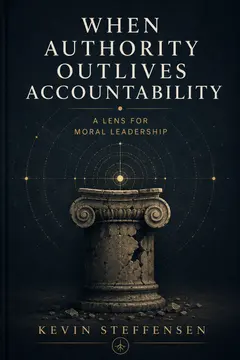
When Authority Outlives Accountability
A Lens for Moral Leadership
A leadership lens on how authority can persist after accountability erodes, and what moral leadership requires to restore integrity in that gap.
View book

Book
When Moral Seriousness Scales
Judgment Under Distance and Pressure
An exploration of how moral responsibility changes under scale, speed, and institutional distance, and how to preserve humane judgment anyway.
View book