
Nonfiction
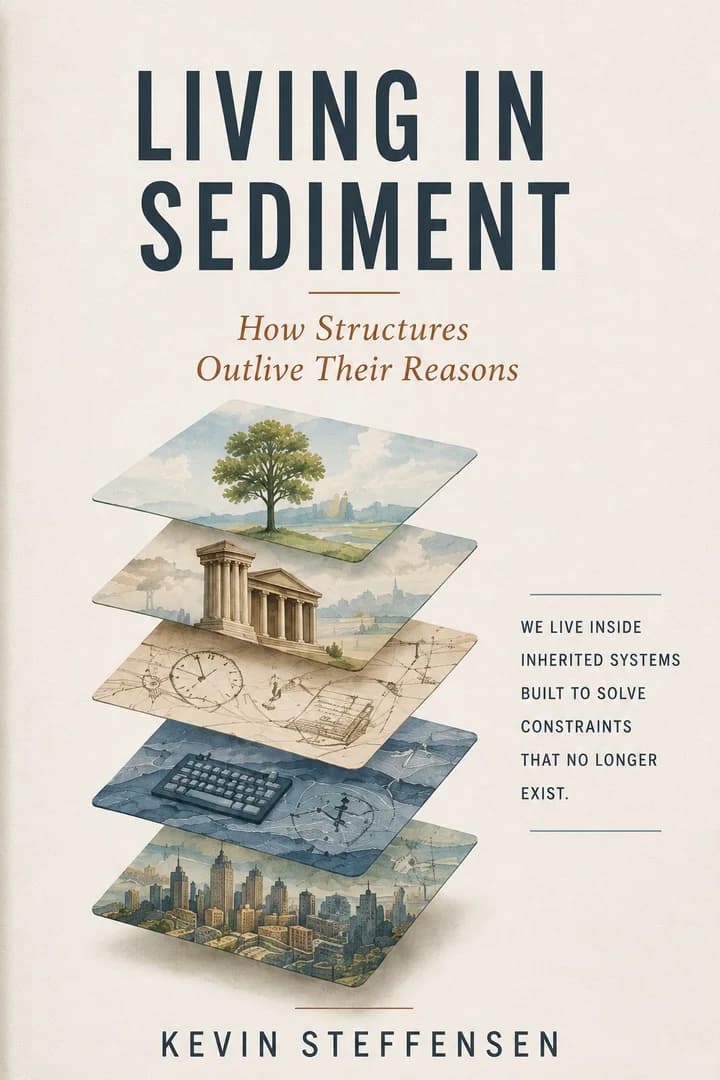
Living in Sediment
How Structures Outlive Their Reasons
By Kevin Steffensen
We live inside inherited systems built for constraints that no longer exist. When structures survive after their reasons disappear, meaning drifts—and the danger is forgetting the sediment is sediment.
We live inside inherited systems built for constraints that no longer exist. When structures survive after their reasons disappear, meaning drifts—and the danger is forgetting the sediment is sediment.
Offered under open publishing terms (CC BY-SA). Download formats are free where available; purchase links support print editions.
- Type
- Nonfiction · monograph
- Author
- Kevin Steffensen
- Published
- 2026
- Chapters
- 21 chapters
- Formats
- EPUB, PDF, DOCX
On these shelves
Also in Systems and Organizations
View all 9 →
Coupling
Cohesion, Consequence, and the Architecture of Responsibility

How Serious Systems Learn
Disciplines for Acting Without Certainty

The Discipline of Uncertainty
Judgment, Restraint, and Decision Quality Under Incomplete Information

Why Collaboration Is So Hard
And Why the Effort Still Matters

When Incentives Become the Moral Language
How Systems Decide For Us When Judgment No Longer Scales

When Accountability No Longer Expires
How Legitimate Authority Learns to Survive Harm
The question this book explores
Why do structures outlive the reasons that created them?
Why this book exists
To teach historical perception of present infrastructure fossils—language, time, policy, metrics, algorithms—across four movements: fossils we do not notice, fossils shaping power, fossils forming now, and living among sediment.
Who it is for
Readers of institutions, technology, and everyday coordination who want a habit of seeing between permanent skepticism and unquestioning acceptance.
What it is not
- It is not a catalog of errors waiting to be corrected.
- It does not treat inherited structures as automatically suspect simply because they are inherited.
- It is not a policy checklist; seeing does not by itself prescribe what to remake.
Central ideas
A curated handful of concepts and patterns this book develops — not the full inventory.
Concept
Inheritance
In this book: Central perception skill: noticing present infrastructure as fossilized prior settlements—language, policy, metrics still steering.
Explore the conceptConcept
Drift
In this book: Names how meaning and fit thin while forms persist; sediment is what remains after reasons fade.
Explore the conceptConcept
Structure
In this book: Focuses on what must be counted and how workflows assign reality—fossils that still coordinate power.
Explore the conceptConcept
Legitimacy
In this book: Asks why sedimented arrangements still feel justified—or refuse challenge—long after their originating story.
Explore the conceptConcept
Compression
In this book: Shows metrics and algorithms as compressed inheritances that travel farther than the judgments that produced them.
Explore the conceptPattern
Meaning Drifts Over Time
In this book: Deepens historical perception: interpretation of the same infrastructure shifts while the form stays.
Explore the patternPattern
Exceptions are Forever
In this book: Applies how temporary workarounds become sedimented operating procedure.
Explore the patternPattern
Examples Accumulate
In this book: Shows how repeated instances under pressure set what later counts as normal—fossils forming now.
Explore the pattern
Inside this book
How the book is organized — parts, chapters, and what each section investigates.
About 97 min of reading across 21 sections in 5 parts.
Part I — Fossils We Don't Notice
5 sections
Part I — Fossils We Don't Notice
5 sectionsShow summaryHide summary
Part I begins with ordinary companions that still carry history: day names, time measurement, keyboard shape, mortgage form, the lingering intuition of gold. These inheritances organize life without demanding a political position; the pleasure is noticing that something familiar has been quietly historical all along. The movement trains perception before the book turns to fossils that shape power.
Central questionWhat can unnoticed everyday forms teach before we look at institutions?
Show summaryHide summary
Thursday still carries Thor’s day — ancient cosmologies keeping appointments after the story that named them has disappeared — showing how institutional sediment hides in ordinary language. The hammer is gone; the name still organizes meetings, grocery lists, and schoolwork without asking to be noticed. Sediment here is not a conspiracy; it is coordination that outlived its cosmology.
Central questionWhat inherited structures still organize us after their original reasons have faded?
Show summaryHide summary
Microwaves, traffic lights, and tooth-brushing timers arrive already assembled around sixty—yet that rhythm is a way of describing the universe, not a property of it. Seconds and minutes feel natural because repetition hid the construction. The chapter treats time measurement as sediment: a coordinating inheritance so familiar it no longer invites curiosity about who chose the counts.
Central questionWhy does a constructed measure of time feel like a property of the universe?
Show summaryHide summary
A home gathers habits—creaking stairs, closet height marks, the Christmas-tree spot— while closing-day papers fix attention on rates and payments. The thirty-year mortgage remembers a crisis response that became the default path to dwelling; sediment here is financial form that still steers family life long after the emergency that standardized it. The house feels personal; the term is institutional inheritance.
Central questionHow does a crisis-era financing form become the ordinary shape of a home?
Show summaryHide summary
A child turns a coin and expects a reason; adults answer with governments, markets, trust, or history. For long stretches value seemed tangible in metal you could hold—an explanation that did not require invisible banking systems. Even after convertibility faded, gold persists as intuition and metaphor: sediment in how minds still reach for solidity when money has become abstract coordination.
Central questionWhy does gold still feel like an explanation after money has become abstract?
Part II — Fossils That Shape Power
5 sections
Part II — Fossils That Shape Power
5 sectionsShow summaryHide summary
Weekday gods and keyboard QWERTY are gentle inheritances; the same pattern settles into institutions. Part II turns from fossils we can smile at to fossils that still allocate voice, credit, moral tempo, and gathering space. History hiding in a government asks more of the reader than history hiding in Thursday—without abandoning the same perception skill.
Central questionWhat changes when the fossil we notice sits inside power rather than a weekday?
Show summaryHide summary
From thirty thousand feet Wyoming and California look equally certain on the map while one holds nearly seventy times the population of the other. The Senate's equal state voice remembers a negotiation room, not a finished principle descending intact. Constitutions are acts of compromise that become sediment: representation rules that still shape power centuries after the delegates left.
Central questionHow does a founding compromise keep allocating political voice after its bargaining room is gone?
Show summaryHide summary
A three-digit number appears in a banking app already carrying authority—few remember first encountering it or asking why it should exist. Credit scores feel like facts rather than inventions that compress judgment into a portable ranking. Sediment here is reputational infrastructure: a measurement that follows people into loans, rentals, and jobs long after its originating underwriting problems have been forgotten.
Central questionHow does an invented ranking become ordinary authority over a person's options?
Show summaryHide summary
Lives remember years as stories; conference rooms every three months compare revenue to guidance in a practiced rhythm. For millions, the year becomes four successive evaluations rather than one continuous passage. Quarterly reporting is sediment that sets moral tempo— what counts as responsible, urgent, or deferred—long after the accounting convenience that installed the cadence.
Central questionHow does a reporting cadence become the moral weather of organizations and careers?
Show summaryHide summary
Cathedrals, courthouses, and libraries quiet voices before anyone asks—architecture that seems to make a request. Early ekklesia named the gathering, not the stone; later the building became the container we treat as the institution. Sediment here is how space and form inherit authority: the gathering's purpose hardens into walls that still teach comportment after the original assembly language has thinned.
Central questionWhen does the building replace the gathering as what we think the institution is?
Part III — Fossils Forming Now
5 sections
Part III — Fossils Forming Now
5 sectionsShow summaryHide summary
Looking backward, compromises and measurements look clear once urgency has stripped away; the present offers no such luxury. People living through printing presses or early railroads rarely knew they were settling tomorrow's sediment. Part III watches structures forming now—ranking, subscription, delegated judgment, data doubles—before time has finished the interpretive work.
Central questionHow do we notice sediment while it is still settling rather than only after it hardens?
Show summaryHide summary
Library shelves once let neighboring books create discovery; blank search boxes return ordered millions in a fraction of a second, and most people click the first few. Ranking systems are not optional decoration—they are how an unnavigable warehouse becomes usable. Sediment forming now is attention ordered before we ask why those results appeared first, compressing judgment into infrastructure still settling.
Central questionWhat does ranking infrastructure decide about attention before we decide what deserves it?
Show summaryHide summary
Buying a book once ended the seller relationship; dust, lending, and grandchildren could follow without another transaction. Subscription turns access into ongoing permission— software, media, even features of cars—so possession becomes a renewable lease. Sediment forming here is life organized by continuous payment and revocable access rather than concluded ownership.
Central questionWhat changes when ordinary goods stop concluding in ownership and become renewable access?
Show summaryHide summary
Bankers, hiring managers, physicians, and teachers once carried judgment and explanation together—someone who could be questioned. Delegation to systems and scores often keeps the decision while thinning the answerable person. Sediment forming now is authority that still steers loans, hires, and care after the conversational face of judgment has been replaced by procedure that does not hesitate in the margins.
Central questionWhat is lost when decisions keep traveling after the person who could explain them no longer stands there?
Show summaryHide summary
Credit applications, recommendations, insurance estimates, and résumé screens already know fragments before a human learns a name. Location pings, purchases, pauses, and routes accumulate into something that begins to resemble someone. Sediment forming now is the statistical shadow that introduces people to institutions—an inherited-looking profile assembled from traces rather than from self-presentation.
Central questionWho meets institutions first—the person, or the double assembled from their traces?
Part IV — Living Among Sediment
4 sections
Part IV — Living Among Sediment
4 sectionsShow summaryHide summary
Weekdays, mortgages, Senate compromise, rankings, and datasets rhyme: a response that worked well enough settles while the original problem fades. Seeing sediment everywhere can tip into permanent distrust—history as a catalogue of mistakes awaiting dismantling. Part IV refuses that reflex: the task is living among inheritance with perception, not treating every layer as obsolete on sight.
Central questionHow do we keep seeing sediment without concluding that everything inherited is only waiting to be torn down?
Show summaryHide summary
An old river bend looks permanent until you remember it began as water finding an easier path that deepened itself year after year. Structures likewise keep their shape after the justification that cut the channel has faded. The chapter practices seeing path-dependence without demanding that every bend be straightened—recognition that form can outlast reason while still carrying water.
Central questionWhat should we do with structures that still function after their original justification has faded?
Show summaryHide summary
Fossils in this book are often still alive: the seven-day week, shared calendars, and old metaphors continue coordinating strangers. Inheritance is generous—civilizations remember more than any individual could—yet noticing layers can breed suspicion of everything that endured. Stability and corrosion arrive together: sediment preserves coordination and can also hide misfit; the work is telling them apart without a single purge.
Central questionHow do we honor sediment that still coordinates without ignoring the corrosion it can hide?
Show summaryHide summary
Archaeologists brush dirt from fragments before deciding what to think—restraint before interpretation. The same patience applies to weekdays, keyboards, mortgages, Senate shape, quarterly cadence, search rankings, and data shadows still underfoot. Archaeology of the present is a practice of noticing layers in living infrastructure: ask what this is and what it remembers before asking only what should replace it.
Central questionWhat does it mean to practice archaeology on structures we still inhabit?
Other sections
2 sections
Other sections
2 sectionsShow summaryHide summary
September still carries seven inside its name though it is the ninth month—a quiet lie made possible by centuries of repetition after the calendar shifted and the labels did not. Children sometimes notice first; adults treat the sequence as architecture rather than inheritance. The prologue opens the book's habit: ordinary timekeeping as evidence that structures outlive the reasons that named them.
Central questionWhat does a familiar calendar label still carry after its original count no longer fits?
Show summaryHide summary
October still means eight; December still carries ten—nothing on the wall has changed, yet the calendar acquires a second dimension once the mismatch is known. Meetings and school years continue; the names become evidence rather than mere labels. The epilogue closes the perception habit the book trained: sediment remains ordinary, and ordinary becomes readable as history we still live inside.
Central questionWhat changes when familiar labels become evidence without the world itself rearranging?
Where it fits
Suggested reading order and nearby volumes — not a mandatory sequence.
Read before
Continue exploring
- Next book — When Incentives Become the Moral Language
- Start with a question — Why do structures outlive the reasons that created them?
Reading trails featuring this book
Editorial paths that include this book as one stop in a longer sequence.
Full related inventoryShowHide
Complete concept, pattern, and thinker lists for readers who want the full semantic map.
Major concepts
Concept
Abstraction
Abstraction is mediation away from direct encounter: compression of complexity as systems scale, valued when it preserves accountability signal at the boundaries where behavior can still be redesigned
View Concept →
Concept
Abstraction
Abstraction is mediation away from direct encounter: compression of complexity as systems scale, valued when it preserves accountability signal at the boundaries where behavior can still be redesigned
Concept
Authority
Authority names who can coordinate action when full agreement is impossible. It becomes important whenever groups must move before every perspective aligns. It helps preserve direction and collective capacity, but can fail when operational power outruns justified recognition or visible consequence. It differs from legitimacy because authority is the capacity to steer; legitimacy is whether that capacity reads as earned and revisable enough to coordinate trust rather than performative compliance.
View Concept →
Concept
Authority
Authority names who can coordinate action when full agreement is impossible. It becomes important whenever groups must move before every perspective aligns. It helps preserve direction and collective capacity, but can fail when operational power outruns justified recognition or visible consequence. It differs from legitimacy because authority is the capacity to steer; legitimacy is whether that capacity reads as earned and revisable enough to coordinate trust rather than performative compliance.
Concept
Bureaucracy
Bureaucracy extends permanence into practice—rules replacing discretion, procedures replacing judgment, roles replacing relationships. At industrial scale it functions as moral infrastructure, coordinating strangers through files, stamps, and queues that must still recognize a name long enough for life to continue. Bureaucracy makes expectations visible and portable—the same form, the same stamp, the same queue number tomorrow—so thousands can coordinate without knowing one another's names. The room feels like Tuesday before the first form is stamped; box seven rather than box four determines whether a lease continues. No one feels cruel; no one feels fully responsible either. Bureaucracy coordinates while meaning quietly thins, systems function without anyone tracing harm, and the machinery keeps its appointments whether or not it still fits the lives it was meant to serve.
View Concept →
Concept
Bureaucracy
Bureaucracy extends permanence into practice—rules replacing discretion, procedures replacing judgment, roles replacing relationships. At industrial scale it functions as moral infrastructure, coordinating strangers through files, stamps, and queues that must still recognize a name long enough for life to continue. Bureaucracy makes expectations visible and portable—the same form, the same stamp, the same queue number tomorrow—so thousands can coordinate without knowing one another's names. The room feels like Tuesday before the first form is stamped; box seven rather than box four determines whether a lease continues. No one feels cruel; no one feels fully responsible either. Bureaucracy coordinates while meaning quietly thins, systems function without anyone tracing harm, and the machinery keeps its appointments whether or not it still fits the lives it was meant to serve.
Concept
Compression
Compression reduces moral complexity for transmission at scale. Collapse gives way to compression, compression produces stabilization, and stabilization hardens into inheritance. When populations must coordinate across distance and strangers must share rules, compression lets expectations travel—law narrows discretion so the same words will be read tomorrow, canon fixes meaning so provinces can align. Compression is adaptation under pressure—instability demands it before truth is settled, acceptable interpretation shrinks while exposure widens. At its best, compression preserves coordination when full discernment is too costly; at its worst, tools built to compress instability begin to constrain adaptation, and compression outlives the conditions that required it.
View Concept →
Concept
Compression
Compression reduces moral complexity for transmission at scale. Collapse gives way to compression, compression produces stabilization, and stabilization hardens into inheritance. When populations must coordinate across distance and strangers must share rules, compression lets expectations travel—law narrows discretion so the same words will be read tomorrow, canon fixes meaning so provinces can align. Compression is adaptation under pressure—instability demands it before truth is settled, acceptable interpretation shrinks while exposure widens. At its best, compression preserves coordination when full discernment is too costly; at its worst, tools built to compress instability begin to constrain adaptation, and compression outlives the conditions that required it.
Concept
Coordination
Coordination names the problem of acting together when lives are fragmented—when people must move collectively across distance, time, strangers, and difference without complete information or full agreement. It becomes important when individual judgment alone cannot sustain the group, when behavior must hold across contexts that no one person can see completely. Coordination helps preserve collective capacity by making expectations predictable, by enabling strangers to act together under shared rules, by allowing large-scale projects that no single person could accomplish. Roles, rituals, law, canon, procedure, and bureaucracy are all coordination technologies—tools for making tomorrow recognizable from yesterday so action can continue. But coordination can become brittle when it suppresses the feedback and variation it needs to stay responsive, when inherited patterns keep moving after fit has thinned, when dissent is treated as disruption rather than signal. Coordination purchased at the cost of revision can continue functioning long after it has stopped serving the purposes that gave it authority. The question coordination raises is: what coordination problem is this tool solving? What breaks if behavior stops being predictable? Coordination differs from alignment in that coordination is about collective movement, while alignment is about shared direction or values.
View Concept →
Concept
Coordination
Coordination names the problem of acting together when lives are fragmented—when people must move collectively across distance, time, strangers, and difference without complete information or full agreement. It becomes important when individual judgment alone cannot sustain the group, when behavior must hold across contexts that no one person can see completely. Coordination helps preserve collective capacity by making expectations predictable, by enabling strangers to act together under shared rules, by allowing large-scale projects that no single person could accomplish. Roles, rituals, law, canon, procedure, and bureaucracy are all coordination technologies—tools for making tomorrow recognizable from yesterday so action can continue. But coordination can become brittle when it suppresses the feedback and variation it needs to stay responsive, when inherited patterns keep moving after fit has thinned, when dissent is treated as disruption rather than signal. Coordination purchased at the cost of revision can continue functioning long after it has stopped serving the purposes that gave it authority. The question coordination raises is: what coordination problem is this tool solving? What breaks if behavior stops being predictable? Coordination differs from alignment in that coordination is about collective movement, while alignment is about shared direction or values.
Concept
Coupling
Coupling names the strength of the link between what was decided and what later arrives. It becomes important when scale, abstraction, or delay lengthen the chain between decision and lived harm. It helps preserve learning and legitimacy, but can fail when dashboards stay green while frontline frustration grows. It differs from cohesion because coupling tracks action-to-effect attachment; cohesion tracks whether responsibility is clearly held. It differs from consequence-architecture because coupling describes the attachment; consequence-architecture describes intentional design of boundaries, feedback, and escalation.
View Concept →
Concept
Coupling
Coupling names the strength of the link between what was decided and what later arrives. It becomes important when scale, abstraction, or delay lengthen the chain between decision and lived harm. It helps preserve learning and legitimacy, but can fail when dashboards stay green while frontline frustration grows. It differs from cohesion because coupling tracks action-to-effect attachment; cohesion tracks whether responsibility is clearly held. It differs from consequence-architecture because coupling describes the attachment; consequence-architecture describes intentional design of boundaries, feedback, and escalation.
Concept
Distance
Distance names separation between decision and consequence, between action and its effects, between authority and those it governs. It becomes important as coordination extends beyond direct relational encounter—as scale grows and abstraction layers multiply. Distance makes harm harder to trace, feedback slower to arrive, and responsibility harder to locate. It helps coordination reach across space and time, enabling larger and more complex forms of collective action, but it thins the connection between choosers and those who live with the outcomes. As distance opens, action and reflection no longer meet in the same place; decisions travel while bodies receive the consequences; institutions record outcomes in ways that differ from how people experience them. Distance becomes built into the architecture of moral life at scale—not as failure but as structure. The question it raises is: how far does decision travel before consequence is felt? Who can see the full chain between policy and harm? Distance differs from mediation (routing through intermediaries) in that distance is the gap itself, while mediation is what fills or crosses the gap.
View Concept →
Concept
Distance
Distance names separation between decision and consequence, between action and its effects, between authority and those it governs. It becomes important as coordination extends beyond direct relational encounter—as scale grows and abstraction layers multiply. Distance makes harm harder to trace, feedback slower to arrive, and responsibility harder to locate. It helps coordination reach across space and time, enabling larger and more complex forms of collective action, but it thins the connection between choosers and those who live with the outcomes. As distance opens, action and reflection no longer meet in the same place; decisions travel while bodies receive the consequences; institutions record outcomes in ways that differ from how people experience them. Distance becomes built into the architecture of moral life at scale—not as failure but as structure. The question it raises is: how far does decision travel before consequence is felt? Who can see the full chain between policy and harm? Distance differs from mediation (routing through intermediaries) in that distance is the gap itself, while mediation is what fills or crosses the gap.
Concept
Drift
Drift names slow misalignment—meaning drifts as it travels, role compliance replaces discernment, systems continue without admitting conditions have shifted. It becomes important when continuity masks thinning fit and inherited tools coordinate long after they stop persuading. It helps recognize strain before rupture feels sudden, but can fail when drift is mistaken for stability because the machinery still turns. It differs from inheritance because drift emphasizes loss of fit over time; inheritance emphasizes what persists. It differs from normalization because drift is the movement; normalization is drift settling into expected background.
View Concept →
Concept
Drift
Drift names slow misalignment—meaning drifts as it travels, role compliance replaces discernment, systems continue without admitting conditions have shifted. It becomes important when continuity masks thinning fit and inherited tools coordinate long after they stop persuading. It helps recognize strain before rupture feels sudden, but can fail when drift is mistaken for stability because the machinery still turns. It differs from inheritance because drift emphasizes loss of fit over time; inheritance emphasizes what persists. It differs from normalization because drift is the movement; normalization is drift settling into expected background.
Concept
Feedback
Feedback names how systems stay in contact with their own effects. It becomes important whenever action and consequence are separated by time, scale, or abstraction. It helps preserve learning, correction, and trust in ongoing coordination, but can fail when dashboards stay green while lived harm accumulates off the ledger. It differs from trust because feedback is the returning signal itself; trust is the bridge that lets people act before every signal arrives. It differs from correction because feedback is what returns; correction is the work of updating in response.
View Concept →
Concept
Feedback
Feedback names how systems stay in contact with their own effects. It becomes important whenever action and consequence are separated by time, scale, or abstraction. It helps preserve learning, correction, and trust in ongoing coordination, but can fail when dashboards stay green while lived harm accumulates off the ledger. It differs from trust because feedback is the returning signal itself; trust is the bridge that lets people act before every signal arrives. It differs from correction because feedback is what returns; correction is the work of updating in response.
Concept
Governance Coupling
The degree to which formal oversight structures preserve real consequence return to decision-capable authority. Governance coupling weakens when signal is filtered, delayed, or politically insulated, even if nominal accountability mechanisms still exist.
View Concept →
Concept
Governance Coupling
The degree to which formal oversight structures preserve real consequence return to decision-capable authority. Governance coupling weakens when signal is filtered, delayed, or politically insulated, even if nominal accountability mechanisms still exist.
Concept
Harm
Harm names where cost lands when influence is exercised—who absorbs it, who is kept in view, and what displacement is treated as acceptable. It marks the lived consequence of action, authority, design, or coordination. The visibility dimension matters—who is harmed in particular, not on average? Can they name it? Can they respond? Does the system register it or treat it as acceptable loss? Harm continues while interpretation expands, briefings make harm legible without smaller, people can still tell when something is doing harm. The question harm raises—is harm unchanged outside while we analyze inside? When does naming harm substitute for reducing it? The failure mode—harm persists while moral work feels complete, delays continue after excellent postmortems, harm becomes statistical at scale. The restoration path—return to particular harms and people, check effects outside the room after briefings, stop when outcomes for people are unchanged, pair analysis with named remedy attempts, accept harm as inevitable without abandoning response.
View Concept →
Concept
Harm
Harm names where cost lands when influence is exercised—who absorbs it, who is kept in view, and what displacement is treated as acceptable. It marks the lived consequence of action, authority, design, or coordination. The visibility dimension matters—who is harmed in particular, not on average? Can they name it? Can they respond? Does the system register it or treat it as acceptable loss? Harm continues while interpretation expands, briefings make harm legible without smaller, people can still tell when something is doing harm. The question harm raises—is harm unchanged outside while we analyze inside? When does naming harm substitute for reducing it? The failure mode—harm persists while moral work feels complete, delays continue after excellent postmortems, harm becomes statistical at scale. The restoration path—return to particular harms and people, check effects outside the room after briefings, stop when outcomes for people are unchanged, pair analysis with named remedy attempts, accept harm as inevitable without abandoning response.
Concept
Humility
Humility—naming tradeoffs, uncertainty, distributional conflict—is epistemically virtuous and politically costly at scale. Certainty orients anxious publics and protects institutions from looking paralyzed. The outperforming of humility is not proof audiences are childish; it is proof that orientation is scarce and fear is abundant. Under interpretive stress, humility also means acknowledging what summaries omit and who pays for resilience.
View Concept →
Concept
Humility
Humility—naming tradeoffs, uncertainty, distributional conflict—is epistemically virtuous and politically costly at scale. Certainty orients anxious publics and protects institutions from looking paralyzed. The outperforming of humility is not proof audiences are childish; it is proof that orientation is scarce and fear is abundant. Under interpretive stress, humility also means acknowledging what summaries omit and who pays for resilience.
Concept
Inheritance
Inheritance names what travels forward when the original scene is gone—archives, canon, titles, feast days, bureaucratic certainty. It becomes important when systems still coordinate long after their makers' conditions have shifted. It helps preserve continuity across generations, but can fail when inherited tools resist revision while fit quietly thins. It differs from adaptation because inheritance carries forward what stabilized; adaptation names the original responsive work. It differs from drift because inheritance emphasizes persistence of form; drift emphasizes gradual decoupling from conditions.
View Concept →
Concept
Inheritance
Inheritance names what travels forward when the original scene is gone—archives, canon, titles, feast days, bureaucratic certainty. It becomes important when systems still coordinate long after their makers' conditions have shifted. It helps preserve continuity across generations, but can fail when inherited tools resist revision while fit quietly thins. It differs from adaptation because inheritance carries forward what stabilized; adaptation names the original responsive work. It differs from drift because inheritance emphasizes persistence of form; drift emphasizes gradual decoupling from conditions.
Concept
Institutional memory
Institutional memory names what organizations retain and transmit across personnel turnover and generational change—protocols shaped by past failure, stories that carry warnings, habits that encode lessons, procedures that prevent forgotten harm from recurring. It becomes important because individuals leave but institutions continue; what is learned must somehow persist in structure rather than only in personal experience. Institutional memory helps organizations avoid repeating costly mistakes, preserve hard-won knowledge, and maintain continuity through transitions. Archives, law, training programs, handoff documents, and cultural stories all serve as institutional memory— distributing cognition across time so that pain can become structure rather than repetition. But institutional memory can also fail by forgetting selectively, by preserving metrics that outlive the problems they measured, by letting ritual replace inquiry, by making success feel like bureaucracy worth cutting. The question institutional memory raises is: what pain did this institution convert into structure, and what did it forget instead? Where does memory strong enough to learn coexist with revision strong enough to unlearn?
View Concept →
Concept
Institutional memory
Institutional memory names what organizations retain and transmit across personnel turnover and generational change—protocols shaped by past failure, stories that carry warnings, habits that encode lessons, procedures that prevent forgotten harm from recurring. It becomes important because individuals leave but institutions continue; what is learned must somehow persist in structure rather than only in personal experience. Institutional memory helps organizations avoid repeating costly mistakes, preserve hard-won knowledge, and maintain continuity through transitions. Archives, law, training programs, handoff documents, and cultural stories all serve as institutional memory— distributing cognition across time so that pain can become structure rather than repetition. But institutional memory can also fail by forgetting selectively, by preserving metrics that outlive the problems they measured, by letting ritual replace inquiry, by making success feel like bureaucracy worth cutting. The question institutional memory raises is: what pain did this institution convert into structure, and what did it forget instead? Where does memory strong enough to learn coexist with revision strong enough to unlearn?
Concept
Judgment
Judgment names the capacity to decide when understanding is incomplete but harm, coordination, or responsibility will not wait. It becomes important whenever action must proceed under partial information and real consequence. It helps preserve proportionality, answerability, and room for revision, but can fail when judgment hardens into dogma, paralysis, or punitive finality. It differs from certainty because judgment accepts incomplete sight; it differs from preference because judgment weighs consequence beyond taste; it differs from optimization because judgment keeps contestability and human proportion in view; it differs from rule-following because judgment must still respond when rules lag reality.
View Concept →
Concept
Judgment
Judgment names the capacity to decide when understanding is incomplete but harm, coordination, or responsibility will not wait. It becomes important whenever action must proceed under partial information and real consequence. It helps preserve proportionality, answerability, and room for revision, but can fail when judgment hardens into dogma, paralysis, or punitive finality. It differs from certainty because judgment accepts incomplete sight; it differs from preference because judgment weighs consequence beyond taste; it differs from optimization because judgment keeps contestability and human proportion in view; it differs from rule-following because judgment must still respond when rules lag reality.
Concept
Legibility
Legibility names the degree to which work, contribution, harm, or signal can be perceived and evaluated by those at distance—especially by those who grade, fund, allocate resources, or make promotion decisions. It becomes important because visibility shapes what gets valued, rewarded, and sustained. What becomes legible can be measured, managed, and integrated into formal systems; what remains illegible often goes unrecognized even when it is essential. Legibility helps coordination at scale by making expectations clear, progress trackable, and accountability visible. But uneven legibility is not the same as uneven value; legibility is a visibility structure, not a measure of worth. Legibility becomes dangerous when it substitutes for trust rather than serving it, when dashboards calm funders while field coordination narrows, when metrics answer anxiety rather than shared questions, when legibility demands consume the work they were meant to track. The question legibility raises is: is legibility serving trust or substituting for it? What work becomes invisible when only counted activity feels real?
View Concept →
Concept
Legibility
Legibility names the degree to which work, contribution, harm, or signal can be perceived and evaluated by those at distance—especially by those who grade, fund, allocate resources, or make promotion decisions. It becomes important because visibility shapes what gets valued, rewarded, and sustained. What becomes legible can be measured, managed, and integrated into formal systems; what remains illegible often goes unrecognized even when it is essential. Legibility helps coordination at scale by making expectations clear, progress trackable, and accountability visible. But uneven legibility is not the same as uneven value; legibility is a visibility structure, not a measure of worth. Legibility becomes dangerous when it substitutes for trust rather than serving it, when dashboards calm funders while field coordination narrows, when metrics answer anxiety rather than shared questions, when legibility demands consume the work they were meant to track. The question legibility raises is: is legibility serving trust or substituting for it? What work becomes invisible when only counted activity feels real?
Concept
Legitimacy
Legitimacy names the standing that lets authority coordinate without constant coercion. It becomes important when scale, abstraction, or time separate decision-makers from lived consequence. It helps preserve trust and willing participation, but can fail when smooth operation is mistaken for moral standing or when scrutiny is treated as disloyalty. It differs from alignment because legitimacy still invites proportionate inquiry; alignment can bind through belonging signals alone.
View Concept →
Concept
Legitimacy
Legitimacy names the standing that lets authority coordinate without constant coercion. It becomes important when scale, abstraction, or time separate decision-makers from lived consequence. It helps preserve trust and willing participation, but can fail when smooth operation is mistaken for moral standing or when scrutiny is treated as disloyalty. It differs from alignment because legitimacy still invites proportionate inquiry; alignment can bind through belonging signals alone.
Concept
Public interpretation
Public interpretation names evaluative activity that still connects reasons to standing across boundaries. It becomes important whenever legitimacy depends on more than enforcement or belonging alone. It helps preserve contestability and repair, but can fail when communication intensifies while evaluative space vanishes. It differs from private understanding because public interpretation must be able to matter publicly; it differs from interpretive collapse because collapse is the loss of this shared function, not failed comprehension alone.
View Concept →
Concept
Public interpretation
Public interpretation names evaluative activity that still connects reasons to standing across boundaries. It becomes important whenever legitimacy depends on more than enforcement or belonging alone. It helps preserve contestability and repair, but can fail when communication intensifies while evaluative space vanishes. It differs from private understanding because public interpretation must be able to matter publicly; it differs from interpretive collapse because collapse is the loss of this shared function, not failed comprehension alone.
Concept
Reciprocity
Reciprocity names mutual exposure, obligation, and constraint made visible—the condition where both sides remain reachable by consequence and answerable to shared expectations. It becomes important when trust depends not only on rules but on mutual vulnerability, when accountability works through shared exposure rather than only through enforcement. Reciprocity helps preserve relationality and answerability in coordination; it makes obligation concrete and visible rather than abstract. When obligations are reciprocal, personal, and explicit, deviation threatens the relationship itself, not merely a principle. Trust is stronger when both parties can see and feel what happens if expectations break. But reciprocity thins as scale grows and abstraction replaces relationships—as categories replace persons, as responsibility shifts from mutual constraint to role compliance, as power travels beyond the reach of mutual consequence. Asymmetry grows when obligation flows only one way, when those who decide are insulated from the effects of their decisions. The question reciprocity raises is: who still shares exposure if this arrangement fails? Where has reciprocity thinned into one-way compliance? Reciprocity differs from accountability in that reciprocity is mutual, while accountability can be unidirectional.
View Concept →
Concept
Reciprocity
Reciprocity names mutual exposure, obligation, and constraint made visible—the condition where both sides remain reachable by consequence and answerable to shared expectations. It becomes important when trust depends not only on rules but on mutual vulnerability, when accountability works through shared exposure rather than only through enforcement. Reciprocity helps preserve relationality and answerability in coordination; it makes obligation concrete and visible rather than abstract. When obligations are reciprocal, personal, and explicit, deviation threatens the relationship itself, not merely a principle. Trust is stronger when both parties can see and feel what happens if expectations break. But reciprocity thins as scale grows and abstraction replaces relationships—as categories replace persons, as responsibility shifts from mutual constraint to role compliance, as power travels beyond the reach of mutual consequence. Asymmetry grows when obligation flows only one way, when those who decide are insulated from the effects of their decisions. The question reciprocity raises is: who still shares exposure if this arrangement fails? Where has reciprocity thinned into one-way compliance? Reciprocity differs from accountability in that reciprocity is mutual, while accountability can be unidirectional.
Concept
Responsibility
Responsibility names what continues after action—the obligation to remain responsive to what one's choices set in motion. It becomes important when systems scale beyond any one person's control but moral weight still accumulates. It helps preserve sustained answerability, but can fail when responsibility collapses into futility or when symbolic gestures replace contact with effects. It differs from accountability because responsibility names the enduring relation; accountability names whether consequence still reaches those who can respond.
View Concept →
Concept
Responsibility
Responsibility names what continues after action—the obligation to remain responsive to what one's choices set in motion. It becomes important when systems scale beyond any one person's control but moral weight still accumulates. It helps preserve sustained answerability, but can fail when responsibility collapses into futility or when symbolic gestures replace contact with effects. It differs from accountability because responsibility names the enduring relation; accountability names whether consequence still reaches those who can respond.
Concept
Structure
How organizations assign what must be counted—metrics, mandates, workflows, and tools that coordinate sight at scale and edit what remains off the ledger.
View Concept →
Concept
Structure
How organizations assign what must be counted—metrics, mandates, workflows, and tools that coordinate sight at scale and edit what remains off the ledger.
Concept
System
A system is an organized set of people, processes, rules, and structures that produces repeatable outcomes over time. The term applies across domains: software architectures, teams, firms, agencies, governance structures, and media institutions. The shared criterion is not technology; it is patterned behavior under constraints, incentives, and feedback.
View Concept →
Concept
System
A system is an organized set of people, processes, rules, and structures that produces repeatable outcomes over time. The term applies across domains: software architectures, teams, firms, agencies, governance structures, and media institutions. The shared criterion is not technology; it is patterned behavior under constraints, incentives, and feedback.
Concept
Trust
Trust names the bridge that lets people act together when no one holds the whole scene. It becomes important when verification must extend beyond firsthand sight—through specialists, records, institutions, or repeated experience. It helps preserve participation across partial perspectives, but can fail when trust stops tracking reality and closure feels safer than checking. It differs from certainty because trust accepts incomplete verification; it differs from blind belief because it still depends on signals that can be tested, strained, or withdrawn.
View Concept →
Concept
Trust
Trust names the bridge that lets people act together when no one holds the whole scene. It becomes important when verification must extend beyond firsthand sight—through specialists, records, institutions, or repeated experience. It helps preserve participation across partial perspectives, but can fail when trust stops tracking reality and closure feels safer than checking. It differs from certainty because trust accepts incomplete verification; it differs from blind belief because it still depends on signals that can be tested, strained, or withdrawn.
Concept
Vitality
Vitality names the condition of a group, system, or relationship when adaptability holds—when the work stays open to revision, feedback still works, and mistakes surface before they harden into identity conflicts—whether coordinated reach is already broad or still developing. It becomes important as a measure of organizational health beyond simple functioning; systems can continue operating long after their vitality has drained. Vitality helps preserve adaptability and responsiveness; it keeps groups from becoming brittle, enables learning from error, and maintains the capacity for correction. It depends on people knowing who must decide, how to escalate, and how to repair; on questions and dissent taking time but preventing bigger breaks; on hard news staying speakable and pushback remaining possible without loss of standing. Vitality can fail when meetings speed up by skipping inconvenient signals, when the social cost of speaking rises while vitality language persists, when reach holds but adaptability falls and the group becomes entrenched rather than regenerative. The question vitality raises is: can people still push back without losing their place at the table? Does friction in the room buy smaller failures now instead of compounded harm later?
View Concept →
Concept
Vitality
Vitality names the condition of a group, system, or relationship when adaptability holds—when the work stays open to revision, feedback still works, and mistakes surface before they harden into identity conflicts—whether coordinated reach is already broad or still developing. It becomes important as a measure of organizational health beyond simple functioning; systems can continue operating long after their vitality has drained. Vitality helps preserve adaptability and responsiveness; it keeps groups from becoming brittle, enables learning from error, and maintains the capacity for correction. It depends on people knowing who must decide, how to escalate, and how to repair; on questions and dissent taking time but preventing bigger breaks; on hard news staying speakable and pushback remaining possible without loss of standing. Vitality can fail when meetings speed up by skipping inconvenient signals, when the social cost of speaking rises while vitality language persists, when reach holds but adaptability falls and the group becomes entrenched rather than regenerative. The question vitality raises is: can people still push back without losing their place at the table? Does friction in the room buy smaller failures now instead of compounded harm later?
Major patterns
Pattern
Examples Accumulate
A leader reacts to a mistake, competing pressures, or unclear ground in a shared setting. People need to know what counts as OK. Clear rules are missing or thin. - People watch others when things are unclear - What people see moves faster than written rules - Early reactions set what feels allowed - Silence and emphasis both send a signal What the leader does—especially under pressure—quickly sets what others treat as acceptable. Careful what we model in the room; examples accumulate faster than anything we post on the wiki.
View Pattern →
Pattern
Examples Accumulate
A leader reacts to a mistake, competing pressures, or unclear ground in a shared setting. People need to know what counts as OK. Clear rules are missing or thin. - People watch others when things are unclear - What people see moves faster than written rules - Early reactions set what feels allowed - Silence and emphasis both send a signal What the leader does—especially under pressure—quickly sets what others treat as acceptable. Careful what we model in the room; examples accumulate faster than anything we post on the wiki.
Pattern
Exceptions are Forever
A group adopts emergency measures or exceptions during a crisis or rush. Moves made for speed or survival do not always roll back when things calm down. - Urgency justifies skipping normal limits - Short-term wins reinforce the exception - Rolling back takes effort and coordination - New ways of working turn into habit fast Workarounds and shortcuts turn into how the group works day to day. Let's be careful carving out another exception—exceptions are forever, and this one will outlive the emergency we made it for.
View Pattern →
Pattern
Exceptions are Forever
A group adopts emergency measures or exceptions during a crisis or rush. Moves made for speed or survival do not always roll back when things calm down. - Urgency justifies skipping normal limits - Short-term wins reinforce the exception - Rolling back takes effort and coordination - New ways of working turn into habit fast Workarounds and shortcuts turn into how the group works day to day. Let's be careful carving out another exception—exceptions are forever, and this one will outlive the emergency we made it for.
Pattern
Meaning Drifts Over Time
People revisit events after additional conversations, outcomes, and memory updates. Interpretation is treated as fixed even though context keeps changing. - Memory gets rebuilt over time, not replayed exactly - Repetition favors convenient summaries - New context changes what earlier events seem to mean Interpretation slowly changes as memory, context, and repetition accumulate. Meaning drifts over time and rarely stays where it first landed.
View Pattern →
Pattern
Meaning Drifts Over Time
People revisit events after additional conversations, outcomes, and memory updates. Interpretation is treated as fixed even though context keeps changing. - Memory gets rebuilt over time, not replayed exactly - Repetition favors convenient summaries - New context changes what earlier events seem to mean Interpretation slowly changes as memory, context, and repetition accumulate. Meaning drifts over time and rarely stays where it first landed.
Supporting · Obscuring
Structures Outlive Reasons
People inherit structures more readily than they inherit the reasons those structures were created. - Structures travel more easily than reasons - Changed conditions do not automatically retire old forms Rules, roles, institutions, workarounds, and routines often persist after the conditions that originally justified them have changed or disappeared.
View Pattern →
Supporting · Obscuring
Structures Outlive Reasons
People inherit structures more readily than they inherit the reasons those structures were created. - Structures travel more easily than reasons - Changed conditions do not automatically retire old forms Rules, roles, institutions, workarounds, and routines often persist after the conditions that originally justified them have changed or disappeared.
Major thinkers
Person
Andrew Abbott
Sociologist of professions, jurisdictional boundaries, and how expert communities claim authority.
View Thinker →
Person
Andrew Abbott
Sociologist of professions, jurisdictional boundaries, and how expert communities claim authority.
Person
Anthony Giddens
Sociologist of structuration, modernity, and how agency and structure co-produce social life.
View Thinker →
Person
Anthony Giddens
Sociologist of structuration, modernity, and how agency and structure co-produce social life.
Person
Brian Christian
Writer on algorithms, human-computer interaction, and the alignment problem in machine decision systems.
View Thinker →
Person
Brian Christian
Writer on algorithms, human-computer interaction, and the alignment problem in machine decision systems.
Person
Bruno Latour
Sociologist of science, actor-networks, and how facts are assembled through alliances and instruments.
View Thinker →
Person
Bruno Latour
Sociologist of science, actor-networks, and how facts are assembled through alliances and instruments.
Person
Carlo Rovelli
Physicist and essayist on relational quantum theory, time, and the limits of naive objectivity.
View Thinker →
Person
Carlo Rovelli
Physicist and essayist on relational quantum theory, time, and the limits of naive objectivity.
Person
Cathy O'Neil
Data scientist and critic of Weapons of Math Destruction—opaque models that encode harm at scale.
View Thinker →
Person
Cathy O'Neil
Data scientist and critic of Weapons of Math Destruction—opaque models that encode harm at scale.
Person
Charles Tilly
Historical sociologist of state formation, coercion, capital, and contentious politics.
View Thinker →
Person
Charles Tilly
Historical sociologist of state formation, coercion, capital, and contentious politics.
Person
Christopher Alexander
Architect and theorist of pattern languages, living structure, and humane scale in built environment.
View Thinker →
Person
Christopher Alexander
Architect and theorist of pattern languages, living structure, and humane scale in built environment.
Person
Clifford Geertz
Anthropologist of thick description, culture as webs of meaning, and interpretive social science.
View Thinker →
Person
Clifford Geertz
Anthropologist of thick description, culture as webs of meaning, and interpretive social science.
Person
Daron Acemoglu
Economists of institutions, extractive versus inclusive political economy, and why nations fail or flourish.
View Thinker →
Person
Daron Acemoglu
Economists of institutions, extractive versus inclusive political economy, and why nations fail or flourish.
Person
David Edgerton
Historian of technology-in-use, shock of the old, and how innovation narratives misread sedimented tools.
View Thinker →
Person
David Edgerton
Historian of technology-in-use, shock of the old, and how innovation narratives misread sedimented tools.
Person
David Graeber
Anthropologist and critic of bureaucracy, debt, and the moral economies embedded in institutions.
View Thinker →
Person
David Graeber
Anthropologist and critic of bureaucracy, debt, and the moral economies embedded in institutions.
Person
David S Landes
Economic historian of culture, clocks, and the wealth and poverty of nations.
View Thinker →
Person
David S Landes
Economic historian of culture, clocks, and the wealth and poverty of nations.
Person
Donella H Meadows
Systems thinker and writer on leverage points, feedback loops, and learning to intervene in complex systems without hubris.
View Thinker →
Person
Donella H Meadows
Systems thinker and writer on leverage points, feedback loops, and learning to intervene in complex systems without hubris.
Person
Douglass C North
Nobel economist of institutions, transaction costs, and path-dependent economic change.
View Thinker →
Person
Douglass C North
Nobel economist of institutions, transaction costs, and path-dependent economic change.
Person
E. H Carr
Historian of Soviet Russia, international relations, and what counts as fact versus interpretation in history.
View Thinker →
Person
E. H Carr
Historian of Soviet Russia, international relations, and what counts as fact versus interpretation in history.
Person
Elinor Ostrom
Nobel laureate in economics; commons governance, institutional design beyond markets and states.
View Thinker →
Person
Elinor Ostrom
Nobel laureate in economics; commons governance, institutional design beyond markets and states.
Person
Eviatar Zerubavel
Sociologist of cognitive sociology, time maps, and hidden calendars that organize collective attention.
View Thinker →
Person
Eviatar Zerubavel
Sociologist of cognitive sociology, time maps, and hidden calendars that organize collective attention.
Person
Felix Martin
Economist and historian of money, sovereign debt, and the social technology of currency.
View Thinker →
Person
Felix Martin
Economist and historian of money, sovereign debt, and the social technology of currency.
Person
Fernand Braudel
Historian of the longue durée—slow structures, material life, and how deep time constrains political events.
View Thinker →
Person
Fernand Braudel
Historian of the longue durée—slow structures, material life, and how deep time constrains political events.
Person
Geoffrey C. Bowker
Science studies scholars of classification, infrastructure, and how categories hide work and marginalize cases.
View Thinker →
Person
Geoffrey C. Bowker
Science studies scholars of classification, infrastructure, and how categories hide work and marginalize cases.
Person
Geoffrey Ingham
Sociologist of money, credit, and the social relations underlying monetary systems.
View Thinker →
Person
Geoffrey Ingham
Sociologist of money, credit, and the social relations underlying monetary systems.
Person
Georg Simmel
Sociologist of social forms, trust, money, and the stranger in modern urban life.
View Thinker →
Person
Georg Simmel
Sociologist of social forms, trust, money, and the stranger in modern urban life.
Person
George Lakoff
Cognitive linguists of conceptual metaphor—how embodied experience structures abstract thought.
View Thinker →
Person
George Lakoff
Cognitive linguists of conceptual metaphor—how embodied experience structures abstract thought.
Person
Guy Deutscher
Linguist and writer on how language shapes thought, color, and the habits of attention cultures train into perception.
View Thinker →
Person
Guy Deutscher
Linguist and writer on how language shapes thought, color, and the habits of attention cultures train into perception.
Person
Hannah Arendt
Political theorist whose work helps frame authority, judgment, responsibility, violence, and public action.
View Thinker →
Person
Hannah Arendt
Political theorist whose work helps frame authority, judgment, responsibility, violence, and public action.
Person
Henry Petroski
Engineer-historian of design failure, success through error, and how artifacts teach by breaking.
View Thinker →
Person
Henry Petroski
Engineer-historian of design failure, success through error, and how artifacts teach by breaking.
Person
Herbert A Simon
Nobel laureate in economics; bounded rationality, satisficing, and administrative behavior in organizations.
View Thinker →
Person
Herbert A Simon
Nobel laureate in economics; bounded rationality, satisficing, and administrative behavior in organizations.
Person
Ian Hacking
Philosopher of historical ontology, looping effects, and how classifications make up people.
View Thinker →
Person
Ian Hacking
Philosopher of historical ontology, looping effects, and how classifications make up people.
Person
Ivan Illich
Social critic of professional monopoly, medicalization, and institutions that disable communal competence.
View Thinker →
Person
Ivan Illich
Social critic of professional monopoly, medicalization, and institutions that disable communal competence.
Person
James A. Robinson
Economists of institutions, extractive versus inclusive political economy, and why nations fail or flourish.
View Thinker →
Person
James A. Robinson
Economists of institutions, extractive versus inclusive political economy, and why nations fail or flourish.
Person
James C Scott
Political scientist of state simplification, legibility, and how high-modernist schemes misfire on local knowledge.
View Thinker →
Person
James C Scott
Political scientist of state simplification, legibility, and how high-modernist schemes misfire on local knowledge.
Person
James G March
Organizational theorists of ambiguous preferences, garbage can decision-making, and institutional choice under uncertainty.
View Thinker →
Person
James G March
Organizational theorists of ambiguous preferences, garbage can decision-making, and institutional choice under uncertainty.
Person
Jane Jacobs
Urbanist of sidewalk life, informal order, and why healthy cities depend on eyes on the street.
View Thinker →
Person
Jane Jacobs
Urbanist of sidewalk life, informal order, and why healthy cities depend on eyes on the street.
Person
Jerry Z Muller
Historian and critic of metric fixation—how measurement distorts the activities it is meant to improve.
View Thinker →
Person
Jerry Z Muller
Historian and critic of metric fixation—how measurement distorts the activities it is meant to improve.
Person
Joseph Henrich
Anthropologist and evolutionary theorist of cultural evolution, collective brains, and how societies scale cooperation differently.
View Thinker →
Person
Joseph Henrich
Anthropologist and evolutionary theorist of cultural evolution, collective brains, and how societies scale cooperation differently.
Person
Karl Polanyi
Economic historian of the Great Transformation—how markets get embedded in social relations and what happens when they are not.
View Thinker →
Person
Karl Polanyi
Economic historian of the Great Transformation—how markets get embedded in social relations and what happens when they are not.
Person
Kate Crawford
Scholar of AI politics, Atlas of AI, and material supply chains behind machine intelligence.
View Thinker →
Person
Kate Crawford
Scholar of AI politics, Atlas of AI, and material supply chains behind machine intelligence.
Person
Langdon Winner
Political theorist of technology—do artifacts have politics?—and autonomous technical systems.
View Thinker →
Person
Langdon Winner
Political theorist of technology—do artifacts have politics?—and autonomous technical systems.
Person
Léon Krier
Architectural theorist and critic of modernist urbanism, advocating humane proportion and traditional form.
View Thinker →
Person
Léon Krier
Architectural theorist and critic of modernist urbanism, advocating humane proportion and traditional form.
Person
Lewis Mumford
Historian and critic of technics, megamachine, and human scale in civilization.
View Thinker →
Person
Lewis Mumford
Historian and critic of technics, megamachine, and human scale in civilization.
Person
Mark Johnson
Cognitive linguists of conceptual metaphor—how embodied experience structures abstract thought.
View Thinker →
Person
Mark Johnson
Cognitive linguists of conceptual metaphor—how embodied experience structures abstract thought.
Person
Mary Beard
Classicist and public historian of Rome, rhetoric, and how power speaks through cultural memory.
View Thinker →
Person
Mary Beard
Classicist and public historian of Rome, rhetoric, and how power speaks through cultural memory.
Person
Mary Douglas
Anthropologist of risk, purity, and how institutions think through classification and blame.
View Thinker →
Person
Mary Douglas
Anthropologist of risk, purity, and how institutions think through classification and blame.
Person
Max Weber
Sociologist of bureaucracy, authority types, rationalization, and the iron cage of modern institutions.
View Thinker →
Person
Max Weber
Sociologist of bureaucracy, authority types, rationalization, and the iron cage of modern institutions.
Person
Michel Foucault
Historian and philosopher of power, knowledge, and institutions—discipline, surveillance, and how subjects are formed.
View Thinker →
Person
Michel Foucault
Historian and philosopher of power, knowledge, and institutions—discipline, surveillance, and how subjects are formed.
Person
Neil MacGregor
Museum director and historian telling world history through objects and material culture.
View Thinker →
Person
Neil MacGregor
Museum director and historian telling world history through objects and material culture.
Person
Niall Ferguson
Historian of empire, finance, and networks of power in modern global history.
View Thinker →
Person
Niall Ferguson
Historian of empire, finance, and networks of power in modern global history.
Person
Norbert Elias
Sociologist of the civilizing process, habitus, and long-run changes in shame, violence, and self-control.
View Thinker →
Person
Norbert Elias
Sociologist of the civilizing process, habitus, and long-run changes in shame, violence, and self-control.
Person
Paul A David
Economist of path dependence and technological lock-in—how historical accidents become irreversible standards.
View Thinker →
Person
Paul A David
Economist of path dependence and technological lock-in—how historical accidents become irreversible standards.
Person
Paul Davies
Physicist and writer on emergence, complexity, and the limits of reductionist explanation in science.
View Thinker →
Person
Paul Davies
Physicist and writer on emergence, complexity, and the limits of reductionist explanation in science.
Person
Paul Pierson
Political scientist of path dependence, policy feedback, and how early choices constrain later reform.
View Thinker →
Person
Paul Pierson
Political scientist of path dependence, policy feedback, and how early choices constrain later reform.
Person
Peter Frankopan
Historian of global connectivity, silk roads, and how trade routes shaped power long before modern globalization.
View Thinker →
Person
Peter Frankopan
Historian of global connectivity, silk roads, and how trade routes shaped power long before modern globalization.
Person
Peter Karnøe
Management scholars of innovation journeys, path creation, and entrepreneurship in evolving markets.
View Thinker →
Person
Peter Karnøe
Management scholars of innovation journeys, path creation, and entrepreneurship in evolving markets.
Person
Peter L. Berger
Sociologists of the social construction of reality—how institutions sediment everyday knowledge into taken-for-granted worlds.
View Thinker →
Person
Peter L. Berger
Sociologists of the social construction of reality—how institutions sediment everyday knowledge into taken-for-granted worlds.
Person
Phil Rosenzweig
Scholar of decision quality, the halo effect, and how success narratives distort managerial judgment.
View Thinker →
Person
Phil Rosenzweig
Scholar of decision quality, the halo effect, and how success narratives distort managerial judgment.
Person
Philip Selznick
Sociologist of leadership, institutional integrity, and how organizations acquire character and mission.
View Thinker →
Person
Philip Selznick
Sociologist of leadership, institutional integrity, and how organizations acquire character and mission.
Person
Raghu Garud
Management scholars of innovation journeys, path creation, and entrepreneurship in evolving markets.
View Thinker →
Person
Raghu Garud
Management scholars of innovation journeys, path creation, and entrepreneurship in evolving markets.
Person
Rebecca Solnit
Writer and critic of certainty, disaster response, and the politics of hope—narrative sense-making in public life.
View Thinker →
Person
Rebecca Solnit
Writer and critic of certainty, disaster response, and the politics of hope—narrative sense-making in public life.
Person
S. J. Liebowitz
Economists who challenged path-dependence myths like QWERTY—debating lock-in and market correction.
View Thinker →
Person
S. J. Liebowitz
Economists who challenged path-dependence myths like QWERTY—debating lock-in and market correction.
Person
Safiya Umoja Noble
Scholar of algorithmic oppression—how search and ranking reproduce racial and gendered hierarchies at scale.
View Thinker →
Person
Safiya Umoja Noble
Scholar of algorithmic oppression—how search and ranking reproduce racial and gendered hierarchies at scale.
Person
Shoshana Zuboff
Scholar of surveillance capitalism—how data extraction turns experience into behavioral prediction and market power.
View Thinker →
Person
Shoshana Zuboff
Scholar of surveillance capitalism—how data extraction turns experience into behavioral prediction and market power.
Person
Stephen E. Margolis
Economists who challenged path-dependence myths like QWERTY—debating lock-in and market correction.
View Thinker →
Person
Stephen E. Margolis
Economists who challenged path-dependence myths like QWERTY—debating lock-in and market correction.
Person
Susan Leigh Star
Science studies scholars of boundary objects—artifacts that coordinate work across communities with different stakes.
View Thinker →
Person
Susan Leigh Star
Science studies scholars of boundary objects—artifacts that coordinate work across communities with different stakes.
Person
Theodore M Porter
Historian of quantification, audit culture, and trust in numbers in modern governance.
View Thinker →
Person
Theodore M Porter
Historian of quantification, audit culture, and trust in numbers in modern governance.
Person
Thomas Luckmann
Sociologists of the social construction of reality—how institutions sediment everyday knowledge into taken-for-granted worlds.
View Thinker →
Person
Thomas Luckmann
Sociologists of the social construction of reality—how institutions sediment everyday knowledge into taken-for-granted worlds.
Person
Tim Wu
Legal scholar of attention, media concentration, and how platforms capture the economics of information.
View Thinker →
Person
Tim Wu
Legal scholar of attention, media concentration, and how platforms capture the economics of information.
Person
Timothy Lister
Consultants and authors on software risk, estimation, and people problems in technology projects.
View Thinker →
Person
Timothy Lister
Consultants and authors on software risk, estimation, and people problems in technology projects.
Person
Tom DeMarco
Authors on software team dynamics, flow, and the human sources of project risk.
View Thinker →
Person
Tom DeMarco
Authors on software team dynamics, flow, and the human sources of project risk.
Person
W. Brian Arthur
Economist of complexity, increasing returns, and path dependence in technology and economic systems.
View Thinker →
Person
W. Brian Arthur
Economist of complexity, increasing returns, and path dependence in technology and economic systems.
Person
William H McNeill
Historian of plagues, populations, and macro-social cohesion—how disease and mobility reshape collective life.
View Thinker →
Person
William H McNeill
Historian of plagues, populations, and macro-social cohesion—how disease and mobility reshape collective life.
Person
Yuval Levin
Political theorist of institutional decay, subsidiarity, and how mediating structures sustain democratic life.
View Thinker →
Person
Yuval Levin
Political theorist of institutional decay, subsidiarity, and how mediating structures sustain democratic life.
Research sources
book
The System of Professions: An Essay on the Division of Expert Labor
Abbott, Andrew. The System of Professions: An Essay on the Division of Expert Labor. Chicago: University of Chicago Press, 1988.
View Source →
book
The System of Professions: An Essay on the Division of Expert Labor
Abbott, Andrew. The System of Professions: An Essay on the Division of Expert Labor. Chicago: University of Chicago Press, 1988.
book
Why Nations Fail: The Origins of Power, Prosperity, and Poverty
Acemoglu, Daron, and James A. Robinson. Why Nations Fail: The Origins of Power, Prosperity, and Poverty. New York: Crown, 2012.
View Source →
book
Why Nations Fail: The Origins of Power, Prosperity, and Poverty
Acemoglu, Daron, and James A. Robinson. Why Nations Fail: The Origins of Power, Prosperity, and Poverty. New York: Crown, 2012.
book
A Pattern Language: Towns, Buildings, Construction
Alexander, Christopher, Sara Ishikawa, Murray Silverstein, et al. A Pattern Language: Towns, Buildings, Construction. New York: Oxford University Press, 1977.
View Source →
book
A Pattern Language: Towns, Buildings, Construction
Alexander, Christopher, Sara Ishikawa, Murray Silverstein, et al. A Pattern Language: Towns, Buildings, Construction. New York: Oxford University Press, 1977.
book
The Timeless Way of Building
Alexander, Christopher. The Timeless Way of Building. New York: Oxford University Press, 1979.
View Source →
book
The Timeless Way of Building
Alexander, Christopher. The Timeless Way of Building. New York: Oxford University Press, 1979.
book
Between Past and Future
Arendt, Hannah. Between Past and Future. New York: Penguin Books, 2006.
View Source →
book
Between Past and Future
Arendt, Hannah. Between Past and Future. New York: Penguin Books, 2006.
book
The Human Condition
Arendt, Hannah. The Human Condition. 2nd ed. Chicago: University of Chicago Press, 1998.
View Source →
book
The Human Condition
Arendt, Hannah. The Human Condition. 2nd ed. Chicago: University of Chicago Press, 1998.
article
Competing Technologies, Increasing Returns, and Lock-In by
Arthur, W. Brian. "Competing Technologies, Increasing Returns, and Lock-In by Historical Events." Economic Journal 99, no. 394 (1989): 116–131.
View Source →
article
Competing Technologies, Increasing Returns, and Lock-In by
Arthur, W. Brian. "Competing Technologies, Increasing Returns, and Lock-In by Historical Events." Economic Journal 99, no. 394 (1989): 116–131.
article
Increasing Returns and Path Dependence in the Economy.
Arthur, W. Brian. "Increasing Returns and Path Dependence in the Economy." In The Economy as an Evolving Complex System II, edited by W. Brian Arthur, Steven N. Durlauf, and David A. Lane, 1–24. Reading, MA: Addison-Wesley, 1997.
View Source →
article
Increasing Returns and Path Dependence in the Economy.
Arthur, W. Brian. "Increasing Returns and Path Dependence in the Economy." In The Economy as an Evolving Complex System II, edited by W. Brian Arthur, Steven N. Durlauf, and David A. Lane, 1–24. Reading, MA: Addison-Wesley, 1997.
book
SPQR: A History of Ancient Rome
Beard, Mary. SPQR: A History of Ancient Rome. New York: Liveright, 2015.
View Source →
book
SPQR: A History of Ancient Rome
Beard, Mary. SPQR: A History of Ancient Rome. New York: Liveright, 2015.
book
The Social Construction of Reality: A Treatise in the Sociology of Knowledge
Berger, Peter L., and Thomas Luckmann. The Social Construction of Reality: A Treatise in the Sociology of Knowledge. Garden City, NY: Doubleday, 1966.
View Source →
book
The Social Construction of Reality: A Treatise in the Sociology of Knowledge
Berger, Peter L., and Thomas Luckmann. The Social Construction of Reality: A Treatise in the Sociology of Knowledge. Garden City, NY: Doubleday, 1966.
book
Sorting Things Out: Classification and
Bowker, Geoffrey C., and Susan Leigh Star. Sorting Things Out: Classification and Its Consequences. Cambridge, MA: MIT Press, 1999.
View Source →
book
Sorting Things Out: Classification and
Bowker, Geoffrey C., and Susan Leigh Star. Sorting Things Out: Classification and Its Consequences. Cambridge, MA: MIT Press, 1999.
book
The Structures of Everyday Life
Braudel, Fernand. The Structures of Everyday Life. Vol. 1 of Civilization and Capitalism, 15th–18th Century. Translated by Siân Reynolds. New York: Harper & Row, 1981.
View Source →
book
The Structures of Everyday Life
Braudel, Fernand. The Structures of Everyday Life. Vol. 1 of Civilization and Capitalism, 15th–18th Century. Translated by Siân Reynolds. New York: Harper & Row, 1981.
book
What Is History?
Carr, E. H. What Is History? New York: Vintage Books, 1961.
View Source →
book
What Is History?
Carr, E. H. What Is History? New York: Vintage Books, 1961.
book
The Alignment Problem: Machine Learning and Human Values
Christian, Brian. The Alignment Problem: Machine Learning and Human Values. New York: W. W. Norton, 2020.
View Source →
book
The Alignment Problem: Machine Learning and Human Values
Christian, Brian. The Alignment Problem: Machine Learning and Human Values. New York: W. W. Norton, 2020.
book
Atlas of AI: Power, Politics, and the Planetary Costs of Artificial
Crawford, Kate. Atlas of AI: Power, Politics, and the Planetary Costs of Artificial Intelligence. New Haven, CT: Yale University Press, 2021.
View Source →
book
Atlas of AI: Power, Politics, and the Planetary Costs of Artificial
Crawford, Kate. Atlas of AI: Power, Politics, and the Planetary Costs of Artificial Intelligence. New Haven, CT: Yale University Press, 2021.
article
Clio and the Economics of QWERTY.
David, Paul A. "Clio and the Economics of QWERTY." American Economic Review 75, no. 2 (1985): 332–337.
View Source →
article
Clio and the Economics of QWERTY.
David, Paul A. "Clio and the Economics of QWERTY." American Economic Review 75, no. 2 (1985): 332–337.
book
About Time: Einstein's Unfinished Revolution
Davies, Paul. About Time: Einstein's Unfinished Revolution. New York: Simon & Schuster, 1995.
View Source →
book
About Time: Einstein's Unfinished Revolution
Davies, Paul. About Time: Einstein's Unfinished Revolution. New York: Simon & Schuster, 1995.
book
Slack: Getting Past Burnout, Busywork, and the
DeMarco, Tom, and Timothy Lister. Slack: Getting Past Burnout, Busywork, and the Myth of Total Efficiency. New York: Broadway Books, 2016.
View Source →
book
Slack: Getting Past Burnout, Busywork, and the
DeMarco, Tom, and Timothy Lister. Slack: Getting Past Burnout, Busywork, and the Myth of Total Efficiency. New York: Broadway Books, 2016.
book
The Unfolding of Language: An Evolutionary Tour of Mankind's
Deutscher, Guy. The Unfolding of Language: An Evolutionary Tour of Mankind's Greatest Invention. New York: Metropolitan Books, 2005.
View Source →
book
The Unfolding of Language: An Evolutionary Tour of Mankind's
Deutscher, Guy. The Unfolding of Language: An Evolutionary Tour of Mankind's Greatest Invention. New York: Metropolitan Books, 2005.
book
Through the Language Glass: Why the World Looks Different in Other
Deutscher, Guy. Through the Language Glass: Why the World Looks Different in Other Languages. New York: Metropolitan Books, 2010.
View Source →
book
Through the Language Glass: Why the World Looks Different in Other
Deutscher, Guy. Through the Language Glass: Why the World Looks Different in Other Languages. New York: Metropolitan Books, 2010.
book
How Institutions Think
Douglas, Mary. How Institutions Think. Syracuse, NY: Syracuse University Press, 1986.
View Source →
book
How Institutions Think
Douglas, Mary. How Institutions Think. Syracuse, NY: Syracuse University Press, 1986.
book
The Shock of the Old: Technology and Global History Since 1900
Edgerton, David. The Shock of the Old: Technology and Global History Since 1900. New York: Oxford University Press, 2006.
View Source →
book
The Shock of the Old: Technology and Global History Since 1900
Edgerton, David. The Shock of the Old: Technology and Global History Since 1900. New York: Oxford University Press, 2006.
book
Time: An Essay
Elias, Norbert. Time: An Essay. Translated by Edmund Jephcott. Oxford: Blackwell, 1992.
View Source →
book
Time: An Essay
Elias, Norbert. Time: An Essay. Translated by Edmund Jephcott. Oxford: Blackwell, 1992.
book
The Ascent of Money: A Financial History of the World
Ferguson, Niall. The Ascent of Money: A Financial History of the World. New York: Penguin Press, 2008.
View Source →
book
The Ascent of Money: A Financial History of the World
Ferguson, Niall. The Ascent of Money: A Financial History of the World. New York: Penguin Press, 2008.
book
The Order of Things: An Archaeology of the Human Sciences
Foucault, Michel. The Order of Things: An Archaeology of the Human Sciences. New York: Pantheon Books, 1970.
View Source →
book
The Order of Things: An Archaeology of the Human Sciences
Foucault, Michel. The Order of Things: An Archaeology of the Human Sciences. New York: Pantheon Books, 1970.
book
The Silk Roads: A New History of the World
Frankopan, Peter. The Silk Roads: A New History of the World. New York: Alfred A. Knopf, 2015.
View Source →
book
The Silk Roads: A New History of the World
Frankopan, Peter. The Silk Roads: A New History of the World. New York: Alfred A. Knopf, 2015.
article
Path Dependence and Creation.
Garud, Raghu, and Peter Karnøe. "Path Dependence and Creation." Research Policy 30, no. 1 (2001): 1–21.
View Source →
article
Path Dependence and Creation.
Garud, Raghu, and Peter Karnøe. "Path Dependence and Creation." Research Policy 30, no. 1 (2001): 1–21.
book
The Interpretation of Cultures
Geertz, Clifford. The Interpretation of Cultures. New York: Basic Books, 1973.
View Source →
book
The Interpretation of Cultures
Geertz, Clifford. The Interpretation of Cultures. New York: Basic Books, 1973.
book
The Constitution of Society: Outline of the Theory of
Giddens, Anthony. The Constitution of Society: Outline of the Theory of Structuration. Berkeley: University of California Press, 1984.
View Source →
book
The Constitution of Society: Outline of the Theory of
Giddens, Anthony. The Constitution of Society: Outline of the Theory of Structuration. Berkeley: University of California Press, 1984.
book
Debt: The First 5,000 Years
Graeber, David. Debt: The First 5,000 Years. Brooklyn, NY: Melville House, 2011.
View Source →
book
Debt: The First 5,000 Years
Graeber, David. Debt: The First 5,000 Years. Brooklyn, NY: Melville House, 2011.
book
The Taming of Chance
Hacking, Ian. The Taming of Chance. Cambridge: Cambridge University Press, 1990.
View Source →
book
The Taming of Chance
Hacking, Ian. The Taming of Chance. Cambridge: Cambridge University Press, 1990.
book
The Secret of Our Success: How Culture Is Driving Human Evolution, Domesticating Our Species, and Making Us Smarter
Henrich, Joseph. The Secret of Our Success: How Culture Is Driving Human Evolution, Domesticating Our Species, and Making Us Smarter. Princeton, NJ: Princeton University Press, 2015.
View Source →
book
The Secret of Our Success: How Culture Is Driving Human Evolution, Domesticating Our Species, and Making Us Smarter
Henrich, Joseph. The Secret of Our Success: How Culture Is Driving Human Evolution, Domesticating Our Species, and Making Us Smarter. Princeton, NJ: Princeton University Press, 2015.
book
Tools for Conviviality
Illich, Ivan. Tools for Conviviality. New York: Harper & Row, 1973.
View Source →
book
Tools for Conviviality
Illich, Ivan. Tools for Conviviality. New York: Harper & Row, 1973.
book
The Nature of Money
Ingham, Geoffrey. The Nature of Money. Cambridge: Polity Press, 2004.
View Source →
book
The Nature of Money
Ingham, Geoffrey. The Nature of Money. Cambridge: Polity Press, 2004.
book
The Death and Life of Great American Cities
Jacobs, Jane. The Death and Life of Great American Cities. New York: Random House, 1961.
View Source →
book
The Death and Life of Great American Cities
Jacobs, Jane. The Death and Life of Great American Cities. New York: Random House, 1961.
book
The Architecture of Community
Krier, Léon. The Architecture of Community. Washington, DC: Island Press, 2009.
View Source →
book
The Architecture of Community
Krier, Léon. The Architecture of Community. Washington, DC: Island Press, 2009.
book
Metaphors We Live By
Lakoff, George, and Mark Johnson. Metaphors We Live By. Chicago: University of Chicago Press, 1980.
View Source →
book
Metaphors We Live By
Lakoff, George, and Mark Johnson. Metaphors We Live By. Chicago: University of Chicago Press, 1980.
book
Revolution in Time: Clocks and the Making of the Modern World
Landes, David S. Revolution in Time: Clocks and the Making of the Modern World. Cambridge, MA: Harvard University Press, 1983.
View Source →
book
Revolution in Time: Clocks and the Making of the Modern World
Landes, David S. Revolution in Time: Clocks and the Making of the Modern World. Cambridge, MA: Harvard University Press, 1983.
book
Reassembling the Social: An Introduction to Actor-Network-Theory
Latour, Bruno. Reassembling the Social: An Introduction to Actor-Network-Theory. Oxford: Oxford University Press, 2005.
View Source →
book
Reassembling the Social: An Introduction to Actor-Network-Theory
Latour, Bruno. Reassembling the Social: An Introduction to Actor-Network-Theory. Oxford: Oxford University Press, 2005.
book
The Fractured Republic: Renewing America's Social Contract in the Age
Levin, Yuval. The Fractured Republic: Renewing America's Social Contract in the Age of Individualism. New York: Basic Books, 2016.
View Source →
book
The Fractured Republic: Renewing America's Social Contract in the Age
Levin, Yuval. The Fractured Republic: Renewing America's Social Contract in the Age of Individualism. New York: Basic Books, 2016.
article
Path Dependence, Lock-In, and History.
Liebowitz, S. J., and Stephen E. Margolis. "Path Dependence, Lock-In, and History." Journal of Law, Economics, and Organization 11, no. 1 (1995): 205–226.
View Source →
article
Path Dependence, Lock-In, and History.
Liebowitz, S. J., and Stephen E. Margolis. "Path Dependence, Lock-In, and History." Journal of Law, Economics, and Organization 11, no. 1 (1995): 205–226.
book
A History of the World in 100 Objects
MacGregor, Neil. A History of the World in 100 Objects. New York: Viking, 2011.
View Source →
book
A History of the World in 100 Objects
MacGregor, Neil. A History of the World in 100 Objects. New York: Viking, 2011.
institutional document
The Federalist Papers
Hamilton, Alexander, James Madison, and John Jay. The Federalist Papers. Edited by Clinton Rossiter. New York: New American Library, 1961.
View Source →
institutional document
The Federalist Papers
Hamilton, Alexander, James Madison, and John Jay. The Federalist Papers. Edited by Clinton Rossiter. New York: New American Library, 1961.
book
Organizations
March, James G., and Herbert A. Simon. Organizations. New York: Wiley, 1958.
View Source →
book
Organizations
March, James G., and Herbert A. Simon. Organizations. New York: Wiley, 1958.
book
Money: The Unauthorized Biography
Martin, Felix. Money: The Unauthorized Biography. New York: Alfred A. Knopf, 2013.
View Source →
book
Money: The Unauthorized Biography
Martin, Felix. Money: The Unauthorized Biography. New York: Alfred A. Knopf, 2013.
book
Keeping Together in Time: Dance and Drill in Human History
McNeill, William H. Keeping Together in Time: Dance and Drill in Human History. Cambridge, MA: Harvard University Press, 1995.
View Source →
book
Keeping Together in Time: Dance and Drill in Human History
McNeill, William H. Keeping Together in Time: Dance and Drill in Human History. Cambridge, MA: Harvard University Press, 1995.
book
Thinking in Systems: A Primer
Meadows, Donella H. Thinking in Systems: A Primer. Edited by Diana Wright. White River Junction, VT: Chelsea Green, 2008.
View Source →
book
Thinking in Systems: A Primer
Meadows, Donella H. Thinking in Systems: A Primer. Edited by Diana Wright. White River Junction, VT: Chelsea Green, 2008.
book
The Tyranny of Metrics
Muller, Jerry Z. The Tyranny of Metrics. Princeton, NJ: Princeton University Press, 2018.
View Source →
book
The Tyranny of Metrics
Muller, Jerry Z. The Tyranny of Metrics. Princeton, NJ: Princeton University Press, 2018.
book
Technics and Civilization
Mumford, Lewis. Technics and Civilization. New York: Harcourt, Brace, 1934.
View Source →
book
Technics and Civilization
Mumford, Lewis. Technics and Civilization. New York: Harcourt, Brace, 1934.
book
Algorithms of Oppression: How Search Engines Reinforce Racism
Noble, Safiya Umoja. Algorithms of Oppression: How Search Engines Reinforce Racism. New York: New York University Press, 2018.
View Source →
book
Algorithms of Oppression: How Search Engines Reinforce Racism
Noble, Safiya Umoja. Algorithms of Oppression: How Search Engines Reinforce Racism. New York: New York University Press, 2018.
book
Institutions, Institutional Change and Economic Performance
North, Douglass C. Institutions, Institutional Change and Economic Performance. Cambridge: Cambridge University Press, 1990.
View Source →
book
Institutions, Institutional Change and Economic Performance
North, Douglass C. Institutions, Institutional Change and Economic Performance. Cambridge: Cambridge University Press, 1990.
book
Weapons of Math Destruction: How Big Data Increases Inequality and
O'Neil, Cathy. Weapons of Math Destruction: How Big Data Increases Inequality and Threatens Democracy. New York: Crown, 2016.
View Source →
book
Weapons of Math Destruction: How Big Data Increases Inequality and
O'Neil, Cathy. Weapons of Math Destruction: How Big Data Increases Inequality and Threatens Democracy. New York: Crown, 2016.
book
Governing the Commons: The Evolution of Institutions for Collective Action
Ostrom, Elinor. Governing the Commons: The Evolution of Institutions for Collective Action. Cambridge: Cambridge University Press, 1990.
View Source →
book
Governing the Commons: The Evolution of Institutions for Collective Action
Ostrom, Elinor. Governing the Commons: The Evolution of Institutions for Collective Action. Cambridge: Cambridge University Press, 1990.
book
The Evolution of Useful Things
Petroski, Henry. The Evolution of Useful Things. New York: Alfred A. Knopf, 1992.
View Source →
book
The Evolution of Useful Things
Petroski, Henry. The Evolution of Useful Things. New York: Alfred A. Knopf, 1992.
article
Increasing Returns, Path Dependence, and the Study of Politics.
Pierson, Paul. "Increasing Returns, Path Dependence, and the Study of Politics." American Political Science Review 94, no. 2 (2000): 251–267.
View Source →
article
Increasing Returns, Path Dependence, and the Study of Politics.
Pierson, Paul. "Increasing Returns, Path Dependence, and the Study of Politics." American Political Science Review 94, no. 2 (2000): 251–267.
book
The Great Transformation: The Political and Economic Origins of Our
Polanyi, Karl. The Great Transformation: The Political and Economic Origins of Our Time. 1944. Reprint, Boston: Beacon Press, 2001.
View Source →
book
The Great Transformation: The Political and Economic Origins of Our
Polanyi, Karl. The Great Transformation: The Political and Economic Origins of Our Time. 1944. Reprint, Boston: Beacon Press, 2001.
book
Trust in Numbers: The Pursuit of Objectivity in Science and
Porter, Theodore M. Trust in Numbers: The Pursuit of Objectivity in Science and Public Life. Princeton, NJ: Princeton University Press, 1995.
View Source →
book
Trust in Numbers: The Pursuit of Objectivity in Science and
Porter, Theodore M. Trust in Numbers: The Pursuit of Objectivity in Science and Public Life. Princeton, NJ: Princeton University Press, 1995.
book
The Halo Effect: . . . and the Eight Other Business Delusions
Rosenzweig, Phil. The Halo Effect: . . . and the Eight Other Business Delusions That Deceive Managers. New York: Free Press, 2007.
View Source →
book
The Halo Effect: . . . and the Eight Other Business Delusions
Rosenzweig, Phil. The Halo Effect: . . . and the Eight Other Business Delusions That Deceive Managers. New York: Free Press, 2007.
book
The Order of Time
Rovelli, Carlo. The Order of Time. New York: Riverhead Books, 2018.
View Source →
book
The Order of Time
Rovelli, Carlo. The Order of Time. New York: Riverhead Books, 2018.
book
Domination and the Arts of Resistance: Hidden Transcripts
Scott, James C. Domination and the Arts of Resistance: Hidden Transcripts. New Haven, CT: Yale University Press, 1990.
View Source →
book
Domination and the Arts of Resistance: Hidden Transcripts
Scott, James C. Domination and the Arts of Resistance: Hidden Transcripts. New Haven, CT: Yale University Press, 1990.
book
Seeing Like a State: How Certain Schemes to Improve the Human Condition Have Failed
Scott, James C. Seeing Like a State: How Certain Schemes to Improve the Human Condition Have Failed. New Haven, CT: Yale University Press, 1998.
View Source →
book
Seeing Like a State: How Certain Schemes to Improve the Human Condition Have Failed
Scott, James C. Seeing Like a State: How Certain Schemes to Improve the Human Condition Have Failed. New Haven, CT: Yale University Press, 1998.
book
Leadership in Administration: A Sociological Interpretation
Selznick, Philip. Leadership in Administration: A Sociological Interpretation. New York: Harper & Row, 1957.
View Source →
book
Leadership in Administration: A Sociological Interpretation
Selznick, Philip. Leadership in Administration: A Sociological Interpretation. New York: Harper & Row, 1957.
book
The Philosophy of Money
Simmel, Georg. The Philosophy of Money. Translated by Tom Bottomore and David Frisby. London: Routledge, 1978.
View Source →
book
The Philosophy of Money
Simmel, Georg. The Philosophy of Money. Translated by Tom Bottomore and David Frisby. London: Routledge, 1978.
book
A Field Guide to Getting Lost
Solnit, Rebecca. A Field Guide to Getting Lost. New York: Viking, 2005.
View Source →
book
A Field Guide to Getting Lost
Solnit, Rebecca. A Field Guide to Getting Lost. New York: Viking, 2005.
book
Hope in the Dark: Untold Histories, Wild Possibilities
Solnit, Rebecca. Hope in the Dark: Untold Histories, Wild Possibilities. 3rd ed. Chicago: Haymarket Books, 2016.
View Source →
book
Hope in the Dark: Untold Histories, Wild Possibilities
Solnit, Rebecca. Hope in the Dark: Untold Histories, Wild Possibilities. 3rd ed. Chicago: Haymarket Books, 2016.
book
No Straight Road Takes You There: Essays for Uneven Terrain
Solnit, Rebecca. No Straight Road Takes You There: Essays for Uneven Terrain. Chicago: Haymarket Books, 2025.
View Source →
book
No Straight Road Takes You There: Essays for Uneven Terrain
Solnit, Rebecca. No Straight Road Takes You There: Essays for Uneven Terrain. Chicago: Haymarket Books, 2025.
book
Big Structures, Large Processes, Huge Comparisons
Tilly, Charles. Big Structures, Large Processes, Huge Comparisons. New York: Russell Sage Foundation, 1984.
View Source →
book
Big Structures, Large Processes, Huge Comparisons
Tilly, Charles. Big Structures, Large Processes, Huge Comparisons. New York: Russell Sage Foundation, 1984.
book
Economy and Society: An Outline of Interpretive Sociology
Weber, Max. Economy and Society: An Outline of Interpretive Sociology. Vol. 1. Edited by Guenther Roth and Claus Wittich. Berkeley: University of California Press, 1978.
View Source →
book
Economy and Society: An Outline of Interpretive Sociology
Weber, Max. Economy and Society: An Outline of Interpretive Sociology. Vol. 1. Edited by Guenther Roth and Claus Wittich. Berkeley: University of California Press, 1978.
article
Do Artifacts Have Politics?
Winner, Langdon. "Do Artifacts Have Politics?" Daedalus 109, no. 1 (1980): 121–136.
View Source →
article
Do Artifacts Have Politics?
Winner, Langdon. "Do Artifacts Have Politics?" Daedalus 109, no. 1 (1980): 121–136.
book
The Attention Merchants: The Epic Scramble to Get Inside Our Heads
Wu, Tim. The Attention Merchants: The Epic Scramble to Get Inside Our Heads. New York: Alfred A. Knopf, 2016.
View Source →
book
The Attention Merchants: The Epic Scramble to Get Inside Our Heads
Wu, Tim. The Attention Merchants: The Epic Scramble to Get Inside Our Heads. New York: Alfred A. Knopf, 2016.
book
Hidden Rhythms: Schedules and Calendars in Social Life
Zerubavel, Eviatar. Hidden Rhythms: Schedules and Calendars in Social Life. Chicago: University of Chicago Press, 1981.
View Source →
book
Hidden Rhythms: Schedules and Calendars in Social Life
Zerubavel, Eviatar. Hidden Rhythms: Schedules and Calendars in Social Life. Chicago: University of Chicago Press, 1981.
book
The Age of Surveillance Capitalism: The Fight for a Human Future at the New Frontier of Power
Zuboff, Shoshana. The Age of Surveillance Capitalism: The Fight for a Human Future at the New Frontier of Power. New York: PublicAffairs, 2019.
View Source →
book
The Age of Surveillance Capitalism: The Fight for a Human Future at the New Frontier of Power
Zuboff, Shoshana. The Age of Surveillance Capitalism: The Fight for a Human Future at the New Frontier of Power. New York: PublicAffairs, 2019.