
book
Governing the Commons: The Evolution of Institutions for Collective Action
Ostrom, Elinor. Governing the Commons: The Evolution of Institutions for Collective Action. Cambridge: Cambridge University Press, 1990.
Related concepts5 concepts
Concept
Coordination
Coordination names the problem of acting together when lives are fragmented—when people must move collectively across distance, time, strangers, and difference without complete information or full agreement. It becomes important when individual judgment alone cannot sustain the group, when behavior must hold across contexts that no one person can see completely. Coordination helps preserve collective capacity by making expectations predictable, by enabling strangers to act together under shared rules, by allowing large-scale projects that no single person could accomplish. Roles, rituals, law, canon, procedure, and bureaucracy are all coordination technologies—tools for making tomorrow recognizable from yesterday so action can continue. But coordination can become brittle when it suppresses the feedback and variation it needs to stay responsive, when inherited patterns keep moving after fit has thinned, when dissent is treated as disruption rather than signal. Coordination purchased at the cost of revision can continue functioning long after it has stopped serving the purposes that gave it authority. The question coordination raises is: what coordination problem is this tool solving? What breaks if behavior stops being predictable? Coordination differs from alignment in that coordination is about collective movement, while alignment is about shared direction or values.
View Concept →
Concept
Governance Coupling
The degree to which formal oversight structures preserve real consequence return to decision-capable authority. Governance coupling weakens when signal is filtered, delayed, or politically insulated, even if nominal accountability mechanisms still exist.
View Concept →
Concept
Legitimacy
Legitimacy names the standing that lets authority coordinate without constant coercion. It becomes important when scale, abstraction, or time separate decision-makers from lived consequence. It helps preserve trust and willing participation, but can fail when smooth operation is mistaken for moral standing or when scrutiny is treated as disloyalty. It differs from alignment because legitimacy still invites proportionate inquiry; alignment can bind through belonging signals alone.
View Concept →
Concept
Reciprocity
Reciprocity names mutual exposure, obligation, and constraint made visible—the condition where both sides remain reachable by consequence and answerable to shared expectations. It becomes important when trust depends not only on rules but on mutual vulnerability, when accountability works through shared exposure rather than only through enforcement. Reciprocity helps preserve relationality and answerability in coordination; it makes obligation concrete and visible rather than abstract. When obligations are reciprocal, personal, and explicit, deviation threatens the relationship itself, not merely a principle. Trust is stronger when both parties can see and feel what happens if expectations break. But reciprocity thins as scale grows and abstraction replaces relationships—as categories replace persons, as responsibility shifts from mutual constraint to role compliance, as power travels beyond the reach of mutual consequence. Asymmetry grows when obligation flows only one way, when those who decide are insulated from the effects of their decisions. The question reciprocity raises is: who still shares exposure if this arrangement fails? Where has reciprocity thinned into one-way compliance? Reciprocity differs from accountability in that reciprocity is mutual, while accountability can be unidirectional.
View Concept →
Concept
Trust
Trust names the bridge that lets people act together when no one holds the whole scene. It becomes important when verification must extend beyond firsthand sight—through specialists, records, institutions, or repeated experience. It helps preserve participation across partial perspectives, but can fail when trust stops tracking reality and closure feels safer than checking. It differs from certainty because trust accepts incomplete verification; it differs from blind belief because it still depends on signals that can be tested, strained, or withdrawn.
View Concept →
Related books7 books

Book
Coupling
Cohesion, Consequence, and the Architecture of Responsibility
A practical framework for seeing where systems are tightly joined, where they drift apart, and how those coupling choices shape accountability over time.
View book

Book
How Trust Forms
Why Participation Becomes Possible
How people become willing to participate with one another under uncertainty—beliefs, actions, outcomes, and the trust cycle.
View book

Book
Living in Sediment
How Structures Outlive Their Reasons
We live inside inherited systems built for constraints that no longer exist. When structures survive after their reasons disappear, meaning drifts—and the danger is forgetting the sediment is sediment.
View book

Book
Trust Beyond Similarity
How Trust Remains Possible Across Difference
How people learn to trust perspectives they do not share—and why trust becomes more valuable when perspectives differ.
View book
Book
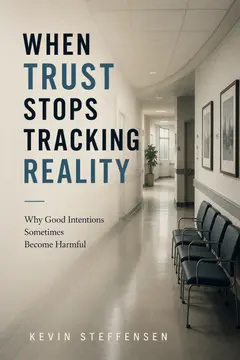
When Trust Stops Tracking Reality
Why Good Intentions Sometimes Become Harmful
How trust drifts from evidence when good intentions stop learning from feedback—through the fictional arc of Calder Family Health and real institutional patterns.
View book

Book
Why Collaboration Is So Hard
And Why the Effort Still Matters
Why joint work fails when incentives, trust, and shared understanding do not line up—and why the effort to collaborate still matters.
View book

Book
The World We Make Together
How Ordinary People, Unequal Power, and Shared Action Shape History
History is collective, but responsibility remains uneven. The World We Make Together follows ordinary objects—a switch, a ballot, a fence, a bowl, a scale—into the institutions and relationships through which people shape public life without becoming either solitary heroes or passive products of structure.
View book