
Nonfiction
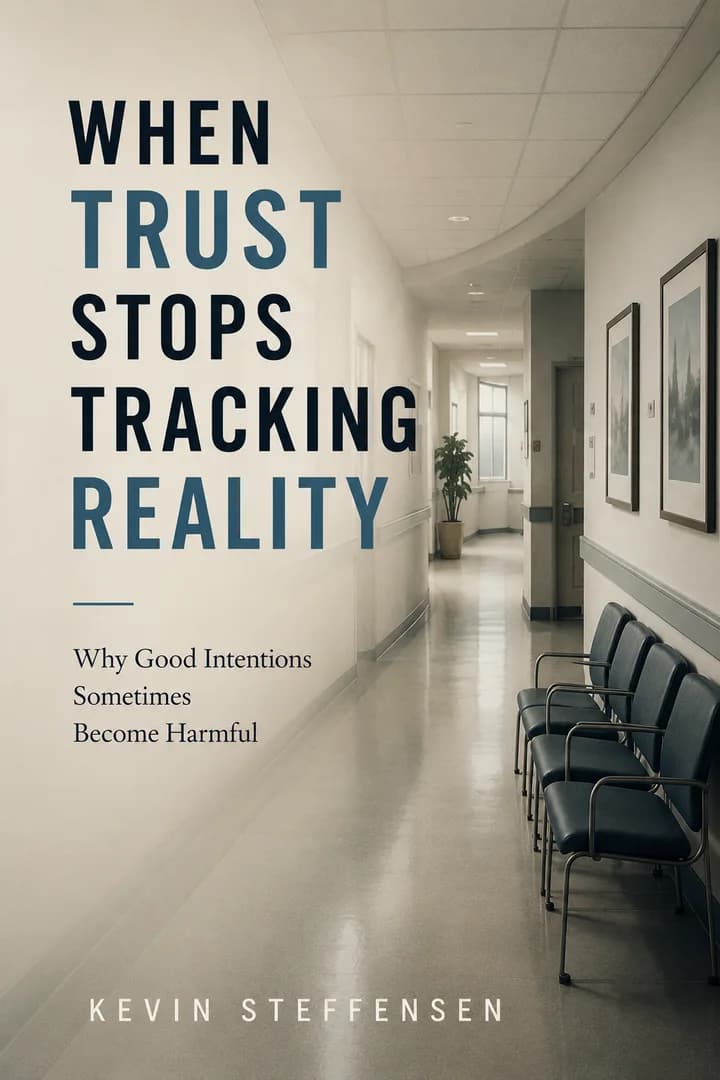
When Trust Stops Tracking Reality
Why Good Intentions Sometimes Become Harmful
By Kevin Steffensen
How trust drifts from evidence when good intentions stop learning from feedback—through the fictional arc of Calder Family Health and real institutional patterns.
How trust drifts from evidence when good intentions stop learning from feedback—through the fictional arc of Calder Family Health and real institutional patterns.
Offered under open publishing terms (CC BY-SA). Download formats are free where available; purchase links support print editions.
- Type
- Nonfiction · monograph
- Author
- Kevin Steffensen
- Published
- 2026
- Chapters
- 15 chapters
- Formats
- EPUB, PDF, DOCX
On these shelves




The question this book explores
How does trust become detached from reality?
Why this book exists
Through Calder Family Health and real institutional patterns, the book shows how trust that once tracked outcomes can stop learning from feedback — until preservation outruns mission.
Who it is for
People inside organizations and communities where good intentions, loyalty, and success stories make weak signals easy to ignore.
What it is not
- It is not a villain story about fraud, deception, or cults as the main case.
- Calder is a lens, not a case study of a real organization.
- It is not an argument for abandoning trust; healthy trust remains correctable.
Central ideas
A curated handful of concepts and patterns this book develops — not the full inventory.
Concept
Trust
Trust names the bridge that lets people act together when no one holds the whole scene. It becomes important when verification must extend beyond firsthand sight—through specialists, records, institutions, or repeated experience. It helps preserve participation across partial perspectives, but can fail when trust stops tracking reality and closure feels safer than checking. It differs from certainty because trust accepts incomplete verification; it differs from blind belief because it still depends on signals that can be tested, strained, or withdrawn.
Trust — open concept pageConcept
Drift
Drift names slow misalignment—meaning drifts as it travels, role compliance replaces discernment, systems continue without admitting conditions have shifted. It becomes important when continuity masks thinning fit and inherited tools coordinate long after they stop persuading. It helps recognize strain before rupture feels sudden, but can fail when drift is mistaken for stability because the machinery still turns. It differs from inheritance because drift emphasizes loss of fit over time; inheritance emphasizes what persists. It differs from normalization because drift is the movement; normalization is drift settling into expected background.
Drift — open concept pageConcept
Feedback
Feedback names how systems stay in contact with their own effects. It becomes important whenever action and consequence are separated by time, scale, or abstraction. It helps preserve learning, correction, and trust in ongoing coordination, but can fail when dashboards stay green while lived harm accumulates off the ledger. It differs from trust because feedback is the returning signal itself; trust is the bridge that lets people act before every signal arrives. It differs from correction because feedback is what returns; correction is the work of updating in response.
Feedback — open concept pageConcept
Legitimacy
Legitimacy names the standing that lets authority coordinate without constant coercion. It becomes important when scale, abstraction, or time separate decision-makers from lived consequence. It helps preserve trust and willing participation, but can fail when smooth operation is mistaken for moral standing or when scrutiny is treated as disloyalty. It differs from alignment because legitimacy still invites proportionate inquiry; alignment can bind through belonging signals alone.
Legitimacy — open concept pageConcept
Momentum
Momentum names continuation after renewed judgment has stopped—when systems, practices, or certainties persist because they once worked and because nothing else yet does. It becomes important when inherited structures keep coordinating even as their fit with current conditions thins, when compliance feels like relief and dependency at once, when nothing in the routine requires conviction—only that the pattern holds. Momentum can preserve stability and continuity when alternatives are genuinely missing, when stopping would break dependencies people cannot afford to lose. But it can also mask thinning fit until saturation feels ordinary, keeping obsolete structures moving long after they have stopped serving the purposes that gave them authority. Momentum is inertia doing coordination work that persuasion no longer does. The question momentum raises is: what keeps moving because stopping would cost too much—not in belief, but in wages, medicine, standing, or schedule? Momentum differs from acceleration in that momentum is passive continuation, while acceleration is active pressure forward. The counterbalance is to distinguish persistence from fitness, to notice strain before open failure arrives, and to recognize why certainty lasted before asking it to leave.
Momentum — open concept pageConcept
Correction
Correction names the lived work of narrowing the gap between what was assumed and what is actually happening. It becomes important whenever systems, beliefs, or coordination can drift while still feeling operational. It helps preserve shared reality and learning, but can fail when every correction spawns new framing instead of updated contact with conditions. It differs from repair because correction updates belief and behavior; repair addresses damaged standing and trust. It differs from revisability because correction is the act; revisability is the designed capacity to keep correcting.
Correction — open concept pagePattern
Scrutiny Preserves Trust
Trust depends on proportionate inquiry, not on insulating admired figures from the questions their power requires. Admiration otherwise protects narratives from revision; legitimacy closes when contradiction arrives. - Inquiry is cast as cynicism - Coherence is prized over contact - Heroes absorb moral weight the system still distributes - Revision threatens belonging Scrutiny keeps legitimacy open without demanding that every admired figure be recast as a villain. A board asks for evidence and tradeoffs in public, not only reassurance about character.
Scrutiny Preserves Trust — open pattern pagePattern
Learning Collapses
Those who decide sit far from where effects show up. News from the ground does not reliably reach them in time. - Size adds distance from impact - Formal reporting filters or delays signals - Bad news is costly to raise - Good news travels easier than bad news They do not get a clear read in time on what their choices are doing. We're steering off summaries again. Learning collapses when the ground story never reaches this room.
Learning Collapses — open pattern pagePattern
Correctness Hardens Into Identity
Correctness begins as a tool for coordination—aligning on evidence, reality, and shared understanding under uncertainty. Under pressure, being right matters less for understanding than for preserving coherence and belonging; revision starts feeling like betrayal. - Disagreement is treated as moral threat - Identity fuses with the winning frame - Revision threatens group coherence - Finality relieves the discomfort of not knowing The danger is not error alone; it is the inability to remain revisable. A team treats a challenged forecast as disloyalty rather than as an update to shared reality.
Correctness Hardens Into Identity — open pattern pagePattern
Admiration Becomes Insulation
Admiration enables trust, imitation, and moral aspiration toward people who seem to carry more than their share of complexity. Heroic narratives stabilize; contradiction becomes hard to absorb without collapsing the story. - Harm is reframed as tradeoff - Context expands selectively around the admired figure - Accountability weakens to preserve narrative coherence - Scrutiny feels like betrayal of belonging The admired person is protected less by trust than by narrative attachment. A leader's harmful call is debated as "what the role required" while proportionate inquiry is treated as disloyalty.
Admiration Becomes Insulation — open pattern page
Inside this book
How the book is organized — parts, chapters, and what each section investigates.
About 41 min of reading across 15 sections in 4 parts.
Part I — Why Trust Exists
4 sections
Part I — Why Trust Exists
4 sectionsPart II — The First Cracks
4 sections
Part II — The First Cracks
4 sectionsShow summaryHide summary
Warning signs arrive as fragments against a success story — complaints, misfires, small shifts — that trust files as exceptions while patience and dismissal still look alike.
Central questionWhy do warning signs become harder to see when trust has been earned?
Part III — Preservation
4 sections
Part III — Preservation
4 sectionsOther sections
3 sections
Other sections
3 sectionsWhere it fits
Suggested reading order and nearby volumes — not a mandatory sequence.
Read before
Continue exploring
- Next book — Trust Beyond Similarity
- Start with a question — How does trust become detached from reality?
Reading trails featuring this book
Editorial paths that include this book as one stop in a longer sequence.
Full related inventoryShowHide
Complete concept, pattern, and thinker lists for readers who want the full semantic map.
Major concepts
Concept
Abstraction
Abstraction is mediation away from direct encounter: compression of complexity as systems scale, valued when it preserves accountability signal at the boundaries where behavior can still be redesigned
View Concept →
Concept
Abstraction
Abstraction is mediation away from direct encounter: compression of complexity as systems scale, valued when it preserves accountability signal at the boundaries where behavior can still be redesigned
Concept
Accountability
Accountability names whether consequence still reaches the people who can respond. It becomes important when scale, narrative, or abstraction thins contact between action and effect. It helps preserve correction and proportionate answerability, but can fail when moral sorting replaces sustained contact with outcomes. It differs from responsibility because accountability emphasizes exposure to consequence; responsibility includes the ongoing obligation to account even when control is partial.
View Concept →
Concept
Accountability
Accountability names whether consequence still reaches the people who can respond. It becomes important when scale, narrative, or abstraction thins contact between action and effect. It helps preserve correction and proportionate answerability, but can fail when moral sorting replaces sustained contact with outcomes. It differs from responsibility because accountability emphasizes exposure to consequence; responsibility includes the ongoing obligation to account even when control is partial.
Concept
Authority
Authority names who can coordinate action when full agreement is impossible. It becomes important whenever groups must move before every perspective aligns. It helps preserve direction and collective capacity, but can fail when operational power outruns justified recognition or visible consequence. It differs from legitimacy because authority is the capacity to steer; legitimacy is whether that capacity reads as earned and revisable enough to coordinate trust rather than performative compliance.
View Concept →
Concept
Authority
Authority names who can coordinate action when full agreement is impossible. It becomes important whenever groups must move before every perspective aligns. It helps preserve direction and collective capacity, but can fail when operational power outruns justified recognition or visible consequence. It differs from legitimacy because authority is the capacity to steer; legitimacy is whether that capacity reads as earned and revisable enough to coordinate trust rather than performative compliance.
Concept
Bureaucracy
Bureaucracy extends permanence into practice—rules replacing discretion, procedures replacing judgment, roles replacing relationships. At industrial scale it functions as moral infrastructure, coordinating strangers through files, stamps, and queues that must still recognize a name long enough for life to continue. Bureaucracy makes expectations visible and portable—the same form, the same stamp, the same queue number tomorrow—so thousands can coordinate without knowing one another's names. The room feels like Tuesday before the first form is stamped; box seven rather than box four determines whether a lease continues. No one feels cruel; no one feels fully responsible either. Bureaucracy coordinates while meaning quietly thins, systems function without anyone tracing harm, and the machinery keeps its appointments whether or not it still fits the lives it was meant to serve.
View Concept →
Concept
Bureaucracy
Bureaucracy extends permanence into practice—rules replacing discretion, procedures replacing judgment, roles replacing relationships. At industrial scale it functions as moral infrastructure, coordinating strangers through files, stamps, and queues that must still recognize a name long enough for life to continue. Bureaucracy makes expectations visible and portable—the same form, the same stamp, the same queue number tomorrow—so thousands can coordinate without knowing one another's names. The room feels like Tuesday before the first form is stamped; box seven rather than box four determines whether a lease continues. No one feels cruel; no one feels fully responsible either. Bureaucracy coordinates while meaning quietly thins, systems function without anyone tracing harm, and the machinery keeps its appointments whether or not it still fits the lives it was meant to serve.
Concept
Coherence Maintenance
The ongoing work required to keep a system governable: enough agreement about who decides, what happened, and what must change next for learning to remain possible. Coherence maintenance becomes expensive as independently evolving boundaries multiply. Systems sometimes pay for it through clear ownership and timely feedback; they sometimes pay through coordination substitutes that preserve throughput while thinning corrective capacity.
View Concept →
Concept
Coherence Maintenance
The ongoing work required to keep a system governable: enough agreement about who decides, what happened, and what must change next for learning to remain possible. Coherence maintenance becomes expensive as independently evolving boundaries multiply. Systems sometimes pay for it through clear ownership and timely feedback; they sometimes pay through coordination substitutes that preserve throughput while thinning corrective capacity.
Concept
Coordination
Coordination names the problem of acting together when lives are fragmented—when people must move collectively across distance, time, strangers, and difference without complete information or full agreement. It becomes important when individual judgment alone cannot sustain the group, when behavior must hold across contexts that no one person can see completely. Coordination helps preserve collective capacity by making expectations predictable, by enabling strangers to act together under shared rules, by allowing large-scale projects that no single person could accomplish. Roles, rituals, law, canon, procedure, and bureaucracy are all coordination technologies—tools for making tomorrow recognizable from yesterday so action can continue. But coordination can become brittle when it suppresses the feedback and variation it needs to stay responsive, when inherited patterns keep moving after fit has thinned, when dissent is treated as disruption rather than signal. Coordination purchased at the cost of revision can continue functioning long after it has stopped serving the purposes that gave it authority. The question coordination raises is: what coordination problem is this tool solving? What breaks if behavior stops being predictable? Coordination differs from alignment in that coordination is about collective movement, while alignment is about shared direction or values.
View Concept →
Concept
Coordination
Coordination names the problem of acting together when lives are fragmented—when people must move collectively across distance, time, strangers, and difference without complete information or full agreement. It becomes important when individual judgment alone cannot sustain the group, when behavior must hold across contexts that no one person can see completely. Coordination helps preserve collective capacity by making expectations predictable, by enabling strangers to act together under shared rules, by allowing large-scale projects that no single person could accomplish. Roles, rituals, law, canon, procedure, and bureaucracy are all coordination technologies—tools for making tomorrow recognizable from yesterday so action can continue. But coordination can become brittle when it suppresses the feedback and variation it needs to stay responsive, when inherited patterns keep moving after fit has thinned, when dissent is treated as disruption rather than signal. Coordination purchased at the cost of revision can continue functioning long after it has stopped serving the purposes that gave it authority. The question coordination raises is: what coordination problem is this tool solving? What breaks if behavior stops being predictable? Coordination differs from alignment in that coordination is about collective movement, while alignment is about shared direction or values.
Concept
Correction
Correction names the lived work of narrowing the gap between what was assumed and what is actually happening. It becomes important whenever systems, beliefs, or coordination can drift while still feeling operational. It helps preserve shared reality and learning, but can fail when every correction spawns new framing instead of updated contact with conditions. It differs from repair because correction updates belief and behavior; repair addresses damaged standing and trust. It differs from revisability because correction is the act; revisability is the designed capacity to keep correcting.
View Concept →
Concept
Correction
Correction names the lived work of narrowing the gap between what was assumed and what is actually happening. It becomes important whenever systems, beliefs, or coordination can drift while still feeling operational. It helps preserve shared reality and learning, but can fail when every correction spawns new framing instead of updated contact with conditions. It differs from repair because correction updates belief and behavior; repair addresses damaged standing and trust. It differs from revisability because correction is the act; revisability is the designed capacity to keep correcting.
Concept
Coupling
Coupling names the strength of the link between what was decided and what later arrives. It becomes important when scale, abstraction, or delay lengthen the chain between decision and lived harm. It helps preserve learning and legitimacy, but can fail when dashboards stay green while frontline frustration grows. It differs from cohesion because coupling tracks action-to-effect attachment; cohesion tracks whether responsibility is clearly held. It differs from consequence-architecture because coupling describes the attachment; consequence-architecture describes intentional design of boundaries, feedback, and escalation.
View Concept →
Concept
Coupling
Coupling names the strength of the link between what was decided and what later arrives. It becomes important when scale, abstraction, or delay lengthen the chain between decision and lived harm. It helps preserve learning and legitimacy, but can fail when dashboards stay green while frontline frustration grows. It differs from cohesion because coupling tracks action-to-effect attachment; cohesion tracks whether responsibility is clearly held. It differs from consequence-architecture because coupling describes the attachment; consequence-architecture describes intentional design of boundaries, feedback, and escalation.
Concept
Distance
Distance names separation between decision and consequence, between action and its effects, between authority and those it governs. It becomes important as coordination extends beyond direct relational encounter—as scale grows and abstraction layers multiply. Distance makes harm harder to trace, feedback slower to arrive, and responsibility harder to locate. It helps coordination reach across space and time, enabling larger and more complex forms of collective action, but it thins the connection between choosers and those who live with the outcomes. As distance opens, action and reflection no longer meet in the same place; decisions travel while bodies receive the consequences; institutions record outcomes in ways that differ from how people experience them. Distance becomes built into the architecture of moral life at scale—not as failure but as structure. The question it raises is: how far does decision travel before consequence is felt? Who can see the full chain between policy and harm? Distance differs from mediation (routing through intermediaries) in that distance is the gap itself, while mediation is what fills or crosses the gap.
View Concept →
Concept
Distance
Distance names separation between decision and consequence, between action and its effects, between authority and those it governs. It becomes important as coordination extends beyond direct relational encounter—as scale grows and abstraction layers multiply. Distance makes harm harder to trace, feedback slower to arrive, and responsibility harder to locate. It helps coordination reach across space and time, enabling larger and more complex forms of collective action, but it thins the connection between choosers and those who live with the outcomes. As distance opens, action and reflection no longer meet in the same place; decisions travel while bodies receive the consequences; institutions record outcomes in ways that differ from how people experience them. Distance becomes built into the architecture of moral life at scale—not as failure but as structure. The question it raises is: how far does decision travel before consequence is felt? Who can see the full chain between policy and harm? Distance differs from mediation (routing through intermediaries) in that distance is the gap itself, while mediation is what fills or crosses the gap.
Concept
Feedback
Feedback names how systems stay in contact with their own effects. It becomes important whenever action and consequence are separated by time, scale, or abstraction. It helps preserve learning, correction, and trust in ongoing coordination, but can fail when dashboards stay green while lived harm accumulates off the ledger. It differs from trust because feedback is the returning signal itself; trust is the bridge that lets people act before every signal arrives. It differs from correction because feedback is what returns; correction is the work of updating in response.
View Concept →
Concept
Feedback
Feedback names how systems stay in contact with their own effects. It becomes important whenever action and consequence are separated by time, scale, or abstraction. It helps preserve learning, correction, and trust in ongoing coordination, but can fail when dashboards stay green while lived harm accumulates off the ledger. It differs from trust because feedback is the returning signal itself; trust is the bridge that lets people act before every signal arrives. It differs from correction because feedback is what returns; correction is the work of updating in response.
Concept
Governance Coupling
The degree to which formal oversight structures preserve real consequence return to decision-capable authority. Governance coupling weakens when signal is filtered, delayed, or politically insulated, even if nominal accountability mechanisms still exist.
View Concept →
Concept
Governance Coupling
The degree to which formal oversight structures preserve real consequence return to decision-capable authority. Governance coupling weakens when signal is filtered, delayed, or politically insulated, even if nominal accountability mechanisms still exist.
Concept
Harm
Harm names where cost lands when influence is exercised—who absorbs it, who is kept in view, and what displacement is treated as acceptable. It marks the lived consequence of action, authority, design, or coordination. The visibility dimension matters—who is harmed in particular, not on average? Can they name it? Can they respond? Does the system register it or treat it as acceptable loss? Harm continues while interpretation expands, briefings make harm legible without smaller, people can still tell when something is doing harm. The question harm raises—is harm unchanged outside while we analyze inside? When does naming harm substitute for reducing it? The failure mode—harm persists while moral work feels complete, delays continue after excellent postmortems, harm becomes statistical at scale. The restoration path—return to particular harms and people, check effects outside the room after briefings, stop when outcomes for people are unchanged, pair analysis with named remedy attempts, accept harm as inevitable without abandoning response.
View Concept →
Concept
Harm
Harm names where cost lands when influence is exercised—who absorbs it, who is kept in view, and what displacement is treated as acceptable. It marks the lived consequence of action, authority, design, or coordination. The visibility dimension matters—who is harmed in particular, not on average? Can they name it? Can they respond? Does the system register it or treat it as acceptable loss? Harm continues while interpretation expands, briefings make harm legible without smaller, people can still tell when something is doing harm. The question harm raises—is harm unchanged outside while we analyze inside? When does naming harm substitute for reducing it? The failure mode—harm persists while moral work feels complete, delays continue after excellent postmortems, harm becomes statistical at scale. The restoration path—return to particular harms and people, check effects outside the room after briefings, stop when outcomes for people are unchanged, pair analysis with named remedy attempts, accept harm as inevitable without abandoning response.
Concept
Interpretation
Interpretation names the ongoing work of deciding what something means enough to coordinate on. It becomes important whenever shared action depends on more than immediate perception—across time, distance, conflict, or institutional scale. It helps preserve continuity between experience and obligation, but can fail when interpretation hardens into category and stops tracking changing conditions. In the authority arc, sacred authority compresses interpretation while writing and law later externalize it so disputes can be settled without shared presence. It differs from private understanding because interpretation must be able to coordinate judgment or contest authority in shared space; it differs from meaning because interpretation is the active reconstruction, not only what gets stabilized.
View Concept →
Concept
Interpretation
Interpretation names the ongoing work of deciding what something means enough to coordinate on. It becomes important whenever shared action depends on more than immediate perception—across time, distance, conflict, or institutional scale. It helps preserve continuity between experience and obligation, but can fail when interpretation hardens into category and stops tracking changing conditions. In the authority arc, sacred authority compresses interpretation while writing and law later externalize it so disputes can be settled without shared presence. It differs from private understanding because interpretation must be able to coordinate judgment or contest authority in shared space; it differs from meaning because interpretation is the active reconstruction, not only what gets stabilized.
Concept
Legibility
Legibility names the degree to which work, contribution, harm, or signal can be perceived and evaluated by those at distance—especially by those who grade, fund, allocate resources, or make promotion decisions. It becomes important because visibility shapes what gets valued, rewarded, and sustained. What becomes legible can be measured, managed, and integrated into formal systems; what remains illegible often goes unrecognized even when it is essential. Legibility helps coordination at scale by making expectations clear, progress trackable, and accountability visible. But uneven legibility is not the same as uneven value; legibility is a visibility structure, not a measure of worth. Legibility becomes dangerous when it substitutes for trust rather than serving it, when dashboards calm funders while field coordination narrows, when metrics answer anxiety rather than shared questions, when legibility demands consume the work they were meant to track. The question legibility raises is: is legibility serving trust or substituting for it? What work becomes invisible when only counted activity feels real?
View Concept →
Concept
Legibility
Legibility names the degree to which work, contribution, harm, or signal can be perceived and evaluated by those at distance—especially by those who grade, fund, allocate resources, or make promotion decisions. It becomes important because visibility shapes what gets valued, rewarded, and sustained. What becomes legible can be measured, managed, and integrated into formal systems; what remains illegible often goes unrecognized even when it is essential. Legibility helps coordination at scale by making expectations clear, progress trackable, and accountability visible. But uneven legibility is not the same as uneven value; legibility is a visibility structure, not a measure of worth. Legibility becomes dangerous when it substitutes for trust rather than serving it, when dashboards calm funders while field coordination narrows, when metrics answer anxiety rather than shared questions, when legibility demands consume the work they were meant to track. The question legibility raises is: is legibility serving trust or substituting for it? What work becomes invisible when only counted activity feels real?
Concept
Legitimacy
Legitimacy names the standing that lets authority coordinate without constant coercion. It becomes important when scale, abstraction, or time separate decision-makers from lived consequence. It helps preserve trust and willing participation, but can fail when smooth operation is mistaken for moral standing or when scrutiny is treated as disloyalty. It differs from alignment because legitimacy still invites proportionate inquiry; alignment can bind through belonging signals alone.
View Concept →
Concept
Legitimacy
Legitimacy names the standing that lets authority coordinate without constant coercion. It becomes important when scale, abstraction, or time separate decision-makers from lived consequence. It helps preserve trust and willing participation, but can fail when smooth operation is mistaken for moral standing or when scrutiny is treated as disloyalty. It differs from alignment because legitimacy still invites proportionate inquiry; alignment can bind through belonging signals alone.
Concept
Meaning
Meaning names what must remain recognizable for life together to continue. It becomes important whenever coordination outruns immediate shared presence. It helps preserve continuity across time, distance, and conflict, but can fail when inherited meaning outlives the conditions that once made it workable. In Before Certainty Arrives, meaning is what moral systems stabilize once coordination survives constraint; writing preserves meaning when oral tradition fractures at scale. In How Meaning Moves, meaning is also what people reconstruct through contact, completion, and the movement of language under pressure. It differs from interpretation because meaning is what gets held steady; interpretation is the active work of reconstruction.
View Concept →
Concept
Meaning
Meaning names what must remain recognizable for life together to continue. It becomes important whenever coordination outruns immediate shared presence. It helps preserve continuity across time, distance, and conflict, but can fail when inherited meaning outlives the conditions that once made it workable. In Before Certainty Arrives, meaning is what moral systems stabilize once coordination survives constraint; writing preserves meaning when oral tradition fractures at scale. In How Meaning Moves, meaning is also what people reconstruct through contact, completion, and the movement of language under pressure. It differs from interpretation because meaning is what gets held steady; interpretation is the active work of reconstruction.
Concept
Reciprocity
Reciprocity names mutual exposure, obligation, and constraint made visible—the condition where both sides remain reachable by consequence and answerable to shared expectations. It becomes important when trust depends not only on rules but on mutual vulnerability, when accountability works through shared exposure rather than only through enforcement. Reciprocity helps preserve relationality and answerability in coordination; it makes obligation concrete and visible rather than abstract. When obligations are reciprocal, personal, and explicit, deviation threatens the relationship itself, not merely a principle. Trust is stronger when both parties can see and feel what happens if expectations break. But reciprocity thins as scale grows and abstraction replaces relationships—as categories replace persons, as responsibility shifts from mutual constraint to role compliance, as power travels beyond the reach of mutual consequence. Asymmetry grows when obligation flows only one way, when those who decide are insulated from the effects of their decisions. The question reciprocity raises is: who still shares exposure if this arrangement fails? Where has reciprocity thinned into one-way compliance? Reciprocity differs from accountability in that reciprocity is mutual, while accountability can be unidirectional.
View Concept →
Concept
Reciprocity
Reciprocity names mutual exposure, obligation, and constraint made visible—the condition where both sides remain reachable by consequence and answerable to shared expectations. It becomes important when trust depends not only on rules but on mutual vulnerability, when accountability works through shared exposure rather than only through enforcement. Reciprocity helps preserve relationality and answerability in coordination; it makes obligation concrete and visible rather than abstract. When obligations are reciprocal, personal, and explicit, deviation threatens the relationship itself, not merely a principle. Trust is stronger when both parties can see and feel what happens if expectations break. But reciprocity thins as scale grows and abstraction replaces relationships—as categories replace persons, as responsibility shifts from mutual constraint to role compliance, as power travels beyond the reach of mutual consequence. Asymmetry grows when obligation flows only one way, when those who decide are insulated from the effects of their decisions. The question reciprocity raises is: who still shares exposure if this arrangement fails? Where has reciprocity thinned into one-way compliance? Reciprocity differs from accountability in that reciprocity is mutual, while accountability can be unidirectional.
Concept
Responsibility
Responsibility names what continues after action—the obligation to remain responsive to what one's choices set in motion. It becomes important when systems scale beyond any one person's control but moral weight still accumulates. It helps preserve sustained answerability, but can fail when responsibility collapses into futility or when symbolic gestures replace contact with effects. It differs from accountability because responsibility names the enduring relation; accountability names whether consequence still reaches those who can respond.
View Concept →
Concept
Responsibility
Responsibility names what continues after action—the obligation to remain responsive to what one's choices set in motion. It becomes important when systems scale beyond any one person's control but moral weight still accumulates. It helps preserve sustained answerability, but can fail when responsibility collapses into futility or when symbolic gestures replace contact with effects. It differs from accountability because responsibility names the enduring relation; accountability names whether consequence still reaches those who can respond.
Concept
Thinking
Thinking names reflective interpretation, explanation, and deliberation made possible by enough stability, time, and distance from immediate constraint. It becomes important when coordination is secure enough that action can be accompanied by—or followed by—reflection on why, not only what. Thinking is not detached from action; it is a way of slowing response enough for judgment to form, for alternatives to be considered, for consequences to be imagined before they arrive. It helps preserve discernment, learning, and moral reasoning, but it requires conditions: distance from urgent threat, cognitive and social surplus, shared language for deliberation, and enough stability that questioning does not destabilize survival itself. Under severe pressure, coordinated action may precede explanation—people act together before they renegotiate why, and meaning accumulates later, if at all. Roles can precede reasons when constraint is visible; practices can work before they are explained; certainty can coordinate when explanation is too slow for the problem at hand. Thinking thins when scale or urgency removes the conditions it requires—when no one can trace harm, when managed doubt persists far from those who wait, when compliance replaces judgment because discernment has become too costly. The question thinking raises is: what must hold before there is time to think? Where is thinking a capacity scale has not yet removed? The counterbalance is to notice coordination before explanation without calling early arrangements irrational, to recognize thinking as conditioned by structure rather than absent by nature, and to ask what held long enough to live before asking what is true.
View Concept →
Concept
Thinking
Thinking names reflective interpretation, explanation, and deliberation made possible by enough stability, time, and distance from immediate constraint. It becomes important when coordination is secure enough that action can be accompanied by—or followed by—reflection on why, not only what. Thinking is not detached from action; it is a way of slowing response enough for judgment to form, for alternatives to be considered, for consequences to be imagined before they arrive. It helps preserve discernment, learning, and moral reasoning, but it requires conditions: distance from urgent threat, cognitive and social surplus, shared language for deliberation, and enough stability that questioning does not destabilize survival itself. Under severe pressure, coordinated action may precede explanation—people act together before they renegotiate why, and meaning accumulates later, if at all. Roles can precede reasons when constraint is visible; practices can work before they are explained; certainty can coordinate when explanation is too slow for the problem at hand. Thinking thins when scale or urgency removes the conditions it requires—when no one can trace harm, when managed doubt persists far from those who wait, when compliance replaces judgment because discernment has become too costly. The question thinking raises is: what must hold before there is time to think? Where is thinking a capacity scale has not yet removed? The counterbalance is to notice coordination before explanation without calling early arrangements irrational, to recognize thinking as conditioned by structure rather than absent by nature, and to ask what held long enough to live before asking what is true.
Concept
Trust
Trust names the bridge that lets people act together when no one holds the whole scene. It becomes important when verification must extend beyond firsthand sight—through specialists, records, institutions, or repeated experience. It helps preserve participation across partial perspectives, but can fail when trust stops tracking reality and closure feels safer than checking. It differs from certainty because trust accepts incomplete verification; it differs from blind belief because it still depends on signals that can be tested, strained, or withdrawn.
View Concept →
Concept
Trust
Trust names the bridge that lets people act together when no one holds the whole scene. It becomes important when verification must extend beyond firsthand sight—through specialists, records, institutions, or repeated experience. It helps preserve participation across partial perspectives, but can fail when trust stops tracking reality and closure feels safer than checking. It differs from certainty because trust accepts incomplete verification; it differs from blind belief because it still depends on signals that can be tested, strained, or withdrawn.
Concept
Uncertainty
Uncertainty names the condition moral and social systems are built to navigate—the space where coordination must happen before truth is settled, where lives are fragmented and behavior must hold together under incomplete information. It becomes important because human action cannot wait for perfect knowledge; groups must decide, move, and coordinate even when the future is unclear, when disagreement is costly, when explanation cannot travel fast enough to settle disputes before consequences arrive. Uncertainty is not a problem to eliminate but a condition to navigate—the ground on which moral life operates. Certainty emerges as an adaptive response to uncertainty, compressing ambiguity into stable expectations so action can proceed. But uncertainty itself is neither failure nor freedom; it is the default state that requires coordination tools. The After Certainty project explores how to practice judgment, accountability, and responsiveness inside uncertainty rather than demanding that uncertainty be resolved before moral life can begin. The question uncertainty raises is: what uncertainty is this system trying to reduce? Is ambiguity dangerous because the stakes are genuinely high, or because failure now scales? Uncertainty differs from ignorance in that uncertainty is about incomplete information in contexts requiring action, while ignorance is simply lack of knowledge.
View Concept →
Concept
Uncertainty
Uncertainty names the condition moral and social systems are built to navigate—the space where coordination must happen before truth is settled, where lives are fragmented and behavior must hold together under incomplete information. It becomes important because human action cannot wait for perfect knowledge; groups must decide, move, and coordinate even when the future is unclear, when disagreement is costly, when explanation cannot travel fast enough to settle disputes before consequences arrive. Uncertainty is not a problem to eliminate but a condition to navigate—the ground on which moral life operates. Certainty emerges as an adaptive response to uncertainty, compressing ambiguity into stable expectations so action can proceed. But uncertainty itself is neither failure nor freedom; it is the default state that requires coordination tools. The After Certainty project explores how to practice judgment, accountability, and responsiveness inside uncertainty rather than demanding that uncertainty be resolved before moral life can begin. The question uncertainty raises is: what uncertainty is this system trying to reduce? Is ambiguity dangerous because the stakes are genuinely high, or because failure now scales? Uncertainty differs from ignorance in that uncertainty is about incomplete information in contexts requiring action, while ignorance is simply lack of knowledge.
Major patterns
Supporting · Corrective
Bad News Reaches Power
Hierarchy, success, identity, fear, and incentives filter bad news as it moves upward. - Correction requires uncomfortable evidence - Hierarchy filters what reaches authority Systems learn and correct only when uncomfortable evidence can reach people with the authority and capacity to act.
View Pattern →
Supporting · Corrective
Bad News Reaches Power
Hierarchy, success, identity, fear, and incentives filter bad news as it moves upward. - Correction requires uncomfortable evidence - Hierarchy filters what reaches authority Systems learn and correct only when uncomfortable evidence can reach people with the authority and capacity to act.
Supporting · Obscuring
Structures Outlive Reasons
People inherit structures more readily than they inherit the reasons those structures were created. - Structures travel more easily than reasons - Changed conditions do not automatically retire old forms Rules, roles, institutions, workarounds, and routines often persist after the conditions that originally justified them have changed or disappeared.
View Pattern →
Supporting · Obscuring
Structures Outlive Reasons
People inherit structures more readily than they inherit the reasons those structures were created. - Structures travel more easily than reasons - Changed conditions do not automatically retire old forms Rules, roles, institutions, workarounds, and routines often persist after the conditions that originally justified them have changed or disappeared.
Related songs
Major thinkers
Person
Diane Vaughan
Sociologist of the Challenger disaster and normalization of deviance—how risky practices become routine.
View Thinker →
Person
Diane Vaughan
Sociologist of the Challenger disaster and normalization of deviance—how risky practices become routine.
Person
Elinor Ostrom
Nobel laureate in economics; commons governance, institutional design beyond markets and states.
View Thinker →
Person
Elinor Ostrom
Nobel laureate in economics; commons governance, institutional design beyond markets and states.
Person
Eric S Raymond
Software essayist on open-source culture, hacker ethics, and distributed collaboration in code communities.
View Thinker →
Person
Eric S Raymond
Software essayist on open-source culture, hacker ethics, and distributed collaboration in code communities.
Organization
Freeh, Sporkin, & Sullivan LLC
Law firm that produced investigative reports for universities and institutions, including the Penn State special counsel report.
View Thinker →
Organization
Freeh, Sporkin, & Sullivan LLC
Law firm that produced investigative reports for universities and institutions, including the Penn State special counsel report.
Person
James C Scott
Political scientist of state simplification, legibility, and how high-modernist schemes misfire on local knowledge.
View Thinker →
Person
James C Scott
Political scientist of state simplification, legibility, and how high-modernist schemes misfire on local knowledge.
Person
James N. Druckman
Political scientist studying persuasion, misinformation, and how public opinion forms under contested information environments.
View Thinker →
Person
James N. Druckman
Political scientist studying persuasion, misinformation, and how public opinion forms under contested information environments.
Person
James Reason
Safety scientist whose work on human error, organizational accidents, and resilient systems shaped modern safety thinking.
View Thinker →
Person
James Reason
Safety scientist whose work on human error, organizational accidents, and resilient systems shaped modern safety thinking.
Person
John Carreyrou
Investigative journalist who exposed the Theranos fraud in Bad Blood.
View Thinker →
Person
John Carreyrou
Investigative journalist who exposed the Theranos fraud in Bad Blood.
Person
John Dewey
Pragmatist philosopher of inquiry, democracy, and education whose work links experience, habit, and public problem-solving.
View Thinker →
Person
John Dewey
Pragmatist philosopher of inquiry, democracy, and education whose work links experience, habit, and public problem-solving.
Person
Karen M. Douglas
Social psychologist studying conspiracy theories, rumor, and motivated belief in online and offline communities.
View Thinker →
Person
Karen M. Douglas
Social psychologist studying conspiracy theories, rumor, and motivated belief in online and offline communities.
Person
Karl E Weick
Organizational theorist of sensemaking—how people enact and retrospectively rationalize meaning under ambiguity.
View Thinker →
Person
Karl E Weick
Organizational theorist of sensemaking—how people enact and retrospectively rationalize meaning under ambiguity.
Person
Max Weber
Sociologist of bureaucracy, authority types, rationalization, and the iron cage of modern institutions.
View Thinker →
Person
Max Weber
Sociologist of bureaucracy, authority types, rationalization, and the iron cage of modern institutions.
Person
Miranda Fricker
Philosopher of epistemic injustice—testimonial and hermeneutical wrongs that distort who gets heard and what can be named.
View Thinker →
Person
Miranda Fricker
Philosopher of epistemic injustice—testimonial and hermeneutical wrongs that distort who gets heard and what can be named.
Person
Niklas Luhmann
Systems theorist of autopoietic social systems, communication, and functional differentiation.
View Thinker →
Person
Niklas Luhmann
Systems theorist of autopoietic social systems, communication, and functional differentiation.
Person
Onora O'Neill
Philosopher of trust, accountability, and intelligent transparency in public institutions and professional ethics.
View Thinker →
Person
Onora O'Neill
Philosopher of trust, accountability, and intelligent transparency in public institutions and professional ethics.
Person
Peter Grady
Journalist and author on the Boeing 737 MAX disasters and institutional failure in aviation safety culture.
View Thinker →
Person
Peter Grady
Journalist and author on the Boeing 737 MAX disasters and institutional failure in aviation safety culture.
Person
Peter J. Vander Nat
Philosophers analyzing infinite regresses, justification, and foundational problems in knowledge claims.
View Thinker →
Person
Peter J. Vander Nat
Philosophers analyzing infinite regresses, justification, and foundational problems in knowledge claims.
Person
Reeves Wiedeman
Journalist and author on WeWork, Adam Neumann, and the mythology of venture-scale startup culture.
View Thinker →
Person
Reeves Wiedeman
Journalist and author on WeWork, Adam Neumann, and the mythology of venture-scale startup culture.
Person
Robert E Cole
Sociologist of quality movements, Japanese manufacturing culture, and institutional learning in production systems.
View Thinker →
Person
Robert E Cole
Sociologist of quality movements, Japanese manufacturing culture, and institutional learning in production systems.
Person
Robert K Merton
Sociologist of unintended consequences, bureaucracy, and the normative structure of science.
View Thinker →
Person
Robert K Merton
Sociologist of unintended consequences, bureaucracy, and the normative structure of science.
Person
Roger Lowenstein
Financial journalist chronicling market hubris, Long-Term Capital Management, and when expertise confuses itself with control.
View Thinker →
Person
Roger Lowenstein
Financial journalist chronicling market hubris, Long-Term Capital Management, and when expertise confuses itself with control.
Person
Susan Raine
Scholar studying NXIVM and how high-control groups promise reinvention while extracting loyalty and secrecy.
View Thinker →
Person
Susan Raine
Scholar studying NXIVM and how high-control groups promise reinvention while extracting loyalty and secrecy.
Person
Walter Isaacson
Biographer and historian of innovation ecosystems—how networks, institutions, and personalities shape discovery.
View Thinker →
Person
Walter Isaacson
Biographer and historian of innovation ecosystems—how networks, institutions, and personalities shape discovery.
Person
William W. Keep
Philosophers analyzing infinite regresses, justification, and foundational problems in knowledge claims.
View Thinker →
Person
William W. Keep
Philosophers analyzing infinite regresses, justification, and foundational problems in knowledge claims.
Research sources
book
Bad Blood: Secrets and Lies in a Silicon Valley Startup
Carreyrou, John. Bad Blood: Secrets and Lies in a Silicon Valley Startup. New York: Knopf, 2018.
View Source →
book
Bad Blood: Secrets and Lies in a Silicon Valley Startup
Carreyrou, John. Bad Blood: Secrets and Lies in a Silicon Valley Startup. New York: Knopf, 2018.
article
What Really Happened to Toyota?
Cole, Robert E. "What Really Happened to Toyota?" MIT Sloan Management Review 52, no. 4 (2011): 29–35.
View Source →
article
What Really Happened to Toyota?
Cole, Robert E. "What Really Happened to Toyota?" MIT Sloan Management Review 52, no. 4 (2011): 29–35.
book
Experience and Education
Dewey, John. Experience and Education. New York: Macmillan, 1938.
View Source →
book
Experience and Education
Dewey, John. Experience and Education. New York: Macmillan, 1938.
article
Understanding Conspiracy Theories.
Douglas, Karen M., et al. "Understanding Conspiracy Theories." In Political Psychology 40, suppl. 1 (2019): 3–35.
View Source →
article
Understanding Conspiracy Theories.
Douglas, Karen M., et al. "Understanding Conspiracy Theories." In Political Psychology 40, suppl. 1 (2019): 3–35.
article
A Framework for the Study of Misinformation and Health.
Druckman, James N., et al. "A Framework for the Study of Misinformation and Health." Annual Review of Public Health 44 (2023): 373–394.
View Source →
article
A Framework for the Study of Misinformation and Health.
Druckman, James N., et al. "A Framework for the Study of Misinformation and Health." Annual Review of Public Health 44 (2023): 373–394.
book
Report of the Special Investigative Counsel Regarding the Actions of the Pennsylvania State University Related to the Child Sexual Abuse Committed by Gerald A. Sandusky
Freeh, Sporkin, & Sullivan LLC. Report of the Special Investigative Counsel Regarding the Actions of the Pennsylvania State University Related to the Child Sexual Abuse Committed by Gerald A. Sandusky. July 12, 2012.
View Source →
book
Report of the Special Investigative Counsel Regarding the Actions of the Pennsylvania State University Related to the Child Sexual Abuse Committed by Gerald A. Sandusky
Freeh, Sporkin, & Sullivan LLC. Report of the Special Investigative Counsel Regarding the Actions of the Pennsylvania State University Related to the Child Sexual Abuse Committed by Gerald A. Sandusky. July 12, 2012.
book
Epistemic Injustice: Power and the Ethics of Knowing
Fricker, Miranda. Epistemic Injustice: Power and the Ethics of Knowing. Oxford: Oxford University Press, 2007.
View Source →
book
Epistemic Injustice: Power and the Ethics of Knowing
Fricker, Miranda. Epistemic Injustice: Power and the Ethics of Knowing. Oxford: Oxford University Press, 2007.
book
Flying Blind: The 737 MAX Tragedy and the Fall of Boeing
Grady, Peter. Flying Blind: The 737 MAX Tragedy and the Fall of Boeing. New York: Anchor Books, 2022.
View Source →
book
Flying Blind: The 737 MAX Tragedy and the Fall of Boeing
Grady, Peter. Flying Blind: The 737 MAX Tragedy and the Fall of Boeing. New York: Anchor Books, 2022.
book
Steve Jobs
Isaacson, Walter. Steve Jobs. New York: Simon & Schuster, 2011.
View Source →
book
Steve Jobs
Isaacson, Walter. Steve Jobs. New York: Simon & Schuster, 2011.
article
Multilevel Marketing and Pyramid Schemes in the United States: An Historical Analysis.
Keep, William W., and Peter J. Vander Nat. "Multilevel Marketing and Pyramid Schemes in the United States: An Historical Analysis." Journal of Historical Research in Marketing 6, no. 2 (2014): 188–210.
View Source →
article
Multilevel Marketing and Pyramid Schemes in the United States: An Historical Analysis.
Keep, William W., and Peter J. Vander Nat. "Multilevel Marketing and Pyramid Schemes in the United States: An Historical Analysis." Journal of Historical Research in Marketing 6, no. 2 (2014): 188–210.
book
Buffett: The Making of an American Capitalist
Lowenstein, Roger. Buffett: The Making of an American Capitalist. New York: Random House, 1995.
View Source →
book
Buffett: The Making of an American Capitalist
Lowenstein, Roger. Buffett: The Making of an American Capitalist. New York: Random House, 1995.
book
Trust and Power: Two Works
Luhmann, Niklas. Trust and Power: Two Works. Translated by Howard Davis, John Raffan, and Kathryn Rooney. Chichester, UK: John Wiley & Sons, 1979.
View Source →
book
Trust and Power: Two Works
Luhmann, Niklas. Trust and Power: Two Works. Translated by Howard Davis, John Raffan, and Kathryn Rooney. Chichester, UK: John Wiley & Sons, 1979.
article
The Normative Structure of Science.
Merton, Robert K. "The Normative Structure of Science." In The Sociology of Science, edited by Norman W. Storer, 267–278. Chicago: University of Chicago Press, 1973. First published 1942.
View Source →
article
The Normative Structure of Science.
Merton, Robert K. "The Normative Structure of Science." In The Sociology of Science, edited by Norman W. Storer, 267–278. Chicago: University of Chicago Press, 1973. First published 1942.
book
A Question of Trust
O'Neill, Onora. A Question of Trust. Cambridge: Cambridge University Press, 2002.
View Source →
book
A Question of Trust
O'Neill, Onora. A Question of Trust. Cambridge: Cambridge University Press, 2002.
book
Governing the Commons: The Evolution of Institutions for Collective Action
Ostrom, Elinor. Governing the Commons: The Evolution of Institutions for Collective Action. Cambridge: Cambridge University Press, 1990.
View Source →
book
Governing the Commons: The Evolution of Institutions for Collective Action
Ostrom, Elinor. Governing the Commons: The Evolution of Institutions for Collective Action. Cambridge: Cambridge University Press, 1990.
article
Reinventing the self: NXIVM's promises, secrets, and lies.
Raine, Susan. "Reinventing the self: NXIVM's promises, secrets, and lies." International Journal for the Study of New Religions 2 (2021). DOI: 10.54208/0002/005.
View Source →
article
Reinventing the self: NXIVM's promises, secrets, and lies.
Raine, Susan. "Reinventing the self: NXIVM's promises, secrets, and lies." International Journal for the Study of New Religions 2 (2021). DOI: 10.54208/0002/005.
book
The Cathedral and the Bazaar: Musings on Linux and Open Source by an Accidental Revolutionary
Raymond, Eric S. The Cathedral and the Bazaar: Musings on Linux and Open Source by an Accidental Revolutionary. Rev. ed. Sebastopol, CA: O'Reilly Media, 2001.
View Source →
book
The Cathedral and the Bazaar: Musings on Linux and Open Source by an Accidental Revolutionary
Raymond, Eric S. The Cathedral and the Bazaar: Musings on Linux and Open Source by an Accidental Revolutionary. Rev. ed. Sebastopol, CA: O'Reilly Media, 2001.
book
Managing the Risks of Organizational Accidents
Reason, James. Managing the Risks of Organizational Accidents. Aldershot, UK: Ashgate, 1997.
View Source →
book
Managing the Risks of Organizational Accidents
Reason, James. Managing the Risks of Organizational Accidents. Aldershot, UK: Ashgate, 1997.
book
Seeing Like a State: How Certain Schemes to Improve the Human Condition Have Failed
Scott, James C. Seeing Like a State: How Certain Schemes to Improve the Human Condition Have Failed. New Haven, CT: Yale University Press, 1998.
View Source →
book
Seeing Like a State: How Certain Schemes to Improve the Human Condition Have Failed
Scott, James C. Seeing Like a State: How Certain Schemes to Improve the Human Condition Have Failed. New Haven, CT: Yale University Press, 1998.
book
The Challenger Launch Decision: Risky Technology, Culture, and Deviance at NASA
Vaughan, Diane. The Challenger Launch Decision: Risky Technology, Culture, and Deviance at NASA. Chicago: University of Chicago Press, 1996.
View Source →
book
The Challenger Launch Decision: Risky Technology, Culture, and Deviance at NASA
Vaughan, Diane. The Challenger Launch Decision: Risky Technology, Culture, and Deviance at NASA. Chicago: University of Chicago Press, 1996.
book
Economy and Society: An Outline of Interpretive Sociology
Weber, Max. Economy and Society: An Outline of Interpretive Sociology. Vol. 1. Edited by Guenther Roth and Claus Wittich. Berkeley: University of California Press, 1978.
View Source →
book
Economy and Society: An Outline of Interpretive Sociology
Weber, Max. Economy and Society: An Outline of Interpretive Sociology. Vol. 1. Edited by Guenther Roth and Claus Wittich. Berkeley: University of California Press, 1978.
book
Sensemaking in Organizations
Weick, Karl E. Sensemaking in Organizations. Foundations for Organizational Science. Thousand Oaks, CA: Sage, 1995.
View Source →
book
Sensemaking in Organizations
Weick, Karl E. Sensemaking in Organizations. Foundations for Organizational Science. Thousand Oaks, CA: Sage, 1995.
book
The Cult of We: WeWork, Adam Neumann, and the Great Startup Delusion
Wiedeman, Reeves. The Cult of We: WeWork, Adam Neumann, and the Great Startup Delusion. New York: Little, Brown, 2021.
View Source →
book
The Cult of We: WeWork, Adam Neumann, and the Great Startup Delusion
Wiedeman, Reeves. The Cult of We: WeWork, Adam Neumann, and the Great Startup Delusion. New York: Little, Brown, 2021.