
Nonfiction
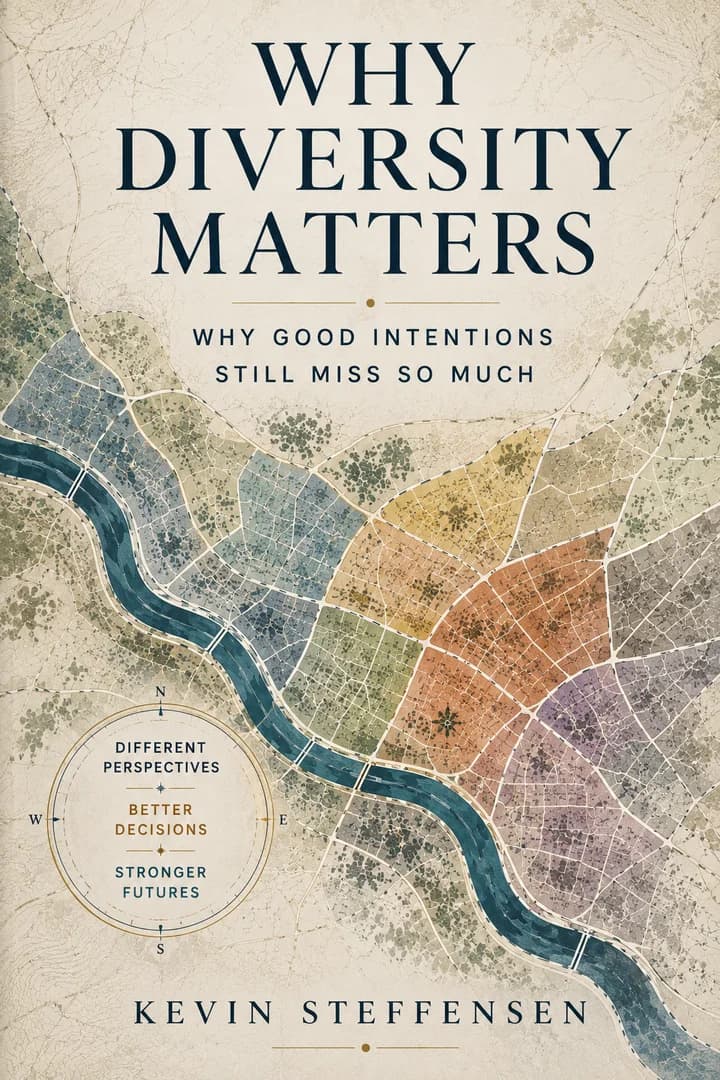
Why Diversity Matters
Why Good Intentions Still Miss So Much
By Kevin Steffensen
Why diversity is about what gets noticed, trusted, and ignored—not just who is in the room.
Why diversity is about what gets noticed, trusted, and ignored—not just who is in the room.
Offered under open publishing terms (CC BY-SA). Download formats are free where available; purchase links support print editions.
- Type
- Nonfiction · monograph
- Author
- Kevin Steffensen
- Published
- 2026
- Chapters
- 16 chapters
- Formats
- EPUB, PDF, DOCX
On these shelves


The question this book explores
Why do good intentions still miss so much — and what does diversity have to do with discovering blind spots?
Why this book exists
Diversity is treated here as a visibility and learning problem, not only representation. The book follows why groups miss what everyone agrees about, why inclusion is not influence, and how difference can surface mistakes earlier.
Who it is for
People who work, govern, or live across difference and keep discovering that sincerity does not guarantee seeing — including readers arriving from perspective and trust books.
What it is not
- It is not a hiring guide, policy proposal, or claim that every perspective is equally correct.
- It does not attempt to speak on behalf of anyone.
- It does not reduce diversity to representation alone while denying fairness and opportunity matter.
Central ideas
A curated handful of concepts and patterns this book develops — not the full inventory.
Concept
Bias
Bias names the architecture of partial sight. It becomes important whenever perception, memory, attention, or institutional counting must choose what to include. It helps perception function by narrowing the field enough to act, but can fail when partial sight is mistaken for neutral or complete sight. The same mechanism is called focus when approved and bias when distrusted. It differs from finite perspective because bias names the selective work inside a vantage point; it differs from integration because bias describes what each partial view leaves out, not how partial views combine. In this project, bias connects to judgment, trust, and the structural question of what a person, group, model, or institution is not positioned to see.
Bias — open concept pageConcept
Finite perspective
Finite perspective names the condition under which all sight in this project begins. It becomes important whenever someone speaks as if their view were complete, neutral, or uninfluenced by position. It helps preserve humility, integration, and honest disagreement, but can fail when partial sight is treated as moral failure or when institutions demand omniscience from individuals. It differs from bias because finite perspective names the structural condition of partiality; bias names the selective work performed within it. It differs from trust because trust extends action beyond firsthand sight without pretending the extension erases partiality.
Finite perspective — open concept pageConcept
Legibility
Legibility names the degree to which work, contribution, harm, or signal can be perceived and evaluated by those at distance—especially by those who grade, fund, allocate resources, or make promotion decisions. It becomes important because visibility shapes what gets valued, rewarded, and sustained. What becomes legible can be measured, managed, and integrated into formal systems; what remains illegible often goes unrecognized even when it is essential. Legibility helps coordination at scale by making expectations clear, progress trackable, and accountability visible. But uneven legibility is not the same as uneven value; legibility is a visibility structure, not a measure of worth. Legibility becomes dangerous when it substitutes for trust rather than serving it, when dashboards calm funders while field coordination narrows, when metrics answer anxiety rather than shared questions, when legibility demands consume the work they were meant to track. The question legibility raises is: is legibility serving trust or substituting for it? What work becomes invisible when only counted activity feels real?
Legibility — open concept pageConcept
Contestability
Contestability names the condition where dispute can reopen without threatening shared coherence—where challenge does not mean collapse. It becomes important when legitimacy depends on more than coercion, when correction and revision matter for trust and adaptation. It helps preserve the capacity to learn from reality and adjust to changed conditions, but it thins when authority relocates legitimacy beyond ordinary revision—when sacred framing, canon, or procedure makes questioning feel dangerous. Contestability depends on whether revision feels survivable or indistinguishable from rupture. When small groups operate under mutual visibility, authority can be argued for even after it is obeyed. But under pressure—breakdown, threat, or instability—dissent begins to read as moral failure rather than political disagreement, and the range of acceptable interpretation narrows. Contestability thins while inherited certainty still coordinates; systems can run on compliance long after persuasion fades. It marks the moment just before certainty becomes difficult to question at all.
Contestability — open concept pageConcept
Feedback
Feedback names how systems stay in contact with their own effects. It becomes important whenever action and consequence are separated by time, scale, or abstraction. It helps preserve learning, correction, and trust in ongoing coordination, but can fail when dashboards stay green while lived harm accumulates off the ledger. It differs from trust because feedback is the returning signal itself; trust is the bridge that lets people act before every signal arrives. It differs from correction because feedback is what returns; correction is the work of updating in response.
Feedback — open concept pageConcept
Correction
Correction names the lived work of narrowing the gap between what was assumed and what is actually happening. It becomes important whenever systems, beliefs, or coordination can drift while still feeling operational. It helps preserve shared reality and learning, but can fail when every correction spawns new framing instead of updated contact with conditions. It differs from repair because correction updates belief and behavior; repair addresses damaged standing and trust. It differs from revisability because correction is the act; revisability is the designed capacity to keep correcting.
Correction — open concept pagePattern
Learning Collapses
Those who decide sit far from where effects show up. News from the ground does not reliably reach them in time. - Size adds distance from impact - Formal reporting filters or delays signals - Bad news is costly to raise - Good news travels easier than bad news They do not get a clear read in time on what their choices are doing. We're steering off summaries again. Learning collapses when the ground story never reaches this room.
Learning Collapses — open pattern pagePattern
Gaps Invite Completion
An exchange contains ambiguity, omitted detail, or unresolved tension. Open meaning is hard to sustain under practical or emotional pressure. - Uncertainty creates interpretive discomfort - Fast social coordination rewards quick closure - Memory and expectation supply plausible filler Missing meaning rarely stays open for long. Because gaps invite completion, the mind usually supplies missing meaning before the speaker does.
Gaps Invite Completion — open pattern pagePattern
Contact Keeps the Read Open
People return to a difficult exchange with more context and lower reactivity. Early interpretation may be useful but still too rough. - Additional context widens what people can see - Lower emotional charge improves tolerance for ambiguity - Restraint keeps meaning revisable Additional context can sharpen understanding without fully resolving it. Contact keeps the read open when understanding tightens without the story having to close.
Contact Keeps the Read Open — open pattern pagePattern
Attention Restores Contact
Scale and abstraction pull moral life away from particular harms, people, and tradeoffs that still exist somewhere. Blame and metrics average consequence until distance feels like innocence. - Abstraction rewards summaries over cases - Distance is institutionally produced - Contact is slower than closure - Visibility substitutes for responsiveness Attention reintroduces consequence where abstraction would conceal it—much of staying human at scale is this discipline repeated. A review names affected people and lived outcomes, not only the accountable role on the org chart.
Attention Restores Contact — open pattern page
Inside this book
How the book is organized — parts, chapters, and what each section investigates.
About 59 min of reading across 16 sections in 4 parts.
Part I — When Good Intentions Miss
4 sections
Part I — When Good Intentions Miss
4 sectionsShow summaryHide summary
A small-town weather story shows how agreement becomes evidence — repetition mistaken for verification — until everyone knows and everyone can still be wrong.
Central questionWhy does agreement feel like confirmation even when no one has checked?
Part II — What Difference Costs
5 sections
Part II — What Difference Costs
5 sectionsPart III — What Might Help
4 sections
Part III — What Might Help
4 sectionsOther sections
3 sections
Other sections
3 sectionsWhere it fits
Suggested reading order and nearby volumes — not a mandatory sequence.
Continue exploring
- Next book — Trust Beyond Similarity
- Start with a question — Why do good intentions still miss so much?
Reading trails featuring this book
Editorial paths that include this book as one stop in a longer sequence.
Full related inventoryShowHide
Complete concept, pattern, and thinker lists for readers who want the full semantic map.
Major patterns
Related songs
Song
Different Evidence
Moody British alt-hop spoken word: comfort among similar voices dresses up as truth, then awkward difference arrives as free additional data worth leaving room for.
View Song →
Song
Different Evidence
Moody British alt-hop spoken word: comfort among similar voices dresses up as truth, then awkward difference arrives as free additional data worth leaving room for.
Song
Same Street, Different City
Lo-fi bossa nova duet in Portuguese and English: one shared street becomes two weathers of meaning, with a soft plea to stay long enough to look again.
View Song →
Song
Same Street, Different City
Lo-fi bossa nova duet in Portuguese and English: one shared street becomes two weathers of meaning, with a soft plea to stay long enough to look again.
Song
The Third Thing
Arabic maqam vocals and trip-hop rap argue over one moon on broken water, then open a house chorus where honest disagreement itself becomes a third, shared thing between them.
View Song →
Song
The Third Thing
Arabic maqam vocals and trip-hop rap argue over one moon on broken water, then open a house chorus where honest disagreement itself becomes a third, shared thing between them.