
Handbook
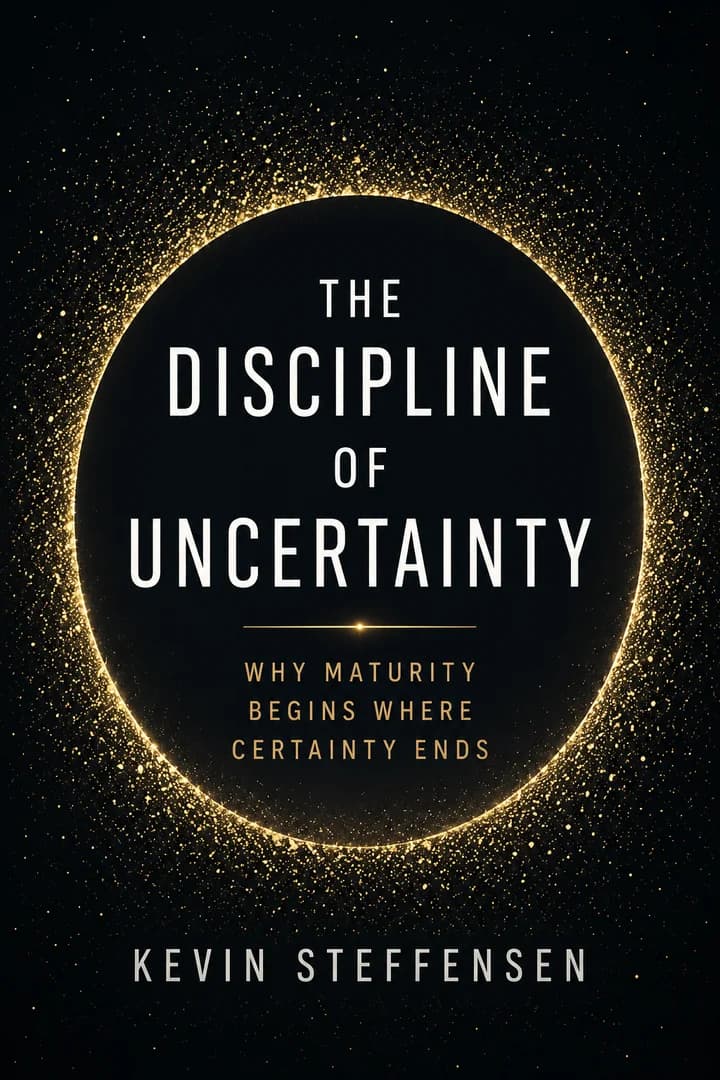
The Discipline of Uncertainty
Judgment, Restraint, and Decision Quality Under Incomplete Information
By Kevin Steffensen
Field notes on judgment, restraint, and decision quality when information is incomplete.
Field notes on judgment, restraint, and decision quality when information is incomplete.
Offered under open publishing terms (CC BY-SA). Download formats are free where available; purchase links support print editions.
- Type
- Handbook
- Author
- Kevin Steffensen
- Published
- 2026
- Chapters
- 23 chapters
- Formats
- EPUB, PDF, DOCX
On these shelves
Also in Systems and Organizations
View all 9 →
Coupling
Cohesion, Consequence, and the Architecture of Responsibility
How Serious Systems Learn
Disciplines for Acting Without Certainty
Why Collaboration Is So Hard
And Why the Effort Still Matters

When Incentives Become the Moral Language
How Systems Decide For Us When Judgment No Longer Scales
When Accountability No Longer Expires
How Legitimate Authority Learns to Survive Harm
Living in Sediment
How Structures Outlive Their Reasons
The question this book explores
How do we keep moral seriousness and decision quality when absolutes fracture and certainty stops working as social glue?
Why this book exists
A handbook for discipline under incomplete information — patterns as warnings not verdicts, probabilistic seriousness without relativism, and leadership that refuses false prophecy.
Who it is for
People who must decide, explain, or govern under constraint — clinical leaders, executives, regulators, elected officials, journalists — and citizens who refuse prophecy without cynicism.
What it is not
- It is not permission to abandon truth, nor a personality manual for “embracing ambiguity.”
- It is not statistical pedantry detached from harm, or an indictment of ordinary intelligence.
- It does not promise happiness, victory, consensus, or a checklist that replaces judgment.
Central ideas
A curated handful of concepts and patterns this book develops — not the full inventory.
Concept
Uncertainty
Uncertainty names the condition moral and social systems are built to navigate—the space where coordination must happen before truth is settled, where lives are fragmented and behavior must hold together under incomplete information. It becomes important because human action cannot wait for perfect knowledge; groups must decide, move, and coordinate even when the future is unclear, when disagreement is costly, when explanation cannot travel fast enough to settle disputes before consequences arrive. Uncertainty is not a problem to eliminate but a condition to navigate—the ground on which moral life operates. Certainty emerges as an adaptive response to uncertainty, compressing ambiguity into stable expectations so action can proceed. But uncertainty itself is neither failure nor freedom; it is the default state that requires coordination tools. The After Certainty project explores how to practice judgment, accountability, and responsiveness inside uncertainty rather than demanding that uncertainty be resolved before moral life can begin. The question uncertainty raises is: what uncertainty is this system trying to reduce? Is ambiguity dangerous because the stakes are genuinely high, or because failure now scales? Uncertainty differs from ignorance in that uncertainty is about incomplete information in contexts requiring action, while ignorance is simply lack of knowledge.
Uncertainty — open concept pageConcept
Judgment
Judgment names the capacity to decide when understanding is incomplete but harm, coordination, or responsibility will not wait. It becomes important whenever action must proceed under partial information and real consequence. It helps preserve proportionality, answerability, and room for revision, but can fail when judgment hardens into dogma, paralysis, or punitive finality. It differs from certainty because judgment accepts incomplete sight; it differs from preference because judgment weighs consequence beyond taste; it differs from optimization because judgment keeps contestability and human proportion in view; it differs from rule-following because judgment must still respond when rules lag reality.
Judgment — open concept pageConcept
Certainty
Certainty names the compression of choice and ambiguity into stable expectation—roles, law, and moral systems that make behavior predictable enough to coordinate under pressure. It is not truth discovered once and for all, but adaptation hardened under instability. It becomes important when coordination breaks down faster than explanation can travel, when seasons will not wait for debate, when strangers must act together without shared context. Certainty enables collective action by reducing the decision space, making tomorrow recognizable from yesterday, allowing people to act together even when they do not agree on reasons. It becomes dangerous when it outlives the conditions that first made it workable—when compression persists after instability has passed, when revision begins to feel like betrayal, when systems still run while the fit between structure and reality thins. It differs from conviction in that certainty is social and structural, while conviction is personal belief.
Certainty — open concept pageConcept
Responsibility
Responsibility names what continues after action—the obligation to remain responsive to what one's choices set in motion. It becomes important when systems scale beyond any one person's control but moral weight still accumulates. It helps preserve sustained answerability, but can fail when responsibility collapses into futility or when symbolic gestures replace contact with effects. It differs from accountability because responsibility names the enduring relation; accountability names whether consequence still reaches those who can respond.
Responsibility — open concept pageConcept
Revisability
Revisability names the capacity to change course without pretending the first pass was final. It becomes important whenever uncertainty remains after action starts and harm can accumulate while people wait for closure. It helps preserve contact with changing conditions and proportionate response, but can fail when updating is labeled flip-flopping or when institutions punish revisions that unsettle prior verdicts. It differs from correction because revisability is the designed openness; correction is the specific act of noticing mismatch and updating. It differs from judgment because revisability keeps decisions attached to reality over time, not only at the moment of decision.
Revisability — open concept pageConcept
Humility
Humility—naming tradeoffs, uncertainty, distributional conflict—is epistemically virtuous and politically costly at scale. Certainty orients anxious publics and protects institutions from looking paralyzed. The outperforming of humility is not proof audiences are childish; it is proof that orientation is scarce and fear is abundant. Under interpretive stress, humility also means acknowledging what summaries omit and who pays for resilience.
Humility — open concept pagePattern
Revisability Preserves Judgment
Judgment remains necessary when certainty weakens; people still must weigh tradeoffs and consequences without a final frame to hide inside. Finality no longer stabilizes judgment, yet paralysis and dogma are both available failures. - New information threatens prior commitments - Groups confuse openness with weakness - Revision must be practiced without infinite deferral - Coherence pressures compete with contact with reality Revisability is what prevents judgment from hardening into dogma. A leader publishes what would change their mind—and acts on the answer when it arrives.
Revisability Preserves Judgment — open pattern pagePattern
Finality Compensates for Uncertainty
When uncertainty feels intolerable, people reach for closure—harsh judgment, confident speech, or premature alignment. Severity and certainty provide emotional relief where epistemic stability no longer exists. - Ambiguity feels morally unstable - Confidence signals competence - Revision is delayed to preserve calm - Groups reward decisive tone over accurate scope Finality provides relief where certainty no longer exists; insecurity often sits underneath severity. A leader announces an irreversible policy so the room can stop inhabiting doubt together.
Finality Compensates for Uncertainty — open pattern pagePattern
Correctness Hardens Into Identity
Correctness begins as a tool for coordination—aligning on evidence, reality, and shared understanding under uncertainty. Under pressure, being right matters less for understanding than for preserving coherence and belonging; revision starts feeling like betrayal. - Disagreement is treated as moral threat - Identity fuses with the winning frame - Revision threatens group coherence - Finality relieves the discomfort of not knowing The danger is not error alone; it is the inability to remain revisable. A team treats a challenged forecast as disloyalty rather than as an update to shared reality.
Correctness Hardens Into Identity — open pattern page
Inside this book
How the book is organized — parts, chapters, and what each section investigates.
About 227 min of reading across 23 sections in 7 parts.
Part I — Why We Crave Absolutes
3 sections
Part I — Why We Crave Absolutes
3 sectionsShow summaryHide summary
Part I asks why absolutes and clean models stay seductive even when they fail—before patterns, probability, institutions, and leadership. It is diagnostic: see why clean answers sell, who buys them, and what institutions pay when reality returns variance. Psychological comfort comes first; abstraction that scales comfort into metrics follows.
Central questionWhy do clean answers keep selling when lived variance keeps returning?
Show summaryHide summary
A resident facing conflicting shortage guidance feels anger at lost orientation; a team after reorganization sighs in relief at a crisp incomplete plan. Certainty ends the spike of open loops—even wrong certainty can feel safer than nuanced truth under stress. The chapter maps why that comfort is so strong and why institutions ignore the load at their peril.
Central questionWhy can wrong certainty feel safer than true nuance when orientation collapses?
Show summaryHide summary
A clinician performance score compresses dozens of behaviors into one number—transparent to administrators, a cartoon to clinicians. Abstraction makes action possible and dispute inevitable when the map is mistaken for the territory. Institutions scale comfort into metrics that travel farther than the lived cases they summarize.
Central questionHow do clean models travel farther than the cases they compress—and at what cost?
Part II — What Patterns Actually Are
3 sections
Part II — What Patterns Actually Are
3 sectionsShow summaryHide summary
Part II turns from why we crave closure to what we do with patterns when closure fails. Patterns are how serious people learn—smoke before fire—not the enemy of discipline. The enemy is verdict language that treats a pattern as if it already decided the ending. Warnings preserve agency; destiny talk ends it.
Central questionHow do we keep patterns as warnings without letting them harden into verdicts?
Show summaryHide summary
Near-misses on a manufacturing line and boundary slips in a training clinic argue for intervention before catastrophe is proven—direction matters before outcome is known. A pattern does not license panic shutdown or doom proclamation. It argues for proportionate response while refusing the leap from tendency to destiny.
Central questionWhat kind of response does a pattern authorize before the ending is known?
Show summaryHide summary
Documented agency failures become "government cannot work, ever"; three missed launches become "we are structurally incapable." The leap from tends-to-happen to must-happen is fatalism wearing pattern language. Real regularities stay real; fatalism ends agency by converting warning into destiny and demoralizing the people who could still revise.
Central questionWhen does pattern recognition stop informing action and start ending it?
Part III — Probabilistic Truth and Moral Seriousness
3 sections
Part III — Probabilistic Truth and Moral Seriousness
3 sectionsShow summaryHide summary
Part III explains how judgment survives when closure fails and patterns stay warnings— practiced in speech and institutions that do not punish revision as betrayal. It is neither a statistics lecture nor moral relativism. Decisions that hurt people—floods, treatments, recalls—keep probabilistic seriousness tied to obligation under incomplete maps.
Central questionHow does moral seriousness survive when truth arrives as a distribution rather than a binary?
Show summaryHide summary
Flood plans, specialty-care centralization, and ethics committees face distributions— average gains, tail harms, waste if overprepared. Responsible questions name populations and triggers for reconsideration rather than "will it happen?" alone. Entering morality with eyes open means naming tradeoffs without pretending a single sentence can end them.
Central questionWhat does responsibility look like when the honest map is a distribution of harms?
Show summaryHide summary
Prosecutors, physicians, parents, city attorneys, and ombuds act before certainty—cases filed, treatments started, interim protections set—under standards made explicit and kept revisable. Probabilistic seriousness is accountability under partial knowledge, not "anything goes." Weighted concern authorizes proportionate action without declaring guilt or outcome as destiny.
Central questionHow can we act under partial knowledge without collapsing into either paralysis or prophecy?
Part IV — Institutions, Authority, and Drift
3 sections
Part IV — Institutions, Authority, and Drift
3 sectionsShow summaryHide summary
Part IV asks what happens when probabilistic judgment must be hosted by systems that remember, signal, and punish. Drift often converts warnings into wallpaper—ethics weeks without power, quiet dashboards read as vindication. Success teaches that the watch was unnecessary; then harm returns and the institution is shocked at its own sleep.
Central questionHow do institutions turn living warnings into wallpaper—and then into absolutes under pressure?
Show summaryHide summary
A hospital's green infection dashboard thins morbidity conferences until a cluster returns; quiet success was read as moral vindication rather than a changed environment. Warning systems are strange: they gain authority by limiting the authority they serve, telling successful institutions that success is a moral risk. Constitutions, scriptures, and safety regimes share that grammar.
Central questionWhy do warning systems erode precisely when their dashboards look like success?
Show summaryHide summary
One teacher's abuse or one bullying manager produces verdicts of "broken everywhere" or "one bad apple"—both offering moral closure that ends the conversation needed for scope, reporting paths, and supervision. Harm is vivid; scope is uncertain; institutions sound like minimization and publics like total judgment. Neither language alone does the boring work that changes probabilities.
Central questionHow do we keep instance and structure in view without collapsing into totalizing absolutes?
Part V — Leadership Without Prophecy
3 sections
Part V — Leadership Without Prophecy
3 sectionsShow summaryHide summary
Part V turns to leaders whose speech is heard as orientation while the map is incomplete. Boards and markets reward decisive tone; hesitation reads as weakness and revision as betrayal. Discipline is not a mood but habits: naming risk without destiny, acting with pre-committed revision. Leadership becomes practice under incomplete information.
Central questionHow can leaders orient others without selling prophecy when the map is incomplete?
Show summaryHide summary
Earnings guidance, charity galas, and legislative testimony each reward closure; finance offers a range while communications wants a repeatable number. Superintendents after safety incidents feel the same compression: honesty about distributions may read as failure to protect. Certainty scales in markets and rooms; humility does not—because institutions buy narratives that behave like verdicts.
Central questionWhat incentives push leaders to speak in verdicts even when they know the range?
Show summaryHide summary
Wildfire orders with triggers, hospital surge decision rules, and product launches under incomplete information need decisiveness and revision without feeling like tricks. Speak in models and notification paths; promise process that is legible when outcomes cannot be guaranteed. Legibility is a moral good when harm is distributed and trust fractures if leaders spoke only in destiny.
Central questionWhat habits let leaders act decisively while pre-committing to honest revision?
Part VI — Living Without Guarantees
3 sections
Part VI — Living Without Guarantees
3 sectionsShow summaryHide summary
Part VI asks what remains for persons after appetite, patterns, probability, institutions, and leadership pressure: responsibility and meaning when guarantees are gone. Acting without a final map still leaves obligations to revise and proportion harm. Meaning that survives uncertainty orients without false closure—avoiding prophecy and cynicism alike.
Central questionWhat holds responsibility and meaning when guarantees are no longer available?
Show summaryHide summary
Parents buckle seatbelts without controlling every road; therapists hold seriousness without promising healing; council members allocate risk without knowing the decade's shocks. Agency without guarantees is maturity—acting where harm is plausible without outsourcing moral labor to fate scripts. Demanding guaranteed outcomes pushes leaders toward prophecy that breaks later.
Central questionWhat does responsibility look like when no clean category assigns it for you?
Show summaryHide summary
Rituals promise repetition more than harvest; researchers keep fidelity to method when most experiments fail; people marry without knowing the future. Meaning does not require certainty—it requires honesty about what is held, why, and what would count against it. Institutions that demand guaranteed outputs push prophecy in public and cynicism in private.
Central questionHow can meaning orient us without depending on false closure?
Other sections
5 sections
Other sections
5 sectionsShow summaryHide summary
Public and organizational life increasingly disagrees from incompatible certainties— the same incident read as system failure and as negligence, metrics improving while frontline reports worsen. The introduction refuses an unkind diagnosis of irrationality and names a structural shift: certainty fraying as social glue under scale and exposure. The book aims to name shared discomfort and practice judgment when absolutes stop working.
Central questionWhat changes when certainty stops holding people together without becoming prophecy or cynicism?
Show summaryHide summary
Certainty stopped functioning as remembered social glue; the response is not performed confidence but discipline—reasoning, judging, and acting when absolutes fail. Uncertainty is not a failure state; treating it as failure produces prophecy culture that punishes revision. The conclusion gathers the book's moves for readers returning to ordinary rooms.
Central questionWhat does it mean to treat uncertainty as a discipline rather than a failure state?
Show summaryHide summary
Some readers hear disciplined uncertainty as permission to drift—if absolutes fail, anything is possible and nothing must be decided. The appendix refuses that confusion: openness without obligation can become moral evasion. Discipline is bounded seriousness— act under known stakes while refusing false inevitability.
Central questionHow is disciplined uncertainty different from keeping every option open forever?
Show summaryHide summary
Cultural skepticism can be overdue accountability or doubt as lifestyle—permanent suspension of commitment that feels virtuous for refusing false certainty. This book does not belong on the doubt shelf. Doubt suspends commitment; discipline commits under partial knowledge with revision rules.
Central questionWhat is the difference between living in doubt and practicing disciplined uncertainty?
Show summaryHide summary
Public fights sort science versus faith while hiding a shared problem: how to commit when proof is incomplete. The appendix is not theology or methods text; it maps where practices overlap and diverge so probabilistic seriousness can learn from each without collapsing them—or treating faith as prophecy in ancient dress.
Central questionWhat can faith and science each teach about committing when proof is incomplete?
Where it fits
Suggested reading order and nearby volumes — not a mandatory sequence.
Continue exploring
- Next book — Learning to See
- Start with a question — How do we keep judgment serious when certainty stops working as social glue?
Reading trails featuring this book
Editorial paths that include this book as one stop in a longer sequence.
Full related inventoryShowHide
Complete concept, pattern, and thinker lists for readers who want the full semantic map.
Major concepts
Concept
Accountability
Accountability names whether consequence still reaches the people who can respond. It becomes important when scale, narrative, or abstraction thins contact between action and effect. It helps preserve correction and proportionate answerability, but can fail when moral sorting replaces sustained contact with outcomes. It differs from responsibility because accountability emphasizes exposure to consequence; responsibility includes the ongoing obligation to account even when control is partial.
View Concept →
Concept
Accountability
Accountability names whether consequence still reaches the people who can respond. It becomes important when scale, narrative, or abstraction thins contact between action and effect. It helps preserve correction and proportionate answerability, but can fail when moral sorting replaces sustained contact with outcomes. It differs from responsibility because accountability emphasizes exposure to consequence; responsibility includes the ongoing obligation to account even when control is partial.
Concept
Certainty
Certainty names the compression of choice and ambiguity into stable expectation—roles, law, and moral systems that make behavior predictable enough to coordinate under pressure. It is not truth discovered once and for all, but adaptation hardened under instability. It becomes important when coordination breaks down faster than explanation can travel, when seasons will not wait for debate, when strangers must act together without shared context. Certainty enables collective action by reducing the decision space, making tomorrow recognizable from yesterday, allowing people to act together even when they do not agree on reasons. It becomes dangerous when it outlives the conditions that first made it workable—when compression persists after instability has passed, when revision begins to feel like betrayal, when systems still run while the fit between structure and reality thins. It differs from conviction in that certainty is social and structural, while conviction is personal belief.
View Concept →
Concept
Certainty
Certainty names the compression of choice and ambiguity into stable expectation—roles, law, and moral systems that make behavior predictable enough to coordinate under pressure. It is not truth discovered once and for all, but adaptation hardened under instability. It becomes important when coordination breaks down faster than explanation can travel, when seasons will not wait for debate, when strangers must act together without shared context. Certainty enables collective action by reducing the decision space, making tomorrow recognizable from yesterday, allowing people to act together even when they do not agree on reasons. It becomes dangerous when it outlives the conditions that first made it workable—when compression persists after instability has passed, when revision begins to feel like betrayal, when systems still run while the fit between structure and reality thins. It differs from conviction in that certainty is social and structural, while conviction is personal belief.
Concept
Feedback
Feedback names how systems stay in contact with their own effects. It becomes important whenever action and consequence are separated by time, scale, or abstraction. It helps preserve learning, correction, and trust in ongoing coordination, but can fail when dashboards stay green while lived harm accumulates off the ledger. It differs from trust because feedback is the returning signal itself; trust is the bridge that lets people act before every signal arrives. It differs from correction because feedback is what returns; correction is the work of updating in response.
View Concept →
Concept
Feedback
Feedback names how systems stay in contact with their own effects. It becomes important whenever action and consequence are separated by time, scale, or abstraction. It helps preserve learning, correction, and trust in ongoing coordination, but can fail when dashboards stay green while lived harm accumulates off the ledger. It differs from trust because feedback is the returning signal itself; trust is the bridge that lets people act before every signal arrives. It differs from correction because feedback is what returns; correction is the work of updating in response.
Concept
Harm
Harm names where cost lands when influence is exercised—who absorbs it, who is kept in view, and what displacement is treated as acceptable. It marks the lived consequence of action, authority, design, or coordination. The visibility dimension matters—who is harmed in particular, not on average? Can they name it? Can they respond? Does the system register it or treat it as acceptable loss? Harm continues while interpretation expands, briefings make harm legible without smaller, people can still tell when something is doing harm. The question harm raises—is harm unchanged outside while we analyze inside? When does naming harm substitute for reducing it? The failure mode—harm persists while moral work feels complete, delays continue after excellent postmortems, harm becomes statistical at scale. The restoration path—return to particular harms and people, check effects outside the room after briefings, stop when outcomes for people are unchanged, pair analysis with named remedy attempts, accept harm as inevitable without abandoning response.
View Concept →
Concept
Harm
Harm names where cost lands when influence is exercised—who absorbs it, who is kept in view, and what displacement is treated as acceptable. It marks the lived consequence of action, authority, design, or coordination. The visibility dimension matters—who is harmed in particular, not on average? Can they name it? Can they respond? Does the system register it or treat it as acceptable loss? Harm continues while interpretation expands, briefings make harm legible without smaller, people can still tell when something is doing harm. The question harm raises—is harm unchanged outside while we analyze inside? When does naming harm substitute for reducing it? The failure mode—harm persists while moral work feels complete, delays continue after excellent postmortems, harm becomes statistical at scale. The restoration path—return to particular harms and people, check effects outside the room after briefings, stop when outcomes for people are unchanged, pair analysis with named remedy attempts, accept harm as inevitable without abandoning response.
Concept
Humility
Humility—naming tradeoffs, uncertainty, distributional conflict—is epistemically virtuous and politically costly at scale. Certainty orients anxious publics and protects institutions from looking paralyzed. The outperforming of humility is not proof audiences are childish; it is proof that orientation is scarce and fear is abundant. Under interpretive stress, humility also means acknowledging what summaries omit and who pays for resilience.
View Concept →
Concept
Humility
Humility—naming tradeoffs, uncertainty, distributional conflict—is epistemically virtuous and politically costly at scale. Certainty orients anxious publics and protects institutions from looking paralyzed. The outperforming of humility is not proof audiences are childish; it is proof that orientation is scarce and fear is abundant. Under interpretive stress, humility also means acknowledging what summaries omit and who pays for resilience.
Concept
Judgment
Judgment names the capacity to decide when understanding is incomplete but harm, coordination, or responsibility will not wait. It becomes important whenever action must proceed under partial information and real consequence. It helps preserve proportionality, answerability, and room for revision, but can fail when judgment hardens into dogma, paralysis, or punitive finality. It differs from certainty because judgment accepts incomplete sight; it differs from preference because judgment weighs consequence beyond taste; it differs from optimization because judgment keeps contestability and human proportion in view; it differs from rule-following because judgment must still respond when rules lag reality.
View Concept →
Concept
Judgment
Judgment names the capacity to decide when understanding is incomplete but harm, coordination, or responsibility will not wait. It becomes important whenever action must proceed under partial information and real consequence. It helps preserve proportionality, answerability, and room for revision, but can fail when judgment hardens into dogma, paralysis, or punitive finality. It differs from certainty because judgment accepts incomplete sight; it differs from preference because judgment weighs consequence beyond taste; it differs from optimization because judgment keeps contestability and human proportion in view; it differs from rule-following because judgment must still respond when rules lag reality.
Concept
Responsibility
Responsibility names what continues after action—the obligation to remain responsive to what one's choices set in motion. It becomes important when systems scale beyond any one person's control but moral weight still accumulates. It helps preserve sustained answerability, but can fail when responsibility collapses into futility or when symbolic gestures replace contact with effects. It differs from accountability because responsibility names the enduring relation; accountability names whether consequence still reaches those who can respond.
View Concept →
Concept
Responsibility
Responsibility names what continues after action—the obligation to remain responsive to what one's choices set in motion. It becomes important when systems scale beyond any one person's control but moral weight still accumulates. It helps preserve sustained answerability, but can fail when responsibility collapses into futility or when symbolic gestures replace contact with effects. It differs from accountability because responsibility names the enduring relation; accountability names whether consequence still reaches those who can respond.
Concept
Revisability
Revisability names the capacity to change course without pretending the first pass was final. It becomes important whenever uncertainty remains after action starts and harm can accumulate while people wait for closure. It helps preserve contact with changing conditions and proportionate response, but can fail when updating is labeled flip-flopping or when institutions punish revisions that unsettle prior verdicts. It differs from correction because revisability is the designed openness; correction is the specific act of noticing mismatch and updating. It differs from judgment because revisability keeps decisions attached to reality over time, not only at the moment of decision.
View Concept →
Concept
Revisability
Revisability names the capacity to change course without pretending the first pass was final. It becomes important whenever uncertainty remains after action starts and harm can accumulate while people wait for closure. It helps preserve contact with changing conditions and proportionate response, but can fail when updating is labeled flip-flopping or when institutions punish revisions that unsettle prior verdicts. It differs from correction because revisability is the designed openness; correction is the specific act of noticing mismatch and updating. It differs from judgment because revisability keeps decisions attached to reality over time, not only at the moment of decision.
Concept
Uncertainty
Uncertainty names the condition moral and social systems are built to navigate—the space where coordination must happen before truth is settled, where lives are fragmented and behavior must hold together under incomplete information. It becomes important because human action cannot wait for perfect knowledge; groups must decide, move, and coordinate even when the future is unclear, when disagreement is costly, when explanation cannot travel fast enough to settle disputes before consequences arrive. Uncertainty is not a problem to eliminate but a condition to navigate—the ground on which moral life operates. Certainty emerges as an adaptive response to uncertainty, compressing ambiguity into stable expectations so action can proceed. But uncertainty itself is neither failure nor freedom; it is the default state that requires coordination tools. The After Certainty project explores how to practice judgment, accountability, and responsiveness inside uncertainty rather than demanding that uncertainty be resolved before moral life can begin. The question uncertainty raises is: what uncertainty is this system trying to reduce? Is ambiguity dangerous because the stakes are genuinely high, or because failure now scales? Uncertainty differs from ignorance in that uncertainty is about incomplete information in contexts requiring action, while ignorance is simply lack of knowledge.
View Concept →
Concept
Uncertainty
Uncertainty names the condition moral and social systems are built to navigate—the space where coordination must happen before truth is settled, where lives are fragmented and behavior must hold together under incomplete information. It becomes important because human action cannot wait for perfect knowledge; groups must decide, move, and coordinate even when the future is unclear, when disagreement is costly, when explanation cannot travel fast enough to settle disputes before consequences arrive. Uncertainty is not a problem to eliminate but a condition to navigate—the ground on which moral life operates. Certainty emerges as an adaptive response to uncertainty, compressing ambiguity into stable expectations so action can proceed. But uncertainty itself is neither failure nor freedom; it is the default state that requires coordination tools. The After Certainty project explores how to practice judgment, accountability, and responsiveness inside uncertainty rather than demanding that uncertainty be resolved before moral life can begin. The question uncertainty raises is: what uncertainty is this system trying to reduce? Is ambiguity dangerous because the stakes are genuinely high, or because failure now scales? Uncertainty differs from ignorance in that uncertainty is about incomplete information in contexts requiring action, while ignorance is simply lack of knowledge.
Major patterns
Supporting · Corrective
Commitment Leaves Room
Systems must act before certainty arrives, but commitments become dangerous when correction threatens identity, legitimacy, sunk cost, or authority. - Action cannot wait for certainty - Closed commitment resists correction Commitment enables coordinated action while preserving room for revision when evidence, conditions, or consequences change.
View Pattern →
Supporting · Corrective
Commitment Leaves Room
Systems must act before certainty arrives, but commitments become dangerous when correction threatens identity, legitimacy, sunk cost, or authority. - Action cannot wait for certainty - Closed commitment resists correction Commitment enables coordinated action while preserving room for revision when evidence, conditions, or consequences change.
Pattern
Correctness Hardens Into Identity
Correctness begins as a tool for coordination—aligning on evidence, reality, and shared understanding under uncertainty. Under pressure, being right matters less for understanding than for preserving coherence and belonging; revision starts feeling like betrayal. - Disagreement is treated as moral threat - Identity fuses with the winning frame - Revision threatens group coherence - Finality relieves the discomfort of not knowing The danger is not error alone; it is the inability to remain revisable. A team treats a challenged forecast as disloyalty rather than as an update to shared reality.
View Pattern →
Pattern
Correctness Hardens Into Identity
Correctness begins as a tool for coordination—aligning on evidence, reality, and shared understanding under uncertainty. Under pressure, being right matters less for understanding than for preserving coherence and belonging; revision starts feeling like betrayal. - Disagreement is treated as moral threat - Identity fuses with the winning frame - Revision threatens group coherence - Finality relieves the discomfort of not knowing The danger is not error alone; it is the inability to remain revisable. A team treats a challenged forecast as disloyalty rather than as an update to shared reality.
Pattern
Finality Compensates for Uncertainty
When uncertainty feels intolerable, people reach for closure—harsh judgment, confident speech, or premature alignment. Severity and certainty provide emotional relief where epistemic stability no longer exists. - Ambiguity feels morally unstable - Confidence signals competence - Revision is delayed to preserve calm - Groups reward decisive tone over accurate scope Finality provides relief where certainty no longer exists; insecurity often sits underneath severity. A leader announces an irreversible policy so the room can stop inhabiting doubt together.
View Pattern →
Pattern
Finality Compensates for Uncertainty
When uncertainty feels intolerable, people reach for closure—harsh judgment, confident speech, or premature alignment. Severity and certainty provide emotional relief where epistemic stability no longer exists. - Ambiguity feels morally unstable - Confidence signals competence - Revision is delayed to preserve calm - Groups reward decisive tone over accurate scope Finality provides relief where certainty no longer exists; insecurity often sits underneath severity. A leader announces an irreversible policy so the room can stop inhabiting doubt together.
Master pattern
Reality Answers Back
Human systems must simplify reality in order to perceive, decide, coordinate, and act. Those simplifications necessarily leave out people, consequences, perspectives, history, and changed conditions. - Simplification is required for coordinated action - What is left out eventually returns - Systems need paths for revision before collapse Every abstraction, institution, decision, and model eventually encounters the reality it only partially captured. Reality answers through failures, exceptions, dissent, unintended behavior, lived experience, or consequences the model did not contain.
View Pattern →
Master pattern
Reality Answers Back
Human systems must simplify reality in order to perceive, decide, coordinate, and act. Those simplifications necessarily leave out people, consequences, perspectives, history, and changed conditions. - Simplification is required for coordinated action - What is left out eventually returns - Systems need paths for revision before collapse Every abstraction, institution, decision, and model eventually encounters the reality it only partially captured. Reality answers through failures, exceptions, dissent, unintended behavior, lived experience, or consequences the model did not contain.
Pattern
Revisability Preserves Judgment
Judgment remains necessary when certainty weakens; people still must weigh tradeoffs and consequences without a final frame to hide inside. Finality no longer stabilizes judgment, yet paralysis and dogma are both available failures. - New information threatens prior commitments - Groups confuse openness with weakness - Revision must be practiced without infinite deferral - Coherence pressures compete with contact with reality Revisability is what prevents judgment from hardening into dogma. A leader publishes what would change their mind—and acts on the answer when it arrives.
View Pattern →
Pattern
Revisability Preserves Judgment
Judgment remains necessary when certainty weakens; people still must weigh tradeoffs and consequences without a final frame to hide inside. Finality no longer stabilizes judgment, yet paralysis and dogma are both available failures. - New information threatens prior commitments - Groups confuse openness with weakness - Revision must be practiced without infinite deferral - Coherence pressures compete with contact with reality Revisability is what prevents judgment from hardening into dogma. A leader publishes what would change their mind—and acts on the answer when it arrives.
Related songs
Song
A Perfectly Reasonable Disaster
Psychedelic art-pop parable: Gerald moves a road sign six feet, everyone follows reasonably, and the world forgets its name.
View Song →
Song
A Perfectly Reasonable Disaster
Psychedelic art-pop parable: Gerald moves a road sign six feet, everyone follows reasonably, and the world forgets its name.
Song
Again, Differently
French-house vocoder anthem: returning to the same question and the same person, but nothing identical—again, differently.
View Song →
Song
Again, Differently
French-house vocoder anthem: returning to the same question and the same person, but nothing identical—again, differently.
Song
Before the Meaning Lands
Hindi–English trip-hop: ठहरो ज़रा—wait before naming silence, before the first story closes into certainty.
View Song →
Song
Before the Meaning Lands
Hindi–English trip-hop: ठहरो ज़रा—wait before naming silence, before the first story closes into certainty.
Song
Just Don’t Grab the Wheel
Rootsy country-folk porch wisdom: welcome the backseat lecture from here to Chapel Hill, but keep your hands on your own wheel and leave room for what you have not learned.
View Song →
Song
Just Don’t Grab the Wheel
Rootsy country-folk porch wisdom: welcome the backseat lecture from here to Chapel Hill, but keep your hands on your own wheel and leave room for what you have not learned.
Song
L’Arrêt en Fait Partie
Experimental French math rock: clipped mantras, shifting meters, and sudden silences insist the stop is part of the groove, and that the small error knows something.
View Song →
Song
L’Arrêt en Fait Partie
Experimental French math rock: clipped mantras, shifting meters, and sudden silences insist the stop is part of the groove, and that the small error knows something.
Song
Le Formulaire Ne Connaît Pas Mardi
French retro-futurist art-pop: cheerful bureaucracy meets a door that sticks—Mardi is not a valid value on the form.
View Song →
Song
Le Formulaire Ne Connaît Pas Mardi
French retro-futurist art-pop: cheerful bureaucracy meets a door that sticks—Mardi is not a valid value on the form.
Song
Miss Maybe & Mister Sure
Speakeasy swing duet: sly Miss Maybe and pompous Mister Sure trade brass-stab jokes about overreading winks, silence, and “fine,” until comic certainty briefly cracks into not-sure.
View Song →
Song
Miss Maybe & Mister Sure
Speakeasy swing duet: sly Miss Maybe and pompous Mister Sure trade brass-stab jokes about overreading winks, silence, and “fine,” until comic certainty briefly cracks into not-sure.
Song
Mr. Bell Keeps the Weather
Noir theatrical piano blues: an ex-weatherman hoards broken barometers and storms that never came, warning not to confuse odds with what happens after all.
View Song →
Song
Mr. Bell Keeps the Weather
Noir theatrical piano blues: an ex-weatherman hoards broken barometers and storms that never came, warning not to confuse odds with what happens after all.
Song
Nóg
Glacial Icelandic post-rock: a fragile voice chants Nóg—enough—to see, answer, and keep hands open without demanding peace, proof, or a final complete picture.
View Song →
Song
Nóg
Glacial Icelandic post-rock: a fragile voice chants Nóg—enough—to see, answer, and keep hands open without demanding peace, proof, or a final complete picture.
Song
NOT YET!
Neon techno J-pop at club tempo: three voices chant NOT YET while Japanese verses catch the mind writing a finished story from one glance, and English hooks keep every answer playfully provisional.
View Song →
Song
NOT YET!
Neon techno J-pop at club tempo: three voices chant NOT YET while Japanese verses catch the mind writing a finished story from one glance, and English hooks keep every answer playfully provisional.
Song
Still We Go
Sunlit Swahili choral anthem: we do not know everything and do not see everything—INATOSHA—and still we go together with open hands and open eyes.
View Song →
Song
Still We Go
Sunlit Swahili choral anthem: we do not know everything and do not see everything—INATOSHA—and still we go together with open hands and open eyes.
Song
The Moon Is Probably Fine
Woozy Mellotron psychedelia: a three a.m. moon scare softens into probably fine—enough uncertain reassurance to leave the curtains open and let the night continue.
View Song →
Song
The Moon Is Probably Fine
Woozy Mellotron psychedelia: a three a.m. moon scare softens into probably fine—enough uncertain reassurance to leave the curtains open and let the night continue.
Song
Wait, What?
Theatrical space-rap battle: Certainty vs Question, with mission-control swagger interrupted every time confidence outruns the evidence.
View Song →
Song
Wait, What?
Theatrical space-rap battle: Certainty vs Question, with mission-control swagger interrupted every time confidence outruns the evidence.
Major thinkers
Person
Barbara W Tuchman
Historian of folly, misgovernment, and how capable leaders persist in policies against evidence.
View Thinker →
Person
Barbara W Tuchman
Historian of folly, misgovernment, and how capable leaders persist in policies against evidence.
Person
Cass R Sunstein
Legal scholar of behavioral economics, group polarization, and how information environments shape belief.
View Thinker →
Person
Cass R Sunstein
Legal scholar of behavioral economics, group polarization, and how information environments shape belief.
Person
Charles G. Lord
Psychologists of belief perseverance and biased assimilation of disconfirming evidence.
View Thinker →
Person
Charles G. Lord
Psychologists of belief perseverance and biased assimilation of disconfirming evidence.
Person
Daniel Kahneman
Psychologist of judgment and decision-making—biases, heuristics, and noise in expert choice.
View Thinker →
Person
Daniel Kahneman
Psychologist of judgment and decision-making—biases, heuristics, and noise in expert choice.
Person
Hannah Arendt
Political theorist whose work helps frame authority, judgment, responsibility, violence, and public action.
View Thinker →
Person
Hannah Arendt
Political theorist whose work helps frame authority, judgment, responsibility, violence, and public action.
Person
James Reason
Safety scientist whose work on human error, organizational accidents, and resilient systems shaped modern safety thinking.
View Thinker →
Person
James Reason
Safety scientist whose work on human error, organizational accidents, and resilient systems shaped modern safety thinking.
Person
Karl E Weick
Organizational theorist of sensemaking—how people enact and retrospectively rationalize meaning under ambiguity.
View Thinker →
Person
Karl E Weick
Organizational theorist of sensemaking—how people enact and retrospectively rationalize meaning under ambiguity.
Person
Lee Ross
Social psychologists of person perception, situational attribution, and the limits of intuitive psychology.
View Thinker →
Person
Lee Ross
Social psychologists of person perception, situational attribution, and the limits of intuitive psychology.
Person
Mark R. Lepper
Psychologists of belief perseverance and biased assimilation of disconfirming evidence.
View Thinker →
Person
Mark R. Lepper
Psychologists of belief perseverance and biased assimilation of disconfirming evidence.
Person
Nassim Nicholas Taleb
Essayist and risk thinker of antifragility, black swans, and fragility under model-driven certainty.
View Thinker →
Person
Nassim Nicholas Taleb
Essayist and risk thinker of antifragility, black swans, and fragility under model-driven certainty.
Person
Paul Tillich
Theologian of courage, anxiety, and faith as the capacity to face meaninglessness without false certainty.
View Thinker →
Person
Paul Tillich
Theologian of courage, anxiety, and faith as the capacity to face meaninglessness without false certainty.
Organization
U.S. Securities and Exchange Commission
U.S. federal regulator publishing whistleblower program reports and securities enforcement materials.
View Thinker →
Organization
U.S. Securities and Exchange Commission
U.S. federal regulator publishing whistleblower program reports and securities enforcement materials.
Research sources
book
Responsibility and Judgment
Arendt, Hannah. Responsibility and Judgment. Edited by Jerome Kohn. New York: Schocken Books, 2003.
View Source →
book
Responsibility and Judgment
Arendt, Hannah. Responsibility and Judgment. Edited by Jerome Kohn. New York: Schocken Books, 2003.
book
Thinking, Fast and Slow
Kahneman, Daniel. Thinking, Fast and Slow. New York: Farrar, Straus and Giroux, 2011.
View Source →
book
Thinking, Fast and Slow
Kahneman, Daniel. Thinking, Fast and Slow. New York: Farrar, Straus and Giroux, 2011.
article
Biased Assimilation and Attitude Polarization: The Effects of Prior Theories on Subsequently Considered Evidence.
Lord, Charles G., Lee Ross, and Mark R. Lepper. "Biased Assimilation and Attitude Polarization: The Effects of Prior Theories on Subsequently Considered Evidence." Journal of Personality and Social Psychology 37, no. 11 (1979): 2098–2109.
View Source →
article
Biased Assimilation and Attitude Polarization: The Effects of Prior Theories on Subsequently Considered Evidence.
Lord, Charles G., Lee Ross, and Mark R. Lepper. "Biased Assimilation and Attitude Polarization: The Effects of Prior Theories on Subsequently Considered Evidence." Journal of Personality and Social Psychology 37, no. 11 (1979): 2098–2109.
book
The Human Contribution: Unsafe Acts, Accidents and Heroic Recoveries
Reason, James. The Human Contribution: Unsafe Acts, Accidents and Heroic Recoveries. Farnham, UK: Ashgate, 2008.
View Source →
book
The Human Contribution: Unsafe Acts, Accidents and Heroic Recoveries
Reason, James. The Human Contribution: Unsafe Acts, Accidents and Heroic Recoveries. Farnham, UK: Ashgate, 2008.
book
#Republic: Divided Democracy in the Age of Social Media
Sunstein, Cass R. #Republic: Divided Democracy in the Age of Social Media. Princeton, NJ: Princeton University Press, 2017.
View Source →
book
#Republic: Divided Democracy in the Age of Social Media
Sunstein, Cass R. #Republic: Divided Democracy in the Age of Social Media. Princeton, NJ: Princeton University Press, 2017.
book
Antifragile: Things That Gain from Disorder
Taleb, Nassim Nicholas. Antifragile: Things That Gain from Disorder. New York: Random House, 2012.
View Source →
book
Antifragile: Things That Gain from Disorder
Taleb, Nassim Nicholas. Antifragile: Things That Gain from Disorder. New York: Random House, 2012.
book
The Courage to Be
Tillich, Paul. The Courage to Be. New Haven, CT: Yale University Press, 1952.
View Source →
book
The Courage to Be
Tillich, Paul. The Courage to Be. New Haven, CT: Yale University Press, 1952.
book
The March of Folly: From Troy to Vietnam
Tuchman, Barbara W. The March of Folly: From Troy to Vietnam. New York: Knopf, 1984.
View Source →
book
The March of Folly: From Troy to Vietnam
Tuchman, Barbara W. The March of Folly: From Troy to Vietnam. New York: Knopf, 1984.
report
Annual reports to Congress.
U.S. Securities and Exchange Commission, Office of the Whistleblower. Annual reports to Congress. https://www.sec.gov/whistleblower.
View Source →
report
Annual reports to Congress.
U.S. Securities and Exchange Commission, Office of the Whistleblower. Annual reports to Congress. https://www.sec.gov/whistleblower.
book
Managing the Unexpected: Resilient Performance in an Age of Uncertainty
Weick, Karl E., and Kathleen M. Sutcliffe. Managing the Unexpected: Resilient Performance in an Age of Uncertainty. 3rd ed. San Francisco: Jossey-Bass, 2015.
View Source →
book
Managing the Unexpected: Resilient Performance in an Age of Uncertainty
Weick, Karl E., and Kathleen M. Sutcliffe. Managing the Unexpected: Resilient Performance in an Age of Uncertainty. 3rd ed. San Francisco: Jossey-Bass, 2015.