
Concept
Revisability
Revisability names the capacity to change course without pretending the first pass was final. It becomes important whenever uncertainty remains after action starts and harm can accumulate while people wait for closure.
Revisability names the capacity to change course without pretending the first pass was final. It becomes important whenever uncertainty remains after action starts and harm can accumulate while people wait for closure. It helps preserve contact with changing conditions and proportionate response, but can fail when updating is labeled flip-flopping or when institutions punish revisions that unsettle prior verdicts. It differs from correction because revisability is the designed openness; correction is the specific act of noticing mismatch and updating. It differs from judgment because revisability keeps decisions attached to reality over time, not only at the moment of decision.
Recognition signals
- forecasts, hires, or evacuations that made sense at noon need refinement by evening
- updating is labeled flip-flopping rather than keeping the decision attached to reality
- models, protocols, and relationships damaged by partial judgment never get revisited
- leaders punish revisions that unsettle prior verdicts or public narratives
- triggers for escalation and de-escalation were never named before acting
Questions to ask
- What would have to be true for this decision to change?
- Where is revision treated as weakness rather than contact with reality?
- What remains revisable after public commitment?
Counterbalances
- name revision triggers before acting
- separate seriousness from permanent settlement
- reward updates that track reality
Trajectory
Early signals
- decisions can still be updated without loss of standing
Intensification
- revision threatens coherence or narrative closure
Failure modes
- institutions harden early calls into identity
Restoration paths
- design processes for update without shame
Manifestations
leadership
- executives delay public commitment to preserve revisability
organizations
- reviews punish updates that unsettle prior verdicts
Appears in chapters
- Chapter 1 — The End of Correctness
- Part II — What Can Still Be Practiced
- Chapter 4 — Judgment Without Finality
- Chapter 7 — The Discipline of Not Knowing
- Chapter 9 — When to Stop Interpreting
- Chapter 4 — Constraint as Discipline
- Chapter 7 — Being Wrong on Purpose
- Chapter 10 — Action as Probe, Not Solution
And 20 more chapters with this association.
Related books4 books

Book
What We Cannot See
Bias, Judgment, and the Limits of Perspective
Why every perspective is necessarily partial, how individuals make responsible judgments despite those limitations, and why integration allows groups to construct understanding that exceeds any single person's perspective.
View book
Book
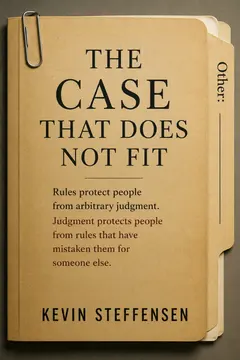
The Case That Does Not Fit
How Rules Protect Us—and What Institutions Must Do When They Misread Us
Rules make shared life possible, but every rule is a compression. The Case That Does Not Fit examines what happens when the ignored detail becomes the morally decisive one—and how institutions can preserve both protection from arbitrary judgment and protection from rules that have mistaken a person for someone else.
View book

Book
The Discipline of Uncertainty
Judgment, Restraint, and Decision Quality Under Incomplete Information
Field notes on judgment, restraint, and decision quality when information is incomplete.
View book

Book
Reality Pushes Back
What Happens When Our Models Meet the World
A narrative pattern language for the After Certainty corpus. Through ordinary life in one town across roughly fifteen years, twelve supporting patterns— organized by perception, power, time, and contact—show how every useful model leaves something out, and how reality answers through materials, people, and consequences the model did not contain.
View book
Outgoing dynamics1 relationship
contrasts
Revisability keeps decisions attached to reality over time; judgment weighs tradeoffs at the moment of decision.
Incoming dynamics4 relationships
requires
Correction depends on decisions remaining open to update after action begins.
requires
Judgment depends on decisions remaining open to update as conditions and understanding change.
contrasts
Corrigibility is capacity for revision when reality pushes back; revisability is designed openness to update.
contrasts
Reversibility is ability to undo without rupture; revisability is disciplined openness to correction after action begins.
Neighboring terrain (other connected entities)2 neighbors
concept
Corrigibility
Corrigibility names the capacity for revision and recovery when conditions change—the ability of a person, institution, model, or moral system to adapt when reality pushes back. It becomes important when stabilization succeeds but conditions continue to shift, when what once compressed instability begins to resist the adaptation it was built to enable. Corrigibility helps preserve responsiveness and learning over time, but it thins when admitting error threatens authority's foundation or when the tools built to preserve certainty begin to constrain revision. Sacred authority can resist correction without appearing illegitimate; canon can slow revision while binding force remains; writing and law can externalize judgment in ways that replace reinterpretation with precedent. Systems can record outcomes that people experience differently, and re-justification can fade while inherited form still coordinates. Corrigibility differs from revisability (openness to correction), repair (mending what broke), and reversibility (ability to undo). The question it raises is: what would have to break for this arrangement to be revised? Recognizing why revision once felt like collapse helps distinguish rigidity from adaptation's residue.
concept
Reversibility
Reversibility names the ability to undo a decision, commitment, institutional movement, or moral settlement without rupture—the capacity to walk back what has been done without threatening the foundation of shared life. It becomes important when coordination depends on stability but conditions continue to change, when what was settled must be reopened but reopening feels dangerous. Reversibility helps preserve adaptability across time; it allows correction without collapse. But reversibility thins as stabilization hardens into permanence—as what small groups could renegotiate through direct conversation becomes fixed in law, canon, or inherited procedure. Writing and formalization externalize judgment into enforceable categories; sacred framing makes revision feel morally dangerous rather than practically difficult; precedent and procedure narrow the range of acceptable variance across time. Revision begins to feel indistinguishable from collapse; admitting error threatens the foundation of authority itself. The question reversibility raises is: what would have to break for this to be undone? Where is permanence providing stability, and where has it become lock-in? Reversibility differs from revisability (openness to correction) and corrigibility (capacity to be corrected)—reversibility is the ability to undo, not merely to adjust or improve. The counterbalance is to recognize why stabilization once required permanence, to notice when permanence first solved real coordination problems, and to separate necessary storage from inherited weight.