
Song
Before the Meaning Lands
Kevin Steffensen
Hindi–English trip-hop: ठहरो ज़रा—wait before naming silence, before the first story closes into certainty.
Tanpura drone, sarod, and heavy breaks hold space between signal and story.
Tanpura drone, sarod, and heavy breaks hold space between signal and story. Bilingual refrains (thehro zara, abhi nahin) make delay audible: what you said and what I heard are not the same, and the mind fills empty spaces and calls the filling evidence. How Meaning Moves and Everyone Knows Love fit intent-gets-assigned and gaps-invite-completion; The Discipline of Uncertainty fits leaving meaning open in your hands. A cover/edit shortens runtime without changing the ask to look again.
- Languages
- en, hi
Recordings
- Before the Meaning LandsPrimary
5:21 · chirp-fenix v5.5
7:30 · chirp-auk v4.5-all
Related patterns4 patterns
Pattern
Intent Gets Assigned
A statement lands with emotional or relational significance. Listeners need to decide whether they are safe, respected, or at risk. - People turn behavior into motive quickly - Threat makes defensive readings more likely - Relationship history primes expectation People infer motive before certainty is possible. Intent gets assigned in the same instant impact is noticed.
View Pattern →
Pattern
Gaps Invite Completion
An exchange contains ambiguity, omitted detail, or unresolved tension. Open meaning is hard to sustain under practical or emotional pressure. - Uncertainty creates interpretive discomfort - Fast social coordination rewards quick closure - Memory and expectation supply plausible filler Missing meaning rarely stays open for long. Because gaps invite completion, the mind usually supplies missing meaning before the speaker does.
View Pattern →
Pattern
Meaning Outruns the Words
People rely on short utterances to carry complex relational meaning. Language cannot carry full context, history, and emotional state by itself. - Context lives in the setting and in shared history - Emotion often shows up outside explicit wording - Social roles load words with extra consequence Language never carries all of the context, emotion, or intent around it. Meaning outruns the words: a line can be precise in grammar and still short on life.
View Pattern →
Pattern
Contact Keeps the Read Open
People return to a difficult exchange with more context and lower reactivity. Early interpretation may be useful but still too rough. - Additional context widens what people can see - Lower emotional charge improves tolerance for ambiguity - Restraint keeps meaning revisable Additional context can sharpen understanding without fully resolving it. Contact keeps the read open when understanding tightens without the story having to close.
View Pattern →
Related concepts4 concepts
Concept
Interpretation
Interpretation names the ongoing work of deciding what something means enough to coordinate on. It becomes important whenever shared action depends on more than immediate perception—across time, distance, conflict, or institutional scale. It helps preserve continuity between experience and obligation, but can fail when interpretation hardens into category and stops tracking changing conditions. In the authority arc, sacred authority compresses interpretation while writing and law later externalize it so disputes can be settled without shared presence. It differs from private understanding because interpretation must be able to coordinate judgment or contest authority in shared space; it differs from meaning because interpretation is the active reconstruction, not only what gets stabilized.
View Concept →
Concept
Meaning
Meaning names what must remain recognizable for life together to continue. It becomes important whenever coordination outruns immediate shared presence. It helps preserve continuity across time, distance, and conflict, but can fail when inherited meaning outlives the conditions that once made it workable. In Before Certainty Arrives, meaning is what moral systems stabilize once coordination survives constraint; writing preserves meaning when oral tradition fractures at scale. In How Meaning Moves, meaning is also what people reconstruct through contact, completion, and the movement of language under pressure. It differs from interpretation because meaning is what gets held steady; interpretation is the active work of reconstruction.
View Concept →
Concept
Certainty
Certainty names the compression of choice and ambiguity into stable expectation—roles, law, and moral systems that make behavior predictable enough to coordinate under pressure. It is not truth discovered once and for all, but adaptation hardened under instability. It becomes important when coordination breaks down faster than explanation can travel, when seasons will not wait for debate, when strangers must act together without shared context. Certainty enables collective action by reducing the decision space, making tomorrow recognizable from yesterday, allowing people to act together even when they do not agree on reasons. It becomes dangerous when it outlives the conditions that first made it workable—when compression persists after instability has passed, when revision begins to feel like betrayal, when systems still run while the fit between structure and reality thins. It differs from conviction in that certainty is social and structural, while conviction is personal belief.
View Concept →
Concept
Humility
Humility—naming tradeoffs, uncertainty, distributional conflict—is epistemically virtuous and politically costly at scale. Certainty orients anxious publics and protects institutions from looking paralyzed. The outperforming of humility is not proof audiences are childish; it is proof that orientation is scarce and fear is abundant. Under interpretive stress, humility also means acknowledging what summaries omit and who pays for resilience.
View Concept →
Related books3 books

Book
How Meaning Moves
Signal, Compression, Restraint, and the Pace of Understanding
Before people disagree, they interpret. How meaning forms through signal, compression, and restraint—long before anyone is obviously wrong, and often while the sentence is still forming.
View book

Book
Everyone Knows Love
Why Is It So Hard to Explain?
An exploration of love as something everyone recognizes yet struggles to explain—treating care as a living mystery rather than a formula.
View book
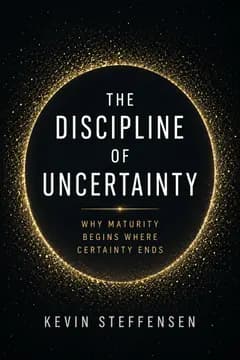
Book
The Discipline of Uncertainty
Judgment, Restraint, and Decision Quality Under Incomplete Information
Field notes on judgment, restraint, and decision quality when information is incomplete.
View book