
Nonfiction
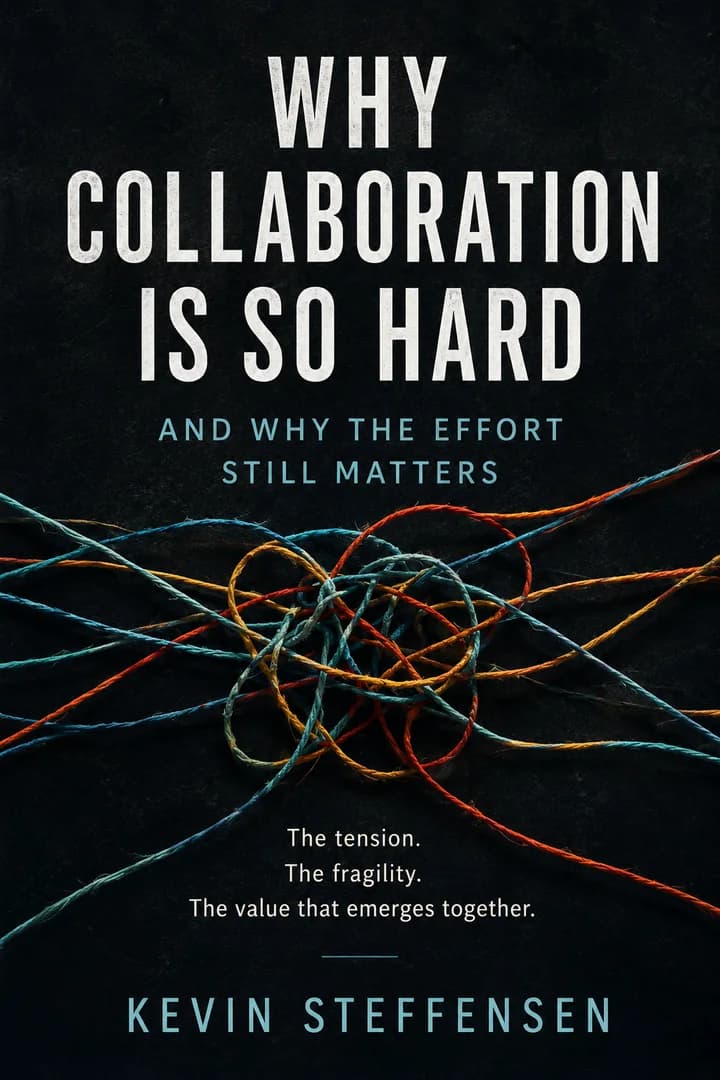
Why Collaboration Is So Hard
And Why the Effort Still Matters
By Kevin Steffensen
Why joint work fails when incentives, trust, and shared understanding do not line up—and why the effort to collaborate still matters.
Why joint work fails when incentives, trust, and shared understanding do not line up—and why the effort to collaborate still matters.
Offered under open publishing terms (CC BY-SA). Download formats are free where available; purchase links support print editions.
- Type
- Nonfiction · monograph
- Author
- Kevin Steffensen
- Published
- 2026
- Chapters
- 10 chapters
- Formats
- EPUB, PDF, DOCX
On these shelves
Also in Systems and Organizations
View all 9 →
Coupling
Cohesion, Consequence, and the Architecture of Responsibility
How Serious Systems Learn
Disciplines for Acting Without Certainty
The Discipline of Uncertainty
Judgment, Restraint, and Decision Quality Under Incomplete Information

When Incentives Become the Moral Language
How Systems Decide For Us When Judgment No Longer Scales
When Accountability No Longer Expires
How Legitimate Authority Learns to Survive Harm

Living in Sediment
How Structures Outlive Their Reasons


The question this book explores
Why does collaboration remain fragile even when people are competent, motivated, and trying in good faith?
Why this book exists
Collaboration can fail among sincere and capable people because shared work exceeds any one person's sight, control, and ownership. The book treats that fragility as a structural condition—not only a virtue or skill deficit to train away.
Who it is for
Anyone responsible for shared outcomes: team leads, facilitators, founders, clinicians, educators, volunteers, and contributors in matrixed organizations.
What it is not
- It is not a teamwork playbook, leadership manual, or productivity framework.
- It does not promise that facilitation eliminates fragility or treat stability as the default.
- It does not romanticize collaboration or treat silence and conflict as mere lack of commitment.
Central ideas
A curated handful of concepts and patterns this book develops — not the full inventory.
Concept
Diffuse ownership
In this book: Core diagnosis: no one can fully predict or control the joint outcome, yet many are answerable—fragility without blaming bad faith.
Explore the conceptConcept
Contribution asymmetry
In this book: Makes visible uneven labor, recognition, and risk inside sincere collaboration—why 'trying hard' still feels unfair.
Explore the conceptConcept
Invisible labor
In this book: Names the coordination work collaboration depends on but artifacts rarely show; central to why gaps keep getting absorbed by the same people.
Explore the conceptConcept
Legibility
In this book: Clarifies what can be read by others as contribution or harm; collaboration fails partly when necessary work stays unreadable.
Explore the conceptConcept
Partial coherence
In this book: Holds that overlapping understanding for the next step is enough—without demanding identical mental models that collaboration never delivers.
Explore the conceptConcept
Structural fragility
In this book: Frames wobble under shared contribution as normal condition, not only a skill deficit to train away.
Explore the conceptPattern
Disagreement is Suppressed
In this book: Applies how dissent softens until decisions go unchallenged—one path by which good-faith teams lose early correction.
Explore the patternPattern
Responsibility Persists Beyond Control
In this book: Deepens the structural bind: people remain answerable for outcomes they cannot fully own or see.
Explore the pattern
Inside this book
How the book is organized — parts, chapters, and what each section investigates.
About 140 min of reading across 10 sections.
Chapters
10 sections
Chapters
10 sectionsShow summaryHide summary
Five people leave a meeting that looked successful carrying five different meetings—engineers solving different problems, a designer updating a prototype, notes rewritten afterward. Blame often finds a careless person; the introduction considers another possibility: collaboration asks people to keep working where no one fully sees, controls, or owns the result.
Central questionWhy can sincere people leave the same room with different meetings in hand?
Show summaryHide summary
By tech week a play has become a field of consequences—beams, cues, codes, sickness—beyond any director’s private picture. Shared contribution holds the show together while credit compresses into a name, and accumulated memory of that erasure can look like resistance to collaboration. Some work cannot be done another way even when recognition fails.
Central questionWhat happens when shared work exceeds any one person’s sight—and credit still needs a name?
Show summaryHide summary
Two engineers leave the same meeting carrying incompatible “agreements”—one heard a decision, the other heard permission to keep thinking—revealing how collaboration often proceeds from partial understanding rather than prior alignment. Visible constraints and translation work matter because silence can look like agreement while someone absorbs the gap between plan and reality.
Central questionWhy can sincere people leave the same meeting with different decisions?
Show summaryHide summary
A temporary curriculum spreadsheet becomes the department’s memory, route, and risk surface— then gratitude asks the same person to keep carrying it through implementation. Appreciation without redistribution apologizes for dependency; deeper recognition asks what she should no longer have to carry. When she proposes handing maintenance off, an invisible arrangement becomes visible.
Central questionWhat does a collaboration owe the person who became everyone’s route?
Show summaryHide summary
A construction crew’s morning circle names the route, wind limit, and signal person; a parked truck is moved after six minutes because the ritual made a small change speakable before the lift. Collaborative practices do not require perfect people—they create moments where limits are less likely to become everyone else’s surprise. Rituals die when they can no longer change anything.
Central questionHow do ordinary rituals keep human limits from becoming collective surprise?
Show summaryHide summary
A board meeting opens on a green “people served” number that is accurate and incomplete—shorter engagements, a coordinator on leave, sites meeting volume while losing experienced volunteers. Summaries let distant governors act; they also invite the fantasy that the dashboard is the work. Asking what the number cost restores texture without discarding the metric.
Central questionWhat does a true summary hide about the cost of hitting the target?
Show summaryHide summary
An alignment session covers the wall in green dots beneath priorities broad enough that no one objects; tensions are parked on a separate sheet to be managed later. Months afterward, ownership meant authority to some and personal accountability to others, and someone who had dotted every square green says they never agreed to the same plan. Nodding can suppress disagreement until execution makes the split undeniable.
Central questionWhen does visible alignment hide that people never agreed to the same plan?
Show summaryHide summary
An ED tracking board makes delay visible—and useful—while pressure still thins the work care requires: medication bottles half-read, histories rebuilt at each handoff, social work arriving only at discharge. Humane optimization does not romanticize slowness; it moves necessary care earlier so the clock no longer forces thinning. Some delays are indefensible; others reveal design that placed care at the end of time.
Central questionWhat happens when systems optimize speed past the pace care can move?
Show summaryHide summary
A consultant’s acronym triggers laughter about an initiative no one discusses; caution about governance, pilots, and facilitation arrives as residue from earlier rooms. Collaboration begins with people remembering other collaborations. Asking what would make this attempt different— changed authority, scope, or repair—beats reassurance; a smaller handoff with a review date is more believable than another grand integration promise.
Central questionHow should a new collaboration account for the residue of rooms that already failed?
Show summaryHide summary
The audience sees a whole; they do not see the doorway moved, the cue adjusted, or the spreadsheet kept. Collaboration remains fragile among sincere people because it asks dependence amid incomplete understanding—and still matters because some work only holds when people carry, revise, and join one another’s unfinished parts before the seats fill.
Central questionWhy does the effort still matter when collaboration never becomes easy?
Where it fits
Suggested reading order and nearby volumes — not a mandatory sequence.
Read before
Read next
Continue exploring
- Next book — How Meaning Moves
- Start with a question — Why does collaboration remain difficult among good people?
Reading trails featuring this book
Editorial paths that include this book as one stop in a longer sequence.
Full related inventoryShowHide
Complete concept, pattern, and thinker lists for readers who want the full semantic map.
Major concepts
Concept
Abstraction
Abstraction is mediation away from direct encounter: compression of complexity as systems scale, valued when it preserves accountability signal at the boundaries where behavior can still be redesigned
View Concept →
Concept
Abstraction
Abstraction is mediation away from direct encounter: compression of complexity as systems scale, valued when it preserves accountability signal at the boundaries where behavior can still be redesigned
Concept
Coherence Maintenance
The ongoing work required to keep a system governable: enough agreement about who decides, what happened, and what must change next for learning to remain possible. Coherence maintenance becomes expensive as independently evolving boundaries multiply. Systems sometimes pay for it through clear ownership and timely feedback; they sometimes pay through coordination substitutes that preserve throughput while thinning corrective capacity.
View Concept →
Concept
Coherence Maintenance
The ongoing work required to keep a system governable: enough agreement about who decides, what happened, and what must change next for learning to remain possible. Coherence maintenance becomes expensive as independently evolving boundaries multiply. Systems sometimes pay for it through clear ownership and timely feedback; they sometimes pay through coordination substitutes that preserve throughput while thinning corrective capacity.
Concept
Contestability
Contestability names the condition where dispute can reopen without threatening shared coherence—where challenge does not mean collapse. It becomes important when legitimacy depends on more than coercion, when correction and revision matter for trust and adaptation. It helps preserve the capacity to learn from reality and adjust to changed conditions, but it thins when authority relocates legitimacy beyond ordinary revision—when sacred framing, canon, or procedure makes questioning feel dangerous. Contestability depends on whether revision feels survivable or indistinguishable from rupture. When small groups operate under mutual visibility, authority can be argued for even after it is obeyed. But under pressure—breakdown, threat, or instability—dissent begins to read as moral failure rather than political disagreement, and the range of acceptable interpretation narrows. Contestability thins while inherited certainty still coordinates; systems can run on compliance long after persuasion fades. It marks the moment just before certainty becomes difficult to question at all.
View Concept →
Concept
Contestability
Contestability names the condition where dispute can reopen without threatening shared coherence—where challenge does not mean collapse. It becomes important when legitimacy depends on more than coercion, when correction and revision matter for trust and adaptation. It helps preserve the capacity to learn from reality and adjust to changed conditions, but it thins when authority relocates legitimacy beyond ordinary revision—when sacred framing, canon, or procedure makes questioning feel dangerous. Contestability depends on whether revision feels survivable or indistinguishable from rupture. When small groups operate under mutual visibility, authority can be argued for even after it is obeyed. But under pressure—breakdown, threat, or instability—dissent begins to read as moral failure rather than political disagreement, and the range of acceptable interpretation narrows. Contestability thins while inherited certainty still coordinates; systems can run on compliance long after persuasion fades. It marks the moment just before certainty becomes difficult to question at all.
Concept
Contribution asymmetry
The uneven distribution of collaborative labor, recognition, and risk. Some participants carry coordination load, translation between functions, or emotional maintenance that others never see; asymmetry produces instability even when timelines look fine.
View Concept →
Concept
Contribution asymmetry
The uneven distribution of collaborative labor, recognition, and risk. Some participants carry coordination load, translation between functions, or emotional maintenance that others never see; asymmetry produces instability even when timelines look fine.
Concept
Coordination
Coordination names the problem of acting together when lives are fragmented—when people must move collectively across distance, time, strangers, and difference without complete information or full agreement. It becomes important when individual judgment alone cannot sustain the group, when behavior must hold across contexts that no one person can see completely. Coordination helps preserve collective capacity by making expectations predictable, by enabling strangers to act together under shared rules, by allowing large-scale projects that no single person could accomplish. Roles, rituals, law, canon, procedure, and bureaucracy are all coordination technologies—tools for making tomorrow recognizable from yesterday so action can continue. But coordination can become brittle when it suppresses the feedback and variation it needs to stay responsive, when inherited patterns keep moving after fit has thinned, when dissent is treated as disruption rather than signal. Coordination purchased at the cost of revision can continue functioning long after it has stopped serving the purposes that gave it authority. The question coordination raises is: what coordination problem is this tool solving? What breaks if behavior stops being predictable? Coordination differs from alignment in that coordination is about collective movement, while alignment is about shared direction or values.
View Concept →
Concept
Coordination
Coordination names the problem of acting together when lives are fragmented—when people must move collectively across distance, time, strangers, and difference without complete information or full agreement. It becomes important when individual judgment alone cannot sustain the group, when behavior must hold across contexts that no one person can see completely. Coordination helps preserve collective capacity by making expectations predictable, by enabling strangers to act together under shared rules, by allowing large-scale projects that no single person could accomplish. Roles, rituals, law, canon, procedure, and bureaucracy are all coordination technologies—tools for making tomorrow recognizable from yesterday so action can continue. But coordination can become brittle when it suppresses the feedback and variation it needs to stay responsive, when inherited patterns keep moving after fit has thinned, when dissent is treated as disruption rather than signal. Coordination purchased at the cost of revision can continue functioning long after it has stopped serving the purposes that gave it authority. The question coordination raises is: what coordination problem is this tool solving? What breaks if behavior stops being predictable? Coordination differs from alignment in that coordination is about collective movement, while alignment is about shared direction or values.
Concept
Correction
Correction names the lived work of narrowing the gap between what was assumed and what is actually happening. It becomes important whenever systems, beliefs, or coordination can drift while still feeling operational. It helps preserve shared reality and learning, but can fail when every correction spawns new framing instead of updated contact with conditions. It differs from repair because correction updates belief and behavior; repair addresses damaged standing and trust. It differs from revisability because correction is the act; revisability is the designed capacity to keep correcting.
View Concept →
Concept
Correction
Correction names the lived work of narrowing the gap between what was assumed and what is actually happening. It becomes important whenever systems, beliefs, or coordination can drift while still feeling operational. It helps preserve shared reality and learning, but can fail when every correction spawns new framing instead of updated contact with conditions. It differs from repair because correction updates belief and behavior; repair addresses damaged standing and trust. It differs from revisability because correction is the act; revisability is the designed capacity to keep correcting.
Concept
Diffuse ownership
A condition in which no single participant can fully predict, justify, or control an outcome, yet many must contribute. Diffuse ownership is structural in complex work, not a failure of accountability design.
View Concept →
Concept
Diffuse ownership
A condition in which no single participant can fully predict, justify, or control an outcome, yet many must contribute. Diffuse ownership is structural in complex work, not a failure of accountability design.
Concept
Distance
Distance names separation between decision and consequence, between action and its effects, between authority and those it governs. It becomes important as coordination extends beyond direct relational encounter—as scale grows and abstraction layers multiply. Distance makes harm harder to trace, feedback slower to arrive, and responsibility harder to locate. It helps coordination reach across space and time, enabling larger and more complex forms of collective action, but it thins the connection between choosers and those who live with the outcomes. As distance opens, action and reflection no longer meet in the same place; decisions travel while bodies receive the consequences; institutions record outcomes in ways that differ from how people experience them. Distance becomes built into the architecture of moral life at scale—not as failure but as structure. The question it raises is: how far does decision travel before consequence is felt? Who can see the full chain between policy and harm? Distance differs from mediation (routing through intermediaries) in that distance is the gap itself, while mediation is what fills or crosses the gap.
View Concept →
Concept
Distance
Distance names separation between decision and consequence, between action and its effects, between authority and those it governs. It becomes important as coordination extends beyond direct relational encounter—as scale grows and abstraction layers multiply. Distance makes harm harder to trace, feedback slower to arrive, and responsibility harder to locate. It helps coordination reach across space and time, enabling larger and more complex forms of collective action, but it thins the connection between choosers and those who live with the outcomes. As distance opens, action and reflection no longer meet in the same place; decisions travel while bodies receive the consequences; institutions record outcomes in ways that differ from how people experience them. Distance becomes built into the architecture of moral life at scale—not as failure but as structure. The question it raises is: how far does decision travel before consequence is felt? Who can see the full chain between policy and harm? Distance differs from mediation (routing through intermediaries) in that distance is the gap itself, while mediation is what fills or crosses the gap.
Concept
Governance Coupling
The degree to which formal oversight structures preserve real consequence return to decision-capable authority. Governance coupling weakens when signal is filtered, delayed, or politically insulated, even if nominal accountability mechanisms still exist.
View Concept →
Concept
Governance Coupling
The degree to which formal oversight structures preserve real consequence return to decision-capable authority. Governance coupling weakens when signal is filtered, delayed, or politically insulated, even if nominal accountability mechanisms still exist.
Concept
Harm
Harm names where cost lands when influence is exercised—who absorbs it, who is kept in view, and what displacement is treated as acceptable. It marks the lived consequence of action, authority, design, or coordination. The visibility dimension matters—who is harmed in particular, not on average? Can they name it? Can they respond? Does the system register it or treat it as acceptable loss? Harm continues while interpretation expands, briefings make harm legible without smaller, people can still tell when something is doing harm. The question harm raises—is harm unchanged outside while we analyze inside? When does naming harm substitute for reducing it? The failure mode—harm persists while moral work feels complete, delays continue after excellent postmortems, harm becomes statistical at scale. The restoration path—return to particular harms and people, check effects outside the room after briefings, stop when outcomes for people are unchanged, pair analysis with named remedy attempts, accept harm as inevitable without abandoning response.
View Concept →
Concept
Harm
Harm names where cost lands when influence is exercised—who absorbs it, who is kept in view, and what displacement is treated as acceptable. It marks the lived consequence of action, authority, design, or coordination. The visibility dimension matters—who is harmed in particular, not on average? Can they name it? Can they respond? Does the system register it or treat it as acceptable loss? Harm continues while interpretation expands, briefings make harm legible without smaller, people can still tell when something is doing harm. The question harm raises—is harm unchanged outside while we analyze inside? When does naming harm substitute for reducing it? The failure mode—harm persists while moral work feels complete, delays continue after excellent postmortems, harm becomes statistical at scale. The restoration path—return to particular harms and people, check effects outside the room after briefings, stop when outcomes for people are unchanged, pair analysis with named remedy attempts, accept harm as inevitable without abandoning response.
Concept
Interpretation
Interpretation names the ongoing work of deciding what something means enough to coordinate on. It becomes important whenever shared action depends on more than immediate perception—across time, distance, conflict, or institutional scale. It helps preserve continuity between experience and obligation, but can fail when interpretation hardens into category and stops tracking changing conditions. In the authority arc, sacred authority compresses interpretation while writing and law later externalize it so disputes can be settled without shared presence. It differs from private understanding because interpretation must be able to coordinate judgment or contest authority in shared space; it differs from meaning because interpretation is the active reconstruction, not only what gets stabilized.
View Concept →
Concept
Interpretation
Interpretation names the ongoing work of deciding what something means enough to coordinate on. It becomes important whenever shared action depends on more than immediate perception—across time, distance, conflict, or institutional scale. It helps preserve continuity between experience and obligation, but can fail when interpretation hardens into category and stops tracking changing conditions. In the authority arc, sacred authority compresses interpretation while writing and law later externalize it so disputes can be settled without shared presence. It differs from private understanding because interpretation must be able to coordinate judgment or contest authority in shared space; it differs from meaning because interpretation is the active reconstruction, not only what gets stabilized.
Concept
Invisible labor
Work without which collaboration fails but which does not appear in artifacts the organization already counts: tickets, slides, revenue lines. Includes maintenance, trust repair, context-holding, and translation under churn. Related scholarship often calls part of this **emotional labor** when feeling rules are managed for the group's comfort.
View Concept →
Concept
Invisible labor
Work without which collaboration fails but which does not appear in artifacts the organization already counts: tickets, slides, revenue lines. Includes maintenance, trust repair, context-holding, and translation under churn. Related scholarship often calls part of this **emotional labor** when feeling rules are managed for the group's comfort.
Concept
Legibility
Legibility names the degree to which work, contribution, harm, or signal can be perceived and evaluated by those at distance—especially by those who grade, fund, allocate resources, or make promotion decisions. It becomes important because visibility shapes what gets valued, rewarded, and sustained. What becomes legible can be measured, managed, and integrated into formal systems; what remains illegible often goes unrecognized even when it is essential. Legibility helps coordination at scale by making expectations clear, progress trackable, and accountability visible. But uneven legibility is not the same as uneven value; legibility is a visibility structure, not a measure of worth. Legibility becomes dangerous when it substitutes for trust rather than serving it, when dashboards calm funders while field coordination narrows, when metrics answer anxiety rather than shared questions, when legibility demands consume the work they were meant to track. The question legibility raises is: is legibility serving trust or substituting for it? What work becomes invisible when only counted activity feels real?
View Concept →
Concept
Legibility
Legibility names the degree to which work, contribution, harm, or signal can be perceived and evaluated by those at distance—especially by those who grade, fund, allocate resources, or make promotion decisions. It becomes important because visibility shapes what gets valued, rewarded, and sustained. What becomes legible can be measured, managed, and integrated into formal systems; what remains illegible often goes unrecognized even when it is essential. Legibility helps coordination at scale by making expectations clear, progress trackable, and accountability visible. But uneven legibility is not the same as uneven value; legibility is a visibility structure, not a measure of worth. Legibility becomes dangerous when it substitutes for trust rather than serving it, when dashboards calm funders while field coordination narrows, when metrics answer anxiety rather than shared questions, when legibility demands consume the work they were meant to track. The question legibility raises is: is legibility serving trust or substituting for it? What work becomes invisible when only counted activity feels real?
Concept
Legitimacy
Legitimacy names the standing that lets authority coordinate without constant coercion. It becomes important when scale, abstraction, or time separate decision-makers from lived consequence. It helps preserve trust and willing participation, but can fail when smooth operation is mistaken for moral standing or when scrutiny is treated as disloyalty. It differs from alignment because legitimacy still invites proportionate inquiry; alignment can bind through belonging signals alone.
View Concept →
Concept
Legitimacy
Legitimacy names the standing that lets authority coordinate without constant coercion. It becomes important when scale, abstraction, or time separate decision-makers from lived consequence. It helps preserve trust and willing participation, but can fail when smooth operation is mistaken for moral standing or when scrutiny is treated as disloyalty. It differs from alignment because legitimacy still invites proportionate inquiry; alignment can bind through belonging signals alone.
Concept
Meaning
Meaning names what must remain recognizable for life together to continue. It becomes important whenever coordination outruns immediate shared presence. It helps preserve continuity across time, distance, and conflict, but can fail when inherited meaning outlives the conditions that once made it workable. In Before Certainty Arrives, meaning is what moral systems stabilize once coordination survives constraint; writing preserves meaning when oral tradition fractures at scale. In How Meaning Moves, meaning is also what people reconstruct through contact, completion, and the movement of language under pressure. It differs from interpretation because meaning is what gets held steady; interpretation is the active work of reconstruction.
View Concept →
Concept
Meaning
Meaning names what must remain recognizable for life together to continue. It becomes important whenever coordination outruns immediate shared presence. It helps preserve continuity across time, distance, and conflict, but can fail when inherited meaning outlives the conditions that once made it workable. In Before Certainty Arrives, meaning is what moral systems stabilize once coordination survives constraint; writing preserves meaning when oral tradition fractures at scale. In How Meaning Moves, meaning is also what people reconstruct through contact, completion, and the movement of language under pressure. It differs from interpretation because meaning is what gets held steady; interpretation is the active work of reconstruction.
Concept
Optimization
Optimization—automation, reorg, tooling—can remove genuine waste. It can also replace participation with workflow, reducing the human to a step. When optimization is the only allowed improvement, contributors stop offering judgment that does not fit the tool; the system gains throughput on what it measures and loses informal checks no dashboard captures.
View Concept →
Concept
Optimization
Optimization—automation, reorg, tooling—can remove genuine waste. It can also replace participation with workflow, reducing the human to a step. When optimization is the only allowed improvement, contributors stop offering judgment that does not fit the tool; the system gains throughput on what it measures and loses informal checks no dashboard captures.
Concept
Partial coherence
Enough overlapping understanding to take the next step together, without identical mental models or full agreement on every latent disagreement. Partial coherence is a species of coordination, not sloppy alignment.
View Concept →
Concept
Partial coherence
Enough overlapping understanding to take the next step together, without identical mental models or full agreement on every latent disagreement. Partial coherence is a species of coordination, not sloppy alignment.
Concept
Reciprocity
Reciprocity names mutual exposure, obligation, and constraint made visible—the condition where both sides remain reachable by consequence and answerable to shared expectations. It becomes important when trust depends not only on rules but on mutual vulnerability, when accountability works through shared exposure rather than only through enforcement. Reciprocity helps preserve relationality and answerability in coordination; it makes obligation concrete and visible rather than abstract. When obligations are reciprocal, personal, and explicit, deviation threatens the relationship itself, not merely a principle. Trust is stronger when both parties can see and feel what happens if expectations break. But reciprocity thins as scale grows and abstraction replaces relationships—as categories replace persons, as responsibility shifts from mutual constraint to role compliance, as power travels beyond the reach of mutual consequence. Asymmetry grows when obligation flows only one way, when those who decide are insulated from the effects of their decisions. The question reciprocity raises is: who still shares exposure if this arrangement fails? Where has reciprocity thinned into one-way compliance? Reciprocity differs from accountability in that reciprocity is mutual, while accountability can be unidirectional.
View Concept →
Concept
Reciprocity
Reciprocity names mutual exposure, obligation, and constraint made visible—the condition where both sides remain reachable by consequence and answerable to shared expectations. It becomes important when trust depends not only on rules but on mutual vulnerability, when accountability works through shared exposure rather than only through enforcement. Reciprocity helps preserve relationality and answerability in coordination; it makes obligation concrete and visible rather than abstract. When obligations are reciprocal, personal, and explicit, deviation threatens the relationship itself, not merely a principle. Trust is stronger when both parties can see and feel what happens if expectations break. But reciprocity thins as scale grows and abstraction replaces relationships—as categories replace persons, as responsibility shifts from mutual constraint to role compliance, as power travels beyond the reach of mutual consequence. Asymmetry grows when obligation flows only one way, when those who decide are insulated from the effects of their decisions. The question reciprocity raises is: who still shares exposure if this arrangement fails? Where has reciprocity thinned into one-way compliance? Reciprocity differs from accountability in that reciprocity is mutual, while accountability can be unidirectional.
Concept
Residue
What remains after collaboration collapses or hardens: mistrust, unspoken corrections, narratives that freeze blame, habits of performed agreement. Residue is structural aftermath, not only interpersonal hurt.
View Concept →
Concept
Residue
What remains after collaboration collapses or hardens: mistrust, unspoken corrections, narratives that freeze blame, habits of performed agreement. Residue is structural aftermath, not only interpersonal hurt.
Concept
Shared contribution
Multiple participants introducing labor, judgment, and constraint into a common effort when no one holds the whole picture in advance. Distinct from centralized authorship or a committee version of one person's idea.
View Concept →
Concept
Shared contribution
Multiple participants introducing labor, judgment, and constraint into a common effort when no one holds the whole picture in advance. Distinct from centralized authorship or a committee version of one person's idea.
Concept
Shared movement
Alignment on what happens next—a timebox, experiment, escalation rule, pause—without resolving every underlying disagreement. Valued when constraints are visible and revision is survivable.
View Concept →
Concept
Shared movement
Alignment on what happens next—a timebox, experiment, escalation rule, pause—without resolving every underlying disagreement. Valued when constraints are visible and revision is survivable.
Concept
Stabilizing practices
Facilitation, rituals, documentation, turn-taking norms, retrospectives, explicit credit for maintenance. They help groups survive fragility; they do not remove contribution asymmetry, uneven visibility, or incomplete control.
View Concept →
Concept
Stabilizing practices
Facilitation, rituals, documentation, turn-taking norms, retrospectives, explicit credit for maintenance. They help groups survive fragility; they do not remove contribution asymmetry, uneven visibility, or incomplete control.
Concept
Structural fragility
The normal wobble of collaboration under shared contribution: diffuse ownership, partial coherence, and uneven load. Fragility is evidence that collaboration is real, not evidence that participants lack character.
View Concept →
Concept
Structural fragility
The normal wobble of collaboration under shared contribution: diffuse ownership, partial coherence, and uneven load. Fragility is evidence that collaboration is real, not evidence that participants lack character.
Concept
Trust
Trust names the bridge that lets people act together when no one holds the whole scene. It becomes important when verification must extend beyond firsthand sight—through specialists, records, institutions, or repeated experience. It helps preserve participation across partial perspectives, but can fail when trust stops tracking reality and closure feels safer than checking. It differs from certainty because trust accepts incomplete verification; it differs from blind belief because it still depends on signals that can be tested, strained, or withdrawn.
View Concept →
Concept
Trust
Trust names the bridge that lets people act together when no one holds the whole scene. It becomes important when verification must extend beyond firsthand sight—through specialists, records, institutions, or repeated experience. It helps preserve participation across partial perspectives, but can fail when trust stops tracking reality and closure feels safer than checking. It differs from certainty because trust accepts incomplete verification; it differs from blind belief because it still depends on signals that can be tested, strained, or withdrawn.
Concept
Uncertainty
Uncertainty names the condition moral and social systems are built to navigate—the space where coordination must happen before truth is settled, where lives are fragmented and behavior must hold together under incomplete information. It becomes important because human action cannot wait for perfect knowledge; groups must decide, move, and coordinate even when the future is unclear, when disagreement is costly, when explanation cannot travel fast enough to settle disputes before consequences arrive. Uncertainty is not a problem to eliminate but a condition to navigate—the ground on which moral life operates. Certainty emerges as an adaptive response to uncertainty, compressing ambiguity into stable expectations so action can proceed. But uncertainty itself is neither failure nor freedom; it is the default state that requires coordination tools. The After Certainty project explores how to practice judgment, accountability, and responsiveness inside uncertainty rather than demanding that uncertainty be resolved before moral life can begin. The question uncertainty raises is: what uncertainty is this system trying to reduce? Is ambiguity dangerous because the stakes are genuinely high, or because failure now scales? Uncertainty differs from ignorance in that uncertainty is about incomplete information in contexts requiring action, while ignorance is simply lack of knowledge.
View Concept →
Concept
Uncertainty
Uncertainty names the condition moral and social systems are built to navigate—the space where coordination must happen before truth is settled, where lives are fragmented and behavior must hold together under incomplete information. It becomes important because human action cannot wait for perfect knowledge; groups must decide, move, and coordinate even when the future is unclear, when disagreement is costly, when explanation cannot travel fast enough to settle disputes before consequences arrive. Uncertainty is not a problem to eliminate but a condition to navigate—the ground on which moral life operates. Certainty emerges as an adaptive response to uncertainty, compressing ambiguity into stable expectations so action can proceed. But uncertainty itself is neither failure nor freedom; it is the default state that requires coordination tools. The After Certainty project explores how to practice judgment, accountability, and responsiveness inside uncertainty rather than demanding that uncertainty be resolved before moral life can begin. The question uncertainty raises is: what uncertainty is this system trying to reduce? Is ambiguity dangerous because the stakes are genuinely high, or because failure now scales? Uncertainty differs from ignorance in that uncertainty is about incomplete information in contexts requiring action, while ignorance is simply lack of knowledge.
Concept
Who can leave safely
Who can leave safely—the project, the meeting, the job—and who cannot? High exit cost makes dissent expensive. Dependency shapes contribution for contractors who must not rock the boat, caregivers who cannot walk away from unsafe systems, and employees on visas with limited mobility. Exit cost includes relational and moral cost, not only economic.
View Concept →
Concept
Who can leave safely
Who can leave safely—the project, the meeting, the job—and who cannot? High exit cost makes dissent expensive. Dependency shapes contribution for contractors who must not rock the boat, caregivers who cannot walk away from unsafe systems, and employees on visas with limited mobility. Exit cost includes relational and moral cost, not only economic.
Major patterns
Major thinkers
Person
Albert O Hirschman
Economist and social theorist of exit, voice, and loyalty—how people respond when institutions disappoint.
View Thinker →
Person
Albert O Hirschman
Economist and social theorist of exit, voice, and loyalty—how people respond when institutions disappoint.
Person
Amy C Edmondson
Organizational scholar known for psychological safety, teaming, and learning under uncertainty in high-stakes work.
View Thinker →
Person
Amy C Edmondson
Organizational scholar known for psychological safety, teaming, and learning under uncertainty in high-stakes work.
Person
Anselm Strauss
Sociologists of ecologies of knowledge—how information infrastructures connect actors across institutional silos.
View Thinker →
Person
Anselm Strauss
Sociologists of ecologies of knowledge—how information infrastructures connect actors across institutional silos.
Person
Arlie Russell Hochschild
Sociologist of emotion labor, feeling rules, and how service work commercializes human expression.
View Thinker →
Person
Arlie Russell Hochschild
Sociologist of emotion labor, feeling rules, and how service work commercializes human expression.
Person
Elinor Ostrom
Nobel laureate in economics; commons governance, institutional design beyond markets and states.
View Thinker →
Person
Elinor Ostrom
Nobel laureate in economics; commons governance, institutional design beyond markets and states.
Person
Herbert A Simon
Nobel laureate in economics; bounded rationality, satisficing, and administrative behavior in organizations.
View Thinker →
Person
Herbert A Simon
Nobel laureate in economics; bounded rationality, satisficing, and administrative behavior in organizations.
Person
James C Scott
Political scientist of state simplification, legibility, and how high-modernist schemes misfire on local knowledge.
View Thinker →
Person
James C Scott
Political scientist of state simplification, legibility, and how high-modernist schemes misfire on local knowledge.
Person
James G March
Organizational theorists of ambiguous preferences, garbage can decision-making, and institutional choice under uncertainty.
View Thinker →
Person
James G March
Organizational theorists of ambiguous preferences, garbage can decision-making, and institutional choice under uncertainty.
Person
Jerry Z Muller
Historian and critic of metric fixation—how measurement distorts the activities it is meant to improve.
View Thinker →
Person
Jerry Z Muller
Historian and critic of metric fixation—how measurement distorts the activities it is meant to improve.
Person
Karl E Weick
Organizational theorist of sensemaking—how people enact and retrospectively rationalize meaning under ambiguity.
View Thinker →
Person
Karl E Weick
Organizational theorist of sensemaking—how people enact and retrospectively rationalize meaning under ambiguity.
Person
Niklas Luhmann
Systems theorist of autopoietic social systems, communication, and functional differentiation.
View Thinker →
Person
Niklas Luhmann
Systems theorist of autopoietic social systems, communication, and functional differentiation.
Person
Richard Sennett
Sociologist of craftsmanship, cooperation, and how skill and mutual regard sustain complex work.
View Thinker →
Person
Richard Sennett
Sociologist of craftsmanship, cooperation, and how skill and mutual regard sustain complex work.
Person
Susan Leigh Star
Science studies scholars of boundary objects—artifacts that coordinate work across communities with different stakes.
View Thinker →
Person
Susan Leigh Star
Science studies scholars of boundary objects—artifacts that coordinate work across communities with different stakes.
Research sources
article
Psychological Safety and Learning Behavior in Work
Edmondson, Amy C. "Psychological Safety and Learning Behavior in Work Teams." Administrative Science Quarterly 44, no. 2 (1999): 350–383.
View Source →
article
Psychological Safety and Learning Behavior in Work
Edmondson, Amy C. "Psychological Safety and Learning Behavior in Work Teams." Administrative Science Quarterly 44, no. 2 (1999): 350–383.
book
Exit, Voice, and Loyalty: Responses to Decline in Firms, Organizations, and States
Hirschman, Albert O. Exit, Voice, and Loyalty: Responses to Decline in Firms, Organizations, and States. Cambridge, MA: Harvard University Press, 1970.
View Source →
book
Exit, Voice, and Loyalty: Responses to Decline in Firms, Organizations, and States
Hirschman, Albert O. Exit, Voice, and Loyalty: Responses to Decline in Firms, Organizations, and States. Cambridge, MA: Harvard University Press, 1970.
book
The Managed Heart: Commercialization of Human Feeling
Hochschild, Arlie Russell. The Managed Heart: Commercialization of Human Feeling. Berkeley: University of California Press, 1983.
View Source →
book
The Managed Heart: Commercialization of Human Feeling
Hochschild, Arlie Russell. The Managed Heart: Commercialization of Human Feeling. Berkeley: University of California Press, 1983.
article
Medication Reconciliation During Transitions of Care as a Patient Safety Strategy: A Systematic Review
Kwan, Janice L., Lisha Lo, Margaret Sampson, and Kaveh G. Shojania. "Medication Reconciliation During Transitions of Care as a Patient Safety Strategy: A Systematic Review." Annals of Internal Medicine 158, no. 5 pt. 2 (2013): 397-403.
View Source →
article
Medication Reconciliation During Transitions of Care as a Patient Safety Strategy: A Systematic Review
Kwan, Janice L., Lisha Lo, Margaret Sampson, and Kaveh G. Shojania. "Medication Reconciliation During Transitions of Care as a Patient Safety Strategy: A Systematic Review." Annals of Internal Medicine 158, no. 5 pt. 2 (2013): 397-403.
book
Trust and Power: Two Works
Luhmann, Niklas. Trust and Power: Two Works. Translated by Howard Davis, John Raffan, and Kathryn Rooney. Chichester, UK: John Wiley & Sons, 1979.
View Source →
book
Trust and Power: Two Works
Luhmann, Niklas. Trust and Power: Two Works. Translated by Howard Davis, John Raffan, and Kathryn Rooney. Chichester, UK: John Wiley & Sons, 1979.
book
Organizations
March, James G., and Herbert A. Simon. Organizations. New York: Wiley, 1958.
View Source →
book
Organizations
March, James G., and Herbert A. Simon. Organizations. New York: Wiley, 1958.
article
Emergency Department Crowding: A Systematic Review of Causes, Consequences and Solutions
Morley, Claire, Maria Unwin, Gregory M. Peterson, Jim Stankovich, and Leigh Kinsman. "Emergency Department Crowding: A Systematic Review of Causes, Consequences and Solutions." PLoS ONE 13, no. 8 (2018): e0203316.
View Source →
article
Emergency Department Crowding: A Systematic Review of Causes, Consequences and Solutions
Morley, Claire, Maria Unwin, Gregory M. Peterson, Jim Stankovich, and Leigh Kinsman. "Emergency Department Crowding: A Systematic Review of Causes, Consequences and Solutions." PLoS ONE 13, no. 8 (2018): e0203316.
book
The Tyranny of Metrics
Muller, Jerry Z. The Tyranny of Metrics. Princeton, NJ: Princeton University Press, 2018.
View Source →
book
The Tyranny of Metrics
Muller, Jerry Z. The Tyranny of Metrics. Princeton, NJ: Princeton University Press, 2018.
institutional document
Cranes and Derricks
Occupational Safety and Health Administration. Cranes and Derricks. OSHA 3433-05. Washington, DC: U.S. Department of Labor, 2011.
View Source →
institutional document
Cranes and Derricks
Occupational Safety and Health Administration. Cranes and Derricks. OSHA 3433-05. Washington, DC: U.S. Department of Labor, 2011.
institutional document
Cranes and Derricks in Construction: Final Rule
Occupational Safety and Health Administration. Cranes and Derricks in Construction: Final Rule. 29 CFR Part 1926 Subpart CC. Washington, DC: U.S. Department of Labor, 2010.
View Source →
institutional document
Cranes and Derricks in Construction: Final Rule
Occupational Safety and Health Administration. Cranes and Derricks in Construction: Final Rule. 29 CFR Part 1926 Subpart CC. Washington, DC: U.S. Department of Labor, 2010.
book
Governing the Commons: The Evolution of Institutions for Collective Action
Ostrom, Elinor. Governing the Commons: The Evolution of Institutions for Collective Action. Cambridge: Cambridge University Press, 1990.
View Source →
book
Governing the Commons: The Evolution of Institutions for Collective Action
Ostrom, Elinor. Governing the Commons: The Evolution of Institutions for Collective Action. Cambridge: Cambridge University Press, 1990.
book
Seeing Like a State: How Certain Schemes to Improve the Human Condition Have Failed
Scott, James C. Seeing Like a State: How Certain Schemes to Improve the Human Condition Have Failed. New Haven, CT: Yale University Press, 1998.
View Source →
book
Seeing Like a State: How Certain Schemes to Improve the Human Condition Have Failed
Scott, James C. Seeing Like a State: How Certain Schemes to Improve the Human Condition Have Failed. New Haven, CT: Yale University Press, 1998.
book
Together: The Rituals, Pleasures and Politics of Cooperation
Sennett, Richard. Together: The Rituals, Pleasures and Politics of Cooperation. New Haven, CT: Yale University Press, 2012.
View Source →
book
Together: The Rituals, Pleasures and Politics of Cooperation
Sennett, Richard. Together: The Rituals, Pleasures and Politics of Cooperation. New Haven, CT: Yale University Press, 2012.
article
Layers of Silence, Arenas of Voice: The Ecology of Visible and Invisible Work.
Star, Susan Leigh, and Anselm Strauss. "Layers of Silence, Arenas of Voice: The Ecology of Visible and Invisible Work." Social Problems 46, no. 3 (1999): 301–24.
View Source →
article
Layers of Silence, Arenas of Voice: The Ecology of Visible and Invisible Work.
Star, Susan Leigh, and Anselm Strauss. "Layers of Silence, Arenas of Voice: The Ecology of Visible and Invisible Work." Social Problems 46, no. 3 (1999): 301–24.
book
Sensemaking in Organizations
Weick, Karl E. Sensemaking in Organizations. Foundations for Organizational Science. Thousand Oaks, CA: Sage, 1995.
View Source →
book
Sensemaking in Organizations
Weick, Karl E. Sensemaking in Organizations. Foundations for Organizational Science. Thousand Oaks, CA: Sage, 1995.