
Nonfiction
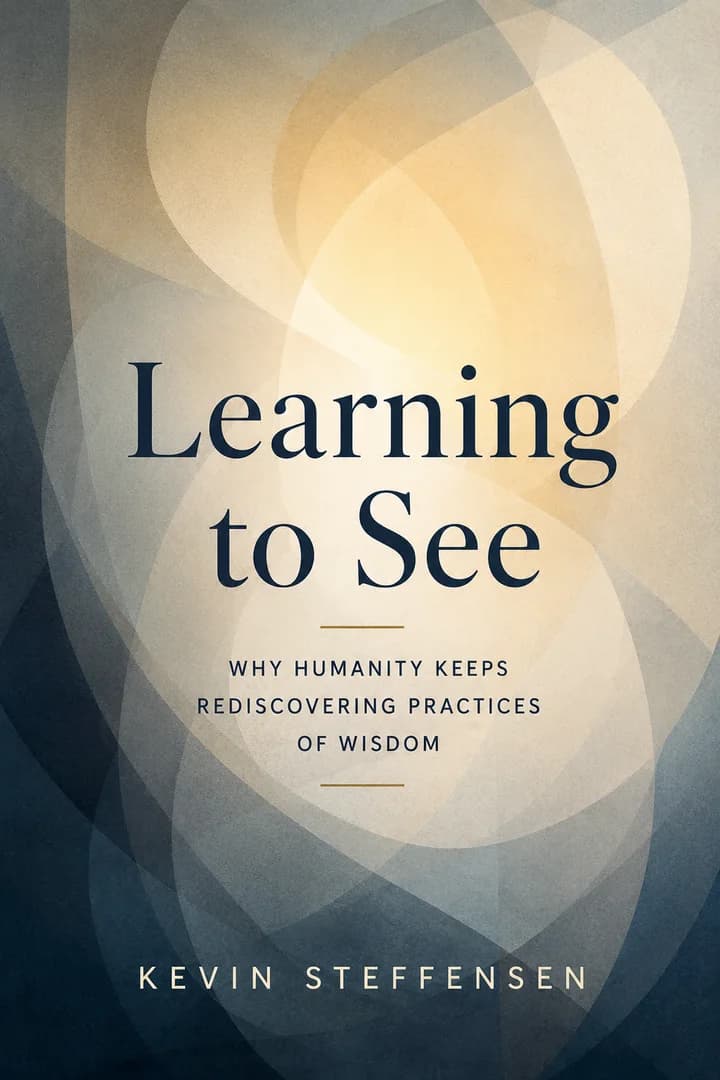
Learning to See
Why Humanity Keeps Rediscovering Practices of Wisdom
By Kevin Steffensen
A comparative inquiry into how scientific, philosophical, psychological, and spiritual traditions develop practices that help people notice more honestly and live with uncertainty—without claiming those traditions are secretly the same.
A comparative inquiry into how scientific, philosophical, psychological, and spiritual traditions develop practices that help people notice more honestly and live with uncertainty—without claiming those traditions are secretly the same.
Offered under open publishing terms (CC BY-SA). Download formats are free where available; purchase links support print editions.
- Type
- Nonfiction · monograph
- Author
- Kevin Steffensen
- Published
- 2026
- Chapters
- 19 chapters
- Formats
- EPUB, PDF, DOCX
On these shelves
Also in Meaning and Perspective
View all 6 →
How Meaning Moves
Signal, Compression, Restraint, and the Pace of Understanding
What We Cannot See
Bias, Judgment, and the Limits of Perspective
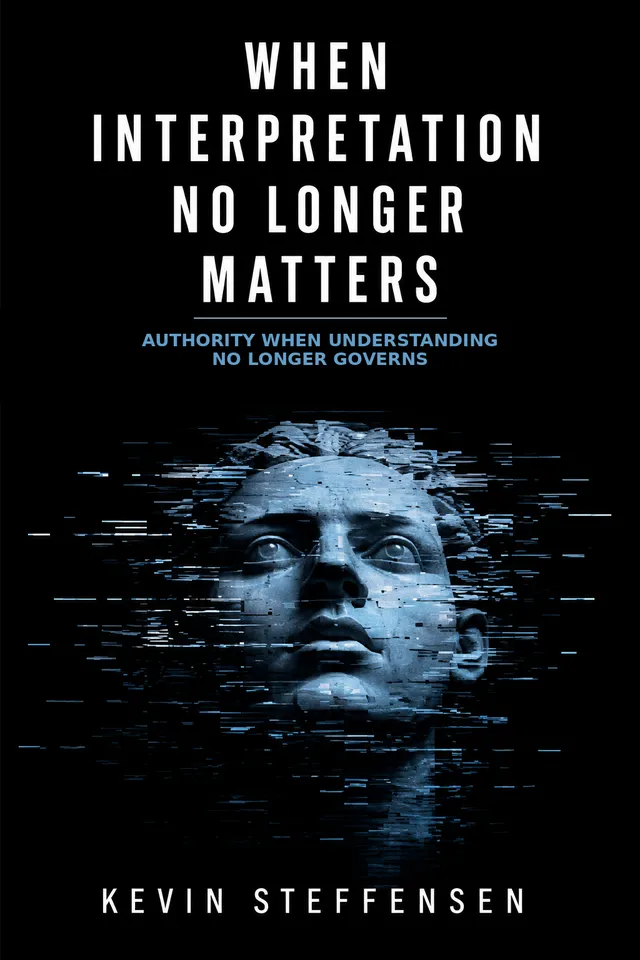
When Interpretation No Longer Matters
Authority When Understanding No Longer Governs
Observer Patterns
Poems about what happens when attention becomes decisive—when looking, deciding, and following reshape what is possible.
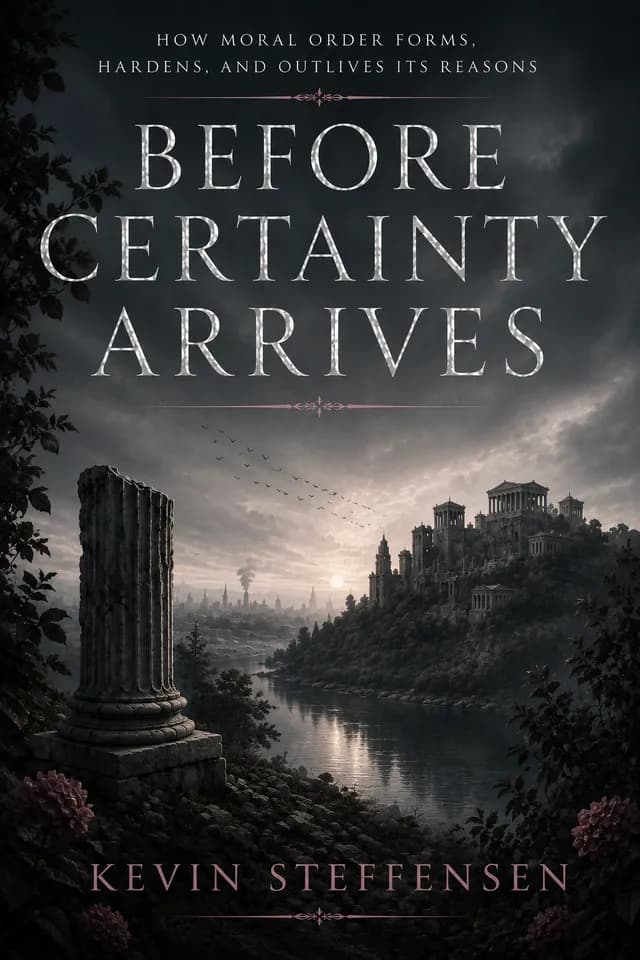
Before Certainty Arrives
How Moral Order Forms, Hardens, and Outlives Its Reasons
The question this book explores
What becomes scarce when answers become cheap—and how do we become better knowers?
Why this book exists
Comparative inquiry into how scientific, philosophical, psychological, and spiritual traditions form knowers through practices of attention—without claiming they are secretly the same—especially when intelligence and answers proliferate.
Who it is for
Readers interested in wisdom practices, epistemology across traditions, and formation under uncertainty who want a learner posture rather than a replacement ideology.
What it is not
- It is not spiritual autobiography or apologetics.
- It does not claim every tradition secretly says the same thing or offer one final synthesis.
- It does not speak for entire communities as uniform wholes.
Central ideas
A curated handful of concepts and patterns this book develops — not the full inventory.
Concept
Attention
In this book: Central practice across traditions: finite capacity that makes some signals available for response—how knowers are formed when answers become cheap.
Explore the conceptConcept
Humility
In this book: Names epistemic virtue as naming uncertainty and tradeoffs, not self-erasure; distinguishes better knowing from accumulating answers.
Explore the conceptConcept
Judgment
In this book: The aim of formation: deciding responsibly under uncertainty rather than outsourcing to proliferating intelligence.
Explore the conceptConcept
Uncertainty
In this book: Condition the book trains readers to inhabit—action remains necessary without full information or a single tradition's monopoly.
Explore the conceptConcept
Inheritance
In this book: Tracks how practices and frames arrive already formed; learning to see includes noticing what one did not choose.
Explore the conceptConcept
Formation
In this book: Names becoming a knower through attention practices across scientific, philosophical, psychological, and spiritual lineages—without collapsing them.
Explore the conceptPattern
Attention Finds a Focus
In this book: Introduces how looking settles and organizes subsequent noticing—first move in becoming a better knower.
Explore the patternPattern
Revisability Preserves Judgment
In this book: Applies the guardrail against dogma: judgment stays live only while it can still be updated.
Explore the patternPattern
Contact Keeps the Read Open
In this book: Deepens comparative inquiry: more context sharpens without forcing premature resolution across traditions.
Explore the pattern
Inside this book
How the book is organized — parts, chapters, and what each section investigates.
About 307 min of reading across 19 sections in 5 parts.
Part I — The Formation of a Knower
4 sections
Part I — The Formation of a Knower
4 sectionsShow summaryHide summary
Returning to a Book of Mormon reading-and-prayer promise he had never honestly tested, the author finds neither restored belief nor decisive proof—but a clearer view of how inherited ways of seeing form the person who judges. Untrained eyes are a fiction; practices of noticing can carry unrecognized wisdom.
Central questionWhat can returning to an inherited practice reveal about how a knower was formed?
Show summaryHide summary
The scripture experiment changed the person asking more than it settled the question asked. Knowing about humility, bias, or self-deception is not the same as having practices that keep those capacities available when certainty rises and identity is threatened.
Central questionWhy is having answers—even good ones—still insufficient for becoming a better knower?
Show summaryHide summary
A carefully prepared design review still depends on questions the author did not think to ask—showing that sustained contact with a problem cannot complete a partial view. Communities extend sight and also share blind spots; the task is formation without becoming unreachable to correction.
Central questionHow do we remain formed by others without surrendering the corrections only we might notice?
Show summaryHide summary
Part I established that knowers are formed and that no individual perspective is enough. The bridge turns toward non-interchangeable practices—prayer, meditation, confession, criticism, ritual, lament—built around attention that drifts, confidence that hardens, and suffering that resists tidy meaning.
Central questionWhat kinds of practices do communities build around limits they cannot escape?
Part II — Practices for Recurring Human Problems
7 sections
Part II — Practices for Recurring Human Problems
7 sectionsShow summaryHide summary
Breath-focused meditation makes wandering mind visible as returnable habit rather than failure—showing how attention opens a field without guaranteeing welcome for what appears. The world we see is partly prepared by practices that decide which interruptions can reach us.
Central questionWhat becomes visible only when a practice changes what attention is willing to notice?
Show summaryHide summary
In a design review, a precise answer meets a question that refuses the frame already explained—tightening identity around being the one who understands. Humility must become discernment: whom to trust for correction when the self and the group both cannot see themselves completely.
Central questionHow do we stay correctable when being wrong threatens identity and competence?
Show summaryHide summary
A design review ends in apparent agreement until a later message names the hardest coordination cost the room never faced—showing how collective seeing can manufacture alignment while suppressing minority risk. Communities learn whether questions are safe by remembering what happened to those who asked them.
Central questionWhen does seeing together deepen judgment, and when does it harden shared certainty?
Show summaryHide summary
Watching a Eucharistic sequence as a visitor, repetition shapes bodies and weeks before full understanding arrives—showing tradition as memory given form. Inherited ritual trains attention across generations and can also keep an earlier answer sacred after the question has changed.
Central questionWhat does ritual carry that explanation alone cannot—and when does inherited memory outlive its question?
Show summaryHide summary
An earlier concern returns as 'you were right' after the assumption fails—satisfaction that cannot undo delay, rework, or absorbed dissent. Confession and repair require more than correctness; some realities cannot be reconciled and must be mourned rather than processed into a complete moral lesson.
Central questionWhat must confession and repair do that being right cannot?
Show summaryHide summary
A blank condolence card makes helpful words feel too complete beside irreversible loss—distinguishing meaning discovered by the one who suffers from meaning assigned beside them. Traditions carry lament and care that once made pain survivable, and may keep teaching fear long after the original wound has changed.
Central questionHow do we accompany suffering without imposing a meaning that betrays it?
Show summaryHide summary
Part II's practices do not float above history: communities inherit, repeat, and reinterpret them until a response to danger becomes virtue and virtue becomes identity. Part III turns to sediment, evaluation without contempt, and integration without reduction.
Central questionHow do practices that once answered danger become identities difficult to distinguish from morality?
Part III — What Traditions Carry
4 sections
Part III — What Traditions Carry
4 sectionsShow summaryHide summary
Old code called technical debt often preserves a vanished failure mode—charging twice, a migration path—misread as carelessness. Cultural sediment is the past continuing to act through habits that feel like personality; contempt makes poor historians of systems still living inside us.
Central questionHow do we judge inherited structures when the problems that produced them have disappeared from view?
Show summaryHide summary
Explaining why a harmful practice developed can arrive as cushion before consequence is established—and distrust of that move can also block needed history. Archaeology without contempt keeps understanding and judgment connected: respect adaptive wisdom without making survival proof of goodness.
Central questionHow can we excavate inherited practices without romanticizing them or turning history into excuse?
Show summaryHide summary
Useful parallels—calibration and humility, peer review and discernment—open a door and then flatten: confession is not peer review; repentance is not updating a belief. Integration without reduction holds what another tradition sees while refusing to dissolve its ends into one's own vocabulary.
Central questionHow do we learn across traditions without reducing them to interchangeable mechanisms?
Show summaryHide summary
Responsible inheritance distinguishes the value a practice protects from the form that carried it. Practices forged under scarce information now meet artificial intelligence that can summarize a tradition fluently while hiding the differences integration requires—raising a new scarcity around attention and formation.
Central questionWhat becomes scarce when information and fluent answers are no longer the limiting constraint?
Part IV — The Future of Wisdom
2 sections
Part IV — The Future of Wisdom
2 sectionsShow summaryHide summary
An AI workshop presentation assembles the day's visible artifacts into a coherent story while missing the conversations, confusion, and emptied exercises that never entered the notes. When intelligence is everywhere, wisdom is knowing what an answer is for, what it leaves out, and who we must become to use it well.
Central questionWhat does intelligence leave out when it can fluently summarize what was recorded?
Show summaryHide summary
An empty minute disappears into a device before silence becomes experience—showing an old human avoidance newly equipped. Ancient practices will not save by antiquity alone; the recurring question is what kind of human beings our practices are helping us become when pauses and unresolved questions can be filled immediately.
Central questionWhat human capacities must still be cultivated when every pause can be filled with answers?
Other sections
2 sections
Other sections
2 sectionsShow summaryHide summary
Seeing is learned: families, professions, sciences, and spiritual traditions train attention differently, leaving other things at the edge. Traditions that disagree about reality still develop practices around distraction, self-deception, and inherited assumption—without being secretly the same.
Central questionWhy do traditions that disagree about reality develop practices around similar human difficulties?
Show summaryHide summary
Seeing never finishes: we inherit mixed habits of attention, need practices because insight fades, and still decide what deserves notice when answers are easier to produce. The work is teachability before certainty, responsibility when it arrives, and willingness to notice what confidence left outside the frame.
Central questionHow do we keep practicing better knowing when no final way of seeing arrives?
Where it fits
Suggested reading order and nearby volumes — not a mandatory sequence.
Read before
Read next
Continue exploring
- Next book — Living in Sediment
- Start with a question — What becomes scarce when intelligence becomes cheap?
Reading trails featuring this book
Editorial paths that include this book as one stop in a longer sequence.
Full related inventoryShowHide
Complete concept, pattern, and thinker lists for readers who want the full semantic map.
Major concepts
Concept
Adaptation
Adaptation marks moral life responding to conditions that will not wait—scarcity, violence, scale, displacement. In Before Certainty Arrives, what begins as adaptation can outlive the pressures that first made it necessary. It helps preserve workable coordination under constraint, but can fail when adaptive tools are mistaken for permanent moral truth. It differs from inheritance because adaptation names responsive change; inheritance names what gets carried forward after conditions shift. It differs from drift because adaptation is active response; drift is gradual decoupling while machinery still runs.
View Concept →
Concept
Adaptation
Adaptation marks moral life responding to conditions that will not wait—scarcity, violence, scale, displacement. In Before Certainty Arrives, what begins as adaptation can outlive the pressures that first made it necessary. It helps preserve workable coordination under constraint, but can fail when adaptive tools are mistaken for permanent moral truth. It differs from inheritance because adaptation names responsive change; inheritance names what gets carried forward after conditions shift. It differs from drift because adaptation is active response; drift is gradual decoupling while machinery still runs.
Concept
Attention
Attention names the scarce gate between signal and response. It becomes important whenever more reaches a person or institution than can be fully tracked. It helps preserve focus and timely response, but can fail when visibility metrics are mistaken for judgments about importance. In When Incentives Become the Moral Language, attention marks the domain where newsrooms still know some stories matter even if they will not perform—yet operational language shifted toward clicks, shares, and time on page. Audience behavior reflects habit, outrage, and placement, not the same thing as what the public needs for democratic judgment. It differs from bias because attention names the capacity itself; bias names the selective work performed through it.
View Concept →
Concept
Attention
Attention names the scarce gate between signal and response. It becomes important whenever more reaches a person or institution than can be fully tracked. It helps preserve focus and timely response, but can fail when visibility metrics are mistaken for judgments about importance. In When Incentives Become the Moral Language, attention marks the domain where newsrooms still know some stories matter even if they will not perform—yet operational language shifted toward clicks, shares, and time on page. Audience behavior reflects habit, outrage, and placement, not the same thing as what the public needs for democratic judgment. It differs from bias because attention names the capacity itself; bias names the selective work performed through it.
Concept
Formation
Formation names the domain where measurable outcomes replace developmental judgment in schools. Education exists to form human beings
View Concept →
Concept
Formation
Formation names the domain where measurable outcomes replace developmental judgment in schools. Education exists to form human beings
Concept
Humility
Humility—naming tradeoffs, uncertainty, distributional conflict—is epistemically virtuous and politically costly at scale. Certainty orients anxious publics and protects institutions from looking paralyzed. The outperforming of humility is not proof audiences are childish; it is proof that orientation is scarce and fear is abundant. Under interpretive stress, humility also means acknowledging what summaries omit and who pays for resilience.
View Concept →
Concept
Humility
Humility—naming tradeoffs, uncertainty, distributional conflict—is epistemically virtuous and politically costly at scale. Certainty orients anxious publics and protects institutions from looking paralyzed. The outperforming of humility is not proof audiences are childish; it is proof that orientation is scarce and fear is abundant. Under interpretive stress, humility also means acknowledging what summaries omit and who pays for resilience.
Concept
Inheritance
Inheritance names what travels forward when the original scene is gone—archives, canon, titles, feast days, bureaucratic certainty. It becomes important when systems still coordinate long after their makers' conditions have shifted. It helps preserve continuity across generations, but can fail when inherited tools resist revision while fit quietly thins. It differs from adaptation because inheritance carries forward what stabilized; adaptation names the original responsive work. It differs from drift because inheritance emphasizes persistence of form; drift emphasizes gradual decoupling from conditions.
View Concept →
Concept
Inheritance
Inheritance names what travels forward when the original scene is gone—archives, canon, titles, feast days, bureaucratic certainty. It becomes important when systems still coordinate long after their makers' conditions have shifted. It helps preserve continuity across generations, but can fail when inherited tools resist revision while fit quietly thins. It differs from adaptation because inheritance carries forward what stabilized; adaptation names the original responsive work. It differs from drift because inheritance emphasizes persistence of form; drift emphasizes gradual decoupling from conditions.
Concept
Interpretation
Interpretation names the ongoing work of deciding what something means enough to coordinate on. It becomes important whenever shared action depends on more than immediate perception—across time, distance, conflict, or institutional scale. It helps preserve continuity between experience and obligation, but can fail when interpretation hardens into category and stops tracking changing conditions. In the authority arc, sacred authority compresses interpretation while writing and law later externalize it so disputes can be settled without shared presence. It differs from private understanding because interpretation must be able to coordinate judgment or contest authority in shared space; it differs from meaning because interpretation is the active reconstruction, not only what gets stabilized.
View Concept →
Concept
Interpretation
Interpretation names the ongoing work of deciding what something means enough to coordinate on. It becomes important whenever shared action depends on more than immediate perception—across time, distance, conflict, or institutional scale. It helps preserve continuity between experience and obligation, but can fail when interpretation hardens into category and stops tracking changing conditions. In the authority arc, sacred authority compresses interpretation while writing and law later externalize it so disputes can be settled without shared presence. It differs from private understanding because interpretation must be able to coordinate judgment or contest authority in shared space; it differs from meaning because interpretation is the active reconstruction, not only what gets stabilized.
Concept
Judgment
Judgment names the capacity to decide when understanding is incomplete but harm, coordination, or responsibility will not wait. It becomes important whenever action must proceed under partial information and real consequence. It helps preserve proportionality, answerability, and room for revision, but can fail when judgment hardens into dogma, paralysis, or punitive finality. It differs from certainty because judgment accepts incomplete sight; it differs from preference because judgment weighs consequence beyond taste; it differs from optimization because judgment keeps contestability and human proportion in view; it differs from rule-following because judgment must still respond when rules lag reality.
View Concept →
Concept
Judgment
Judgment names the capacity to decide when understanding is incomplete but harm, coordination, or responsibility will not wait. It becomes important whenever action must proceed under partial information and real consequence. It helps preserve proportionality, answerability, and room for revision, but can fail when judgment hardens into dogma, paralysis, or punitive finality. It differs from certainty because judgment accepts incomplete sight; it differs from preference because judgment weighs consequence beyond taste; it differs from optimization because judgment keeps contestability and human proportion in view; it differs from rule-following because judgment must still respond when rules lag reality.
Concept
Uncertainty
Uncertainty names the condition moral and social systems are built to navigate—the space where coordination must happen before truth is settled, where lives are fragmented and behavior must hold together under incomplete information. It becomes important because human action cannot wait for perfect knowledge; groups must decide, move, and coordinate even when the future is unclear, when disagreement is costly, when explanation cannot travel fast enough to settle disputes before consequences arrive. Uncertainty is not a problem to eliminate but a condition to navigate—the ground on which moral life operates. Certainty emerges as an adaptive response to uncertainty, compressing ambiguity into stable expectations so action can proceed. But uncertainty itself is neither failure nor freedom; it is the default state that requires coordination tools. The After Certainty project explores how to practice judgment, accountability, and responsiveness inside uncertainty rather than demanding that uncertainty be resolved before moral life can begin. The question uncertainty raises is: what uncertainty is this system trying to reduce? Is ambiguity dangerous because the stakes are genuinely high, or because failure now scales? Uncertainty differs from ignorance in that uncertainty is about incomplete information in contexts requiring action, while ignorance is simply lack of knowledge.
View Concept →
Concept
Uncertainty
Uncertainty names the condition moral and social systems are built to navigate—the space where coordination must happen before truth is settled, where lives are fragmented and behavior must hold together under incomplete information. It becomes important because human action cannot wait for perfect knowledge; groups must decide, move, and coordinate even when the future is unclear, when disagreement is costly, when explanation cannot travel fast enough to settle disputes before consequences arrive. Uncertainty is not a problem to eliminate but a condition to navigate—the ground on which moral life operates. Certainty emerges as an adaptive response to uncertainty, compressing ambiguity into stable expectations so action can proceed. But uncertainty itself is neither failure nor freedom; it is the default state that requires coordination tools. The After Certainty project explores how to practice judgment, accountability, and responsiveness inside uncertainty rather than demanding that uncertainty be resolved before moral life can begin. The question uncertainty raises is: what uncertainty is this system trying to reduce? Is ambiguity dangerous because the stakes are genuinely high, or because failure now scales? Uncertainty differs from ignorance in that uncertainty is about incomplete information in contexts requiring action, while ignorance is simply lack of knowledge.
Major patterns
Pattern
Attention Finds a Focus
The group faces unclear next steps. It needs direction. People need to work together. No clear process has named who will lead. - People want a steer when things are unclear - Silence pushes someone to act - Early signals weigh extra - Leadership can show up without anyone planning it Attention settles on one person. Others start lining up their behavior with that person's actions, tone, or timing. When nobody knows the next move, attention finds a focus fast—then direction follows whether anyone planned it or not.
View Pattern →
Pattern
Attention Finds a Focus
The group faces unclear next steps. It needs direction. People need to work together. No clear process has named who will lead. - People want a steer when things are unclear - Silence pushes someone to act - Early signals weigh extra - Leadership can show up without anyone planning it Attention settles on one person. Others start lining up their behavior with that person's actions, tone, or timing. When nobody knows the next move, attention finds a focus fast—then direction follows whether anyone planned it or not.
Supporting · Corrective
Commitment Leaves Room
Systems must act before certainty arrives, but commitments become dangerous when correction threatens identity, legitimacy, sunk cost, or authority. - Action cannot wait for certainty - Closed commitment resists correction Commitment enables coordinated action while preserving room for revision when evidence, conditions, or consequences change.
View Pattern →
Supporting · Corrective
Commitment Leaves Room
Systems must act before certainty arrives, but commitments become dangerous when correction threatens identity, legitimacy, sunk cost, or authority. - Action cannot wait for certainty - Closed commitment resists correction Commitment enables coordinated action while preserving room for revision when evidence, conditions, or consequences change.
Pattern
Contact Keeps the Read Open
People return to a difficult exchange with more context and lower reactivity. Early interpretation may be useful but still too rough. - Additional context widens what people can see - Lower emotional charge improves tolerance for ambiguity - Restraint keeps meaning revisable Additional context can sharpen understanding without fully resolving it. Contact keeps the read open when understanding tightens without the story having to close.
View Pattern →
Pattern
Contact Keeps the Read Open
People return to a difficult exchange with more context and lower reactivity. Early interpretation may be useful but still too rough. - Additional context widens what people can see - Lower emotional charge improves tolerance for ambiguity - Restraint keeps meaning revisable Additional context can sharpen understanding without fully resolving it. Contact keeps the read open when understanding tightens without the story having to close.
Master pattern
Reality Answers Back
Human systems must simplify reality in order to perceive, decide, coordinate, and act. Those simplifications necessarily leave out people, consequences, perspectives, history, and changed conditions. - Simplification is required for coordinated action - What is left out eventually returns - Systems need paths for revision before collapse Every abstraction, institution, decision, and model eventually encounters the reality it only partially captured. Reality answers through failures, exceptions, dissent, unintended behavior, lived experience, or consequences the model did not contain.
View Pattern →
Master pattern
Reality Answers Back
Human systems must simplify reality in order to perceive, decide, coordinate, and act. Those simplifications necessarily leave out people, consequences, perspectives, history, and changed conditions. - Simplification is required for coordinated action - What is left out eventually returns - Systems need paths for revision before collapse Every abstraction, institution, decision, and model eventually encounters the reality it only partially captured. Reality answers through failures, exceptions, dissent, unintended behavior, lived experience, or consequences the model did not contain.
Pattern
Revisability Preserves Judgment
Judgment remains necessary when certainty weakens; people still must weigh tradeoffs and consequences without a final frame to hide inside. Finality no longer stabilizes judgment, yet paralysis and dogma are both available failures. - New information threatens prior commitments - Groups confuse openness with weakness - Revision must be practiced without infinite deferral - Coherence pressures compete with contact with reality Revisability is what prevents judgment from hardening into dogma. A leader publishes what would change their mind—and acts on the answer when it arrives.
View Pattern →
Pattern
Revisability Preserves Judgment
Judgment remains necessary when certainty weakens; people still must weigh tradeoffs and consequences without a final frame to hide inside. Finality no longer stabilizes judgment, yet paralysis and dogma are both available failures. - New information threatens prior commitments - Groups confuse openness with weakness - Revision must be practiced without infinite deferral - Coherence pressures compete with contact with reality Revisability is what prevents judgment from hardening into dogma. A leader publishes what would change their mind—and acts on the answer when it arrives.
Related songs
Song
Learning to See
Ethereal Celtic new-age hymn: a soft vow to keep learning to see, stay, and leave wonder inside beliefs, claiming no final window and no final view.
View Song →
Song
Learning to See
Ethereal Celtic new-age hymn: a soft vow to keep learning to see, stay, and leave wonder inside beliefs, claiming no final window and no final view.
Song
NOT YET!
Neon techno J-pop at club tempo: three voices chant NOT YET while Japanese verses catch the mind writing a finished story from one glance, and English hooks keep every answer playfully provisional.
View Song →
Song
NOT YET!
Neon techno J-pop at club tempo: three voices chant NOT YET while Japanese verses catch the mind writing a finished story from one glance, and English hooks keep every answer playfully provisional.
Major thinkers
Person
Alasdair MacIntyre
Moral philosopher of virtue ethics, tradition-constituted practice, and critique of emotivist modern morality.
View Thinker →
Person
Alasdair MacIntyre
Moral philosopher of virtue ethics, tradition-constituted practice, and critique of emotivist modern morality.
Person
Dan M Kahan
Legal scholar studying cultural cognition—how group identity shapes risk perception and belief formation.
View Thinker →
Person
Dan M Kahan
Legal scholar studying cultural cognition—how group identity shapes risk perception and belief formation.
Person
Daniel Kahneman
Psychologist of judgment and decision-making—biases, heuristics, and noise in expert choice.
View Thinker →
Person
Daniel Kahneman
Psychologist of judgment and decision-making—biases, heuristics, and noise in expert choice.
Person
Irving L Janis
Psychologist of groupthink—how cohesive groups suppress dissent and convince themselves their consensus is rational.
View Thinker →
Person
Irving L Janis
Psychologist of groupthink—how cohesive groups suppress dissent and convince themselves their consensus is rational.
Person
J David Pulsipher
Scholar of peace studies and Mormon theology; coauthor of Proclaim Peace.
View Thinker →
Person
J David Pulsipher
Scholar of peace studies and Mormon theology; coauthor of Proclaim Peace.
Person
Jan Shipps
Historian of Mormonism as new religious tradition emerging in American society.
View Thinker →
Person
Jan Shipps
Historian of Mormonism as new religious tradition emerging in American society.
Person
Karl R Popper
Philosopher of falsification, open society, and critique of historicist certainty.
View Thinker →
Person
Karl R Popper
Philosopher of falsification, open society, and critique of historicist certainty.
Person
Leonard J Arrington
Historian of Mormon economic and frontier settlement history; author of Great Basin Kingdom.
View Thinker →
Person
Leonard J Arrington
Historian of Mormon economic and frontier settlement history; author of Great Basin Kingdom.
Person
Patrick Q Mason
Historian of Mormonism and peace studies; coauthor of Proclaim Peace on conflict and contention in Latter-day Saint culture.
View Thinker →
Person
Patrick Q Mason
Historian of Mormonism and peace studies; coauthor of Proclaim Peace on conflict and contention in Latter-day Saint culture.
Person
Philip E Tetlock
Researchers on integrative complexity and how leaders structure thinking under conflict and uncertainty.
View Thinker →
Person
Philip E Tetlock
Researchers on integrative complexity and how leaders structure thinking under conflict and uncertainty.
Person
Richard Lyman Bushman
Historian of early Mormonism, Joseph Smith, and the cultural formation of Latter-day Saint community.
View Thinker →
Person
Richard Lyman Bushman
Historian of early Mormonism, Joseph Smith, and the cultural formation of Latter-day Saint community.
Person
Thomas F O'Dea
Sociologist of Mormonism; authority, cooperation, and sources of internal strain.
View Thinker →
Person
Thomas F O'Dea
Sociologist of Mormonism; authority, cooperation, and sources of internal strain.
Person
Thomas S Kuhn
Historian and philosopher of scientific paradigms, normal science, and revolutionary shifts in what counts as evidence.
View Thinker →
Person
Thomas S Kuhn
Historian and philosopher of scientific paradigms, normal science, and revolutionary shifts in what counts as evidence.
Research sources
book
Great Basin Kingdom: An Economic History of the Latter-day Saints, 1830–1900
Arrington, Leonard J. Great Basin Kingdom: An Economic History of the Latter-day Saints, 1830–1900. Cambridge, MA: Harvard University Press, 1958.
View Source →
book
Great Basin Kingdom: An Economic History of the Latter-day Saints, 1830–1900
Arrington, Leonard J. Great Basin Kingdom: An Economic History of the Latter-day Saints, 1830–1900. Cambridge, MA: Harvard University Press, 1958.
book
Joseph Smith: Rough Stone Rolling
Bushman, Richard Lyman. Joseph Smith: Rough Stone Rolling. New York: Alfred A. Knopf, 2005.
View Source →
book
Joseph Smith: Rough Stone Rolling
Bushman, Richard Lyman. Joseph Smith: Rough Stone Rolling. New York: Alfred A. Knopf, 2005.
book
Groupthink: Psychological Studies of Policy Decisions and Fiascoes
Janis, Irving L. Groupthink: Psychological Studies of Policy Decisions and Fiascoes. 2nd ed. Boston: Houghton Mifflin, 1982.
View Source →
book
Groupthink: Psychological Studies of Policy Decisions and Fiascoes
Janis, Irving L. Groupthink: Psychological Studies of Policy Decisions and Fiascoes. 2nd ed. Boston: Houghton Mifflin, 1982.
article
Motivated Reasoning.
Kahan, Dan M. "Motivated Reasoning." Behavioral and Brain Sciences (2017).
View Source →
article
Motivated Reasoning.
Kahan, Dan M. "Motivated Reasoning." Behavioral and Brain Sciences (2017).
book
Thinking, Fast and Slow
Kahneman, Daniel. Thinking, Fast and Slow. New York: Farrar, Straus and Giroux, 2011.
View Source →
book
Thinking, Fast and Slow
Kahneman, Daniel. Thinking, Fast and Slow. New York: Farrar, Straus and Giroux, 2011.
book
The Structure of Scientific Revolutions
Kuhn, Thomas S. The Structure of Scientific Revolutions. 4th ed. Chicago: University of Chicago Press, 2012.
View Source →
book
The Structure of Scientific Revolutions
Kuhn, Thomas S. The Structure of Scientific Revolutions. 4th ed. Chicago: University of Chicago Press, 2012.
book
After Virtue: A Study in Moral Theory
MacIntyre, Alasdair. After Virtue: A Study in Moral Theory. 3rd ed. Notre Dame, IN: University of Notre Dame Press, 2007.
View Source →
book
After Virtue: A Study in Moral Theory
MacIntyre, Alasdair. After Virtue: A Study in Moral Theory. 3rd ed. Notre Dame, IN: University of Notre Dame Press, 2007.
book
Proclaim Peace: The Restoration's Answer to an Age of Conflict
Mason, Patrick Q., and J. David Pulsipher. Proclaim Peace: The Restoration's Answer to an Age of Conflict. Salt Lake City: Deseret Book; Provo, UT: Neal A. Maxwell Institute for Religious Scholarship, 2021.
View Source →
book
Proclaim Peace: The Restoration's Answer to an Age of Conflict
Mason, Patrick Q., and J. David Pulsipher. Proclaim Peace: The Restoration's Answer to an Age of Conflict. Salt Lake City: Deseret Book; Provo, UT: Neal A. Maxwell Institute for Religious Scholarship, 2021.
book
The Mormons
O'Dea, Thomas F. The Mormons. Chicago: University of Chicago Press, 1957.
View Source →
book
The Mormons
O'Dea, Thomas F. The Mormons. Chicago: University of Chicago Press, 1957.
book
The Logic of Scientific Discovery
Popper, Karl R. The Logic of Scientific Discovery. London: Hutchinson, 1959.
View Source →
book
The Logic of Scientific Discovery
Popper, Karl R. The Logic of Scientific Discovery. London: Hutchinson, 1959.
book
Mormonism: The Story of a New Religious Tradition
Shipps, Jan. Mormonism: The Story of a New Religious Tradition. Urbana: University of Illinois Press, 1985.
View Source →
book
Mormonism: The Story of a New Religious Tradition
Shipps, Jan. Mormonism: The Story of a New Religious Tradition. Urbana: University of Illinois Press, 1985.
book
Expert Political Judgment: How Good Is It? How Can We Know?
Tetlock, Philip E. Expert Political Judgment: How Good Is It? How Can We Know?. Princeton, NJ: Princeton University Press, 2005.
View Source →
book
Expert Political Judgment: How Good Is It? How Can We Know?
Tetlock, Philip E. Expert Political Judgment: How Good Is It? How Can We Know?. Princeton, NJ: Princeton University Press, 2005.