
Pattern
Attention Finds a Focus
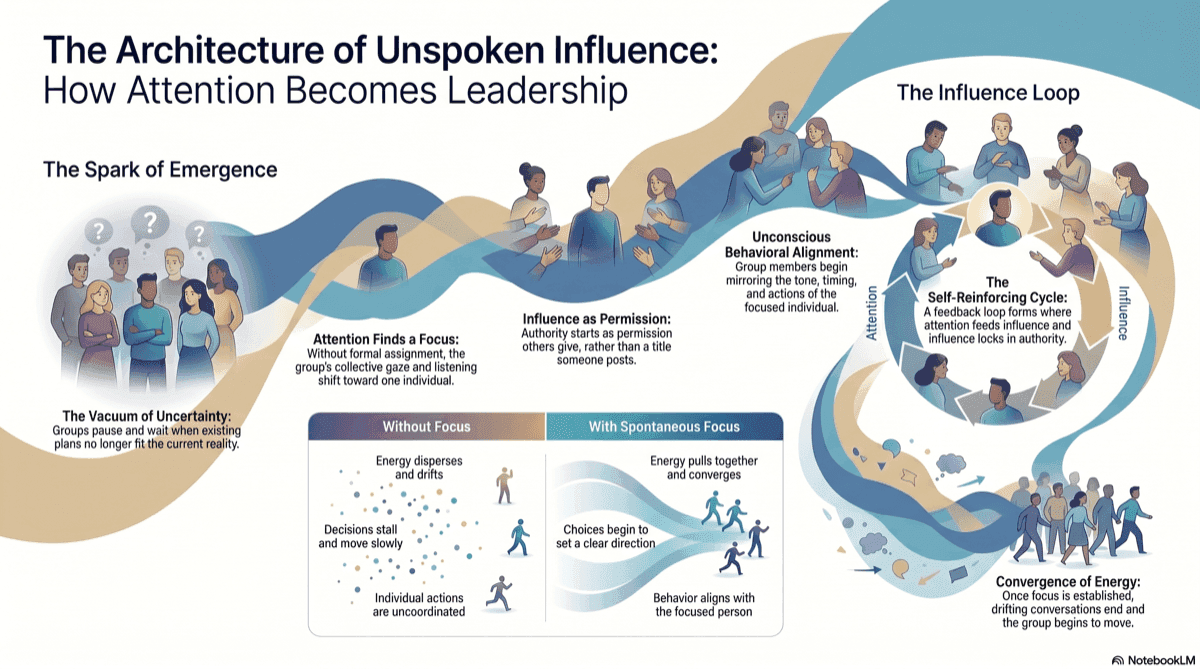
Attention settles on one person. Others start lining up their behavior with that person's actions, tone, or timing.
The group faces unclear next steps. It needs direction. People need to work together. No clear process has named who will lead. - People want a steer when things are unclear - Silence pushes someone to act - Early signals weigh extra - Leadership can show up without anyone planning it Attention settles on one person. Others start lining up their behavior with that person's actions, tone, or timing. When nobody knows the next move, attention finds a focus fast—then direction follows whether anyone planned it or not.
Setup
The group faces unclear next steps. It needs direction.
Problem
People need to work together. No clear process has named who will lead.
Forces
- People want a steer when things are unclear
- Silence pushes someone to act
- Early signals weigh extra
- Leadership can show up without anyone planning it
Observation
Attention settles on one person. Others start lining up their behavior with that person's actions, tone, or timing.
Example
When nobody knows the next move, attention finds a focus fast—then direction follows whether anyone planned it or not.
At a glance
What it does
Attention settles on one person. Others start lining up their behavior with that person's actions, tone, or timing.
Why it matters
People need to work together. No clear process has named who will lead.
Key risk
people glance toward the same person when uncertainty rises in a meeting
Counterbalance
name who is deciding for this stretch before ambiguity hardens
Related video
Having trouble playing the video? Open it on YouTube.
Infographic
Recognition signals
- people glance toward the same person when uncertainty rises in a meeting
- silence pushes someone to act before any formal handoff
- early reactions and tone get copied before rules do
- pace, tolerance, and silence from one person become group instruction
- influence forms before anyone names who will lead
Questions to ask
- When nobody knows the next move, where does attention settle first?
- What signals are people reading from my silence or reaction?
- Has one person become the default steer without a title change?
Counterbalances
- name who is deciding for this stretch before ambiguity hardens
- rotate who opens unclear meetings so attention does not lock early
- make space for a second voice before the first reaction sets the norm
Trajectory
Early signals
- cues gather around whoever spoke confidently last
- the group pauses and looks toward one seat when stakes rise
Intensification
- attention and influence reinforce each other in a tightening loop
- others line up timing and tone with the focal person automatically
Failure modes
- authority locks in while formal roles still look unsettled
- leadership coalesces before circulation or correction paths exist
Restoration paths
- interrupt the loop by handing a temporary steer to whoever is closest to the issue
- make early signals explicit before they become habit
Manifestations
leadership
- a congregation listens for tone before interpreting a difficult moment
organizations
- a team waits for direction when performance falters even without a charted lead
family
- a child hesitates at a crossing and glances at a parent before moving
Appears in chapters
- Introduction — Learning to See
- Chapter 1 — The Experiment I Had Never Tried
- Bridge — The Practices We Build Around Our Limits
- Chapter 4 — What Attention Makes Visible
- Bridge — The Next Scarcity
- Chapter 14 — Ancient Practices, Future Problems
- Chapter 1 — What the Scoreboard Leaves Out
- Introduction — When Others Look To You
And 8 more chapters with this association.
Related books3 books

Book
When Others Look to You
Renewal and Erosion in Leadership
A leadership field guide to how influence forms, how trust is renewed, and how erosion begins when responsibility drifts from practice.
View book

Book
When Others Look to You: Companion Edition
Forming, Renewing, Eroding, Repeating
How leadership influence forms, renews, erodes, and repeats across the full cycle of responsibility in practice.
View book
Book
Learning to See
Why Humanity Keeps Rediscovering Practices of Wisdom
A comparative inquiry into how scientific, philosophical, psychological, and spiritual traditions develop practices that help people notice more honestly and live with uncertainty—without claiming those traditions are secretly the same.
View book
Related songs
Outgoing dynamics1 relationship
precedes
Focused collective attention precedes authority formation.