Introduction — When Others Look To You
Skip to chapter textIntroduction
Introduction — When Others Look To You
Central question: Where does leadership begin if not with title, authority, or formal responsibility?
A leader is someone others look to when deciding what to do next—not first a title, authority, or assigned responsibility. Leadership begins when attention finds a focus. The introduction opens the book's arc: forming, renewing, eroding, and repeating as observable conditions rather than personality traits.
A leader is someone others look to when deciding what to do next.1
That’s where leadership begins. Not with a title. Not with authority. Not with responsibility. Leadership begins when Attention Finds a Focus.
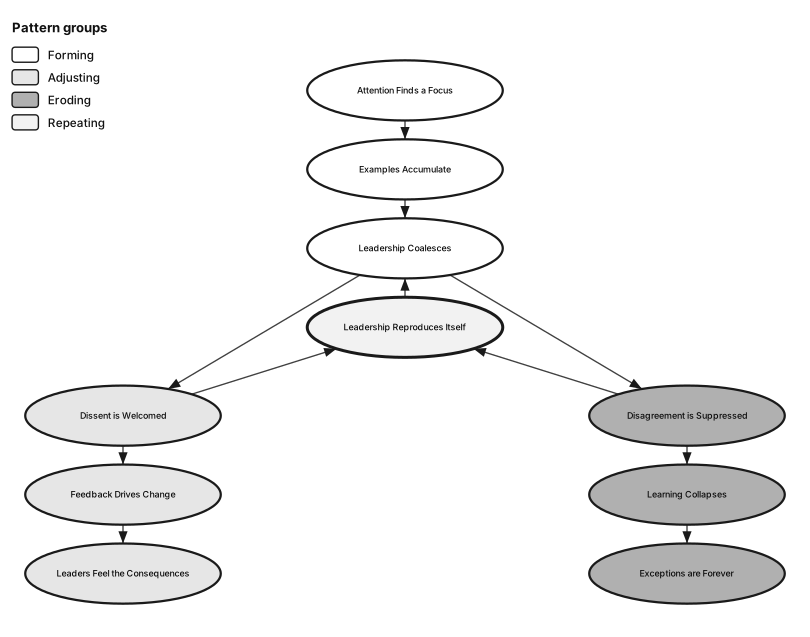
A question comes up, and the room slows until Attention Finds a Focus on one person. What they do next matters more than it seems, because Examples Accumulate. Others begin to adjust around it. Over time, without anyone deciding it explicitly, Leadership Coalesces. The group starts to rely on that more often.
If things are working well, Dissent is Welcomed, and problems show up while they can still be handled. When that happens, Feedback Drives Change. The group adjusts instead of just continuing. Things stay grounded when Leaders Feel the Consequences. The people deciding remain close to what actually happens next.
But this can shift. At some point, Disagreement is Suppressed. Decisions move forward without being tested. As that continues, Learning Collapse takes hold. What is really happening no longer reaches the people making decisions. Small workarounds start to stick. What was meant to be temporary doesn’t get undone. Before long, Exceptions are Forever.
People notice all of this. They see what moves things forward and what persists. Eventually Leadership Reproduces Itself, carrying it into the next moment when Attention Finds a Focus again.
How the dynamics stack
Those same dynamics also gather into four groups. Appendix A summarizes the full catalog under Forming, Renewing, Eroding, and Repeating. The diagram legend uses Adjusting instead of Renewing for the second group; the Renewing part follows that territory. That is the loop that keeps decisions tied to reality.
This happens everywhere—in meetings, in conversations, in families, in teams—whether anyone intends it or not.
Leadership is not something you step into once. It happens in moments. A pause. A glance. A question that needs an answer. And in that moment, what you do does not stay contained. It is seen. It is interpreted. It is repeated.
This book is about those moments. It shows how leadership forms when Attention Finds a Focus. It shows how leadership stays connected to reality—or drifts away from it. It shows how what gets copied shapes what comes next.
These dynamics are not prescriptions. They are not steps to follow. They are observable conditions that appear again and again, from small groups to large institutions.
You do not need to become a leader for them to apply. You only need to notice when others look to you.
Because when they do, something has already started. What happens next will not stay there. It will be learned. It will be repeated.
Footnotes
-
Foundational framing for authority, legitimacy, and how attention gathers around direction: Max Weber, Economy and Society: An Outline of Interpretive Sociology, ed. Guenther Roth and Claus Wittich (Berkeley: University of California Press, 1978); Hannah Arendt, "What Is Authority?" in Between Past and Future (New York: Viking Press, 1961). ↩
AI-generated narration
About 252s