
Nonfiction
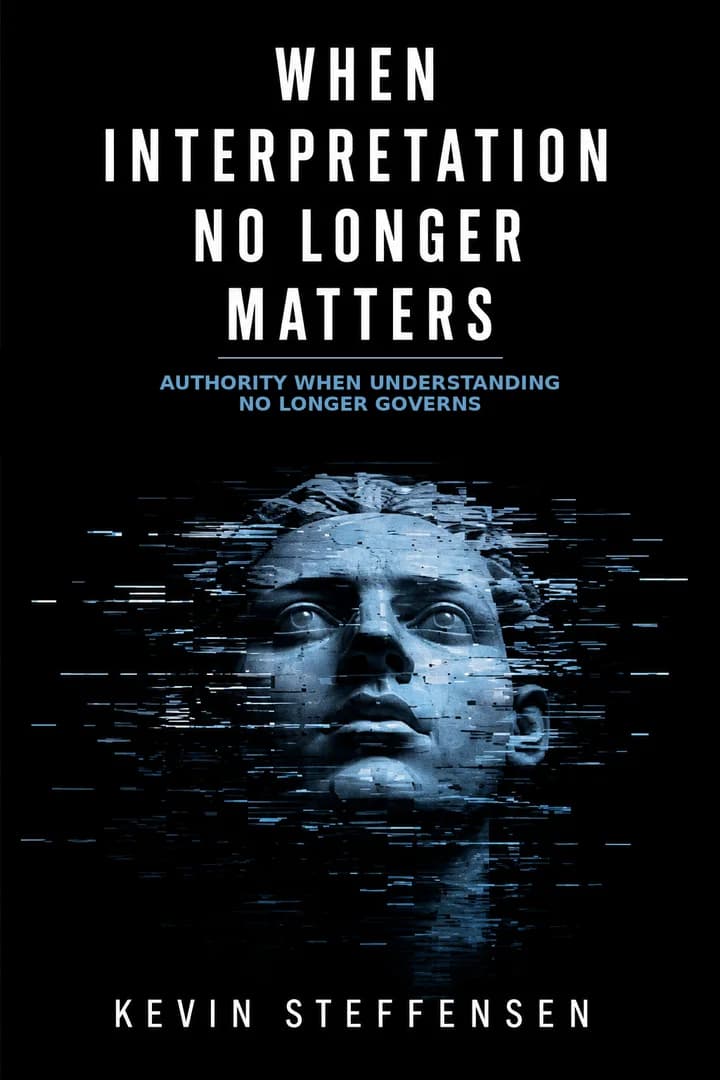
When Interpretation No Longer Matters
Authority When Understanding No Longer Governs
By Kevin Steffensen
When interpretation loses public consequence while understanding persists—and what kinds of authority remain when hearing no longer becomes legitimacy, accountability, or repair.
When interpretation loses public consequence while understanding persists—and what kinds of authority remain when hearing no longer becomes legitimacy, accountability, or repair.
Offered under open publishing terms (CC BY-SA). Download formats are free where available; purchase links support print editions.
- Type
- Nonfiction · monograph
- Author
- Kevin Steffensen
- Published
- 2026
- Chapters
- 15 chapters
- Formats
- EPUB, PDF, DOCX
On these shelves
Also in Meaning and Perspective
View all 6 →
How Meaning Moves
Signal, Compression, Restraint, and the Pace of Understanding
Learning to See
Why Humanity Keeps Rediscovering Practices of Wisdom

What We Cannot See
Bias, Judgment, and the Limits of Perspective
Observer Patterns
Poems about what happens when attention becomes decisive—when looking, deciding, and following reshape what is possible.

Before Certainty Arrives
How Moral Order Forms, Hardens, and Outlives Its Reasons


The question this book explores
What kind of authority exists when understanding no longer has the power to matter?
Why this book exists
Earlier books stay where interpretation is strained but still operative. This one begins at the boundary — hearing, restatement, even private assent without revised legitimacy — and diagnoses authority after shared evaluation loses consequence.
Who it is for
Readers of meaning, leadership, and institutions who need to tell misunderstanding apart from interpretation without leverage — before prescribing clearer speech.
What it is not
- It is not a moral verdict on people, nor a rescue plan to restore interpretation everywhere.
- It does not collapse misunderstanding, disagreement, refusal, and missing leverage into one failure.
- It is not the same inquiry as metrics replacing judgment (see When Incentives Become the Moral Language).
Central ideas
A curated handful of concepts and patterns this book develops — not the full inventory.
Concept
Interpretation
Interpretation names the ongoing work of deciding what something means enough to coordinate on. It becomes important whenever shared action depends on more than immediate perception—across time, distance, conflict, or institutional scale. It helps preserve continuity between experience and obligation, but can fail when interpretation hardens into category and stops tracking changing conditions. In the authority arc, sacred authority compresses interpretation while writing and law later externalize it so disputes can be settled without shared presence. It differs from private understanding because interpretation must be able to coordinate judgment or contest authority in shared space; it differs from meaning because interpretation is the active reconstruction, not only what gets stabilized.
Interpretation — open concept pageConcept
Authority
Authority names who can coordinate action when full agreement is impossible. It becomes important whenever groups must move before every perspective aligns. It helps preserve direction and collective capacity, but can fail when operational power outruns justified recognition or visible consequence. It differs from legitimacy because authority is the capacity to steer; legitimacy is whether that capacity reads as earned and revisable enough to coordinate trust rather than performative compliance.
Authority — open concept pageConcept
Narrative enclosure
Narrative enclosure names an interpretive system that absorbs all evidence internally and prevents external meaning from functioning as correction. Interpretation is rigorous but bounded by a predetermined frame—the narrative itself cannot be questioned, only elaborated. External contradiction intensifies commitment rather than weakening it, disconfirming evidence is reclassified as persecution or fulfillment, and no external input can alter the narrative boundary. Intensive internal study and theological debate flourish, but the leader controls the interpretive frame. Failed predictions are absorbed as prophetic testing, state pressure is reframed as validation, internal doubt is reclassified as misunderstanding. Can external disagreement alter the frame—or only intensify internal debate? Where does every contradiction become confirmation? Interpretation loses access to external constraint, correction mechanisms function only inside the story, and intervention accelerates collapse rather than restoring accountability. The restoration path—maintain inputs that can alter the frame before standoff, preserve epistemic permeability before enclosure seals, separate internal coherence from external accountability.
Narrative enclosure — open concept pageConcept
Displacement (of interpretation)
Displacement names the condition where interpretation exists but no longer functions—it continues privately while losing public leverage. People understand what is happening without that understanding altering standing, disagreement is reframed as betrayal rather than alternative reading, moral language persists while evaluative traction disappears. Informational remedies fail despite accurate recognition because the problem is not ignorance but loss of mediating function. Displacement differs from interpretive collapse (where public interpretation vanishes) and from coercion (where threat operates). It connects to public interpretation (which still mediates), private understanding (which does not travel), and post-interpretive authority (which no longer depends on justification). Where does understanding persist without changing authority's position? What still interprets—and what no longer mediates legitimacy? The question is not content but function.
Displacement (of interpretation) — open concept pageConcept
Witness
Witness names a form of judgment that does not pretend to fix what it cannot yet change. It becomes important when mediating institutions are gone, damaged, or structurally unable to connect interpretation to consequence. It helps preserve memory, moral clarity, and refusal of erasure, but can fail when witness is mistaken for intervention—or when expressive condemnation substitutes for understanding structural limits. It differs from repair because witness does not assume standing can be restored; it differs from correction because witness may record harm without altering it; it differs from accountability because witness can persist where consequence pathways are blocked.
Witness — open concept pageConcept
Post-interpretive authority
Post-interpretive authority names a regime shift in which power continues while familiar interpretive tools lose traction across boundaries. Explanation, transparency, and dialogue may persist as language without mediating legitimacy. It becomes important when repair backfires or when contradiction strengthens loyalty rather than weakening standing. It differs from boundary because boundary marks where understanding ceases to govern persistence; post-interpretive authority names the regime that can result. It differs from total authority because some private or fragmented interpretation may still exist—public evaluative function is displaced, not always extinguished.
Post-interpretive authority — open concept pagePattern
Explanation Replaces Response
Explanation helps people understand events, reduce confusion, and name causes when situations outrun intuition. Analysis expands while action stalls; understanding becomes satisfying enough to substitute for responsibility. - More context feels like moral progress - Meetings reward comprehension over commitment - Harm is reorganized faster than it is reduced - Urgency is discharged into interpretation At its limit, explanation reorganizes harm rather than reducing it. A fifth working session adds history and incentives while the decision everyone already senses stays unmade.
Explanation Replaces Response — open pattern pagePattern
Disagreement is Suppressed
A leader or leadership setup gains stability, success, or repeated proof that they are right. Guarding the leader can matter as much as getting the facts right. - Success builds confidence. Challenge feels less needed. - Speaking against the line costs more socially - Loyalty is rewarded over pushback - Stories about who we are harden around the leader Dissent fades or softens until it no longer challenges decisions. I keep asking where the challenge is, and I'm not hearing it. Disagreement is suppressed—even when the risk is staring at us.
Disagreement is Suppressed — open pattern pagePattern
Correctness Hardens Into Identity
Correctness begins as a tool for coordination—aligning on evidence, reality, and shared understanding under uncertainty. Under pressure, being right matters less for understanding than for preserving coherence and belonging; revision starts feeling like betrayal. - Disagreement is treated as moral threat - Identity fuses with the winning frame - Revision threatens group coherence - Finality relieves the discomfort of not knowing The danger is not error alone; it is the inability to remain revisable. A team treats a challenged forecast as disloyalty rather than as an update to shared reality.
Correctness Hardens Into Identity — open pattern pagePattern
Meaning Reinforces Itself
A group repeats interactions through an existing interpretive frame. The frame no longer feels provisional. - Selective attention confirms prior meaning - Repetition normalizes prior conclusions - Social alignment penalizes interpretive differences Once established, interpretation begins shaping future interpretation. Meaning reinforces itself when what we conclude once becomes what we are prepared to see again.
Meaning Reinforces Itself — open pattern page
Inside this book
How the book is organized — parts, chapters, and what each section investigates.
About 190 min of reading across 15 sections in 4 parts.
Part I — Where Interpretation Ends
3 sections
Part I — Where Interpretation Ends
3 sectionsShow summaryHide summary
Part I opens where interpretation stops functioning as a shared path into consequence: doors that open only inward, and rooms where everyone already knows. The movement is diagnostic rather than accusatory—learning to recognize the boundary before prescribing clearer speech.
Central questionWhere does shared understanding stop being able to revise what authority may do?
Show summaryHide summary
Some doors open only from inside—the lock works, reasons from the hallway cannot turn the bolt. Family rules, workplace customs, and congregational readings can give reasons that hold within while sounding circular to outsiders. The threshold chapter names enclosure: interpretation still happens inside, but entry is not available to argument from without.
Central questionHow can meaning remain lively inside a room that outsiders cannot argue their way into?
Show summaryHide summary
Across a kitchen table someone warns carefully; the other nods gratefully—*I know*—and the conversation ends because recognition was absorbed as agreement. Shared understanding arrives quickly and still leaves no path into a world where the warning can matter. Knowing together is not yet leverage; displacement begins when recognition substitutes for repair.
Central questionWhy can shared recognition feel like progress while leaving danger untouched?
Part II — What Replaces It
5 sections
Part II — What Replaces It
5 sectionsShow summaryHide summary
Part II follows what takes interpretation's place when shared evaluation no longer governs: arguments that sort loyalty, names that outlive platforms, applause that cannot end, and stories that metabolize every objection. Replacement is not silence—it is other uses of speech.
Central questionWhat kinds of speech take over when interpretation no longer revises authority?
Show summaryHide summary
A family group chat fills with forwarded posts; the question looks like evidence while the work is affiliation. Caution is heard as softness or betrayal; neutrality becomes a side. Disagreement no longer clarifies a proposition across a shared evaluative space—it sorts who belongs. Interpretation is displaced by sorting.
Central questionWhen does an argument about evidence become a machine for sorting loyalty?
Show summaryHide summary
A campaign button in a drawer outlives the wage board and foreign policy that once justified its slogan. Inherited political labels become household atmosphere—children learn the name before the budget. Loyalty can outlive the reasons that once made loyalty look like judgment; the name waits for an heir, not a better brief.
Central questionHow does a political name keep organizing belonging after its first platform is gone?
Show summaryHide summary
Palms are sore and rhythm has gone wrong, yet the ovation continues because stopping marks you against a room that has not granted permission to end it. What holds the sound open is not belief that the words deserve another minute—it is shared knowledge that the first lowered hands will be seen. Performative legitimacy under coercion replaces evaluation with watched endurance.
Central questionWhat kind of authority is being performed when no one can safely stop applauding?
Show summaryHide summary
Attack is answered not with evidence first but with a quieter sentence: if this were nothing, no one would bother. The move feels like thoughtfulness—thicker accounts of motive, tone, and timing—while sealing the belief against interruption. Interpreting harder becomes enclosure; every objection confirms the story rather than reopening shared evaluation.
Central questionHow can interpreting harder seal a belief against the very objections that should test it?
Part III — Before and After the Boundary
4 sections
Part III — Before and After the Boundary
4 sectionsShow summaryHide summary
Part III asks what happens before and after the boundary when questions become disloyalty, criticism becomes purification ritual, and judgment still has work that is not repair. Correction's tools remain available as language while losing the capacity to revise standing.
Central questionWhat can still be done when the tools of correction no longer reopen authority?
Show summaryHide summary
An ordinary ask for pilot results and verification dates is met with smiles about negativity, momentum, and vision—openness language intact while the corridor translation reprices the question. Freedom to ask remains; a second and third request start to sound like personality. Evidence becomes an attitude problem when constraint has been cast as optional drama.
Central questionHow does a request for evidence become coded as disloyalty without anyone forbidding the question?
Show summaryHide summary
Retrospectives and self-criticism hours ask for candor on a timer; what follows is approved failure—flaws the hierarchy is ready to absorb—rather than discovery that would rearrange standing. Notebooks fill with sentences that sound like repair and function as ritual proof that criticism occurred. Critique can be commandeered as authority's output, not its constraint.
Central questionWhen does required criticism stop correcting authority and start reproducing it?
Show summaryHide summary
Someone writes after it is too late—names copied before they thin, testimony for a tribunal that may not arrive. The hand is not inventing theory; it is attaching words to events that would otherwise remain private weather. Witness is not a rescue program when mediating pathways are smashed; it is judgment's remaining social life—record, address, and obligation that outlasts the speaker.
Central questionWhat can judgment still do when it cannot restore the pathway from recognition to repair?
Other sections
3 sections
Other sections
3 sectionsShow summaryHide summary
A careful concern is raised, restated more cleanly, and met with nods—yet nothing redistributes consequence. The room did not lack sentences; it lacked an obligation that sentences could enforce. The introduction names the book's question: what kind of authority exists when understanding no longer has the power to matter, and how to tell that condition apart from mere misunderstanding.
Central questionWhat remains of authority when recognition no longer redistributes consequence?
Show summaryHide summary
The opening shrug—concern understood, decision unchanged—returns harder to treat as mere etiquette. The book refuses a single explanation (misunderstanding, refusal, capture, evil) for every failure of consequence, keeping a sharper alternative available: not everything that fails to matter has been misunderstood. The improvement is modest: which questions to keep open long enough for a useful distinction to appear.
Central questionWhat distinction remains useful after we stop collapsing every unanswered concern into misunderstanding?
Show summaryHide summary
Working terms for scenes already argued—alignment/sorting, interpretation as shared consequential evaluation, and related reminders—not a checklist for diagnosing every room or a syllabus to recite over a meeting. The appendix keeps vocabulary available without pretending definitions replace judgment.
Central questionWhich working terms help keep the book's distinctions available without turning them into a checklist?
Where it fits
Suggested reading order and nearby volumes — not a mandatory sequence.
Read before
Continue exploring
- Next book — When Incentives Become the Moral Language
- Start with a question — What happens when authority no longer needs understanding?
Reading trails featuring this book
Editorial paths that include this book as one stop in a longer sequence.
Full related inventoryShowHide
Complete concept, pattern, and thinker lists for readers who want the full semantic map.
Major concepts
Concept
Alignment
Alignment names how people move together—shared direction, mutual recognition, coordinated response. It becomes important when groups must act before full agreement is possible. Ordinarily, alignment can still be tested against evidence and revised through persuasion. In the authority arc, alignment can be sustained through belonging signals rather than evaluation; disagreement sorts allies from adversaries, and claims function as badges of membership. It helps preserve cohesion under pressure, but can fail when alignment replaces the capacity to be moved by reasons from outside the frame. It differs from legitimacy because alignment can persist without justified recognition; it differs from coordination because alignment can bind identity, not only sequence action.
View Concept →
Concept
Alignment
Alignment names how people move together—shared direction, mutual recognition, coordinated response. It becomes important when groups must act before full agreement is possible. Ordinarily, alignment can still be tested against evidence and revised through persuasion. In the authority arc, alignment can be sustained through belonging signals rather than evaluation; disagreement sorts allies from adversaries, and claims function as badges of membership. It helps preserve cohesion under pressure, but can fail when alignment replaces the capacity to be moved by reasons from outside the frame. It differs from legitimacy because alignment can persist without justified recognition; it differs from coordination because alignment can bind identity, not only sequence action.
Concept
Alignment at scale
Alignment at scale names what happens when belonging-signal authority hardens into institution—participation precedes comprehension, ritual routinizes commitment, and external critique rarely destabilizes standing. It differs from alignment because alignment names the pattern of sustaining authority through belonging; alignment at scale names its institutional reproduction across distance and generations.
View Concept →
Concept
Alignment at scale
Alignment at scale names what happens when belonging-signal authority hardens into institution—participation precedes comprehension, ritual routinizes commitment, and external critique rarely destabilizes standing. It differs from alignment because alignment names the pattern of sustaining authority through belonging; alignment at scale names its institutional reproduction across distance and generations.
Concept
Authority
Authority names who can coordinate action when full agreement is impossible. It becomes important whenever groups must move before every perspective aligns. It helps preserve direction and collective capacity, but can fail when operational power outruns justified recognition or visible consequence. It differs from legitimacy because authority is the capacity to steer; legitimacy is whether that capacity reads as earned and revisable enough to coordinate trust rather than performative compliance.
View Concept →
Concept
Authority
Authority names who can coordinate action when full agreement is impossible. It becomes important whenever groups must move before every perspective aligns. It helps preserve direction and collective capacity, but can fail when operational power outruns justified recognition or visible consequence. It differs from legitimacy because authority is the capacity to steer; legitimacy is whether that capacity reads as earned and revisable enough to coordinate trust rather than performative compliance.
Concept
Boundary
Boundary names where one kind of obligation ends and another begins—between roles, institutions, scales, or interpretive frames. It becomes important when coordination must clarify who can decide, who must answer, and what counts as shared ground. It helps preserve legible responsibility and evaluative contact, but can fail when boundaries harden into walls that block correction. In the post-interpretive authority context, a boundary is where external understanding ceases to govern legitimacy while power continues. It differs from coupling because a boundary marks a shift in shape, not the strength of attachment between action and consequence.
View Concept →
Concept
Boundary
Boundary names where one kind of obligation ends and another begins—between roles, institutions, scales, or interpretive frames. It becomes important when coordination must clarify who can decide, who must answer, and what counts as shared ground. It helps preserve legible responsibility and evaluative contact, but can fail when boundaries harden into walls that block correction. In the post-interpretive authority context, a boundary is where external understanding ceases to govern legitimacy while power continues. It differs from coupling because a boundary marks a shift in shape, not the strength of attachment between action and consequence.
Concept
Coercion
Coercion names authority maintained through threat or enforcement that strips public interpretation of relevance. Compliance matters; belief does not. Public disagreement functions as self-exposure rather than interpretation, rituals of affirmation substitute for evaluative agreement, and private understanding persists without public consequence. Silence signals uncertainty while visible conformity signals safety. Show trials, denunciations, and orchestrated demonstrations mark the shift—meaning becomes script to enact rather than claim to evaluate. Coercion succeeds when each act of compliance raises the perceived cost for others, when dissent carries not just social cost but extreme risk. At its limit, public interpretation as shared evaluative process disappears, and exposure or reform fail to constrain authority.
View Concept →
Concept
Coercion
Coercion names authority maintained through threat or enforcement that strips public interpretation of relevance. Compliance matters; belief does not. Public disagreement functions as self-exposure rather than interpretation, rituals of affirmation substitute for evaluative agreement, and private understanding persists without public consequence. Silence signals uncertainty while visible conformity signals safety. Show trials, denunciations, and orchestrated demonstrations mark the shift—meaning becomes script to enact rather than claim to evaluate. Coercion succeeds when each act of compliance raises the perceived cost for others, when dissent carries not just social cost but extreme risk. At its limit, public interpretation as shared evaluative process disappears, and exposure or reform fail to constrain authority.
Concept
Displacement (of interpretation)
Displacement names the condition where interpretation exists but no longer functions—it continues privately while losing public leverage. People understand what is happening without that understanding altering standing, disagreement is reframed as betrayal rather than alternative reading, moral language persists while evaluative traction disappears. Informational remedies fail despite accurate recognition because the problem is not ignorance but loss of mediating function. Displacement differs from interpretive collapse (where public interpretation vanishes) and from coercion (where threat operates). It connects to public interpretation (which still mediates), private understanding (which does not travel), and post-interpretive authority (which no longer depends on justification). Where does understanding persist without changing authority's position? What still interprets—and what no longer mediates legitimacy? The question is not content but function.
View Concept →
Concept
Displacement (of interpretation)
Displacement names the condition where interpretation exists but no longer functions—it continues privately while losing public leverage. People understand what is happening without that understanding altering standing, disagreement is reframed as betrayal rather than alternative reading, moral language persists while evaluative traction disappears. Informational remedies fail despite accurate recognition because the problem is not ignorance but loss of mediating function. Displacement differs from interpretive collapse (where public interpretation vanishes) and from coercion (where threat operates). It connects to public interpretation (which still mediates), private understanding (which does not travel), and post-interpretive authority (which no longer depends on justification). Where does understanding persist without changing authority's position? What still interprets—and what no longer mediates legitimacy? The question is not content but function.
Concept
Exit
Exit names the ability to leave an authority system without prohibitive moral, social, or material cost. It matters because exit cost determines whether participation is genuinely voluntary or functionally coerced. Each act of participation increases the cost of leaving—family estrangement and financial demands raise exit barriers, communal immersion makes departure feel like moral betrayal, alternatives appear prohibitively costly. When exit is affordable, voice can function—disagreement carries survivable cost. When exit is blocked, participation deepens faster than evaluation, loyalty performance substitutes for ongoing evaluative choice, and authority reproduces through sunk cost rather than persuasion. Departure feels indistinguishable from moral collapse. Who can exit without being cast as traitor or failure? What would leaving cost morally, socially, and materially? Where has participation deepened faster than evaluation? The restoration path—preserve low-cost exit before commitment deepens, maintain relationships outside the authority system, reduce material and social penalties for departure.
View Concept →
Concept
Exit
Exit names the ability to leave an authority system without prohibitive moral, social, or material cost. It matters because exit cost determines whether participation is genuinely voluntary or functionally coerced. Each act of participation increases the cost of leaving—family estrangement and financial demands raise exit barriers, communal immersion makes departure feel like moral betrayal, alternatives appear prohibitively costly. When exit is affordable, voice can function—disagreement carries survivable cost. When exit is blocked, participation deepens faster than evaluation, loyalty performance substitutes for ongoing evaluative choice, and authority reproduces through sunk cost rather than persuasion. Departure feels indistinguishable from moral collapse. Who can exit without being cast as traitor or failure? What would leaving cost morally, socially, and materially? Where has participation deepened faster than evaluation? The restoration path—preserve low-cost exit before commitment deepens, maintain relationships outside the authority system, reduce material and social penalties for departure.
Concept
Identity-saturated political authority
Political legitimacy grounded in collective identity rather than outcomes, arguments, or institutional justification.
View Concept →
Concept
Identity-saturated political authority
Political legitimacy grounded in collective identity rather than outcomes, arguments, or institutional justification.
Concept
Identity saturation
Authority embedded so deeply in group identity that disagreement is experienced as a threat to belonging rather than a challenge to claims.
View Concept →
Concept
Identity saturation
Authority embedded so deeply in group identity that disagreement is experienced as a threat to belonging rather than a challenge to claims.
Concept
Interpretation
Interpretation names the ongoing work of deciding what something means enough to coordinate on. It becomes important whenever shared action depends on more than immediate perception—across time, distance, conflict, or institutional scale. It helps preserve continuity between experience and obligation, but can fail when interpretation hardens into category and stops tracking changing conditions. In the authority arc, sacred authority compresses interpretation while writing and law later externalize it so disputes can be settled without shared presence. It differs from private understanding because interpretation must be able to coordinate judgment or contest authority in shared space; it differs from meaning because interpretation is the active reconstruction, not only what gets stabilized.
View Concept →
Concept
Interpretation
Interpretation names the ongoing work of deciding what something means enough to coordinate on. It becomes important whenever shared action depends on more than immediate perception—across time, distance, conflict, or institutional scale. It helps preserve continuity between experience and obligation, but can fail when interpretation hardens into category and stops tracking changing conditions. In the authority arc, sacred authority compresses interpretation while writing and law later externalize it so disputes can be settled without shared presence. It differs from private understanding because interpretation must be able to coordinate judgment or contest authority in shared space; it differs from meaning because interpretation is the active reconstruction, not only what gets stabilized.
Concept
Interpretive collapse
Interpretive collapse names a structural shift, not mere ignorance. It becomes important when people still recognize contradictions but that recognition no longer alters standing, coordinates judgment, or opens repair. It helps diagnose regimes where informational remedies fail because the problem is function, not content. It differs from private understanding because collapse concerns public activity; private understanding can continue beneath it. It differs from post-interpretive authority because collapse describes lost function; post-interpretive authority describes authority that no longer requires external interpretation to persist.
View Concept →
Concept
Interpretive collapse
Interpretive collapse names a structural shift, not mere ignorance. It becomes important when people still recognize contradictions but that recognition no longer alters standing, coordinates judgment, or opens repair. It helps diagnose regimes where informational remedies fail because the problem is function, not content. It differs from private understanding because collapse concerns public activity; private understanding can continue beneath it. It differs from post-interpretive authority because collapse describes lost function; post-interpretive authority describes authority that no longer requires external interpretation to persist.
Concept
Judgment
Judgment names the capacity to decide when understanding is incomplete but harm, coordination, or responsibility will not wait. It becomes important whenever action must proceed under partial information and real consequence. It helps preserve proportionality, answerability, and room for revision, but can fail when judgment hardens into dogma, paralysis, or punitive finality. It differs from certainty because judgment accepts incomplete sight; it differs from preference because judgment weighs consequence beyond taste; it differs from optimization because judgment keeps contestability and human proportion in view; it differs from rule-following because judgment must still respond when rules lag reality.
View Concept →
Concept
Judgment
Judgment names the capacity to decide when understanding is incomplete but harm, coordination, or responsibility will not wait. It becomes important whenever action must proceed under partial information and real consequence. It helps preserve proportionality, answerability, and room for revision, but can fail when judgment hardens into dogma, paralysis, or punitive finality. It differs from certainty because judgment accepts incomplete sight; it differs from preference because judgment weighs consequence beyond taste; it differs from optimization because judgment keeps contestability and human proportion in view; it differs from rule-following because judgment must still respond when rules lag reality.
Concept
Judgment failure
The condition in which moral clarity increases without restoring interpretive traction or practical leverage.
View Concept →
Concept
Judgment failure
The condition in which moral clarity increases without restoring interpretive traction or practical leverage.
Concept
Legitimacy
Legitimacy names the standing that lets authority coordinate without constant coercion. It becomes important when scale, abstraction, or time separate decision-makers from lived consequence. It helps preserve trust and willing participation, but can fail when smooth operation is mistaken for moral standing or when scrutiny is treated as disloyalty. It differs from alignment because legitimacy still invites proportionate inquiry; alignment can bind through belonging signals alone.
View Concept →
Concept
Legitimacy
Legitimacy names the standing that lets authority coordinate without constant coercion. It becomes important when scale, abstraction, or time separate decision-makers from lived consequence. It helps preserve trust and willing participation, but can fail when smooth operation is mistaken for moral standing or when scrutiny is treated as disloyalty. It differs from alignment because legitimacy still invites proportionate inquiry; alignment can bind through belonging signals alone.
Concept
Narrative enclosure
Narrative enclosure names an interpretive system that absorbs all evidence internally and prevents external meaning from functioning as correction. Interpretation is rigorous but bounded by a predetermined frame—the narrative itself cannot be questioned, only elaborated. External contradiction intensifies commitment rather than weakening it, disconfirming evidence is reclassified as persecution or fulfillment, and no external input can alter the narrative boundary. Intensive internal study and theological debate flourish, but the leader controls the interpretive frame. Failed predictions are absorbed as prophetic testing, state pressure is reframed as validation, internal doubt is reclassified as misunderstanding. Can external disagreement alter the frame—or only intensify internal debate? Where does every contradiction become confirmation? Interpretation loses access to external constraint, correction mechanisms function only inside the story, and intervention accelerates collapse rather than restoring accountability. The restoration path—maintain inputs that can alter the frame before standoff, preserve epistemic permeability before enclosure seals, separate internal coherence from external accountability.
View Concept →
Concept
Narrative enclosure
Narrative enclosure names an interpretive system that absorbs all evidence internally and prevents external meaning from functioning as correction. Interpretation is rigorous but bounded by a predetermined frame—the narrative itself cannot be questioned, only elaborated. External contradiction intensifies commitment rather than weakening it, disconfirming evidence is reclassified as persecution or fulfillment, and no external input can alter the narrative boundary. Intensive internal study and theological debate flourish, but the leader controls the interpretive frame. Failed predictions are absorbed as prophetic testing, state pressure is reframed as validation, internal doubt is reclassified as misunderstanding. Can external disagreement alter the frame—or only intensify internal debate? Where does every contradiction become confirmation? Interpretation loses access to external constraint, correction mechanisms function only inside the story, and intervention accelerates collapse rather than restoring accountability. The restoration path—maintain inputs that can alter the frame before standoff, preserve epistemic permeability before enclosure seals, separate internal coherence from external accountability.
Concept
Performative legitimacy
Performative legitimacy names authority maintained through visible compliance and ritualized participation rather than belief or justification. Visible compliance matters more than belief or coherence, ritual affirmation substitutes for justification, private skepticism coexists with public performance, and silence signals uncertainty while compliance signals safety. Understanding retreats to spaces where it cannot be spoken. Show trials turn confession into visible compliance, orchestrated demonstrations and unanimous votes mark legitimacy, revolutionary suicide rehearsals frame loyalty as public display. Where is legitimacy enacted rather than negotiated? What performance is required for safety in public space? Does private understanding alter standing at all? Each performance increases cost of visible dissent, collective practices substitute for shared evaluation, and official narratives frame repression as defense. The failure mode—legitimacy maintained through performance under threat alone, interpretation survives only where it cannot influence consequence. The restoration path—restore evaluative agreement as condition of standing where possible, reduce cost of non-performance before preference falsification locks in, protect domains where performance is not required for standing.
View Concept →
Concept
Performative legitimacy
Performative legitimacy names authority maintained through visible compliance and ritualized participation rather than belief or justification. Visible compliance matters more than belief or coherence, ritual affirmation substitutes for justification, private skepticism coexists with public performance, and silence signals uncertainty while compliance signals safety. Understanding retreats to spaces where it cannot be spoken. Show trials turn confession into visible compliance, orchestrated demonstrations and unanimous votes mark legitimacy, revolutionary suicide rehearsals frame loyalty as public display. Where is legitimacy enacted rather than negotiated? What performance is required for safety in public space? Does private understanding alter standing at all? Each performance increases cost of visible dissent, collective practices substitute for shared evaluation, and official narratives frame repression as defense. The failure mode—legitimacy maintained through performance under threat alone, interpretation survives only where it cannot influence consequence. The restoration path—restore evaluative agreement as condition of standing where possible, reduce cost of non-performance before preference falsification locks in, protect domains where performance is not required for standing.
Concept
Post-interpretive authority
Post-interpretive authority names a regime shift in which power continues while familiar interpretive tools lose traction across boundaries. Explanation, transparency, and dialogue may persist as language without mediating legitimacy. It becomes important when repair backfires or when contradiction strengthens loyalty rather than weakening standing. It differs from boundary because boundary marks where understanding ceases to govern persistence; post-interpretive authority names the regime that can result. It differs from total authority because some private or fragmented interpretation may still exist—public evaluative function is displaced, not always extinguished.
View Concept →
Concept
Post-interpretive authority
Post-interpretive authority names a regime shift in which power continues while familiar interpretive tools lose traction across boundaries. Explanation, transparency, and dialogue may persist as language without mediating legitimacy. It becomes important when repair backfires or when contradiction strengthens loyalty rather than weakening standing. It differs from boundary because boundary marks where understanding ceases to govern persistence; post-interpretive authority names the regime that can result. It differs from total authority because some private or fragmented interpretation may still exist—public evaluative function is displaced, not always extinguished.
Concept
Private understanding
Private understanding names awareness that does not travel—diaries, whispered recognition, informal networks preserving clarity beneath performative agreement. It becomes important when expression carries extreme cost but moral clarity still accumulates. It helps preserve memory and refusal of erasure, but can fail when silence is misread as unanimity or when private clarity never translates into public pressure. It differs from interpretive collapse because understanding may persist; what fails is public interpretive function.
View Concept →
Concept
Private understanding
Private understanding names awareness that does not travel—diaries, whispered recognition, informal networks preserving clarity beneath performative agreement. It becomes important when expression carries extreme cost but moral clarity still accumulates. It helps preserve memory and refusal of erasure, but can fail when silence is misread as unanimity or when private clarity never translates into public pressure. It differs from interpretive collapse because understanding may persist; what fails is public interpretive function.
Concept
Public interpretation
Public interpretation names evaluative activity that still connects reasons to standing across boundaries. It becomes important whenever legitimacy depends on more than enforcement or belonging alone. It helps preserve contestability and repair, but can fail when communication intensifies while evaluative space vanishes. It differs from private understanding because public interpretation must be able to matter publicly; it differs from interpretive collapse because collapse is the loss of this shared function, not failed comprehension alone.
View Concept →
Concept
Public interpretation
Public interpretation names evaluative activity that still connects reasons to standing across boundaries. It becomes important whenever legitimacy depends on more than enforcement or belonging alone. It helps preserve contestability and repair, but can fail when communication intensifies while evaluative space vanishes. It differs from private understanding because public interpretation must be able to matter publicly; it differs from interpretive collapse because collapse is the loss of this shared function, not failed comprehension alone.
Concept
Repair
Repair names the work of mending what authority, coordination, or relationship has strained—not merely explaining, apologizing, or documenting harm. It becomes important after drift, betrayal, or structural decoupling has weakened the link between action and answerability. It helps preserve legitimacy and renewed participation, but can fail when repair language persists while traction disappears—or when more interpretation accelerates rather than constrains authority. It differs from correction because repair addresses damaged standing and trust, not only mistaken belief; it differs from accountability because repair seeks restoration, not only exposure; it differs from witness because repair still aims to change the scene, not only preserve record.
View Concept →
Concept
Repair
Repair names the work of mending what authority, coordination, or relationship has strained—not merely explaining, apologizing, or documenting harm. It becomes important after drift, betrayal, or structural decoupling has weakened the link between action and answerability. It helps preserve legitimacy and renewed participation, but can fail when repair language persists while traction disappears—or when more interpretation accelerates rather than constrains authority. It differs from correction because repair addresses damaged standing and trust, not only mistaken belief; it differs from accountability because repair seeks restoration, not only exposure; it differs from witness because repair still aims to change the scene, not only preserve record.
Concept
Sorting
Communication that functions to classify audiences by loyalty or alignment rather than to persuade or inform.
View Concept →
Concept
Sorting
Communication that functions to classify audiences by loyalty or alignment rather than to persuade or inform.
Concept
Stability
Continuity of coordination and expectation that resists disruption; can trade off against contestability when revision paths thin.
View Concept →
Concept
Stability
Continuity of coordination and expectation that resists disruption; can trade off against contestability when revision paths thin.
Concept
Total authority
Total authority names the extreme case where public disagreement becomes life-threatening and independent evaluative institutions are eliminated. Communication may intensify while assessment vanishes—public meaning enacted as obedience, not claim. It differs from post-interpretive authority because total authority extinguishes public evaluative space rather than merely decoupling legitimacy from external interpretation. It differs from interpretive collapse because total authority actively eliminates evaluative activity; collapse can occur without full elimination.
View Concept →
Concept
Total authority
Total authority names the extreme case where public disagreement becomes life-threatening and independent evaluative institutions are eliminated. Communication may intensify while assessment vanishes—public meaning enacted as obedience, not claim. It differs from post-interpretive authority because total authority extinguishes public evaluative space rather than merely decoupling legitimacy from external interpretation. It differs from interpretive collapse because total authority actively eliminates evaluative activity; collapse can occur without full elimination.
Concept
Transitional authority
Systems that strain toward post-interpretive conditions but retain enough interpretive leverage to fracture rather than seal.
View Concept →
Concept
Transitional authority
Systems that strain toward post-interpretive conditions but retain enough interpretive leverage to fracture rather than seal.
Concept
Witness
Witness names a form of judgment that does not pretend to fix what it cannot yet change. It becomes important when mediating institutions are gone, damaged, or structurally unable to connect interpretation to consequence. It helps preserve memory, moral clarity, and refusal of erasure, but can fail when witness is mistaken for intervention—or when expressive condemnation substitutes for understanding structural limits. It differs from repair because witness does not assume standing can be restored; it differs from correction because witness may record harm without altering it; it differs from accountability because witness can persist where consequence pathways are blocked.
View Concept →
Concept
Witness
Witness names a form of judgment that does not pretend to fix what it cannot yet change. It becomes important when mediating institutions are gone, damaged, or structurally unable to connect interpretation to consequence. It helps preserve memory, moral clarity, and refusal of erasure, but can fail when witness is mistaken for intervention—or when expressive condemnation substitutes for understanding structural limits. It differs from repair because witness does not assume standing can be restored; it differs from correction because witness may record harm without altering it; it differs from accountability because witness can persist where consequence pathways are blocked.
Related songs
Song
Almost Completely True
Uneasy late-nineties art rock: badges, rating faces, and captchas accept an almost-you, while something that would not fit the question surfaces for a second and vanishes.
View Song →
Song
Almost Completely True
Uneasy late-nineties art rock: badges, rating faces, and captchas accept an almost-you, while something that would not fit the question surfaces for a second and vanishes.
Song
Epistemic Jiujitsu
Cinematic Krautrock industrial: deadpan commands about patterns proving plans, empty control rooms, and “alignment” that is only robots approving other robots.
View Song →
Song
Epistemic Jiujitsu
Cinematic Krautrock industrial: deadpan commands about patterns proving plans, empty control rooms, and “alignment” that is only robots approving other robots.
Major thinkers
Person
Albert O Hirschman
Economist and social theorist of exit, voice, and loyalty—how people respond when institutions disappoint.
View Thinker →
Person
Albert O Hirschman
Economist and social theorist of exit, voice, and loyalty—how people respond when institutions disappoint.
Person
Ashley Parker
Washington Post journalist and co-author on Donald Trump and the erosion of shared factual reference in American politics.
View Thinker →
Person
Ashley Parker
Washington Post journalist and co-author on Donald Trump and the erosion of shared factual reference in American politics.
Person
Ben Kiernan
Historian of genocide and mass violence, documenting how regimes mobilize ideology and bureaucracy.
View Thinker →
Person
Ben Kiernan
Historian of genocide and mass violence, documenting how regimes mobilize ideology and bureaucracy.
Person
Bob Woodward
Investigative journalist chronicling presidential decision-making, secrecy, and bureaucratic power.
View Thinker →
Person
Bob Woodward
Investigative journalist chronicling presidential decision-making, secrecy, and bureaucratic power.
Person
Carl Schmitt
Political theorist of sovereignty, the friend-enemy distinction, and states of exception.
View Thinker →
Person
Carl Schmitt
Political theorist of sovereignty, the friend-enemy distinction, and states of exception.
Person
Carlos Escudé
Historian of economic thought and Latin American political economy.
View Thinker →
Person
Carlos Escudé
Historian of economic thought and Latin American political economy.
Person
Cass R Sunstein
Legal scholar of behavioral economics, group polarization, and how information environments shape belief.
View Thinker →
Person
Cass R Sunstein
Legal scholar of behavioral economics, group polarization, and how information environments shape belief.
Person
Chantal Mouffe
Political theorist of agonistic democracy and constitutive conflict in plural societies.
View Thinker →
Person
Chantal Mouffe
Political theorist of agonistic democracy and constitutive conflict in plural societies.
Person
David P Chandler
Historian of Cambodia, Cold War intervention, and bureaucratic radicalism under the Khmer Rouge.
View Thinker →
Person
David P Chandler
Historian of Cambodia, Cold War intervention, and bureaucratic radicalism under the Khmer Rouge.
Person
Eileen Barker
Sociologist of new religious movements and how scholars study high-demand communities ethically.
View Thinker →
Person
Eileen Barker
Sociologist of new religious movements and how scholars study high-demand communities ethically.
Person
Eliot Brown
Journalists documenting corporate scandal, incentive distortion, and executive accountability failures.
View Thinker →
Person
Eliot Brown
Journalists documenting corporate scandal, incentive distortion, and executive accountability failures.
Person
Ernesto Laclau
Political theorist of hegemony, empty signifiers, and populist articulation of collective identity.
View Thinker →
Person
Ernesto Laclau
Political theorist of hegemony, empty signifiers, and populist articulation of collective identity.
Person
Erving Goffman
Sociologist of interaction ritual, face, framing, and the presentation of self in everyday life.
View Thinker →
Person
Erving Goffman
Sociologist of interaction ritual, face, framing, and the presentation of self in everyday life.
Person
Eugene V. Gallagher
Scholars of new religious movements, apocalyptic groups, and how high-demand communities manage dissent.
View Thinker →
Person
Eugene V. Gallagher
Scholars of new religious movements, apocalyptic groups, and how high-demand communities manage dissent.
Person
Ezra Klein
Journalist and analyst of political polarization, media incentives, and institutional dysfunction.
View Thinker →
Person
Ezra Klein
Journalist and analyst of political polarization, media incentives, and institutional dysfunction.
Person
Frank Dikötter
Historian of Mao's China, mass campaigns, and bureaucratic terror in the People's Republic.
View Thinker →
Person
Frank Dikötter
Historian of Mao's China, mass campaigns, and bureaucratic terror in the People's Republic.
Person
George D Chryssides
Scholar of new religious movements and minority faith communities in modern societies.
View Thinker →
Person
George D Chryssides
Scholar of new religious movements and minority faith communities in modern societies.
Person
Hannah Arendt
Political theorist whose work helps frame authority, judgment, responsibility, violence, and public action.
View Thinker →
Person
Hannah Arendt
Political theorist whose work helps frame authority, judgment, responsibility, violence, and public action.
Person
Henry W. Riecken
Social psychologists who studied cognitive dissonance in a doomsday cult when prophecy failed.
View Thinker →
Person
Henry W. Riecken
Social psychologists who studied cognitive dissonance in a doomsday cult when prophecy failed.
Person
Ian Kershaw
Historian of Nazi Germany, Hitler, and how ordinary institutions enabled radical evil.
View Thinker →
Person
Ian Kershaw
Historian of Nazi Germany, Hitler, and how ordinary institutions enabled radical evil.
Person
Isaiah Berlin
Political philosopher of value pluralism, liberty, and dangers of monist certainty in politics.
View Thinker →
Person
Isaiah Berlin
Political philosopher of value pluralism, liberty, and dangers of monist certainty in politics.
Person
Jacques Ellul
Theologian and critic of technique—autonomous efficiency logic colonizing moral and political life.
View Thinker →
Person
Jacques Ellul
Theologian and critic of technique—autonomous efficiency logic colonizing moral and political life.
Person
James D. Tabor
Scholars of new religious movements, apocalyptic groups, and how high-demand communities manage dissent.
View Thinker →
Person
James D. Tabor
Scholars of new religious movements, apocalyptic groups, and how high-demand communities manage dissent.
Person
Jan Shipps
Historian of Mormonism as new religious tradition emerging in American society.
View Thinker →
Person
Jan Shipps
Historian of Mormonism as new religious tradition emerging in American society.
Person
Javier Corrales
Political scientists of Venezuelan authoritarianism, oil states, and democratic backsliding.
View Thinker →
Person
Javier Corrales
Political scientists of Venezuelan authoritarianism, oil states, and democratic backsliding.
Person
John Carreyrou
Investigative journalist who exposed the Theranos fraud in Bad Blood.
View Thinker →
Person
John Carreyrou
Investigative journalist who exposed the Theranos fraud in Bad Blood.
Person
Joseph A Page
Scholar of Brazilian and Latin American political development.
View Thinker →
Person
Joseph A Page
Scholar of Brazilian and Latin American political development.
Person
Judith Shklar
Political theorist of liberalism of fear, cruelty, and putting avoidance of atrocity first.
View Thinker →
Person
Judith Shklar
Political theorist of liberalism of fear, cruelty, and putting avoidance of atrocity first.
Person
Jürgen Habermas
Philosopher of communicative action, public sphere, and legitimacy through discursive justification.
View Thinker →
Person
Jürgen Habermas
Philosopher of communicative action, public sphere, and legitimacy through discursive justification.
Person
Karl R Popper
Philosopher of falsification, open society, and critique of historicist certainty.
View Thinker →
Person
Karl R Popper
Philosopher of falsification, open society, and critique of historicist certainty.
Person
Kevin Steffensen
Author and editor of After Certainty works on meaning, authority, and how interpretation moves through institutions.
View Thinker →
Person
Kevin Steffensen
Author and editor of After Certainty works on meaning, authority, and how interpretation moves through institutions.
Person
Kirk A Hawkins
Political scientist of populist discourse, Chávez-era Venezuela, and measuring ideological constraints.
View Thinker →
Person
Kirk A Hawkins
Political scientist of populist discourse, Chávez-era Venezuela, and measuring ideological constraints.
Person
Leon Festinger
Social psychologists who studied cognitive dissonance in a doomsday cult when prophecy failed.
View Thinker →
Person
Leon Festinger
Social psychologists who studied cognitive dissonance in a doomsday cult when prophecy failed.
Person
Maggie Haberman
Pulitzer-winning political correspondent and author chronicling Donald Trump and the transformation of American political media.
View Thinker →
Person
Maggie Haberman
Pulitzer-winning political correspondent and author chronicling Donald Trump and the transformation of American political media.
Person
Maureen Farrell
Journalists documenting corporate scandal, incentive distortion, and executive accountability failures.
View Thinker →
Person
Maureen Farrell
Journalists documenting corporate scandal, incentive distortion, and executive accountability failures.
Person
Max Weber
Sociologist of bureaucracy, authority types, rationalization, and the iron cage of modern institutions.
View Thinker →
Person
Max Weber
Sociologist of bureaucracy, authority types, rationalization, and the iron cage of modern institutions.
Person
Michael Penfold
Political scientists of Venezuelan authoritarianism, oil states, and democratic backsliding.
View Thinker →
Person
Michael Penfold
Political scientists of Venezuelan authoritarianism, oil states, and democratic backsliding.
Person
Michael Scherer
Washington Post journalist covering national politics and co-author on Donald Trump and attacks on truth in public life.
View Thinker →
Person
Michael Scherer
Washington Post journalist covering national politics and co-author on Donald Trump and attacks on truth in public life.
Person
Michael Schoenhals
Historians of Mao's China drawing on archival sources for everyday life under radical campaigns.
View Thinker →
Person
Michael Schoenhals
Historians of Mao's China drawing on archival sources for everyday life under radical campaigns.
Person
Michel Foucault
Historian and philosopher of power, knowledge, and institutions—discipline, surveillance, and how subjects are formed.
View Thinker →
Person
Michel Foucault
Historian and philosopher of power, knowledge, and institutions—discipline, surveillance, and how subjects are formed.
Person
Neil Postman
Media theorist of how television and entertainment reshape public discourse, attention, and political judgment.
View Thinker →
Person
Neil Postman
Media theorist of how television and entertainment reshape public discourse, attention, and political judgment.
Person
Orlando Figes
Historian of the Russian Revolution, Soviet society, and how violence reshapes private and public memory.
View Thinker →
Person
Orlando Figes
Historian of the Russian Revolution, Soviet society, and how violence reshapes private and public memory.
Person
Peter L. Berger
Sociologists of the social construction of reality—how institutions sediment everyday knowledge into taken-for-granted worlds.
View Thinker →
Person
Peter L. Berger
Sociologists of the social construction of reality—how institutions sediment everyday knowledge into taken-for-granted worlds.
Organization
Pew Research Center
Nonpartisan research organization publishing surveys on religion, media, technology, and American public life.
View Thinker →
Organization
Pew Research Center
Nonpartisan research organization publishing surveys on religion, media, technology, and American public life.
Person
Richard Gott
Journalist and historian of Hugo Chávez and the Bolivarian revolution in Venezuelan politics.
View Thinker →
Person
Richard Gott
Journalist and historian of Hugo Chávez and the Bolivarian revolution in Venezuelan politics.
Person
Richard Lyman Bushman
Historian of early Mormonism, Joseph Smith, and the cultural formation of Latter-day Saint community.
View Thinker →
Person
Richard Lyman Bushman
Historian of early Mormonism, Joseph Smith, and the cultural formation of Latter-day Saint community.
Person
Roderick MacFarquhar
Historians of Mao's China drawing on archival sources for everyday life under radical campaigns.
View Thinker →
Person
Roderick MacFarquhar
Historians of Mao's China drawing on archival sources for everyday life under radical campaigns.
Person
Sheila Fitzpatrick
Historian of Soviet everyday life, social mobility, and how ordinary people navigated revolutionary bureaucracy.
View Thinker →
Person
Sheila Fitzpatrick
Historian of Soviet everyday life, social mobility, and how ordinary people navigated revolutionary bureaucracy.
Person
Stanley Schachter
Social psychologists who studied cognitive dissonance in a doomsday cult when prophecy failed.
View Thinker →
Person
Stanley Schachter
Social psychologists who studied cognitive dissonance in a doomsday cult when prophecy failed.
Person
Stephen Kotkin
Historian of Soviet power, Stalinism, and how revolutionary regimes build administrative terror and loyalty.
View Thinker →
Person
Stephen Kotkin
Historian of Soviet power, Stalinism, and how revolutionary regimes build administrative terror and loyalty.
Person
Stuart A. Wright
Sociologist and editor of scholarship on the Branch Davidian conflict and religious violence.
View Thinker →
Person
Stuart A. Wright
Sociologist and editor of scholarship on the Branch Davidian conflict and religious violence.
Person
Terryl L Givens
Scholar of Mormon thought, scripture, and the theological imagination of Latter-day Saint community life.
View Thinker →
Person
Terryl L Givens
Scholar of Mormon thought, scripture, and the theological imagination of Latter-day Saint community life.
Organization
The Church of Jesus Christ of Latter-day Saints
Religious institution whose texts, governance, and community practices shape a distinct moral and interpretive world.
View Thinker →
Organization
The Church of Jesus Christ of Latter-day Saints
Religious institution whose texts, governance, and community practices shape a distinct moral and interpretive world.
Person
Thomas Luckmann
Sociologists of the social construction of reality—how institutions sediment everyday knowledge into taken-for-granted worlds.
View Thinker →
Person
Thomas Luckmann
Sociologists of the social construction of reality—how institutions sediment everyday knowledge into taken-for-granted worlds.
Person
Thomas S Kuhn
Historian and philosopher of scientific paradigms, normal science, and revolutionary shifts in what counts as evidence.
View Thinker →
Person
Thomas S Kuhn
Historian and philosopher of scientific paradigms, normal science, and revolutionary shifts in what counts as evidence.
Person
Tim Reiterman
Journalist and chronicler of the Peoples Temple tragedy—how charismatic authority can override moral alarm.
View Thinker →
Person
Tim Reiterman
Journalist and chronicler of the Peoples Temple tragedy—how charismatic authority can override moral alarm.
Person
Timur Kuran
Economist of preference falsification—how public silence distorts perceived consensus and enables sudden reversals.
View Thinker →
Person
Timur Kuran
Economist of preference falsification—how public silence distorts perceived consensus and enables sudden reversals.
Organization
U.S. House of Representatives
U.S. House whose Katrina investigation report catalogued federal initiative failure.
View Thinker →
Organization
U.S. House of Representatives
U.S. House whose Katrina investigation report catalogued federal initiative failure.
Person
Václav Havel
Writer and statesman of living in truth, dissident responsibility, and moral seriousness under ideological pressure.
View Thinker →
Person
Václav Havel
Writer and statesman of living in truth, dissident responsibility, and moral seriousness under ideological pressure.
Person
Victor Klemperer
Literary scholar and diarist who analyzed how totalitarian regimes reshape everyday language and thought.
View Thinker →
Person
Victor Klemperer
Literary scholar and diarist who analyzed how totalitarian regimes reshape everyday language and thought.
Research sources
book
The Cult of We: WeWork, Adam Neumann, and the Great Startup Delusion
Brown, Eliot, and Maureen Farrell. The Cult of We: WeWork, Adam Neumann, and the Great Startup Delusion. New York: Crown, 2021.
View Source →
book
The Cult of We: WeWork, Adam Neumann, and the Great Startup Delusion
Brown, Eliot, and Maureen Farrell. The Cult of We: WeWork, Adam Neumann, and the Great Startup Delusion. New York: Crown, 2021.
book
Joseph Smith: Rough Stone Rolling
Bushman, Richard Lyman. Joseph Smith: Rough Stone Rolling. New York: Alfred A. Knopf, 2005.
View Source →
book
Joseph Smith: Rough Stone Rolling
Bushman, Richard Lyman. Joseph Smith: Rough Stone Rolling. New York: Alfred A. Knopf, 2005.
book
Bad Blood: Secrets and Lies in a Silicon Valley Startup
Carreyrou, John. Bad Blood: Secrets and Lies in a Silicon Valley Startup. New York: Knopf, 2018.
View Source →
book
Bad Blood: Secrets and Lies in a Silicon Valley Startup
Carreyrou, John. Bad Blood: Secrets and Lies in a Silicon Valley Startup. New York: Knopf, 2018.
book
Voices from S-21: Terror and History in Pol Pot’s Secret Prison
Chandler, David P. Voices from S-21: Terror and History in Pol Pot’s Secret Prison. Berkeley: University of California Press, 1999.
View Source →
book
Voices from S-21: Terror and History in Pol Pot’s Secret Prison
Chandler, David P. Voices from S-21: Terror and History in Pol Pot’s Secret Prison. Berkeley: University of California Press, 1999.
book
Dragon in the Tropics: Hugo Chávez and the Political Economy of Revolution in Venezuela
Corrales, Javier, and Michael Penfold. Dragon in the Tropics: Hugo Chávez and the Political Economy of Revolution in Venezuela. Washington, DC: Brookings Institution Press, 2011.
View Source →
book
Dragon in the Tropics: Hugo Chávez and the Political Economy of Revolution in Venezuela
Corrales, Javier, and Michael Penfold. Dragon in the Tropics: Hugo Chávez and the Political Economy of Revolution in Venezuela. Washington, DC: Brookings Institution Press, 2011.
book
The Cultural Revolution: A People’s History, 1962–1976
Dikötter, Frank. The Cultural Revolution: A People’s History, 1962–1976. New York: Bloomsbury Press, 2016.
View Source →
book
The Cultural Revolution: A People’s History, 1962–1976
Dikötter, Frank. The Cultural Revolution: A People’s History, 1962–1976. New York: Bloomsbury Press, 2016.
book
Argentine Political Culture
Escudé, Carlos. Argentine Political Culture. Pittsburgh: University of Pittsburgh Press, 1992.
View Source →
book
Argentine Political Culture
Escudé, Carlos. Argentine Political Culture. Pittsburgh: University of Pittsburgh Press, 1992.
book
The Whisperers: Private Life in Stalin’s Russia
Figes, Orlando. The Whisperers: Private Life in Stalin’s Russia. New York: Metropolitan Books, 2007.
View Source →
book
The Whisperers: Private Life in Stalin’s Russia
Figes, Orlando. The Whisperers: Private Life in Stalin’s Russia. New York: Metropolitan Books, 2007.
book
Everyday Stalinism: Ordinary Life in Extraordinary Times
Fitzpatrick, Sheila. Everyday Stalinism: Ordinary Life in Extraordinary Times. New York: Oxford University Press, 1999.
View Source →
book
Everyday Stalinism: Ordinary Life in Extraordinary Times
Fitzpatrick, Sheila. Everyday Stalinism: Ordinary Life in Extraordinary Times. New York: Oxford University Press, 1999.
book
By the Hand of Mormon: The American Scripture That Launched a New World Religion
Givens, Terryl L. By the Hand of Mormon. New York: Oxford University Press, 2002.
View Source →
book
By the Hand of Mormon: The American Scripture That Launched a New World Religion
Givens, Terryl L. By the Hand of Mormon. New York: Oxford University Press, 2002.
book
Confidence Man: The Making of Donald Trump and the Breaking of America
Haberman, Maggie. Confidence Man: The Making of Donald Trump and the Breaking of America. New York: Penguin Press, 2022.
View Source →
book
Confidence Man: The Making of Donald Trump and the Breaking of America
Haberman, Maggie. Confidence Man: The Making of Donald Trump and the Breaking of America. New York: Penguin Press, 2022.
book
Venezuela’s Chavismo and Populism in Comparative Perspective
Hawkins, Kirk A. Venezuela’s Chavismo and Populism in Comparative Perspective. Cambridge: Cambridge University Press, 2010.
View Source →
book
Venezuela’s Chavismo and Populism in Comparative Perspective
Hawkins, Kirk A. Venezuela’s Chavismo and Populism in Comparative Perspective. Cambridge: Cambridge University Press, 2010.
book
Exit, Voice, and Loyalty: Responses to Decline in Firms, Organizations, and States
Hirschman, Albert O. Exit, Voice, and Loyalty: Responses to Decline in Firms, Organizations, and States. Cambridge, MA: Harvard University Press, 1970.
View Source →
book
Exit, Voice, and Loyalty: Responses to Decline in Firms, Organizations, and States
Hirschman, Albert O. Exit, Voice, and Loyalty: Responses to Decline in Firms, Organizations, and States. Cambridge, MA: Harvard University Press, 1970.
article
Last Trump Job Approval 34%; Average Is Record-Low 41%
Jones, Jeffrey M. "Last Trump Job Approval 34%; Average Is Record-Low 41%." Gallup, January 18, 2021.
View Source →
article
Last Trump Job Approval 34%; Average Is Record-Low 41%
Jones, Jeffrey M. "Last Trump Job Approval 34%; Average Is Record-Low 41%." Gallup, January 18, 2021.
article
Trump Approval More Stable Than Approval for Prior Presidents
Jones, Jeffrey M. "Trump Approval More Stable Than Approval for Prior Presidents." Gallup, January 18, 2019.
View Source →
article
Trump Approval More Stable Than Approval for Prior Presidents
Jones, Jeffrey M. "Trump Approval More Stable Than Approval for Prior Presidents." Gallup, January 18, 2019.
article
Trump Job Approval Sets New Record for Polarization
Jones, Jeffrey M. "Trump Job Approval Sets New Record for Polarization." Gallup, January 18, 2019.
View Source →
article
Trump Job Approval Sets New Record for Polarization
Jones, Jeffrey M. "Trump Job Approval Sets New Record for Polarization." Gallup, January 18, 2019.
book
Hitler: 1889–1936 Hubris
Kershaw, Ian. Hitler: 1889–1936 Hubris. New York: W. W. Norton, 1998.
View Source →
book
Hitler: 1889–1936 Hubris
Kershaw, Ian. Hitler: 1889–1936 Hubris. New York: W. W. Norton, 1998.
article
President Trump Has Made More Than 20,000 False or Misleading Claims
Kessler, Glenn, Salvador Rizzo, and Meg Kelly. "President Trump Has Made More Than 20,000 False or Misleading Claims." Washington Post, July 13, 2020.
View Source →
article
President Trump Has Made More Than 20,000 False or Misleading Claims
Kessler, Glenn, Salvador Rizzo, and Meg Kelly. "President Trump Has Made More Than 20,000 False or Misleading Claims." Washington Post, July 13, 2020.
book
The Pol Pot Regime: Race, Power, and Genocide in Cambodia under the Khmer Rouge, 1975–79
Kiernan, Ben. The Pol Pot Regime: Race, Power, and Genocide in Cambodia under the Khmer Rouge, 1975–79. 3rd ed. New Haven, CT: Yale University Press, 2008.
View Source →
book
The Pol Pot Regime: Race, Power, and Genocide in Cambodia under the Khmer Rouge, 1975–79
Kiernan, Ben. The Pol Pot Regime: Race, Power, and Genocide in Cambodia under the Khmer Rouge, 1975–79. 3rd ed. New Haven, CT: Yale University Press, 2008.
book
Why We’re Polarized
Klein, Ezra. Why We’re Polarized. New York: Avid Reader Press, 2020.
View Source →
book
Why We’re Polarized
Klein, Ezra. Why We’re Polarized. New York: Avid Reader Press, 2020.
book
I Will Bear Witness: A Diary of the Nazi Years, 1933–1941
Klemperer, Victor. I Will Bear Witness: A Diary of the Nazi Years, 1933–1941. New York: Modern Library, 1998.
View Source →
book
I Will Bear Witness: A Diary of the Nazi Years, 1933–1941
Klemperer, Victor. I Will Bear Witness: A Diary of the Nazi Years, 1933–1941. New York: Modern Library, 1998.
book
Stalin: Paradoxes of Power, 1878–1928
Kotkin, Stephen. Stalin: Paradoxes of Power, 1878–1928. New York: Penguin Press, 2014.
View Source →
book
Stalin: Paradoxes of Power, 1878–1928
Kotkin, Stephen. Stalin: Paradoxes of Power, 1878–1928. New York: Penguin Press, 2014.
book
Private Truths, Public Lies: The Social Consequences of Preference Falsification
Kuran, Timur. Private Truths, Public Lies: The Social Consequences of Preference Falsification. Cambridge, MA: Harvard University Press, 1995.
View Source →
book
Private Truths, Public Lies: The Social Consequences of Preference Falsification
Kuran, Timur. Private Truths, Public Lies: The Social Consequences of Preference Falsification. Cambridge, MA: Harvard University Press, 1995.
book
On Populist Reason
Laclau, Ernesto. On Populist Reason. London: Verso, 2005.
View Source →
book
On Populist Reason
Laclau, Ernesto. On Populist Reason. London: Verso, 2005.
book
Mao’s Last Revolution
MacFarquhar, Roderick, and Michael Schoenhals. Mao’s Last Revolution. Cambridge, MA: Harvard University Press, 2006.
View Source →
book
Mao’s Last Revolution
MacFarquhar, Roderick, and Michael Schoenhals. Mao’s Last Revolution. Cambridge, MA: Harvard University Press, 2006.
book
Perón: A Biography
Page, Joseph A. Perón: A Biography. New York: Random House, 1983.
View Source →
book
Perón: A Biography
Page, Joseph A. Perón: A Biography. New York: Random House, 1983.
article
A Look Back at Americans' Reactions to the Jan. 6 Riot at the U.S. Capitol
Pew Research Center. "A Look Back at Americans' Reactions to the Jan. 6 Riot at the U.S. Capitol." January 4, 2022.
View Source →
article
A Look Back at Americans' Reactions to the Jan. 6 Riot at the U.S. Capitol
Pew Research Center. "A Look Back at Americans' Reactions to the Jan. 6 Riot at the U.S. Capitol." January 4, 2022.
article
Large Majority of the Public Views Prosecution of Capitol Rioters as 'Very Important.'
Pew Research Center. "Large Majority of the Public Views Prosecution of Capitol Rioters as 'Very Important.'" March 18, 2021.
View Source →
article
Large Majority of the Public Views Prosecution of Capitol Rioters as 'Very Important.'
Pew Research Center. "Large Majority of the Public Views Prosecution of Capitol Rioters as 'Very Important.'" March 18, 2021.
article
Views on the Rioting at the U.S. Capitol
Pew Research Center. "Views on the Rioting at the U.S. Capitol." January 15, 2021.
View Source →
article
Views on the Rioting at the U.S. Capitol
Pew Research Center. "Views on the Rioting at the U.S. Capitol." January 15, 2021.
book
Raven: The Untold Story of the Rev. Jim Jones
Reiterman, Tim. Raven: The Untold Story of the Rev. Jim Jones. New York: E. P. Dutton, 1982.
View Source →
book
Raven: The Untold Story of the Rev. Jim Jones
Reiterman, Tim. Raven: The Untold Story of the Rev. Jim Jones. New York: E. P. Dutton, 1982.
book
Mormonism: The Story of a New Religious Tradition
Shipps, Jan. Mormonism: The Story of a New Religious Tradition. Urbana: University of Illinois Press, 1985.
View Source →
book
Mormonism: The Story of a New Religious Tradition
Shipps, Jan. Mormonism: The Story of a New Religious Tradition. Urbana: University of Illinois Press, 1985.
book
The Gulag Archipelago, 1918-1956: An Experiment in Literary Investigation
Solzhenitsyn, Aleksandr I. The Gulag Archipelago, 1918-1956: An Experiment in Literary Investigation. Vol. 1. Translated by Thomas P. Whitney. New York: Harper & Row, 1973.
View Source →
book
The Gulag Archipelago, 1918-1956: An Experiment in Literary Investigation
Solzhenitsyn, Aleksandr I. The Gulag Archipelago, 1918-1956: An Experiment in Literary Investigation. Vol. 1. Translated by Thomas P. Whitney. New York: Harper & Row, 1973.
book
Why Waco? Cults and the Battle for Religious Freedom in America
Tabor, James D., and Eugene V. Gallagher. Why Waco? Cults and the Battle for Religious Freedom in America. Berkeley: University of California Press, 1995.
View Source →
book
Why Waco? Cults and the Battle for Religious Freedom in America
Tabor, James D., and Eugene V. Gallagher. Why Waco? Cults and the Battle for Religious Freedom in America. Berkeley: University of California Press, 1995.
book
Pearl of Great Price
The Church of Jesus Christ of Latter-day Saints. Pearl of Great Price. Salt Lake City: The Church of Jesus Christ of Latter-day Saints, 2013.
View Source →
book
Pearl of Great Price
The Church of Jesus Christ of Latter-day Saints. Pearl of Great Price. Salt Lake City: The Church of Jesus Christ of Latter-day Saints, 2013.
book
Articles of Impeachment against Donald John Trump (H. Res. 755, 116th Cong.)
U.S. House of Representatives. Articles of Impeachment against Donald John Trump. H. Res. 755. 116th Cong. (December 18, 2019).
View Source →
book
Articles of Impeachment against Donald John Trump (H. Res. 755, 116th Cong.)
U.S. House of Representatives. Articles of Impeachment against Donald John Trump. H. Res. 755. 116th Cong. (December 18, 2019).
book
Impeaching Donald John Trump, President of the United States, for High Crimes and Misdemeanors (H. Res. 24, 117th Cong.)
U.S. House of Representatives. Impeaching Donald John Trump, President of the United States, for High Crimes and Misdemeanors. H. Res. 24. 117th Cong. (January 13, 2021).
View Source →
book
Impeaching Donald John Trump, President of the United States, for High Crimes and Misdemeanors (H. Res. 24, 117th Cong.)
U.S. House of Representatives. Impeaching Donald John Trump, President of the United States, for High Crimes and Misdemeanors. H. Res. 24. 117th Cong. (January 13, 2021).
book
First They Killed My Father: A Daughter of Cambodia Remembers
Ung, Loung. First They Killed My Father: A Daughter of Cambodia Remembers. New York: HarperCollins, 2000.
View Source →
book
First They Killed My Father: A Daughter of Cambodia Remembers
Ung, Loung. First They Killed My Father: A Daughter of Cambodia Remembers. New York: HarperCollins, 2000.
book
Armageddon in Waco: Critical Perspectives on the Branch Davidian Conflict
Wright, Stuart A., ed. Armageddon in Waco: Critical Perspectives on the Branch Davidian Conflict. Chicago: University of Chicago Press, 1995.
View Source →
book
Armageddon in Waco: Critical Perspectives on the Branch Davidian Conflict
Wright, Stuart A., ed. Armageddon in Waco: Critical Perspectives on the Branch Davidian Conflict. Chicago: University of Chicago Press, 1995.