Song
Le Formulaire Ne Connaît Pas Mardi
Kevin Steffensen
French retro-futurist art-pop: cheerful bureaucracy meets a door that sticks—Mardi is not a valid value on the form.
Breezy synths and deadpan French vocals satirize categories that run cleanly while missing the decisive detail. The form knows the building, the priority, the phone number—and not Tuesday.
Breezy synths and deadpan French vocals satirize categories that run cleanly while missing the decisive detail. The form knows the building, the priority, the phone number—and not Tuesday. Bureaucracy and compression name the machinery; residue is what Autre cannot hold. The Case That Does Not Fit and How Serious Systems Learn map reconsideration when the ignored detail becomes decisive. Patterns reality-answers-back and revisability-preserves-judgment match a stuck door that will not become a dropdown.
- Languages
- fr
Recordings
4:34 · chirp-hawk v6
Related patterns3 patterns
Master pattern
Reality Answers Back
Human systems must simplify reality in order to perceive, decide, coordinate, and act. Those simplifications necessarily leave out people, consequences, perspectives, history, and changed conditions. - Simplification is required for coordinated action - What is left out eventually returns - Systems need paths for revision before collapse Every abstraction, institution, decision, and model eventually encounters the reality it only partially captured. Reality answers through failures, exceptions, dissent, unintended behavior, lived experience, or consequences the model did not contain.
View Pattern →
Pattern
Revisability Preserves Judgment
Judgment remains necessary when certainty weakens; people still must weigh tradeoffs and consequences without a final frame to hide inside. Finality no longer stabilizes judgment, yet paralysis and dogma are both available failures. - New information threatens prior commitments - Groups confuse openness with weakness - Revision must be practiced without infinite deferral - Coherence pressures compete with contact with reality Revisability is what prevents judgment from hardening into dogma. A leader publishes what would change their mind—and acts on the answer when it arrives.
View Pattern →
Pattern
Finality Compensates for Uncertainty
When uncertainty feels intolerable, people reach for closure—harsh judgment, confident speech, or premature alignment. Severity and certainty provide emotional relief where epistemic stability no longer exists. - Ambiguity feels morally unstable - Confidence signals competence - Revision is delayed to preserve calm - Groups reward decisive tone over accurate scope Finality provides relief where certainty no longer exists; insecurity often sits underneath severity. A leader announces an irreversible policy so the room can stop inhabiting doubt together.
View Pattern →
Related concepts5 concepts
Concept
Bureaucracy
Bureaucracy extends permanence into practice—rules replacing discretion, procedures replacing judgment, roles replacing relationships. At industrial scale it functions as moral infrastructure, coordinating strangers through files, stamps, and queues that must still recognize a name long enough for life to continue. Bureaucracy makes expectations visible and portable—the same form, the same stamp, the same queue number tomorrow—so thousands can coordinate without knowing one another's names. The room feels like Tuesday before the first form is stamped; box seven rather than box four determines whether a lease continues. No one feels cruel; no one feels fully responsible either. Bureaucracy coordinates while meaning quietly thins, systems function without anyone tracing harm, and the machinery keeps its appointments whether or not it still fits the lives it was meant to serve.
View Concept →
Concept
Compression
Compression reduces moral complexity for transmission at scale. Collapse gives way to compression, compression produces stabilization, and stabilization hardens into inheritance. When populations must coordinate across distance and strangers must share rules, compression lets expectations travel—law narrows discretion so the same words will be read tomorrow, canon fixes meaning so provinces can align. Compression is adaptation under pressure—instability demands it before truth is settled, acceptable interpretation shrinks while exposure widens. At its best, compression preserves coordination when full discernment is too costly; at its worst, tools built to compress instability begin to constrain adaptation, and compression outlives the conditions that required it.
View Concept →
Concept
Residue
What remains after collaboration collapses or hardens: mistrust, unspoken corrections, narratives that freeze blame, habits of performed agreement. Residue is structural aftermath, not only interpersonal hurt.
View Concept →
Concept
Judgment
Judgment names the capacity to decide when understanding is incomplete but harm, coordination, or responsibility will not wait. It becomes important whenever action must proceed under partial information and real consequence. It helps preserve proportionality, answerability, and room for revision, but can fail when judgment hardens into dogma, paralysis, or punitive finality. It differs from certainty because judgment accepts incomplete sight; it differs from preference because judgment weighs consequence beyond taste; it differs from optimization because judgment keeps contestability and human proportion in view; it differs from rule-following because judgment must still respond when rules lag reality.
View Concept →
Concept
Correction
Correction names the lived work of narrowing the gap between what was assumed and what is actually happening. It becomes important whenever systems, beliefs, or coordination can drift while still feeling operational. It helps preserve shared reality and learning, but can fail when every correction spawns new framing instead of updated contact with conditions. It differs from repair because correction updates belief and behavior; repair addresses damaged standing and trust. It differs from revisability because correction is the act; revisability is the designed capacity to keep correcting.
View Concept →
Related books3 books

Book
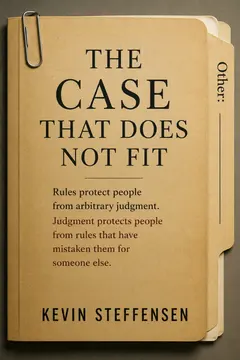
The Case That Does Not Fit
How Rules Protect Us—and What Institutions Must Do When They Misread Us
Rules make shared life possible, but every rule is a compression. The Case That Does Not Fit examines what happens when the ignored detail becomes the morally decisive one—and how institutions can preserve both protection from arbitrary judgment and protection from rules that have mistaken a person for someone else.
View book
Book
How Serious Systems Learn
Disciplines for Acting Without Certainty
A handbook for teams and institutions that need to learn in motion, improve under pressure, and make better decisions without waiting for perfect information.
View book
Book
The Discipline of Uncertainty
Judgment, Restraint, and Decision Quality Under Incomplete Information
Field notes on judgment, restraint, and decision quality when information is incomplete.
View book