
Pattern
Examples Accumulate
What the leader does—especially under pressure—quickly sets what others treat as acceptable.
A leader reacts to a mistake, competing pressures, or unclear ground in a shared setting. People need to know what counts as OK. Clear rules are missing or thin. - People watch others when things are unclear - What people see moves faster than written rules - Early reactions set what feels allowed - Silence and emphasis both send a signal What the leader does—especially under pressure—quickly sets what others treat as acceptable. Careful what we model in the room; examples accumulate faster than anything we post on the wiki.
Setup
A leader reacts to a mistake, competing pressures, or unclear ground in a shared setting.
Problem
People need to know what counts as OK. Clear rules are missing or thin.
Forces
- People watch others when things are unclear
- What people see moves faster than written rules
- Early reactions set what feels allowed
- Silence and emphasis both send a signal
Observation
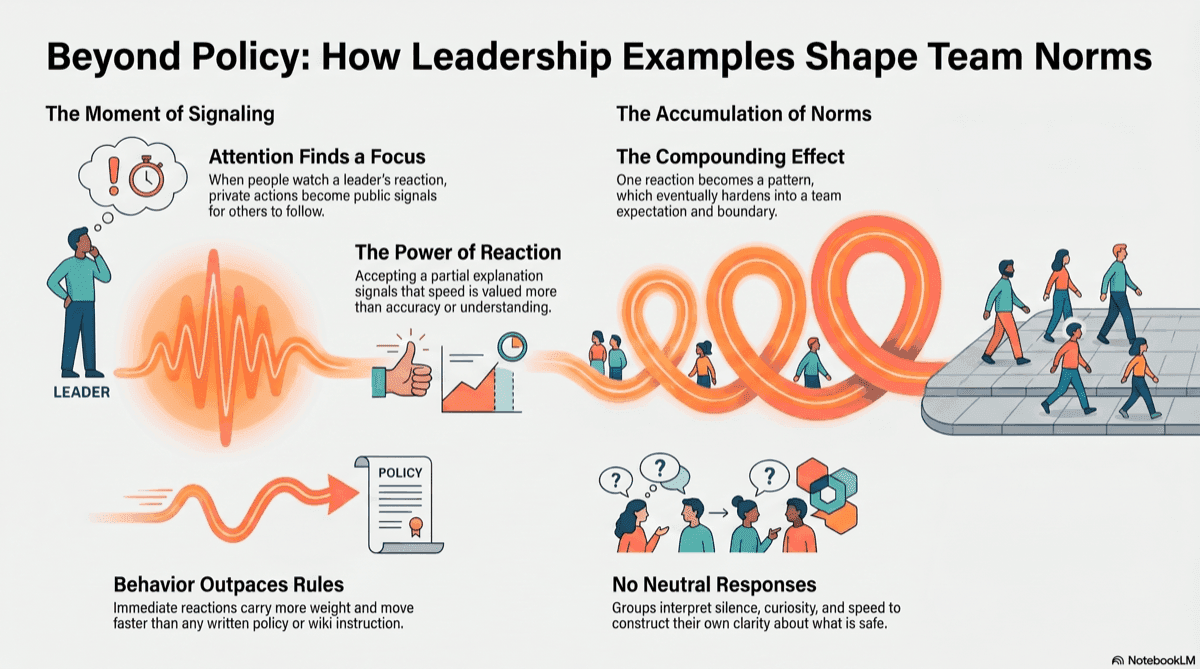
What the leader does—especially under pressure—quickly sets what others treat as acceptable.
Example
Careful what we model in the room; examples accumulate faster than anything we post on the wiki.
At a glance
What it does
What the leader does—especially under pressure—quickly sets what others treat as acceptable.
Why it matters
People need to know what counts as OK. Clear rules are missing or thin.
Key risk
what the leader rewards, punishes, or ignores sets acceptable faster than posted policy
Counterbalance
name what you are choosing to absorb or defer while others watch
Related video
Having trouble playing the video? Open it on YouTube.
Infographic
Recognition signals
- what the leader rewards, punishes, or ignores sets acceptable faster than posted policy
- under pressure, reactions and silence both get read as instruction
- early handling of mistake or harm teaches what is safe to raise next time
- people watch others when rules are thin and copy what they see
- tolerance for harm or avoidance of correction spreads through modeled behavior
Questions to ask
- What did we model in the room that people will treat as allowed?
- What are newcomers learning from example before they learn from rules?
- Which silence just sent a signal as loud as a spoken reaction?
Counterbalances
- name what you are choosing to absorb or defer while others watch
- intervene once on a harmful pattern before it teaches tolerance
- align public reaction under pressure with the wiki standard you want copied
Trajectory
Early signals
- small reactions to error get noticed and repeated by others
- people quote what someone did last time, not what policy says
Intensification
- norms harden into habit read through the last visible example
- what gets emphasized and what gets waved off diverge from written rules
Failure modes
- examples accumulate toward insulation and narrowed correction
- leadership reproduces the same permission lesson in the next cohort
Restoration paths
- change one visible reaction under pressure and let it spread
- make acknowledgment follow mistake so accountability stays teachable
Manifestations
leadership
- dismissing harm in a meeting makes others dismiss it more easily afterward
organizations
- how the lead handled the last near-miss sets the near-miss protocol informally
family
- a parent's unaddressed mistake teaches children what accountability means here
Appears in chapters
- Chapter 7 — Memory, Ritual, and Tradition
- Chapter 10 — Cultural Sediment
- Part I bridge
- Chapter 2 — Sixty Seconds
- Part II bridge
- Chapter 7 — Ninety-Day Morality
- Part III bridge
- Chapter 9 — What the Algorithm Sees
And 14 more chapters with this association.
Related books3 books

Book
When Others Look to You
Renewal and Erosion in Leadership
A leadership field guide to how influence forms, how trust is renewed, and how erosion begins when responsibility drifts from practice.
View book

Book
Coupling
Cohesion, Consequence, and the Architecture of Responsibility
A practical framework for seeing where systems are tightly joined, where they drift apart, and how those coupling choices shape accountability over time.
View book

Book
Living in Sediment
How Structures Outlive Their Reasons
We live inside inherited systems built for constraints that no longer exist. When structures survive after their reasons disappear, meaning drifts—and the danger is forgetting the sediment is sediment.
View book
Related songs
Song
It Moves Through You
Euphoric-then-dark synth-pop: three voices pass kindness, fear, custom, and power through each other until inheritance becomes a conscious choice about what keeps moving.
View Song →
Song
It Moves Through You
Euphoric-then-dark synth-pop: three voices pass kindness, fear, custom, and power through each other until inheritance becomes a conscious choice about what keeps moving.
Song
PASA
Nocturnal Latin electronic with Spanish vocals and trumpet: PASA chants laughs, fears, and mother-phrases traveling hand to hand, refusing to return unchanged.
View Song →
Song
PASA
Nocturnal Latin electronic with Spanish vocals and trumpet: PASA chants laughs, fears, and mother-phrases traveling hand to hand, refusing to return unchanged.