
Nonfiction
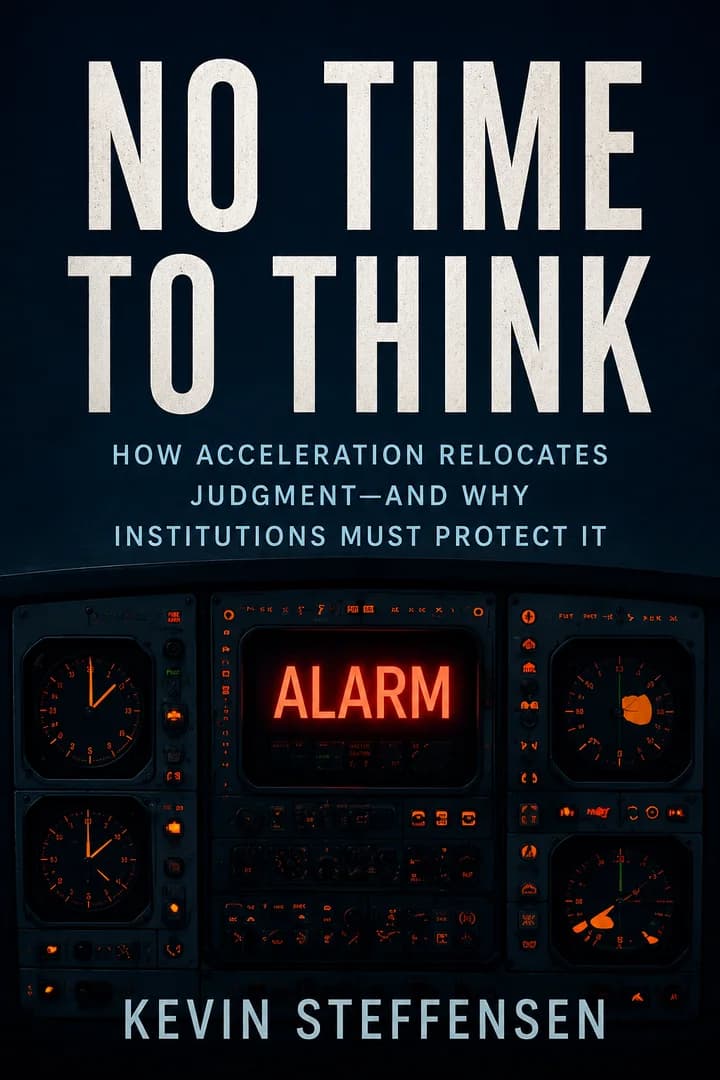
No Time to Think
How Acceleration Relocates Judgment—and Why Institutions Must Protect It
By Kevin Steffensen
Speed is not inherently careless, but judgment depends on conditions—time, attention, consequence contact, and stop authority. No Time to Think examines what happens when production accelerates faster than a system's capacity to understand, verify, integrate, maintain, and care for what it produces—and how institutions can design responsible speed.
Speed is not inherently careless, but judgment depends on conditions—time, attention, consequence contact, and stop authority. No Time to Think examines what happens when production accelerates faster than a system's capacity to understand, verify, integrate, maintain, and care for what it produces—and how institutions can design responsible speed.
Offered under open publishing terms (CC BY-SA). Download formats are free where available; purchase links support print editions.
- Type
- Nonfiction · monograph
- Author
- Kevin Steffensen
- Published
- 2026
- Chapters
- 16 chapters
- Formats
- EPUB, PDF, DOCX
On these shelves
Also in Systems and Organizations
View all 9 →
Coupling
Cohesion, Consequence, and the Architecture of Responsibility
How Serious Systems Learn
Disciplines for Acting Without Certainty

The Discipline of Uncertainty
Judgment, Restraint, and Decision Quality Under Incomplete Information

Why Collaboration Is So Hard
And Why the Effort Still Matters

When Incentives Become the Moral Language
How Systems Decide For Us When Judgment No Longer Scales
When Accountability No Longer Expires
How Legitimate Authority Learns to Survive Harm
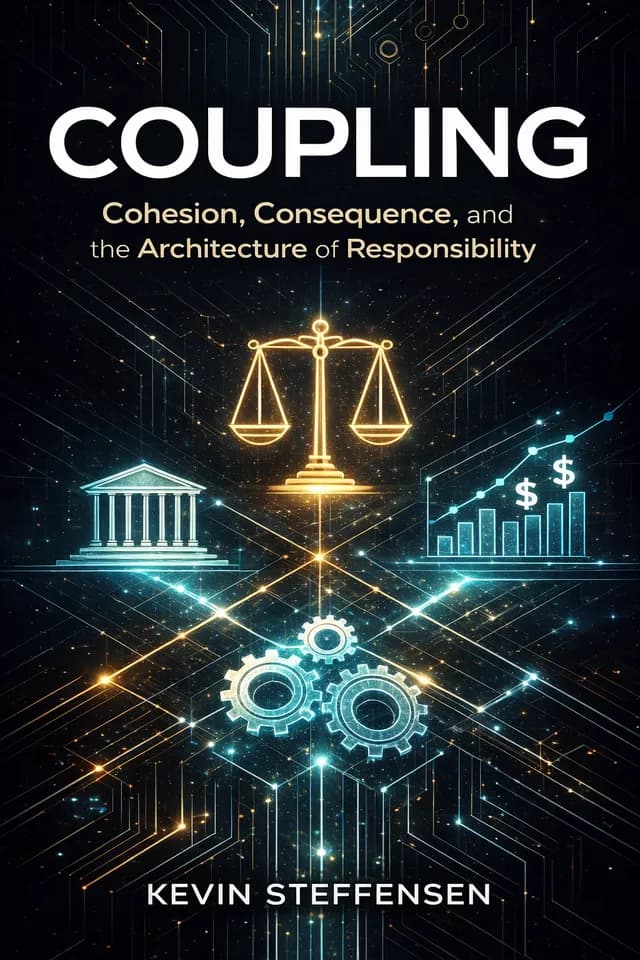
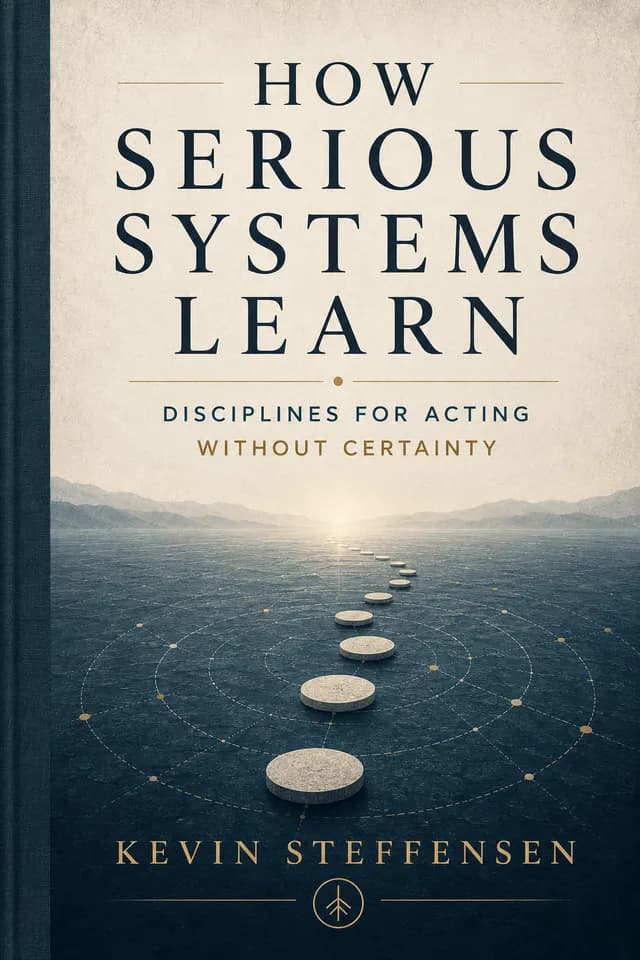



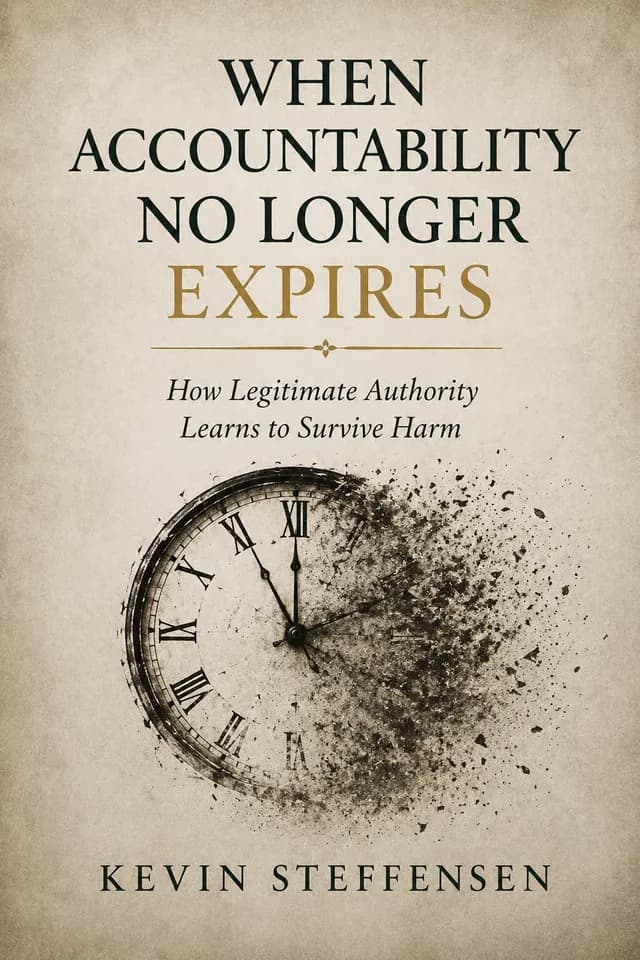
The question this book explores
What social and institutional conditions must exist before thinking is actually possible?
Why this book exists
A faster step does not necessarily create a faster system; it often relocates the constraint. This book follows that relocation—from Merge buttons and clinical signatures through Taylor, Ford, Challenger, and Three Mile Island—toward the design of protected judgment.
Who it is for
Leaders, engineers, clinicians, operators, and readers who work inside accelerated systems and need language for capacity, verification, and stop authority that dashboards do not count.
What it is not
- It is not an argument against AI, automation, or speed as such.
- It does not treat slowness as a virtue or nostalgia for pre-digital work.
- It is not a compliance checklist or vendor evaluation guide.
Central ideas
A curated handful of concepts and patterns this book develops — not the full inventory.
Concept
Judgment
In this book: Central scarce capacity: deciding under consequence when production outruns the conditions judgment needs—time, attention, context, and permission to stop.
Explore the conceptConcept
Attention
In this book: Tracks what acceleration relocates—review load, monitoring, and the attentional budget that verification and interruption still require.
Explore the conceptConcept
Accountability
In this book: Holds who remains answerable when fluent systems draft notes, suggest codes, or remove the steering wheel from the passenger's hands.
Explore the conceptConcept
Authority
In this book: Names stop-work and interruption rights—whether someone still has standing to halt throughput when uncertainty outruns the dashboard.
Explore the conceptConcept
Coordination
In this book: Frames how institutions coordinate speed without erasing the places where understanding and verification must still live.
Explore the conceptConcept
Institutional memory
In this book: Preserves what history kept—checklists, sterile cockpit, reporting systems—against the drift that treats each new acceleration as without precedent.
Explore the conceptPattern
Learning Collapses
In this book: Shows when throughput gains hide the review, maintenance, and apprenticeship work that learning still requires.
Explore the patternPattern
Revisability Preserves Judgment
In this book: Deepens why protected pause and revision remain necessary after automation relocates the bottleneck.
Explore the patternPattern
Dissent is Welcomed
In this book: Anchors stop-work and protected reporting as architectures that keep near-misses from vanishing into silence.
Explore the patternPattern
Feedback Drives Change
In this book: Ties incident investigation and anonymous reporting to institutional learning after speed has relocated consequence.
Explore the patternPattern
Attention Finds a Signal
In this book: Names how distraction and fluent surfaces compete for the attention judgment needs under operational pressure.
Explore the pattern
Inside this book
How the book is organized — parts, chapters, and what each section investigates.
About 145 min of reading across 16 sections in 4 parts.
Part I — The Acceleration Around Us
4 sections
Part I — The Acceleration Around Us
4 sectionsPart II — Where the Constraint Went
6 sections
Part II — Where the Constraint Went
6 sectionsPart III — Responsible Speed
4 sections
Part III — Responsible Speed
4 sectionsOther sections
2 sections
Other sections
2 sectionsWhere it fits
Suggested reading order and nearby volumes — not a mandatory sequence.
Continue exploring
- Next book — Why Collaboration Is So Hard
- Start with a question — What social and institutional conditions must exist before thinking is actually possible?
Reading trails featuring this book
Editorial paths that include this book as one stop in a longer sequence.
Full related inventoryShowHide
Complete concept, pattern, and thinker lists for readers who want the full semantic map.
Major concepts
Concept
Accountability
Accountability names whether consequence still reaches the people who can respond. It becomes important when scale, narrative, or abstraction thins contact between action and effect. It helps preserve correction and proportionate answerability, but can fail when moral sorting replaces sustained contact with outcomes. It differs from responsibility because accountability emphasizes exposure to consequence; responsibility includes the ongoing obligation to account even when control is partial.
View Concept →
Concept
Accountability
Accountability names whether consequence still reaches the people who can respond. It becomes important when scale, narrative, or abstraction thins contact between action and effect. It helps preserve correction and proportionate answerability, but can fail when moral sorting replaces sustained contact with outcomes. It differs from responsibility because accountability emphasizes exposure to consequence; responsibility includes the ongoing obligation to account even when control is partial.
Concept
Attention
Attention names the scarce gate between signal and response. It becomes important whenever more reaches a person or institution than can be fully tracked. It helps preserve focus and timely response, but can fail when visibility metrics are mistaken for judgments about importance. In When Incentives Become the Moral Language, attention marks the domain where newsrooms still know some stories matter even if they will not perform—yet operational language shifted toward clicks, shares, and time on page. Audience behavior reflects habit, outrage, and placement, not the same thing as what the public needs for democratic judgment. It differs from bias because attention names the capacity itself; bias names the selective work performed through it.
View Concept →
Concept
Attention
Attention names the scarce gate between signal and response. It becomes important whenever more reaches a person or institution than can be fully tracked. It helps preserve focus and timely response, but can fail when visibility metrics are mistaken for judgments about importance. In When Incentives Become the Moral Language, attention marks the domain where newsrooms still know some stories matter even if they will not perform—yet operational language shifted toward clicks, shares, and time on page. Audience behavior reflects habit, outrage, and placement, not the same thing as what the public needs for democratic judgment. It differs from bias because attention names the capacity itself; bias names the selective work performed through it.
Concept
Authority
Authority names who can coordinate action when full agreement is impossible. It becomes important whenever groups must move before every perspective aligns. It helps preserve direction and collective capacity, but can fail when operational power outruns justified recognition or visible consequence. It differs from legitimacy because authority is the capacity to steer; legitimacy is whether that capacity reads as earned and revisable enough to coordinate trust rather than performative compliance.
View Concept →
Concept
Authority
Authority names who can coordinate action when full agreement is impossible. It becomes important whenever groups must move before every perspective aligns. It helps preserve direction and collective capacity, but can fail when operational power outruns justified recognition or visible consequence. It differs from legitimacy because authority is the capacity to steer; legitimacy is whether that capacity reads as earned and revisable enough to coordinate trust rather than performative compliance.
Concept
Coordination
Coordination names the problem of acting together when lives are fragmented—when people must move collectively across distance, time, strangers, and difference without complete information or full agreement. It becomes important when individual judgment alone cannot sustain the group, when behavior must hold across contexts that no one person can see completely. Coordination helps preserve collective capacity by making expectations predictable, by enabling strangers to act together under shared rules, by allowing large-scale projects that no single person could accomplish. Roles, rituals, law, canon, procedure, and bureaucracy are all coordination technologies—tools for making tomorrow recognizable from yesterday so action can continue. But coordination can become brittle when it suppresses the feedback and variation it needs to stay responsive, when inherited patterns keep moving after fit has thinned, when dissent is treated as disruption rather than signal. Coordination purchased at the cost of revision can continue functioning long after it has stopped serving the purposes that gave it authority. The question coordination raises is: what coordination problem is this tool solving? What breaks if behavior stops being predictable? Coordination differs from alignment in that coordination is about collective movement, while alignment is about shared direction or values.
View Concept →
Concept
Coordination
Coordination names the problem of acting together when lives are fragmented—when people must move collectively across distance, time, strangers, and difference without complete information or full agreement. It becomes important when individual judgment alone cannot sustain the group, when behavior must hold across contexts that no one person can see completely. Coordination helps preserve collective capacity by making expectations predictable, by enabling strangers to act together under shared rules, by allowing large-scale projects that no single person could accomplish. Roles, rituals, law, canon, procedure, and bureaucracy are all coordination technologies—tools for making tomorrow recognizable from yesterday so action can continue. But coordination can become brittle when it suppresses the feedback and variation it needs to stay responsive, when inherited patterns keep moving after fit has thinned, when dissent is treated as disruption rather than signal. Coordination purchased at the cost of revision can continue functioning long after it has stopped serving the purposes that gave it authority. The question coordination raises is: what coordination problem is this tool solving? What breaks if behavior stops being predictable? Coordination differs from alignment in that coordination is about collective movement, while alignment is about shared direction or values.
Concept
Institutional memory
Institutional memory names what organizations retain and transmit across personnel turnover and generational change—protocols shaped by past failure, stories that carry warnings, habits that encode lessons, procedures that prevent forgotten harm from recurring. It becomes important because individuals leave but institutions continue; what is learned must somehow persist in structure rather than only in personal experience. Institutional memory helps organizations avoid repeating costly mistakes, preserve hard-won knowledge, and maintain continuity through transitions. Archives, law, training programs, handoff documents, and cultural stories all serve as institutional memory— distributing cognition across time so that pain can become structure rather than repetition. But institutional memory can also fail by forgetting selectively, by preserving metrics that outlive the problems they measured, by letting ritual replace inquiry, by making success feel like bureaucracy worth cutting. The question institutional memory raises is: what pain did this institution convert into structure, and what did it forget instead? Where does memory strong enough to learn coexist with revision strong enough to unlearn?
View Concept →
Concept
Institutional memory
Institutional memory names what organizations retain and transmit across personnel turnover and generational change—protocols shaped by past failure, stories that carry warnings, habits that encode lessons, procedures that prevent forgotten harm from recurring. It becomes important because individuals leave but institutions continue; what is learned must somehow persist in structure rather than only in personal experience. Institutional memory helps organizations avoid repeating costly mistakes, preserve hard-won knowledge, and maintain continuity through transitions. Archives, law, training programs, handoff documents, and cultural stories all serve as institutional memory— distributing cognition across time so that pain can become structure rather than repetition. But institutional memory can also fail by forgetting selectively, by preserving metrics that outlive the problems they measured, by letting ritual replace inquiry, by making success feel like bureaucracy worth cutting. The question institutional memory raises is: what pain did this institution convert into structure, and what did it forget instead? Where does memory strong enough to learn coexist with revision strong enough to unlearn?
Concept
Judgment
Judgment names the capacity to decide when understanding is incomplete but harm, coordination, or responsibility will not wait. It becomes important whenever action must proceed under partial information and real consequence. It helps preserve proportionality, answerability, and room for revision, but can fail when judgment hardens into dogma, paralysis, or punitive finality. It differs from certainty because judgment accepts incomplete sight; it differs from preference because judgment weighs consequence beyond taste; it differs from optimization because judgment keeps contestability and human proportion in view; it differs from rule-following because judgment must still respond when rules lag reality.
View Concept →
Concept
Judgment
Judgment names the capacity to decide when understanding is incomplete but harm, coordination, or responsibility will not wait. It becomes important whenever action must proceed under partial information and real consequence. It helps preserve proportionality, answerability, and room for revision, but can fail when judgment hardens into dogma, paralysis, or punitive finality. It differs from certainty because judgment accepts incomplete sight; it differs from preference because judgment weighs consequence beyond taste; it differs from optimization because judgment keeps contestability and human proportion in view; it differs from rule-following because judgment must still respond when rules lag reality.
Major patterns
Pattern
Attention Finds a Signal
An exchange begins under uncertainty, urgency, or social consequence. People need orientation before they can process complete information. - People notice what stands out before they interpret it - Tone, timing, and power register before content - Social risk pushes attention toward possible consequence What stands out first shapes what people notice next. In practice, attention finds a signal in the first cue, and that cue often decides the channel everything else travels through.
View Pattern →
Pattern
Attention Finds a Signal
An exchange begins under uncertainty, urgency, or social consequence. People need orientation before they can process complete information. - People notice what stands out before they interpret it - Tone, timing, and power register before content - Social risk pushes attention toward possible consequence What stands out first shapes what people notice next. In practice, attention finds a signal in the first cue, and that cue often decides the channel everything else travels through.
Supporting · Corrective
Bad News Reaches Power
Hierarchy, success, identity, fear, and incentives filter bad news as it moves upward. - Correction requires uncomfortable evidence - Hierarchy filters what reaches authority Systems learn and correct only when uncomfortable evidence can reach people with the authority and capacity to act.
View Pattern →
Supporting · Corrective
Bad News Reaches Power
Hierarchy, success, identity, fear, and incentives filter bad news as it moves upward. - Correction requires uncomfortable evidence - Hierarchy filters what reaches authority Systems learn and correct only when uncomfortable evidence can reach people with the authority and capacity to act.
Pattern
Dissent is Welcomed
Problems, risks, or failures show up inside a group or setting. Timely correction depends on whether bad news can reach those who decide. - Speaking up can cost people socially or at work - Reporting lines filter or delay information - Good news travels easier than bad news - People learn what is safe to say Problems show up early. Reality reaches those who decide in time. If you see a problem, say it now. Dissent is welcomed here—we can't fix what we don't raise while it's still small.
View Pattern →
Pattern
Dissent is Welcomed
Problems, risks, or failures show up inside a group or setting. Timely correction depends on whether bad news can reach those who decide. - Speaking up can cost people socially or at work - Reporting lines filter or delay information - Good news travels easier than bad news - People learn what is safe to say Problems show up early. Reality reaches those who decide in time. If you see a problem, say it now. Dissent is welcomed here—we can't fix what we don't raise while it's still small.
Pattern
Feedback Drives Change
New facts, visible risk, or bad assumptions show up after direction is set. The group must choose: change course or protect the public story and what people already signed up for. - Going public makes reversal costly - Momentum favors staying the course - Saying we were wrong can threaten legitimacy - Small fixes are easier than full reversals The group shifts direction based on new facts or new risk. We're not wed to yesterday's plan—feedback drives change, and what we learned this morning changes what we ship.
View Pattern →
Pattern
Feedback Drives Change
New facts, visible risk, or bad assumptions show up after direction is set. The group must choose: change course or protect the public story and what people already signed up for. - Going public makes reversal costly - Momentum favors staying the course - Saying we were wrong can threaten legitimacy - Small fixes are easier than full reversals The group shifts direction based on new facts or new risk. We're not wed to yesterday's plan—feedback drives change, and what we learned this morning changes what we ship.
Pattern
Learning Collapses
Those who decide sit far from where effects show up. News from the ground does not reliably reach them in time. - Size adds distance from impact - Formal reporting filters or delays signals - Bad news is costly to raise - Good news travels easier than bad news They do not get a clear read in time on what their choices are doing. We're steering off summaries again. Learning collapses when the ground story never reaches this room.
View Pattern →
Pattern
Learning Collapses
Those who decide sit far from where effects show up. News from the ground does not reliably reach them in time. - Size adds distance from impact - Formal reporting filters or delays signals - Bad news is costly to raise - Good news travels easier than bad news They do not get a clear read in time on what their choices are doing. We're steering off summaries again. Learning collapses when the ground story never reaches this room.
Pattern
Revisability Preserves Judgment
Judgment remains necessary when certainty weakens; people still must weigh tradeoffs and consequences without a final frame to hide inside. Finality no longer stabilizes judgment, yet paralysis and dogma are both available failures. - New information threatens prior commitments - Groups confuse openness with weakness - Revision must be practiced without infinite deferral - Coherence pressures compete with contact with reality Revisability is what prevents judgment from hardening into dogma. A leader publishes what would change their mind—and acts on the answer when it arrives.
View Pattern →
Pattern
Revisability Preserves Judgment
Judgment remains necessary when certainty weakens; people still must weigh tradeoffs and consequences without a final frame to hide inside. Finality no longer stabilizes judgment, yet paralysis and dogma are both available failures. - New information threatens prior commitments - Groups confuse openness with weakness - Revision must be practiced without infinite deferral - Coherence pressures compete with contact with reality Revisability is what prevents judgment from hardening into dogma. A leader publishes what would change their mind—and acts on the answer when it arrives.
Supporting · Obscuring
Speed Relocates Judgment
Production can accelerate faster than observation, interpretation, integration, maintenance, and care. - Acceleration outruns reflection - Defaults absorb judgment As systems accelerate, judgment moves away from the work, becomes embedded in defaults and automation, or disappears into processes no one can pause.
View Pattern →
Supporting · Obscuring
Speed Relocates Judgment
Production can accelerate faster than observation, interpretation, integration, maintenance, and care. - Acceleration outruns reflection - Defaults absorb judgment As systems accelerate, judgment moves away from the work, becomes embedded in defaults and automation, or disappears into processes no one can pause.
Related songs
Song
Before You Finish
Atmospheric jungle and drum-and-bass: a cool voice begs before you finish as chopped replies, reposts, and reactions outrun meaning, ending dryly on Can I finish?
View Song →
Song
Before You Finish
Atmospheric jungle and drum-and-bass: a cool voice begs before you finish as chopped replies, reposts, and reactions outrun meaning, ending dryly on Can I finish?
Song
L’Arrêt en Fait Partie
Experimental French math rock: clipped mantras, shifting meters, and sudden silences insist the stop is part of the groove, and that the small error knows something.
View Song →
Song
L’Arrêt en Fait Partie
Experimental French math rock: clipped mantras, shifting meters, and sudden silences insist the stop is part of the groove, and that the small error knows something.