
Supporting · Obscuring
Speed Relocates Judgment
As systems accelerate, judgment moves away from the work, becomes embedded in defaults and automation, or disappears into processes no one can pause.
Production can accelerate faster than observation, interpretation, integration, maintenance, and care. - Acceleration outruns reflection - Defaults absorb judgment As systems accelerate, judgment moves away from the work, becomes embedded in defaults and automation, or disappears into processes no one can pause.
Problem
Production can accelerate faster than observation, interpretation, integration, maintenance, and care.
Forces
- Acceleration outruns reflection
- Defaults absorb judgment
Observation
As systems accelerate, judgment moves away from the work, becomes embedded in defaults and automation, or disappears into processes no one can pause.
Pattern language
- Supporting pattern
- Obscuring dynamic — tends to obscure contact with reality
- Organizing force: Time
- Master pattern: Reality Answers Back
At a glance
What it does
As systems accelerate, judgment moves away from the work, becomes embedded in defaults and automation, or disappears into processes no one can pause.
Why it matters
Production can accelerate faster than observation, interpretation, integration, maintenance, and care.
Counterbalance
Increase speed only where the people closest to the work retain the time, information, and authority to notice, stop, and revise
Counterbalances
- Increase speed only where the people closest to the work retain the time, information, and authority to notice, stop, and revise
Related books3 books
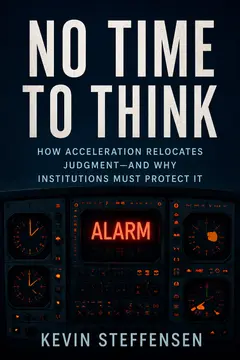
Book
No Time to Think
How Acceleration Relocates Judgment—and Why Institutions Must Protect It
Speed is not inherently careless, but judgment depends on conditions—time, attention, consequence contact, and stop authority. No Time to Think examines what happens when production accelerates faster than a system's capacity to understand, verify, integrate, maintain, and care for what it produces—and how institutions can design responsible speed.
View book
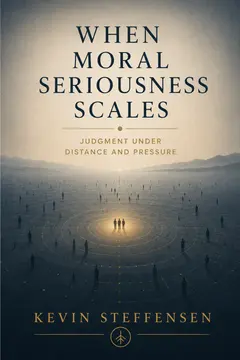
Book
When Moral Seriousness Scales
Judgment Under Distance and Pressure
An exploration of how moral responsibility changes under scale, speed, and institutional distance, and how to preserve humane judgment anyway.
View book

Book
Reality Pushes Back
What Happens When Our Models Meet the World
A narrative pattern language for the After Certainty corpus. Through ordinary life in one town across roughly fifteen years, twelve supporting patterns— organized by perception, power, time, and contact—show how every useful model leaves something out, and how reality answers through materials, people, and consequences the model did not contain.
View book
Related songs
Song
Before You Finish
Atmospheric jungle and drum-and-bass: a cool voice begs before you finish as chopped replies, reposts, and reactions outrun meaning, ending dryly on Can I finish?
View Song →
Song
Before You Finish
Atmospheric jungle and drum-and-bass: a cool voice begs before you finish as chopped replies, reposts, and reactions outrun meaning, ending dryly on Can I finish?
Song
L’Arrêt en Fait Partie
Experimental French math rock: clipped mantras, shifting meters, and sudden silences insist the stop is part of the groove, and that the small error knows something.
View Song →
Song
L’Arrêt en Fait Partie
Experimental French math rock: clipped mantras, shifting meters, and sudden silences insist the stop is part of the groove, and that the small error knows something.
Outgoing dynamics4 relationships
expresses
Obscuring dynamic: how reality becomes harder to notice or revise.
weakens
Acceleration weakens the circulation of understanding.
intensifies
Speed increases distance from consequence.
weakens
Relocated judgment can weaken routes for bad news to reach power.