
Pattern
Dissent is Welcomed
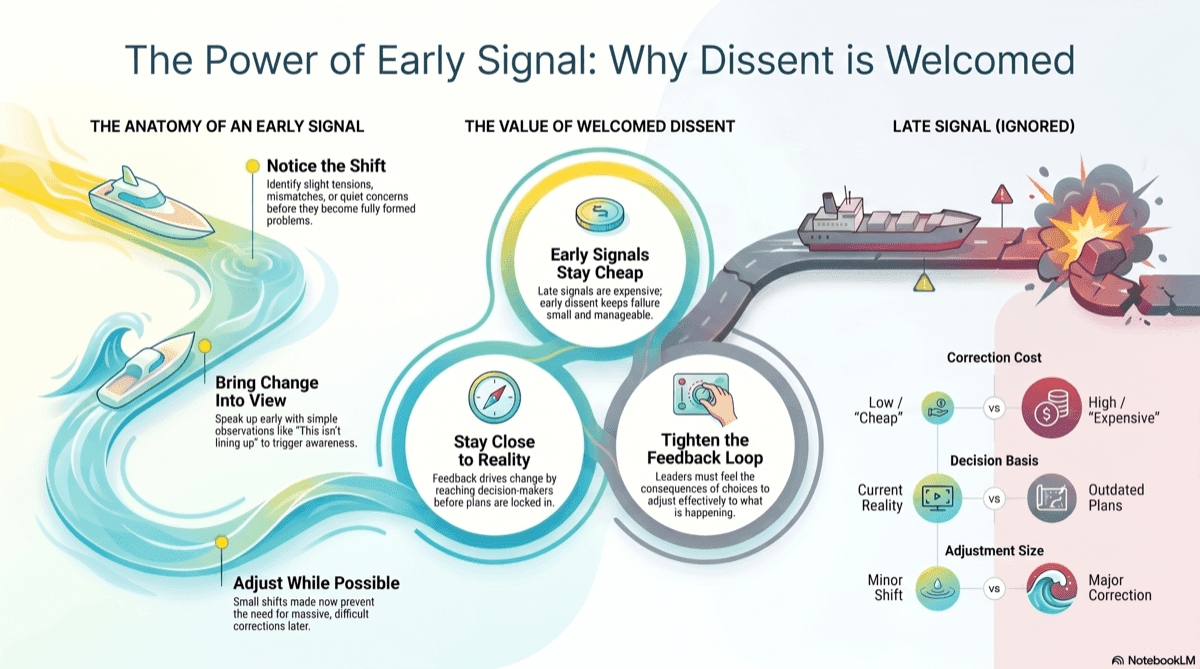
Problems show up early. Reality reaches those who decide in time.
Problems, risks, or failures show up inside a group or setting. Timely correction depends on whether bad news can reach those who decide. - Speaking up can cost people socially or at work - Reporting lines filter or delay information - Good news travels easier than bad news - People learn what is safe to say Problems show up early. Reality reaches those who decide in time. If you see a problem, say it now. Dissent is welcomed here—we can't fix what we don't raise while it's still small.
Setup
Problems, risks, or failures show up inside a group or setting.
Problem
Timely correction depends on whether bad news can reach those who decide.
Forces
- Speaking up can cost people socially or at work
- Reporting lines filter or delay information
- Good news travels easier than bad news
- People learn what is safe to say
Observation
Problems show up early. Reality reaches those who decide in time.
Example
If you see a problem, say it now. Dissent is welcomed here—we can't fix what we don't raise while it's still small.
At a glance
What it does
Problems show up early. Reality reaches those who decide in time.
Why it matters
Timely correction depends on whether bad news can reach those who decide.
Key risk
someone interrupts the agenda to hold at an inconvenient slide without being treated as disloyal
Counterbalance
reply-all a plain correction when the public story is wrong
Recognition signals
- someone interrupts the agenda to hold at an inconvenient slide without being treated as disloyal
- bad news moves in a thread or room everyone already saw
- raising risk early does not cost a place at the table
- problems show up before they compound into identity fights
- the lead asks edge cases to be walked through before moving on
Questions to ask
- If you see a problem, can you say it now while it is still small?
- Can inconvenient truth land in public without the speaker becoming the problem?
- Does the first warning reach the people who decide before the moment passes?
Counterbalances
- reply-all a plain correction when the public story is wrong
- pause the schedule when the first analyst flags a hidden drop
- reward the interrupt that saves a later drama, not only smooth meetings
Trajectory
Early signals
- side-thread warnings still reach the decision meeting
- people describe speaking up as part of the job
Intensification
- warnings survive but arrive too late to steer the plan
- good news still travels easier than bad news up the chain
Failure modes
- dissent is welcomed in language but punished in credit and assignment
- learning collapses after disagreement is suppressed in practice
Restoration paths
- let one straight correction happen in public and keep the speaker in the room
- shorten reporting lines when risk signals die in digests
Manifestations
leadership
- an engineer stops a lead after an executive check-in to name a stub release
organizations
- a nurse flags dosage-order risk and protocol updates push before repeat error
family
- a teenager names a scheduling conflict before plans harden for the weekend
Reading trails featuring this pattern
Editorial paths that include this pattern as one stop in a longer sequence.
Appears in chapters
- Acknowledgments
- Part II — Disciplines That Survived Reality
- Chapter 7 — Being Wrong on Purpose
- Chapter 8 — When Failure Is Not an Option
- Part III — What These Disciplines Share
- Chapter 11 — Authority That Preserves Correction
- Part V — After Certainty
- Chapter 16 — Learning as a Way of Being
And 12 more chapters with this association.
Related books6 books

Book
When Others Look to You
Renewal and Erosion in Leadership
A leadership field guide to how influence forms, how trust is renewed, and how erosion begins when responsibility drifts from practice.
View book
Book
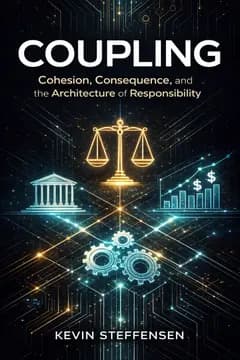
Coupling
Cohesion, Consequence, and the Architecture of Responsibility
A practical framework for seeing where systems are tightly joined, where they drift apart, and how those coupling choices shape accountability over time.
View book
Book
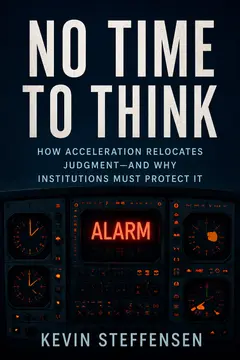
No Time to Think
How Acceleration Relocates Judgment—and Why Institutions Must Protect It
Speed is not inherently careless, but judgment depends on conditions—time, attention, consequence contact, and stop authority. No Time to Think examines what happens when production accelerates faster than a system's capacity to understand, verify, integrate, maintain, and care for what it produces—and how institutions can design responsible speed.
View book
Book
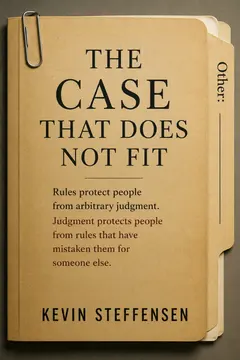
The Case That Does Not Fit
How Rules Protect Us—and What Institutions Must Do When They Misread Us
Rules make shared life possible, but every rule is a compression. The Case That Does Not Fit examines what happens when the ignored detail becomes the morally decisive one—and how institutions can preserve both protection from arbitrary judgment and protection from rules that have mistaken a person for someone else.
View book
Book
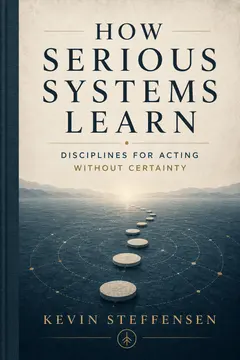
How Serious Systems Learn
Disciplines for Acting Without Certainty
A handbook for teams and institutions that need to learn in motion, improve under pressure, and make better decisions without waiting for perfect information.
View book

Book
When Others Look to You: Companion Edition
Forming, Renewing, Eroding, Repeating
How leadership influence forms, renews, erodes, and repeats across the full cycle of responsibility in practice.
View book
Related songs
Song
Check Your Angle
East Coast alt hip-hop cypher: three rappers and a robot argue that the same picture changes with the frame—check your angle.
View Song →
Song
Check Your Angle
East Coast alt hip-hop cypher: three rappers and a robot argue that the same picture changes with the frame—check your angle.
Song
Different Evidence
Moody British alt-hop spoken word: comfort among similar voices dresses up as truth, then awkward difference arrives as free additional data worth leaving room for.
View Song →
Song
Different Evidence
Moody British alt-hop spoken word: comfort among similar voices dresses up as truth, then awkward difference arrives as free additional data worth leaving room for.
Song
Right Until Further Notice
UK garage–zydeco story-song: everyone saw something different, and the tale stays right—until further notice.
View Song →
Song
Right Until Further Notice
UK garage–zydeco story-song: everyone saw something different, and the tale stays right—until further notice.
Song
The Third Thing
Arabic maqam vocals and trip-hop rap argue over one moon on broken water, then open a house chorus where honest disagreement itself becomes a third, shared thing between them.
View Song →
Song
The Third Thing
Arabic maqam vocals and trip-hop rap argue over one moon on broken water, then open a house chorus where honest disagreement itself becomes a third, shared thing between them.