
Pattern
Feedback Drives Change
The group shifts direction based on new facts or new risk.
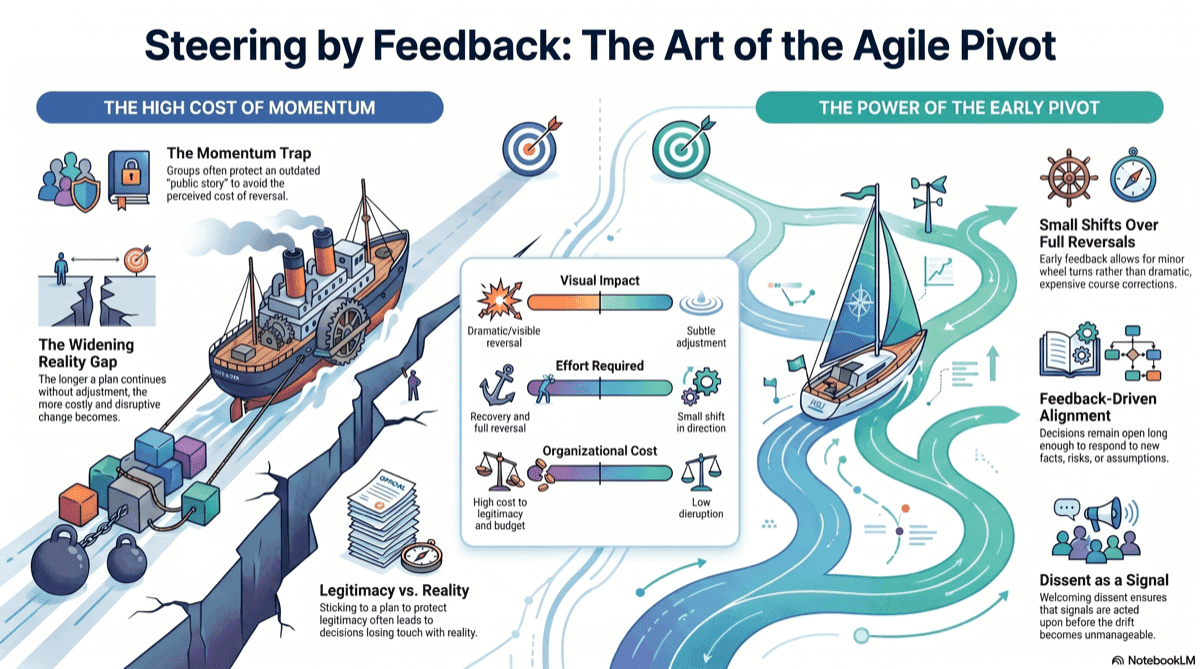
New facts, visible risk, or bad assumptions show up after direction is set. The group must choose: change course or protect the public story and what people already signed up for. - Going public makes reversal costly - Momentum favors staying the course - Saying we were wrong can threaten legitimacy - Small fixes are easier than full reversals The group shifts direction based on new facts or new risk. We're not wed to yesterday's plan—feedback drives change, and what we learned this morning changes what we ship.
Setup
New facts, visible risk, or bad assumptions show up after direction is set.
Problem
The group must choose: change course or protect the public story and what people already signed up for.
Forces
- Going public makes reversal costly
- Momentum favors staying the course
- Saying we were wrong can threaten legitimacy
- Small fixes are easier than full reversals
Observation
The group shifts direction based on new facts or new risk.
Example
We're not wed to yesterday's plan—feedback drives change, and what we learned this morning changes what we ship.
At a glance
What it does
The group shifts direction based on new facts or new risk.
Why it matters
The group must choose: change course or protect the public story and what people already signed up for.
Key risk
new facts or visible risk shift the plan after direction was already set
Counterbalance
schedule an explicit revise point after launch commitments
Recognition signals
- new facts or visible risk shift the plan after direction was already set
- leaders describe themselves as not wed to yesterday's plan when morning learnings change the ship
- revision is treated as normal work, not as proof of personal failure
- public story yields when ground read contradicts the deck
- small fixes happen before full reversals become politically impossible
Questions to ask
- What we learned this morning—does it still change what we ship?
- When going public makes reversal costly, do facts still win?
- Is momentum protecting an outdated story?
Counterbalances
- schedule an explicit revise point after launch commitments
- separate legitimacy from never changing course
- let field read trigger plan change before the next reporting cycle
Trajectory
Early signals
- teams reopen decisions when edge data contradicts the green dashboard
- leaders name what changed since the last public commitment
Intensification
- saying we were wrong starts threatening identity or legitimacy
- momentum favors staying the course despite new risk
Failure modes
- feedback arrives but no longer steers; learning collapses behind summaries
- cosmetic fixes substitute for course change
Restoration paths
- change the plan in view of the people who already signed up
- tie steering decisions to the freshest ground read, not the oldest deck
Manifestations
leadership
- a product team changes scope after Friday QA contradicts Monday's milestone slide
organizations
- hospital protocol updates in two days after a nurse warning, before repeat error
family
- vacation plans shift when weather or traffic updates arrive after the group text went out
Reading trails featuring this pattern
Editorial paths that include this pattern as one stop in a longer sequence.
Appears in chapters
- Part I — Why Knowing No Longer Governs Outcomes
- Chapter 1 — When Knowing Is No Longer Enough
- Chapter 2 — Confidence Outruns Correction
- Chapter 3 — The Collapse of Corrective Loops
- Part II — Disciplines That Survived Reality
- Chapter 4 — Constraint as Discipline
- Chapter 5 — Learning Faster Than Prediction
- Chapter 6 — Seeing the System You Are In
And 29 more chapters with this association.
Related books4 books

Book
When Others Look to You
Renewal and Erosion in Leadership
A leadership field guide to how influence forms, how trust is renewed, and how erosion begins when responsibility drifts from practice.
View book
Book
Coupling
Cohesion, Consequence, and the Architecture of Responsibility
A practical framework for seeing where systems are tightly joined, where they drift apart, and how those coupling choices shape accountability over time.
View book
Book
No Time to Think
How Acceleration Relocates Judgment—and Why Institutions Must Protect It
Speed is not inherently careless, but judgment depends on conditions—time, attention, consequence contact, and stop authority. No Time to Think examines what happens when production accelerates faster than a system's capacity to understand, verify, integrate, maintain, and care for what it produces—and how institutions can design responsible speed.
View book
Book
How Serious Systems Learn
Disciplines for Acting Without Certainty
A handbook for teams and institutions that need to learn in motion, improve under pressure, and make better decisions without waiting for perfect information.
View book