book
The Fearless Organization: Creating Psychological Safety in the Workplace for Learning, Innovation, and Growth
Edmondson, Amy C. The Fearless Organization: Creating Psychological Safety in the Workplace for Learning, Innovation, and Growth. Hoboken, NJ: Wiley, 2018.
Related concepts7 concepts
Concept
Adaptation
Adaptation marks moral life responding to conditions that will not wait—scarcity, violence, scale, displacement. In Before Certainty Arrives, what begins as adaptation can outlive the pressures that first made it necessary. It helps preserve workable coordination under constraint, but can fail when adaptive tools are mistaken for permanent moral truth. It differs from inheritance because adaptation names responsive change; inheritance names what gets carried forward after conditions shift. It differs from drift because adaptation is active response; drift is gradual decoupling while machinery still runs.
View Concept →
Concept
Contestability
Contestability names the condition where dispute can reopen without threatening shared coherence—where challenge does not mean collapse. It becomes important when legitimacy depends on more than coercion, when correction and revision matter for trust and adaptation. It helps preserve the capacity to learn from reality and adjust to changed conditions, but it thins when authority relocates legitimacy beyond ordinary revision—when sacred framing, canon, or procedure makes questioning feel dangerous. Contestability depends on whether revision feels survivable or indistinguishable from rupture. When small groups operate under mutual visibility, authority can be argued for even after it is obeyed. But under pressure—breakdown, threat, or instability—dissent begins to read as moral failure rather than political disagreement, and the range of acceptable interpretation narrows. Contestability thins while inherited certainty still coordinates; systems can run on compliance long after persuasion fades. It marks the moment just before certainty becomes difficult to question at all.
View Concept →
Concept
Correction
Correction names the lived work of narrowing the gap between what was assumed and what is actually happening. It becomes important whenever systems, beliefs, or coordination can drift while still feeling operational. It helps preserve shared reality and learning, but can fail when every correction spawns new framing instead of updated contact with conditions. It differs from repair because correction updates belief and behavior; repair addresses damaged standing and trust. It differs from revisability because correction is the act; revisability is the designed capacity to keep correcting.
View Concept →
Concept
Interpretation
Interpretation names the ongoing work of deciding what something means enough to coordinate on. It becomes important whenever shared action depends on more than immediate perception—across time, distance, conflict, or institutional scale. It helps preserve continuity between experience and obligation, but can fail when interpretation hardens into category and stops tracking changing conditions. In the authority arc, sacred authority compresses interpretation while writing and law later externalize it so disputes can be settled without shared presence. It differs from private understanding because interpretation must be able to coordinate judgment or contest authority in shared space; it differs from meaning because interpretation is the active reconstruction, not only what gets stabilized.
View Concept →
Concept
Thinking
Thinking names reflective interpretation, explanation, and deliberation made possible by enough stability, time, and distance from immediate constraint. It becomes important when coordination is secure enough that action can be accompanied by—or followed by—reflection on why, not only what. Thinking is not detached from action; it is a way of slowing response enough for judgment to form, for alternatives to be considered, for consequences to be imagined before they arrive. It helps preserve discernment, learning, and moral reasoning, but it requires conditions: distance from urgent threat, cognitive and social surplus, shared language for deliberation, and enough stability that questioning does not destabilize survival itself. Under severe pressure, coordinated action may precede explanation—people act together before they renegotiate why, and meaning accumulates later, if at all. Roles can precede reasons when constraint is visible; practices can work before they are explained; certainty can coordinate when explanation is too slow for the problem at hand. Thinking thins when scale or urgency removes the conditions it requires—when no one can trace harm, when managed doubt persists far from those who wait, when compliance replaces judgment because discernment has become too costly. The question thinking raises is: what must hold before there is time to think? Where is thinking a capacity scale has not yet removed? The counterbalance is to notice coordination before explanation without calling early arrangements irrational, to recognize thinking as conditioned by structure rather than absent by nature, and to ask what held long enough to live before asking what is true.
View Concept →
Concept
Trust
Trust names the bridge that lets people act together when no one holds the whole scene. It becomes important when verification must extend beyond firsthand sight—through specialists, records, institutions, or repeated experience. It helps preserve participation across partial perspectives, but can fail when trust stops tracking reality and closure feels safer than checking. It differs from certainty because trust accepts incomplete verification; it differs from blind belief because it still depends on signals that can be tested, strained, or withdrawn.
View Concept →
Concept
Uncertainty
Uncertainty names the condition moral and social systems are built to navigate—the space where coordination must happen before truth is settled, where lives are fragmented and behavior must hold together under incomplete information. It becomes important because human action cannot wait for perfect knowledge; groups must decide, move, and coordinate even when the future is unclear, when disagreement is costly, when explanation cannot travel fast enough to settle disputes before consequences arrive. Uncertainty is not a problem to eliminate but a condition to navigate—the ground on which moral life operates. Certainty emerges as an adaptive response to uncertainty, compressing ambiguity into stable expectations so action can proceed. But uncertainty itself is neither failure nor freedom; it is the default state that requires coordination tools. The After Certainty project explores how to practice judgment, accountability, and responsiveness inside uncertainty rather than demanding that uncertainty be resolved before moral life can begin. The question uncertainty raises is: what uncertainty is this system trying to reduce? Is ambiguity dangerous because the stakes are genuinely high, or because failure now scales? Uncertainty differs from ignorance in that uncertainty is about incomplete information in contexts requiring action, while ignorance is simply lack of knowledge.
View Concept →
Related patterns2 patterns
Pattern
Contact Keeps the Read Open
People return to a difficult exchange with more context and lower reactivity. Early interpretation may be useful but still too rough. - Additional context widens what people can see - Lower emotional charge improves tolerance for ambiguity - Restraint keeps meaning revisable Additional context can sharpen understanding without fully resolving it. Contact keeps the read open when understanding tightens without the story having to close.
View Pattern →
Pattern
Meaning Gets Distorted
A provisional interpretation is repeated without re-exposure to source context. Coherence is preserved at the expense of accuracy. - Confirmation bias filters incoming data - Social reinforcement rewards consistency - Identity defense resists revision Interpretation can harden in ways that no longer track reality. Meaning gets distorted when certainty outlives contact with what was actually said.
View Pattern →
Related books7 books

Book
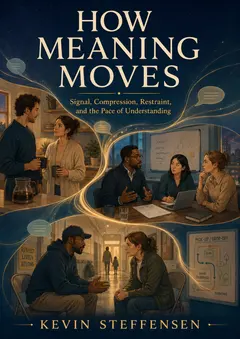
How Meaning Moves
Signal, Compression, Restraint, and the Pace of Understanding
Before people disagree, they interpret. How meaning forms through signal, compression, and restraint—long before anyone is obviously wrong, and often while the sentence is still forming.
View book
Book
How Serious Systems Learn
Disciplines for Acting Without Certainty
A handbook for teams and institutions that need to learn in motion, improve under pressure, and make better decisions without waiting for perfect information.
View book

Book
Trust Beyond Similarity
How Trust Remains Possible Across Difference
How people learn to trust perspectives they do not share—and why trust becomes more valuable when perspectives differ.
View book
Book
When Authority Outlives Accountability
A Lens for Moral Leadership
A leadership lens on how authority can persist after accountability erodes, and what moral leadership requires to restore integrity in that gap.
View book
Book
When Moral Seriousness Scales
Judgment Under Distance and Pressure
An exploration of how moral responsibility changes under scale, speed, and institutional distance, and how to preserve humane judgment anyway.
View book

Book
When Others Look to You
Renewal and Erosion in Leadership
A leadership field guide to how influence forms, how trust is renewed, and how erosion begins when responsibility drifts from practice.
View book

Book
When Others Look to You: Companion Edition
Forming, Renewing, Eroding, Repeating
How leadership influence forms, renews, erodes, and repeats across the full cycle of responsibility in practice.
View book