
Supporting · Corrective
Responsibility Follows Leverage
The greater a person's or institution's capacity to shape outcomes, prevent harm, benefit from a system, or repair consequences, the greater its responsibility.
Collective explanations can dissolve responsibility, while individual blame can conceal unequal power and structural production. - Leverage is uneven - Blame and collectivity can both obscure capacity The greater a person's or institution's capacity to shape outcomes, prevent harm, benefit from a system, or repair consequences, the greater its responsibility.
Problem
Collective explanations can dissolve responsibility, while individual blame can conceal unequal power and structural production.
Forces
- Leverage is uneven
- Blame and collectivity can both obscure capacity
Observation
The greater a person's or institution's capacity to shape outcomes, prevent harm, benefit from a system, or repair consequences, the greater its responsibility.
Pattern language
- Supporting pattern
- Corrective dynamic — tends to restore contact with reality
- Organizing force: Power
- Master pattern: Reality Answers Back
At a glance
What it does
The greater a person's or institution's capacity to shape outcomes, prevent harm, benefit from a system, or repair consequences, the greater its responsibility.
Why it matters
Collective explanations can dissolve responsibility, while individual blame can conceal unequal power and structural production.
Counterbalance
Assign responsibility according to leverage, knowledge, freedom of action, benefit, and capacity to prevent or repair harm
Counterbalances
- Assign responsibility according to leverage, knowledge, freedom of action, benefit, and capacity to prevent or repair harm
Related books8 books

Book
The World We Make Together
How Ordinary People, Unequal Power, and Shared Action Shape History
History is collective, but responsibility remains uneven. The World We Make Together follows ordinary objects—a switch, a ballot, a fence, a bowl, a scale—into the institutions and relationships through which people shape public life without becoming either solitary heroes or passive products of structure.
View book

Book
Coupling
Cohesion, Consequence, and the Architecture of Responsibility
A practical framework for seeing where systems are tightly joined, where they drift apart, and how those coupling choices shape accountability over time.
View book

Book
When Authority Outlives Accountability
A Lens for Moral Leadership
A leadership lens on how authority can persist after accountability erodes, and what moral leadership requires to restore integrity in that gap.
View book

Book
When Accountability No Longer Expires
How Legitimate Authority Learns to Survive Harm
An institutional lens on why legitimate authority can persist after harm. Organizations learn to survive scandal without resolving it.
View book

Book
When Others Look to You
Renewal and Erosion in Leadership
A leadership field guide to how influence forms, how trust is renewed, and how erosion begins when responsibility drifts from practice.
View book
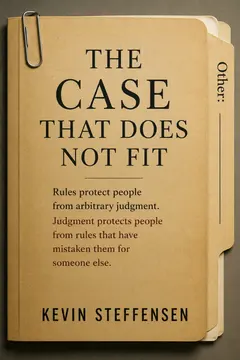
Book
The Case That Does Not Fit
How Rules Protect Us—and What Institutions Must Do When They Misread Us
Rules make shared life possible, but every rule is a compression. The Case That Does Not Fit examines what happens when the ignored detail becomes the morally decisive one—and how institutions can preserve both protection from arbitrary judgment and protection from rules that have mistaken a person for someone else.
View book

Book
After Certainty
How to Live and Judge When Understanding is not Enough
How to live and judge once explanation reaches its limits—judgment, responsibility, and participation without replacement frameworks.
View book

Book
Reality Pushes Back
What Happens When Our Models Meet the World
A narrative pattern language for the After Certainty corpus. Through ordinary life in one town across roughly fifteen years, twelve supporting patterns— organized by perception, power, time, and contact—show how every useful model leaves something out, and how reality answers through materials, people, and consequences the model did not contain.
View book
Related songs
Outgoing dynamics1 relationship
expresses
Corrective dynamic: how systems remain open to reality answering back.
Incoming dynamics2 relationships
intensifies
Authority formed by attention increases the leverage that responsibility must follow.