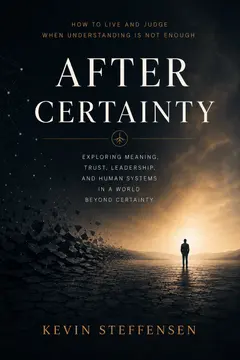
book
The Person and the Situation
Ross, Lee, and Richard Nisbett. The Person and the Situation. New York: McGraw-Hill, 1991.
Related concepts3 concepts
Concept
Interpretation
Interpretation names the ongoing work of deciding what something means enough to coordinate on. It becomes important whenever shared action depends on more than immediate perception—across time, distance, conflict, or institutional scale. It helps preserve continuity between experience and obligation, but can fail when interpretation hardens into category and stops tracking changing conditions. In the authority arc, sacred authority compresses interpretation while writing and law later externalize it so disputes can be settled without shared presence. It differs from private understanding because interpretation must be able to coordinate judgment or contest authority in shared space; it differs from meaning because interpretation is the active reconstruction, not only what gets stabilized.
View Concept →
Concept
Thinking
Thinking names reflective interpretation, explanation, and deliberation made possible by enough stability, time, and distance from immediate constraint. It becomes important when coordination is secure enough that action can be accompanied by—or followed by—reflection on why, not only what. Thinking is not detached from action; it is a way of slowing response enough for judgment to form, for alternatives to be considered, for consequences to be imagined before they arrive. It helps preserve discernment, learning, and moral reasoning, but it requires conditions: distance from urgent threat, cognitive and social surplus, shared language for deliberation, and enough stability that questioning does not destabilize survival itself. Under severe pressure, coordinated action may precede explanation—people act together before they renegotiate why, and meaning accumulates later, if at all. Roles can precede reasons when constraint is visible; practices can work before they are explained; certainty can coordinate when explanation is too slow for the problem at hand. Thinking thins when scale or urgency removes the conditions it requires—when no one can trace harm, when managed doubt persists far from those who wait, when compliance replaces judgment because discernment has become too costly. The question thinking raises is: what must hold before there is time to think? Where is thinking a capacity scale has not yet removed? The counterbalance is to notice coordination before explanation without calling early arrangements irrational, to recognize thinking as conditioned by structure rather than absent by nature, and to ask what held long enough to live before asking what is true.
View Concept →
Concept
Uncertainty
Uncertainty names the condition moral and social systems are built to navigate—the space where coordination must happen before truth is settled, where lives are fragmented and behavior must hold together under incomplete information. It becomes important because human action cannot wait for perfect knowledge; groups must decide, move, and coordinate even when the future is unclear, when disagreement is costly, when explanation cannot travel fast enough to settle disputes before consequences arrive. Uncertainty is not a problem to eliminate but a condition to navigate—the ground on which moral life operates. Certainty emerges as an adaptive response to uncertainty, compressing ambiguity into stable expectations so action can proceed. But uncertainty itself is neither failure nor freedom; it is the default state that requires coordination tools. The After Certainty project explores how to practice judgment, accountability, and responsiveness inside uncertainty rather than demanding that uncertainty be resolved before moral life can begin. The question uncertainty raises is: what uncertainty is this system trying to reduce? Is ambiguity dangerous because the stakes are genuinely high, or because failure now scales? Uncertainty differs from ignorance in that uncertainty is about incomplete information in contexts requiring action, while ignorance is simply lack of knowledge.
View Concept →
Related patterns2 patterns
Pattern
Contact Keeps the Read Open
People return to a difficult exchange with more context and lower reactivity. Early interpretation may be useful but still too rough. - Additional context widens what people can see - Lower emotional charge improves tolerance for ambiguity - Restraint keeps meaning revisable Additional context can sharpen understanding without fully resolving it. Contact keeps the read open when understanding tightens without the story having to close.
View Pattern →
Pattern
Meaning Gets Distorted
A provisional interpretation is repeated without re-exposure to source context. Coherence is preserved at the expense of accuracy. - Confirmation bias filters incoming data - Social reinforcement rewards consistency - Identity defense resists revision Interpretation can harden in ways that no longer track reality. Meaning gets distorted when certainty outlives contact with what was actually said.
View Pattern →