Fiction
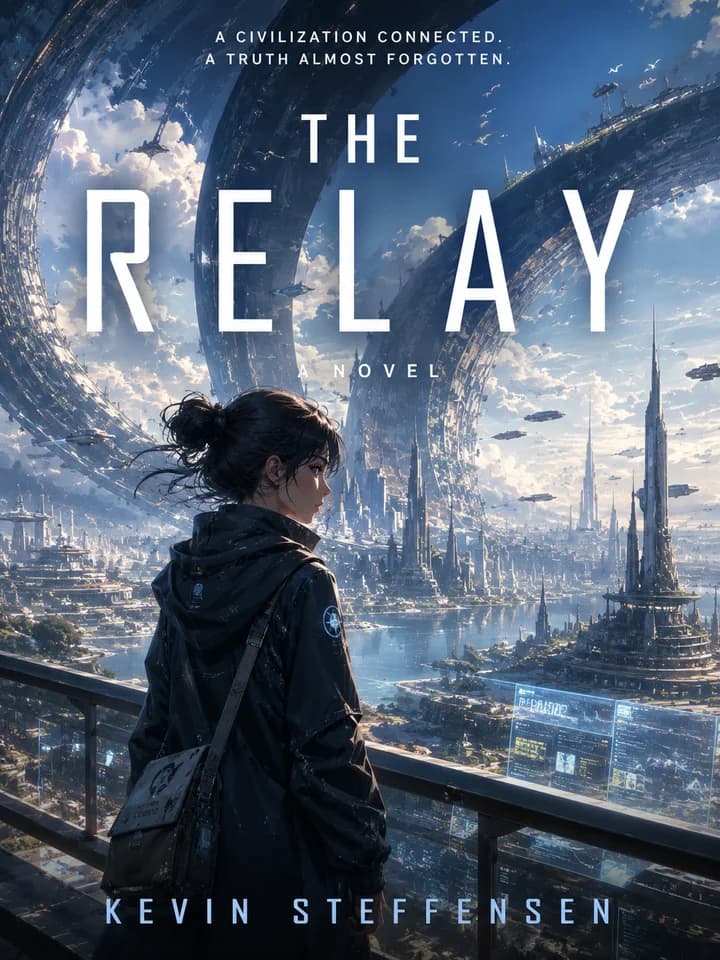
The Relay
A Social Science Fiction Novel
By Kevin Steffensen
A courier notices silence where explanations should be — and a civilization-sized blind spot emerges one perspective at a time. When circulation collapses, people reach for the nearest clear answer; the work is learning how to keep asking without that comfort.
A courier notices silence where explanations should be — and a civilization-sized blind spot emerges one perspective at a time. When circulation collapses, people reach for the nearest clear answer; the work is learning how to keep asking without that comfort.
Offered under open publishing terms (CC BY-SA). Download formats are free where available; purchase links support print editions.
- Type
- Fiction · novel
- Author
- Kevin Steffensen
- Published
- July 2026
- Chapters
- 29 chapters
- Formats
- EPUB, PDF, DOCX
On these shelves
Also in Start Here
View all 8 →
Curiosity Before Certainty
How Curiosity Helps Us Understand a Complex World
How Serious Systems Learn
Disciplines for Acting Without Certainty

Trust Beyond Similarity
How Trust Remains Possible Across Difference
What We Cannot See
Bias, Judgment, and the Limits of Perspective

Everyone Knows Love
Why Is It So Hard to Explain?
After Certainty
How to Live and Judge When Understanding is not Enough
The question this book explores
What happens when a civilization-sized blind spot can only be seen one perspective at a time?
Why this book exists
The Relay is a fiction doorway into the same terrain: uncertainty, participation, and coordination when no courier holds the complete map.
Who it is for
Readers who prefer story as an entry into the project’s questions about meaning, responsibility, and shared work.
What it is not
- It is not a treatise or handbook disguised as a novel.
- It does not settle the project’s nonfiction arguments by plot alone.
Central ideas
A curated handful of concepts and patterns this book develops — not the full inventory.
Concept
Finite perspective
In this book: Dramatizes sight from somewhere—each courier and world holds only a fragment of the network's truth.
Explore the conceptConcept
Coordination
In this book: Stages shared movement across gates when no center holds the complete map.
Explore the conceptConcept
Uncertainty
In this book: The condition the civilization lives inside when explanations go silent and participation must continue.
Explore the conceptConcept
Feedback
In this book: What fails when silence replaces report—and what must return for the relay to learn again.
Explore the conceptConcept
Trust
In this book: Participation across partial sight; willingness to move without verifying the whole corridor.
Explore the conceptConcept
Institutional memory
In this book: Stages what organizations forget and what unofficial fixes preserve when truth stops circulating.
Explore the conceptPattern
Learning Collapses
In this book: Dramatizes ground story that never reaches the room—gates darken while summaries stay calm.
Explore the patternPattern
Meaning Outruns the Words
In this book: Stages explanations that cannot travel as fast as the cascade of effects.
Explore the patternPattern
Gaps Invite Completion
In this book: Shows how silence is filled with convenient stories until fragments force a harder read.
Explore the patternPattern
Feedback Drives Change
In this book: Dramatizes the rare moments when new facts still revise direction instead of protecting the public story.
Explore the patternPattern
Responsibility Persists Beyond Control
In this book: Stages answerability that remains when no courier can steer the whole network.
Explore the pattern
Inside this book
How the book is organized — parts, chapters, and what each section investigates.
About 581 min of reading across 29 sections in 6 parts.
Act I — The Absence
5 sections
Act I — The Absence
5 sectionsShow summaryHide summary
Lena clears freight by reading how crates are really sealed, not by trusting the paperwork — until the Vesper gate goes dark under a notice that says only "suspended pending review." Three words and a stamp: a shrug with formatting. Her brother Arin is stuck on the far side. With no who, why, or fault code, she starts hunting for whoever wrote the notice.
Central questionWhat does a civilization do when a critical crossing fails without explanation?
Show summaryHide summary
Lena asks why the gate is closed and finds clerks, platforms, and rumor feeds full of stories forming faster than facts. Offices put out longer notices that say less. Jun climbs onto a baggage scale and makes people say what they actually heard — pending is not lost, pending is rude — and still nobody can say why the gate went dark.
Central questionWhat is more frightening than a broken gate—a room that cannot say why?
- Chapter 3 — The Slow Way14 min
Show summaryHide summary
With the gate shut, Lena books a slow freighter — weeks through ordinary space instead of four seconds through a door. Upstream improves the notice into Fault Code 0 and pending-as-policy; Lena signs an incident form OTHER: wall, keeps peppermint candies and a "next time" tag for Arin, and commits to the long way around the dark.
Central questionWhat does it cost to keep a relationship across a network that no longer connects?
- Chapter 4 — More Gates12 min
Show summaryHide summary
On the slow route she finds a second gate failing, then news of a third. Dockside talk hardens into a sabotage story that comforts people faster than Lena can outrun it. She meets a calm woman offering tea without a finished theory.
Central questionWhen failure spreads, what story arrives first to make the chaos feel owned?
Show summaryHide summary
On a slow corridor, Lena meets waystation keeper Pell — a man who keeps one remote station running and knows nothing beyond it — and finally feels how huge the gate network is. No one is minding the whole of it. The sabotage story would be easier; what she sees is a system too big for any single office to explain.
Central questionHow do you orient when the thing you belonged to is larger than anyone can hold?
Act II — The Cascade
7 sections
Act II — The Cascade
7 sectionsShow summaryHide summary
On Maween, fear is dutiable: a customs clerk charges Lena for carrying one undeclared rumor across a border, origin everyone, destination further. At Tessom she loses a fight with negotiated gravity while locals walk the air. Ahead, the sabotage story is already closing causeways — and the only way north runs back through a tidebound arch into the thick of it.
Central questionWhat returns to sight when ordinary motion through a vast system becomes impossible?
Show summaryHide summary
On Anneth, the crossing bell rang safe and the sea climbed anyway. Now the town kneels on the drying flats to thank the dry-bell flood, and Lena has to argue with a miracle that may have saved forty lives for the wrong reason. Denied the ebb-stones, she barters toward the floodmark arch at Coll, no longer sure that being right is useful.
Central questionHow do you argue with a story that just saved lives?
- Chapter 8 — The Docks18 min
Show summaryHide summary
At the Drevin drift markets, the cutters story turns a quiet crowd against traders, and Varik's name travels the dock before his body does. Lena gets two children clear while pilot Nadi refuses unpaid questions about whose fault the dark is. People still have to eat, and moral urgency does not load a barge.
Central questionWhat happens when a useful story becomes a reason to hurt the wrong people?
Show summaryHide summary
At Khoury Transfer, a hungry crowd is about to break into sealed relief food. Varik does the dangerous thing: he gives the room a plan good enough to obey — talks father Bram off the lock-bar, puts his name in the liability box, turns counting into religion, and feeds the children. Lena feels the pull even as she refuses to join him yet.
Central questionWhy is premature certainty so hard to refuse when it works today?
Show summaryHide summary
On the pilgrim road, Sera holds displaced people with practical care and no finished theory. Lena stands between Varik's certainty and Sera's kindness. Out past the dark gates, the people who never travel have begun passing scraps of unseasonals: marsh-light gone green, cooling-river milky, birds missing from the week they always come. Lena does not yet know it, but the forgotten edge of the network has started learning before the center has admitted it is blind.
Central questionWhat if the kind answer is real and still insufficient for a failing network?
- Chapter 11 — The Caveats13 min
Show summaryHide summary
Analyst Jun has spent decades measuring how rumor outruns evidence. He watches his hedged findings hung as Varik's banners with every caveat stripped away — his careful curve getting "reach," the worst congratulation in the language. The caution that would not speak in public helps build the certainty he feared.
Central questionWhat happens when careful doubt is stripped into a public certainty?
Show summaryHide summary
A route Lena cleared dies mid-crossing; people she put on a boat called the Wren do not come back. Exhausted at Borren, she almost accepts Varik's demand for one answer today — then says no, and keeps walking toward the warning lists she still cannot name.
Central questionWhen fear is loudest, what does “one answer, today” cost tomorrow?
Act III — The Fragments
6 sections
Act III — The Fragments
6 sectionsShow summaryHide summary
On the Vellum Moon, archivist Toma shows Lena records that look scrubbed — institutions missing from the books. The conspiracy reading feels satisfying and almost fits. She leaves for Lower Vellum seeking someone who can say what the absences mean.
Central questionWhen the record shows absence, how do you know whether something was erased?
Show summaryHide summary
Beneath the archive moon, Veya ruins Toma's cover-up story. The old return offices weren't scrubbed by a villain — Lena reads the schedules herself: no reply received, resent, no reply — and hears how Veya's son died inside ordinary unanswered notices. She leaves for Ivera looking for keepers who kept fixing gates after those offices died.
Central questionHow does a civilization lose a way of seeing without leaving a deletion to prosecute?
Show summaryHide summary
First time inside Arin at the Tarn: the lake is wearing winter early — winter-skin, moths low, water late into the locks — while the official gauge still reads fine. He writes what he and the lockside neighbors notice, and starts sending the scraps onward with Tell the next and Answer if you see the same. He does not think of it as building a network. Staying is just the work of seeing one place clearly.
Central questionWhat kind of knowledge can only accumulate by remaining in one place?
Show summaryHide summary
At Ivera — which slow pilots call Cai's world — Lena finally meets Cai, a gate keeper who keeps the crossing open with local repairs he never writes down for anyone else. The fixes work here; the wider network still cannot learn from them. Then Lio hands her a line that stops her cold: Skin first. Gauge late. — and she recognizes her brother's winter-skin traveling hand to hand.
Central questionWhat fails when every repair is local and none of the repairs can see each other?
Show summaryHide summary
At Merrow, Sera's people care for the stranded and refuse to blame outsiders — then their gate goes dark anyway. Kindness is real and still not enough to keep travel moving. Lena names the unseasonals aloud for the first time, and carries Arin's note — Skin first. Gauge late. — as their failure reports leave asking other places to write back.
Central questionWhat becomes visible when the best local holding still cannot keep a gate alive?
- Chapter 18 — Whose Hand28 min
Show summaryHide summary
Lena finally understands who has been stitching the unseasonals together: while she traveled, Arin stayed put and built a way for local observations to move. She turns toward getting travelers and settled people into the same room — not yet with a finished method.
Central questionWhat becomes possible when moving sight and staying sight finally meet?
Act IV — Integration
6 sections
Act IV — Integration
6 sectionsShow summaryHide summary
They choose the dark Vesper gatehouse as the meeting place because it belongs to neither side. Getting couriers, keepers, archivists, and lake people into one wounded room is logistics and friction, not ceremony.
Central questionWhere can opposed halves meet without either arriving as host?
Show summaryHide summary
Arin leaves the lake, bringing water readings, peppermint candies, and neighbors from the far side toward the meeting. The people who stayed arrive to help invent the fix — not as rescued cargo.
Central questionWhat does it mean for staying knowledge to travel without becoming tourism?
- Chapter 21 — The Room18 min
Show summaryHide summary
In the dead gatehouse at Vesper, opposed positions collide — hold the line, keep moving, restore the old, trust people, let it die, put one office in charge, honor those who stay. Everyone is partly right; no one yet has a shared answer. Lena and Arin stand in the same room at last.
Central questionHow do partial truths share a room without instantly becoming a fight for the center?
Show summaryHide summary
By morning, each person has to name what they will not give up — and then release it on the page: preservation alone, motion alone, restoration, unstructured trust, dignified ending, staying that never travels. Lena lets go of carrying the work alone.
Central questionWhat must be abandoned before a shared method can be invented?
- Chapter 23 — No Center22 min
Show summaryHide summary
Jun gives up his dream of one mind that sees the whole network. He can accept a method with no headquarters — people ask each other to compare notes instead of waiting for a central order. The empty middle of the room stops looking like failure.
Central questionCan a civilization produce shared sight without installing a center that freezes learning?
Show summaryHide summary
They remake an ordinary courier shipping form so each person can add observations and open questions before passing it on — Lio learns to insult forms without improving them into false honesty. Traveling sight and staying sight share one page. The first copy leaves into weather with no promise it will survive.
Central questionWhat artifact lets observation travel without pretending any hand holds the whole?
Act V — The Relay
4 sections
Act V — The Relay
4 sectionsShow summaryHide summary
The first page comes home worse than it left — mud, crossed fields, Ren's too-honest "Wrong remaining after answer: all of it" — and people fixing different broken places finally see one another's work. Gates begin staying open unsteadily. Clean bureaucratic forms try to capture the practice and fail to own it.
Central questionWhat restores circulation when repair cannot be centralized?
Show summaryHide summary
Lena and Arin stand together in mud, working a water lock, each having carried half a weight they mistook for the other's escape. Traveling and staying become shared tasks, not identities. "Next time" becomes: answer if anything has changed.
Central questionWhat does reunion look like when neither sibling was the rescued one?
Show summaryHide summary
Sera carries the new practice into towns as something people can trust each other with. Varik still gives useful answers and remains liked — until a room turns back to the page when someone asks who has the word from the Tarn. Certainty stays useful and stops being final.
Central questionHow does a better way of knowing displace premature certainty without a public unmasking?
Show summaryHide summary
A strange report from Theral West fits none of the newly learned pattern. The old "suspended pending review" notice becomes something people can answer again; an abandoned operations desk holds the open question instead of pretending to repair the gate. The question continues through other hands while Lena stands still and watches it go on without her.
Central questionWhat does it mean for a civilization to stay able to learn after its first working method proves incomplete?
Other sections
1 section
Other sections
1 section- Jacket Copy1 min
Show summaryHide summary
For seven hundred years, gates have made travel between a thousand worlds ordinary. Courier Lena watches the Vesper gate shut without warning, trapping her brother on the far side, while more gates fail and frightened people reach for the nearest clear voice. She keeps asking where answers come from before certainty fills the silence.
Central questionWhat happens when a civilization-sized blind spot can only be seen one perspective at a time?
Where it fits
Suggested reading order and nearby volumes — not a mandatory sequence.
Continue exploring
- Next book — How Meaning Moves
Updates
Reading trails featuring this book
Editorial paths that include this book as one stop in a longer sequence.
Full related inventoryShowHide
Complete concept, pattern, and thinker lists for readers who want the full semantic map.
Major patterns
Supporting · Corrective
Commitment Leaves Room
Systems must act before certainty arrives, but commitments become dangerous when correction threatens identity, legitimacy, sunk cost, or authority. - Action cannot wait for certainty - Closed commitment resists correction Commitment enables coordinated action while preserving room for revision when evidence, conditions, or consequences change.
View Pattern →
Supporting · Corrective
Commitment Leaves Room
Systems must act before certainty arrives, but commitments become dangerous when correction threatens identity, legitimacy, sunk cost, or authority. - Action cannot wait for certainty - Closed commitment resists correction Commitment enables coordinated action while preserving room for revision when evidence, conditions, or consequences change.
Supporting · Corrective
Participation Creates Legitimacy
Centralized direction may be faster, but systems imposed without meaningful participation often lose legitimacy and local knowledge. - Speed favors centralized direction - Legitimacy requires consequential voice People are more likely to trust, sustain, and recognize a shared order when they have a consequential role in shaping, contesting, or repairing it.
View Pattern →
Supporting · Corrective
Participation Creates Legitimacy
Centralized direction may be faster, but systems imposed without meaningful participation often lose legitimacy and local knowledge. - Speed favors centralized direction - Legitimacy requires consequential voice People are more likely to trust, sustain, and recognize a shared order when they have a consequential role in shaping, contesting, or repairing it.
Master pattern
Reality Answers Back
Human systems must simplify reality in order to perceive, decide, coordinate, and act. Those simplifications necessarily leave out people, consequences, perspectives, history, and changed conditions. - Simplification is required for coordinated action - What is left out eventually returns - Systems need paths for revision before collapse Every abstraction, institution, decision, and model eventually encounters the reality it only partially captured. Reality answers through failures, exceptions, dissent, unintended behavior, lived experience, or consequences the model did not contain.
View Pattern →
Master pattern
Reality Answers Back
Human systems must simplify reality in order to perceive, decide, coordinate, and act. Those simplifications necessarily leave out people, consequences, perspectives, history, and changed conditions. - Simplification is required for coordinated action - What is left out eventually returns - Systems need paths for revision before collapse Every abstraction, institution, decision, and model eventually encounters the reality it only partially captured. Reality answers through failures, exceptions, dissent, unintended behavior, lived experience, or consequences the model did not contain.
Supporting · Corrective
Understanding Circulates
No one sees the whole situation, yet organizations often treat understanding as something possessed by individuals or authorities. - No single vantage sees the whole - Authority may hoard interpretation Understanding emerges and corrects itself when partial perspectives move among people rather than remaining isolated.
View Pattern →
Supporting · Corrective
Understanding Circulates
No one sees the whole situation, yet organizations often treat understanding as something possessed by individuals or authorities. - No single vantage sees the whole - Authority may hoard interpretation Understanding emerges and corrects itself when partial perspectives move among people rather than remaining isolated.