Fiction
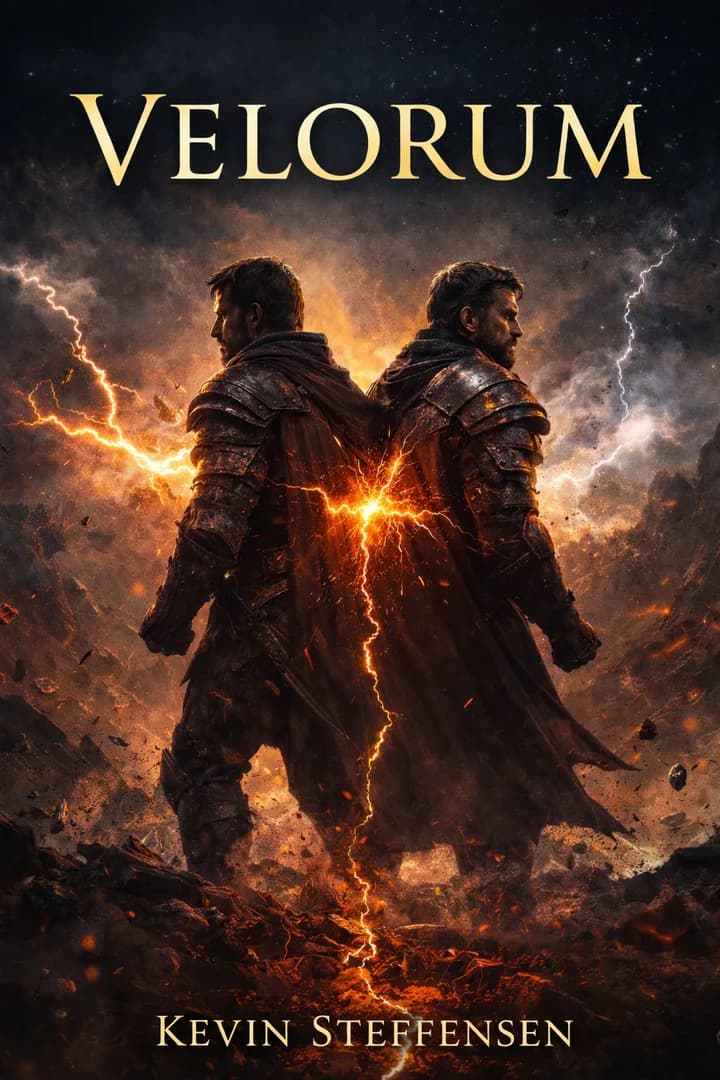
Velorum
A Tragic Mythic Fantasy Novel
By Kevin Steffensen
A mythic fantasy about loyalty, sacrifice, and power, where personal vows and political fate collide at tragic scale.
A mythic fantasy about loyalty, sacrifice, and power, where personal vows and political fate collide at tragic scale.
Offered under open publishing terms (CC BY-SA). Download formats are free where available; purchase links support print editions.
- Type
- Fiction · novel
- Author
- Kevin Steffensen
- Published
- 2026
- Chapters
- 30 chapters
- Formats
- EPUB, PDF, DOCX
On these shelves


The question this book explores
What happens when loyalty, vow, and shared burden bind people into power they cannot easily leave?
Why this book exists
Mythic fantasy that dramatizes how bonds become obligations, how names carry gravity, and how authority exacts cost when personal vows meet political fate—recognition through story, not a leadership manual.
Who it is for
Readers who want tragic fantasy that stages responsibility, harm, and legitimacy under bond and curse rather than organizational case study.
What it is not
- The story dramatizes tensions rather than proving a general theory of loyalty or sacrifice.
- It is not a leadership handbook or allegory key for the nonfiction portfolio.
- It does not invent glossary stems for loyalty or sacrifice outside existing concepts.
Central ideas
A curated handful of concepts and patterns this book develops — not the full inventory.
Concept
Authority
Authority names who can coordinate action when full agreement is impossible. It becomes important whenever groups must move before every perspective aligns. It helps preserve direction and collective capacity, but can fail when operational power outruns justified recognition or visible consequence. It differs from legitimacy because authority is the capacity to steer; legitimacy is whether that capacity reads as earned and revisable enough to coordinate trust rather than performative compliance.
Authority — open concept pageConcept
Legitimacy
Legitimacy names the standing that lets authority coordinate without constant coercion. It becomes important when scale, abstraction, or time separate decision-makers from lived consequence. It helps preserve trust and willing participation, but can fail when smooth operation is mistaken for moral standing or when scrutiny is treated as disloyalty. It differs from alignment because legitimacy still invites proportionate inquiry; alignment can bind through belonging signals alone.
Legitimacy — open concept pageConcept
Harm
Harm names where cost lands when influence is exercised—who absorbs it, who is kept in view, and what displacement is treated as acceptable. It marks the lived consequence of action, authority, design, or coordination. The visibility dimension matters—who is harmed in particular, not on average? Can they name it? Can they respond? Does the system register it or treat it as acceptable loss? Harm continues while interpretation expands, briefings make harm legible without smaller, people can still tell when something is doing harm. The question harm raises—is harm unchanged outside while we analyze inside? When does naming harm substitute for reducing it? The failure mode—harm persists while moral work feels complete, delays continue after excellent postmortems, harm becomes statistical at scale. The restoration path—return to particular harms and people, check effects outside the room after briefings, stop when outcomes for people are unchanged, pair analysis with named remedy attempts, accept harm as inevitable without abandoning response.
Harm — open concept pageConcept
Responsibility
Responsibility names what continues after action—the obligation to remain responsive to what one's choices set in motion. It becomes important when systems scale beyond any one person's control but moral weight still accumulates. It helps preserve sustained answerability, but can fail when responsibility collapses into futility or when symbolic gestures replace contact with effects. It differs from accountability because responsibility names the enduring relation; accountability names whether consequence still reaches those who can respond.
Responsibility — open concept pageConcept
Renewal
The direction in which course correction remains possible, whether coordinated reach is already broad or still developing
Renewal — open concept pageConcept
Erosion
Erosion names the direction in which a group, system, or relationship moves when adaptability shrinks—when influence stops changing direction under pressure, when correction channels narrow, when insulation builds while the surface still looks coordinated. Scalability then determines whether that erosion remains coordinated or also loses reach. It becomes important because erosion is structural rather than dramatic; systems can erode long before they visibly fail, and what looks like stability from inside the room may be thinning fit unseen. Low scalability alone does not mean erosion: a group may still renew while struggling to coordinate at scale, just as it may stay highly coordinated while losing the ability to change course. It helps to notice erosion early—before learning collapses, before disagreement is recoded as disloyalty, before temporary workarounds outlast the emergency they were made for. Erosion often appears as ordinary choices that teach people correction is costly: warnings that travel farther but change less on arrival, exceptions that start appearing in training materials, harm that gets buried in vague wording. The question erosion raises is: is adaptability shrinking, and is coordination holding or fraying as that rigidity sets in? What ordinary patterns are teaching people that speaking up carries cost? Erosion differs from decay in that erosion names the process of thinning, while decay names the end state.
Erosion — open concept pagePattern
Responsibility Persists Beyond Control
Outcomes often exceed personal influence, yet participation, attention, and response still matter where contact exists. Innocence becomes an escape from participation when systems feel too large to steer. - Scale makes withdrawal feel rational - Formal authority ends while influence continues - Care is mistaken for omnipotence - Answerability is confused with blame Care survives after control disappears; responsibility is not the same as mastery. An executive who has left a role still shapes what others do through permissions and precedents they normalized.
Responsibility Persists Beyond Control — open pattern pagePattern
Leaders Feel the Consequences
A decision creates cost, risk, or gain for people in a group. Where people decide and where costs land can separate. - Incentives favor visible wins over visible cost - In large settings, effects land unevenly - Distance makes harm easier to miss - Pushing pain downhill is easier Those who decide stay tied to what their choices do to others. If we called it, we sit with the fallout. Leaders feel the consequences on this; we're not sliding the pain down a layer.
Leaders Feel the Consequences — open pattern pagePattern
Admiration Becomes Insulation
Admiration enables trust, imitation, and moral aspiration toward people who seem to carry more than their share of complexity. Heroic narratives stabilize; contradiction becomes hard to absorb without collapsing the story. - Harm is reframed as tradeoff - Context expands selectively around the admired figure - Accountability weakens to preserve narrative coherence - Scrutiny feels like betrayal of belonging The admired person is protected less by trust than by narrative attachment. A leader's harmful call is debated as "what the role required" while proportionate inquiry is treated as disloyalty.
Admiration Becomes Insulation — open pattern page
Inside this book
How the book is organized — parts, chapters, and what each section investigates.
About 442 min of reading across 30 sections in 5 parts.
Part I — The Choice
6 sections
Part I — The Choice
6 sectionsShow summaryHide summary
Riven hauls herring on Greyhaven's lower dock, makes the boss count the crates again, then climbs the hill to Heartbridge — the worn stone monument of two figures bound by a carved rope. The pamphlet in his pocket promises heroes never forgotten; he reaches for the stone and stops short. Cael finds him there and proposes they walk to Ashfen, where the bond legend is said to live, and learn whether it is more than market talk. Riven hears him — and will not say yes before he sleeps on it.
Central questionWhat do you do with a hunger to be remembered when the monument already looks like a warning?
- Chapter 2 — The Decision14 min
Show summaryHide summary
Behind Mara's inn, Cael draws the north road in chalk on her yard stones and commits to Ashfen. Mara warns she will erase them from her board if they do not come back. Riven still does not believe the pamphlet — he agrees to walk because Cael is going. Neither sleeps easily before the morning bell.
Central questionIs loyalty enough reason to walk toward a story you do not yet believe?
Show summaryHide summary
They buy oatcakes and fresh bread, settle with Mara, and watch her chalk "gone north" on the board. Through the north gate they leave Greyhaven. On the road Cael walks like he already belongs there and Riven snaps at him for it, then they take the steeper fork and camp in the hollow Cael marked. Riven half-hears a market bell that is not there.
Central questionHow do two people start a journey when one is already carrying the other's certainty?
- Chapter 4 — Ashfen16 min
Show summaryHide summary
Cael leads the climb into Ashfen — across a groaning ice ribbon, past a dead mule whose pack strap was cut clean from below, then to a rock seep where they refill. The water tastes faintly metallic. Both of them say something is off. At the pale rings of the Ashring they take each other's wrists and step inward. Heat climbs through their boots. Neither lets go as they move toward the empty center.
Central questionWhat does it mean when the land itself starts to feel timed against you?
- Chapter 5 — Velorum11 min
Show summaryHide summary
On the warm rings Cael still has Riven's wrist and will not let go. They lay rope in an old pilgrim groove and lean as if on a dock line. The rope draws taut without either of them pulling harder. Something watches from the empty center, and when they both say they are in, the stone hums and one shared inhale fills two chests. They try to pull free and cannot. They leave the center still holding each other's wrists.
Central questionWhat happens the moment a vow stops being optional and becomes shared breath?
- Chapter 6 — The Curse16 min
Show summaryHide summary
Outside the rings, thoughts cross between them unasked — nail, dock, Mara — before either speaks. Cael thinks cabbage as a private test; Riven hears it and snorts before Cael opens his mouth. The bond is not a gift. They argue whether the cost was worth the walk, then take up "We hold" at a pine camp and turn east instead of home — into whatever the road will make of them.
Central questionCan you consent to a bond after you learn it invades the room you kept for yourself?
Part II — The Gift
7 sections
Part II — The Gift
7 sections- Chapter 7 — Shared Load17 min
Show summaryHide summary
On the east road they put the bond to work. Riven and Cael fight ditch bandits without meaning to move as one, both grabbing the same mule line until their knuckles crack. They bind the attackers, walk point for a caravan, and haul a child from marsh mud. Riven feels the win and the invasion in the same breath. A boy asks if they are brothers. By Split Mile the ledgers already list them as oath-bound on the road to Kestrel Gate.
Central questionWhen shared strain wins a fight, how do you tell gift from invasion?
Show summaryHide summary
Mile by mile, people press abandoned watch posts onto them and hand over a ballad scrap — THEY CARRIED IT TOGETHER AND THE ROAD HELD. They fight at a mile marker, haul wagons over a flooded causeway, and take a summons from Magistrate Halverin with the wax still soft. Cael feels purpose arrive with the praise. They enter Kestrel Gate under the pasted slogan and take bunks on the barracks row reserved for heroes — logged as the pair.
Central questionWhat does a city do when it needs a story more than it needs the people inside it?
Show summaryHide summary
Halverin's clerk fetches them to a council room of maps and a woodcut of joined hands. The magistrate offers a plan: put the bond to work for a failing city. Cael reassigns overlapping squads with Merrow's chalk and sides with him at once. Riven refuses to sign a TRUST THE SWORN PAIR broadside. Under the duty sheet a darker line already waits: REPORT BOND INSTABILITY IMMEDIATELY.
Central questionWhen does useful power become someone else's narrative leash?
- Chapter 10 — Lyra17 min
Show summaryHide summary
Riven arrives at the infirmary with a split forearm. Lyra stitches him, puts him to work holding basin and screen, and says they are getting into each other's heads — and people turned that into a legend — not teamwork, not destiny. Outside, Cael feels the laugh and conversation land in his own chest before Riven can shut anything down. Jealousy crosses with it. For the first time Riven wants a thought the bond cannot reach.
Central questionWhat happens when one person sees the bond clearly and the other still needs it to mean purpose?
- Chapter 11 — No Privacy16 min
Show summaryHide summary
Riven climbs the east watchtower to keep one thought private — the winter canal where he nearly drowned as a boy. Cael finds him anyway and says he forgot that happened. The canal. Both of them start shaking as the bond spills into their bodies. Halverin will not wait: his aide copies a public demonstration date despite their refusal. The city means to prove them in the square.
Central questionWhat is left of a self when even a near-drowning memory will not stay yours?
Show summaryHide summary
A blast hits the grain quarter before any demonstration. Cael pulls Riven into the fight, but a half-beat of shared shame at the riverside stairs lets a raider cut a dockworker's throat. They still hold the berm — too late for the people on the stairs. Merrow's slate later lists Thom, fish table. Halverin calls noticing the mistake progress. Riven warns Cael not to let him use the dead.
Central questionHow do you claim a win when the people you meant to carry are already on the slate?
- Chapter 13 — Aftermath18 min
Show summaryHide summary
Riven shovels wet ash and hears the dead named at the identification desk, feeling pain twice — his and Cael's. Lyra makes him eat and tells him they are breaking. Before Halverin finishes his square speech, paste crews hang PUBLIC DEMONSTRATION over missing-person sheets. Cael wants Thom's death to mean something. Riven will not trade bodies for Halverin's next show.
Central questionAfter bodies are named, what does a city ask of the survivors who failed them?
Part III — The Break
7 sections
Part III — The Break
7 sectionsShow summaryHide summary
Halverin tells Cael the stairs failed because they resisted the bond, not because they were weak. Cael signs for both, walks the cordon, and writes Carry the weight. Don't pull apart. — hand shaking on the last word. Riven leaves for Lyra's annex and refuses that story. Paste crews hang joined-hand woodcuts that look nothing like the men who failed on the stairs.
Central questionWhen does an explanation become a substitute for facing what the bond actually did?
Show summaryHide summary
Cael clears the dry fountain basin and rehearses Halverin's counts on a mock timber frame, keeping the west lane open for casualties. Halverin adds the rule: do not break on my voice until you have no choice left. Cael holds so the dead from the stairs mean something. Riven and Lyra watch the square become a trap dressed as a cure.
Central questionCan you fix a bond by performing steadiness for the person who needs the show?
Show summaryHide summary
In the infirmary annex Lyra tells Riven plain: "this is loss, not getting better" — your palms will split before the crowd stops clapping. Outside, Tam watches the staging with an empty basket for his missing brother. Riven hears her. He still crosses the east chalk line and takes his place beside Cael as Halverin raises the horn.
Central questionWhat do you do when the clearest witness tells you the performance will cost flesh?
Show summaryHide summary
The square fills. Cael and Riven run Halverin's signals and lift the mock breach frame while a north-wall echo returns the horn late. The crowd surges and breaks their count. They abandon the magistrate's rhythm for their own — then that rhythm tears and they go down with the frame. The square starts arguing why before Halverin admits the show is over.
Central questionWhat happens when a public proof of control becomes the pressure that breaks it?
Show summaryHide summary
Pain and panic ricochet between them until a pigeon freezes mid-wing and lurches half a beat late. They stop fighting to keep any feeling private. Merrow seizes the square; Halverin's cracked horn ends on the stair. In the south tent Riven says what Lyra already warned: "loss, not getting better." The city's proof of control fails in public.
Central questionWhat remains of authority when the body it used as proof fails in front of everyone?
Show summaryHide summary
Cael refuses Halverin's explanations on the magistrate steps and will not testify against the crowd. Copyists sell THEY HELD / THEY FAILED in two columns while Merrow suspends the public demonstration. The plan Cael trusted is gone. He learns Lyra leaves tomorrow night — and has nothing left to put in her place.
Central questionAfter the show fails, which story fills the silence — and who gets to sell it?
- Chapter 20 — Lyra Leaves21 min
Show summaryHide summary
Lyra bandages Riven's knuckles at the annex prep table and says she is leaving for Greyhaven's outer clinics before she starts lying to them both. The bond has already made her a wedge. He does not chase the supply wagon. From the east wall he watches her go, then returns to work that still exists — quieter, and worse.
Central questionWhat does love do when staying would mean becoming part of the lie?
Part IV — The Truth
6 sections
Part IV — The Truth
6 sectionsShow summaryHide summary
In a rainy council room Cael refuses Halverin's unsigned blame sheet. Halverin admits he cannot manage the bond and points them back north — to Velorum, the source they already touched. Cael crosses out Don't pull apart and writes Stop pretending. Merrow stamps a gate pass. Riven stands on the half-dismantled platform, spits Good riddance, and they leave Kestrel Gate at first dark.
Central questionWhen civic authority has nothing left worth obeying, where do you take the bond next?
- Chapter 22 — The Seeker12 min
Show summaryHide summary
On a road where sound arrives late, they find a dry well and a still-water slip where pebbles sink too slowly. A silent walker — the Seeker — drops stones that refuse ordinary time, answers almost nothing, then stands and walks. With Halverin's plan dead and Lyra gone, they follow. Later a warm wet pebble appears in Riven's coat pocket.
Central questionWhat do you follow when explanation has failed and only motion remains?
Show summaryHide summary
Cael stops demanding reasons and follows the Seeker left across tilting slabs and a bent-tree valley. Boot prints face the wrong way; hail the size of knuckles bruises both of them through the bond. From a crest they see a distant standing-stone ring and commit: we are not going back.
Central questionIs following a choice when the land ahead is already writing your route?
Show summaryHide summary
The land presses harder on the bond. Dreams of falling and feelings about Lyra's absence spill until Riven tells Cael he sounds like Halverin. They lift an old wooden support from a standing-water basin; gravel skitters uphill when it tears free. For a moment the square and the basin feel like the same place. They camp outside the Ashring rim — private suffering will not stay private.
Central questionWhat happens when the land forces your worst private rooms into the shared circuit?
Show summaryHide summary
Riven tries once more to keep fear in his own skull and fails by noon. He belts their wrists with his old Greyhaven leather; they still fall down the scree together — one scream from two mouths. The Seeker hauls them up. The belt comes off; the bond does not. At the rim they refuse the last chance to turn around before the rings.
Central questionWhat remains when even a physical line cannot keep one person's fear from the other?
Show summaryHide summary
They enter an older Ashring with cracked seams and learn what they came for: there is no cure — only a way to carry what crosses between them when neither can keep a thought to himself. The Seeker finally speaks — walk back to the story you tell strangers, or forward to the story they tell about you — then adds neither was yours, and vanishes. They choose forward and take the eastern cut toward home.
Central questionWhat do you choose when the only options are the story you tell or the story told about you?
Part V — The Legend
4 sections
Part V — The Legend
4 sections- Chapter 27 — The Choice12 min
Show summaryHide summary
They come home to Greyhaven. Bran hides them in the cooper's loft while Merrow's warning reaches them: a tear in the land is moving; if the north berm fails, Heartbridge is next. Overnight Riven argues for one closed-off thought against the town's need. At second bell they brace the berm posts. He stops holding back, pulls laborer Henn free while Cael holds weight, and tears a wet broadside — THE PAIR HELD — for the timber stack, not for themselves.
Central questionWhen the town needs load more than legend, what does choosing each other actually cost?
Show summaryHide summary
The north berm fails into the mill channel. Cael and Riven drive posts at the breach and the cooper's yard, refuse to split apart, and hold channel and market together. A warehouse owner snaps that heroes do not pay timber bills; Riven answers, Call us labor. Three buildings fall. Cael finally has purpose that is work, not Halverin's story — and they keep working toward Heartbridge if the tear moves.
Central questionWhat does purpose look like when the town needs labor more than heroes?
- Chapter 29 — Surrender10 min
Show summaryHide summary
On Heartbridge hill the ridge tear hangs over the northern fields. Riven stops keeping anything back — necessity, not belief — and grips forearms with Cael on the monument stone. The tear eases; the market stays dry. A hairline crack opens in the old carving. When Merrow's runner asks fill or leave, Cael says leave it. Let it show. They remain two people, permanently sharing the burden.
Central questionWhat does surrender mean when the only way to hold the town is to stop keeping a self sealed off?
Show summaryHide summary
Lyra returns in late autumn to a new granite monument carved VELORUM HOLDS — hero faces smoothed over the cost she already knew. She wraps needles in a tinker woodcut of the statue, then throws the picture in a ditch: the only honest edit she can make. In the market she finds Riven and Cael still alive, still bound, still working. She treats ordinary clinic injuries, refuses to tend the shrine, and keeps the ledger of timber and cost instead of songs.
Central questionHow do you witness a living bond after the town has already carved it into legend?
Where it fits
Suggested reading order and nearby volumes — not a mandatory sequence.
Read before
Continue exploring
- Next book — When Authority Outlives Accountability
Reading trails featuring this book
Editorial paths that include this book as one stop in a longer sequence.