
Pattern
Leaders Feel the Consequences
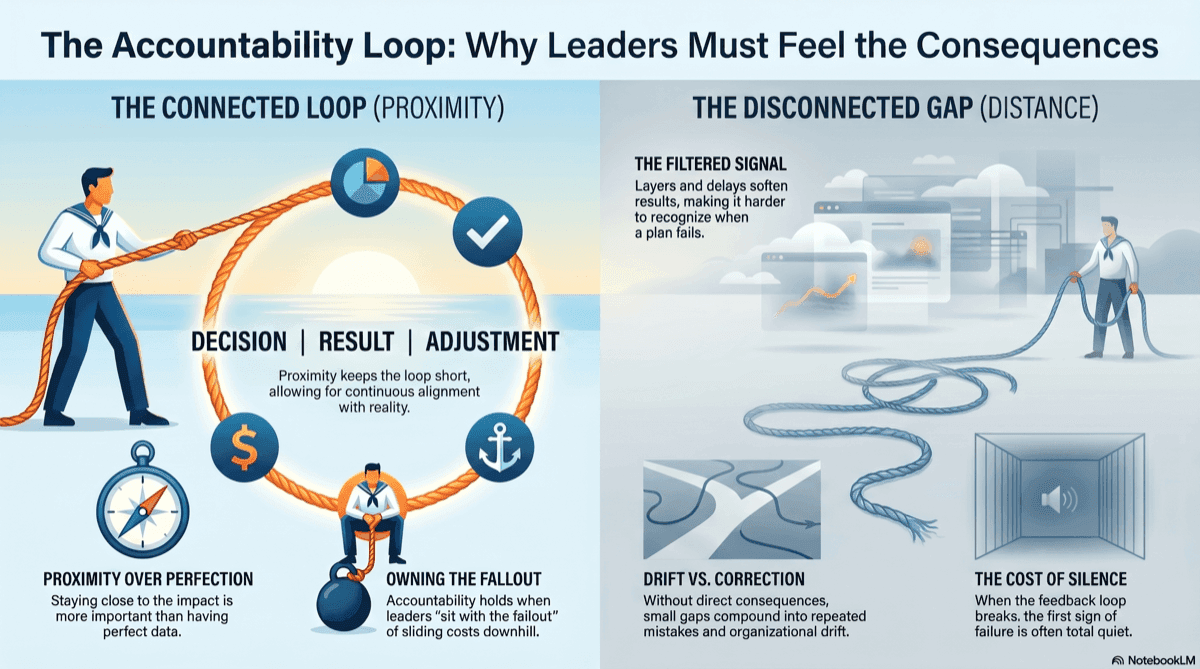
Those who decide stay tied to what their choices do to others.
A decision creates cost, risk, or gain for people in a group. Where people decide and where costs land can separate. - Incentives favor visible wins over visible cost - In large settings, effects land unevenly - Distance makes harm easier to miss - Pushing pain downhill is easier Those who decide stay tied to what their choices do to others. If we called it, we sit with the fallout. Leaders feel the consequences on this; we're not sliding the pain down a layer.
Setup
A decision creates cost, risk, or gain for people in a group.
Problem
Where people decide and where costs land can separate.
Forces
- Incentives favor visible wins over visible cost
- In large settings, effects land unevenly
- Distance makes harm easier to miss
- Pushing pain downhill is easier
Observation
Those who decide stay tied to what their choices do to others.
Example
If we called it, we sit with the fallout. Leaders feel the consequences on this; we're not sliding the pain down a layer.
At a glance
What it does
Those who decide stay tied to what their choices do to others.
Why it matters
Where people decide and where costs land can separate.
Key risk
whoever called the stop sits with fallout when trucks stay parked or loads go short
Counterbalance
name who authorized the call and the cost in the same huddle
Recognition signals
- whoever called the stop sits with fallout when trucks stay parked or loads go short
- costs do not quietly slide onto route teams, docks, or hourly staff
- decision-makers stay tied to what their choices do to others, not only to metrics
- harm is named in the room where release was judged, not reframed as field noise
- accountability stays visible when pressure favors pushing pain downhill
Questions to ask
- If we called it, who sits with the fallout?
- Where do costs land when the center keeps the commitment story intact?
- Are visible wins separating from visible cost at growing distance?
Counterbalances
- name who authorized the call and the cost in the same huddle
- refuse to ship rework downstream without recording the decision
- keep consequence contact when scale adds layers between decide and absorb
Trajectory
Early signals
- leaders absorb part of the cost of their own visible decisions
- stops and delays get credited to the person who could still say no
Intensification
- rework and risk travel downward while the dashboard stays green
- distance makes harm easier to miss from the conference room
Failure modes
- harm displacement repeats until correction feels disruptive
- trust that feedback will matter erodes with each unpunished offload
Restoration paths
- pull one decision's cost back into the room where it was authorized
- pair every visible win with who paid for it
Manifestations
leadership
- a director parks trucks and takes the blunt partner note instead of blaming the supervisor
organizations
- rework from a rushed release lands on field teams while the center keeps on-time numbers
family
- a parent owns the awkward conversation when a child's plan creates cost for siblings
Appears in chapters
- Part V — Leadership Without Prophecy
- Chapter 9 — Why Leaders Are Pressured Into Certainty
- Chapter 10 — The Discipline of Uncertainty as Leadership Practice
- Chapter 11 — Responsibility After Certainty
- Chapter 4 — The Chair
- Chapter 9 — The Scale
- Chapter 2 — The Decision
in Velorum
- Chapter 3 — Leaving Greyhaven
in Velorum
And 37 more chapters with this association.
Related books3 books

Book
When Others Look to You
Renewal and Erosion in Leadership
A leadership field guide to how influence forms, how trust is renewed, and how erosion begins when responsibility drifts from practice.
View book

Book
When Others Become Leaders
What Enduring Influence Leaves Behind
What kind of leadership increases the capacity of others to act, care, organize, and lead beyond the originating person.
View book

Book
When Others Look to You: Companion Edition
Forming, Renewing, Eroding, Repeating
How leadership influence forms, renews, erodes, and repeats across the full cycle of responsibility in practice.
View book