
Pattern
Leadership Coalesces
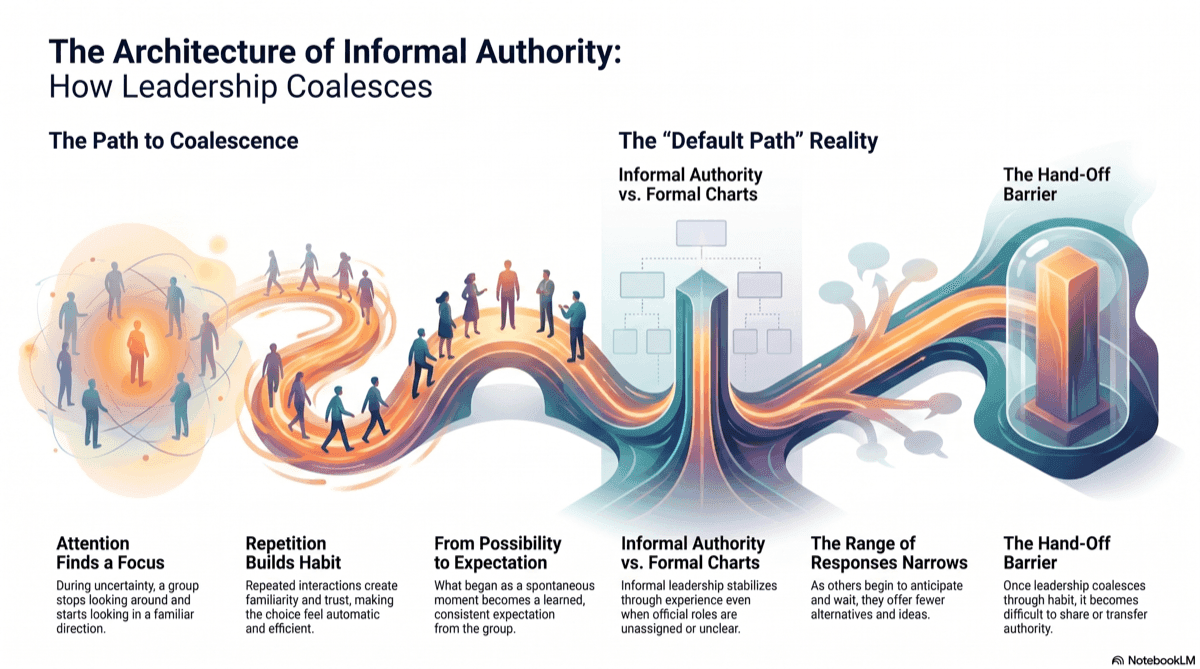
The group defaults to the same person. That can happen even when no formal authority exists.
A group repeatedly turns to the same person when decisions are unclear. On paper, who decides is unclear. Or the role is assigned, but the work still slides to the same person. - Repetition builds familiarity and trust - Speed favors the usual decision path - Dodging unclear ground reinforces habit - Informal authority can feel easier than formal handoff The group defaults to the same person. That can happen even when no formal authority exists. It's not on the chart, but leadership coalesces around you—every time it's fuzzy, the call still comes back to you.
Setup
A group repeatedly turns to the same person when decisions are unclear.
Problem
On paper, who decides is unclear. Or the role is assigned, but the work still slides to the same person.
Forces
- Repetition builds familiarity and trust
- Speed favors the usual decision path
- Dodging unclear ground reinforces habit
- Informal authority can feel easier than formal handoff
Observation
The group defaults to the same person. That can happen even when no formal authority exists.
Example
It's not on the chart, but leadership coalesces around you—every time it's fuzzy, the call still comes back to you.
At a glance
What it does
The group defaults to the same person. That can happen even when no formal authority exists.
Why it matters
On paper, who decides is unclear. Or the role is assigned, but the work still slides to the same person.
Key risk
every fuzzy call still comes back to the same person, chart or no chart
Counterbalance
hand temporary steer to whoever is closest before the call repeats
Related video
Having trouble playing the video? Open it on YouTube.
Infographic
Recognition signals
- every fuzzy call still comes back to the same person, chart or no chart
- speed favors the usual decision path over exploring alternatives
- informal authority feels easier than formal handoff
- repetition builds familiarity until one person becomes the default gate
- other paths for leading grow weaker without anyone announcing consolidation
Questions to ask
- Is leadership coalescing around one name every time it is fuzzy?
- What work still slides to the same person despite assigned roles?
- Who is waiting on one place before a problem reads as real?
Counterbalances
- hand temporary steer to whoever is closest before the call repeats
- name alternate decision paths before repetition hardens habit
- rotate escalation so speed does not always mean the same gate
Trajectory
Early signals
- the group turns to the same voice when decisions are unclear
- dodging unclear ground reinforces the familiar path
Intensification
- authority forms through repetition and gets hard to share
- disagreement suppresses around the consolidated center
Failure modes
- only one escalation point remains at growing scale
- circulation narrows while correction may still work on paper
Restoration paths
- delegate one decision ring with credit when the formal lead returns
- build a bench by letting others hold the center before crisis arrives
Manifestations
leadership
- a volunteer director becomes the de facto decision point without title change
organizations
- assigned role holders exist but work still slides to the usual coordinator
family
- one sibling becomes the default planner for every holiday because others wait for their cue
Reading trails featuring this pattern
Editorial paths that include this pattern as one stop in a longer sequence.
Appears in chapters
- Introduction — The Switch
- Part I
- Chapter 1 — The Photograph
- Chapter 3 — The Clock
- Part II bridge
- Chapter 4 — The Chair
- Part IV bridge
- Chapter 10 — The Window
And 19 more chapters with this association.
Related books4 books

Book
When Others Look to You
Renewal and Erosion in Leadership
A leadership field guide to how influence forms, how trust is renewed, and how erosion begins when responsibility drifts from practice.
View book

Book
The World We Make Together
How Ordinary People, Unequal Power, and Shared Action Shape History
History is collective, but responsibility remains uneven. The World We Make Together follows ordinary objects—a switch, a ballot, a fence, a bowl, a scale—into the institutions and relationships through which people shape public life without becoming either solitary heroes or passive products of structure.
View book
Book
When Others Become Leaders
What Enduring Influence Leaves Behind
What kind of leadership increases the capacity of others to act, care, organize, and lead beyond the originating person.
View book

Book
When Others Look to You: Companion Edition
Forming, Renewing, Eroding, Repeating
How leadership influence forms, renews, erodes, and repeats across the full cycle of responsibility in practice.
View book