
Situation
Meaning outruns shared understanding
Words, plans, and summaries move faster than the shared read they presuppose; coordination proceeds on incompatible assumptions.
Recognition signals
- teams act for days on an assumption nobody explicitly agreed to
- archived summaries train newcomers on a read the originator did not intend
- the distinction between direction and intent becomes difficult to maintain
- meaning races ahead of contact while vocabulary stays the same
- later evidence arrives too late to unwind what already moved
Questions to ask
- What did we start doing before we agreed on what was said?
- Which record is now teaching future attention the wrong lesson?
Counterbalances
- pause coordination until exact wording is confirmed
- label provisional assumptions in shared documents before they propagate
Trajectory
Early signals
- a passing comment gets treated as direction
- hallway coordination outpaces the official read
Intensification
- plans change without a vote while everyone describes it as decided
- archives accumulate layers that obscure the original uncertainty
Failure modes
- consequence competes with intent as the account of what happened
- repair requires rewriting history, not just fixing the plan
Restoration paths
- return to exact language before defending the coordinated outcome
- add a contact checkpoint before the next handoff
Manifestations
software
- a ticket comment becomes scope while the author still thought they were brainstorming
leadership
- a leader's informal remark becomes policy in the project plan summary
organizations
- edited meeting notes remove an assumption the room had been acting on for a week
family
- a casual remark about weekend plans becomes the family's assumed commitment
Active patterns2 patterns
Pattern
Meaning Outruns the Words
People rely on short utterances to carry complex relational meaning. Language cannot carry full context, history, and emotional state by itself. - Context lives in the setting and in shared history - Emotion often shows up outside explicit wording - Social roles load words with extra consequence Language never carries all of the context, emotion, or intent around it. Meaning outruns the words: a line can be precise in grammar and still short on life.
View Pattern →
Pattern
Contact Keeps the Read Open
People return to a difficult exchange with more context and lower reactivity. Early interpretation may be useful but still too rough. - Additional context widens what people can see - Lower emotional charge improves tolerance for ambiguity - Restraint keeps meaning revisable Additional context can sharpen understanding without fully resolving it. Contact keeps the read open when understanding tightens without the story having to close.
View Pattern →
Related books2 books
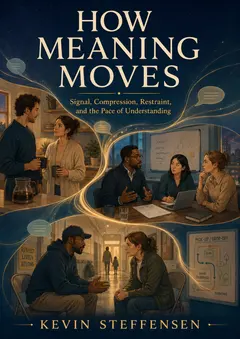
Book
How Meaning Moves
Signal, Compression, Restraint, and the Pace of Understanding
Before people disagree, they interpret. How meaning forms through signal, compression, and restraint—long before anyone is obviously wrong, and often while the sentence is still forming.
View book

Book
The Relay
A Social Science Fiction Novel
A courier notices silence where explanations should be — and a civilization-sized blind spot emerges one perspective at a time. When circulation collapses, people reach for the nearest clear answer; the work is learning how to keep asking without that comfort.
View book