Chapter 2 — Two Directions
Skip to chapter textPart II — Renewal, Erosion, and Circulation
Chapter 2 — Two Directions
When Reality Pushes Back
A hospital sets a new triage protocol in the main site on Monday. By Friday, three satellite clinics are using the same thresholds and hitting the same response-time target. Reach looks clean on the weekly sheet.
Midweek, nurses flag a dosage risk in a standing order attached to the new protocol. Two clinics update practice within days. The third keeps the old order posted at the station and waits for the monthly review. The sheet at the center still reads coordinated. At the third clinic, the protocol that traveled so fast has not moved when the facts did.
People take cues from the same few voices. What separates the networks is what happens when reality pushes back against a plan that has already spread.
That is the pivot. Once Attention Finds a Focus, influence keeps producing one of two directions. The group can still correct course while coordinated action grows in reach, or insulation sets in and correction weakens as reach gets harder to coordinate.
These are directions—structural tendencies under pressure—not fixed types of people or organizations. The same group can renew in one domain and erode in another, shift over time, or look stable while the capacities underneath change. The framework is diagnostic: it helps you read movement, not sort teams into moral categories.
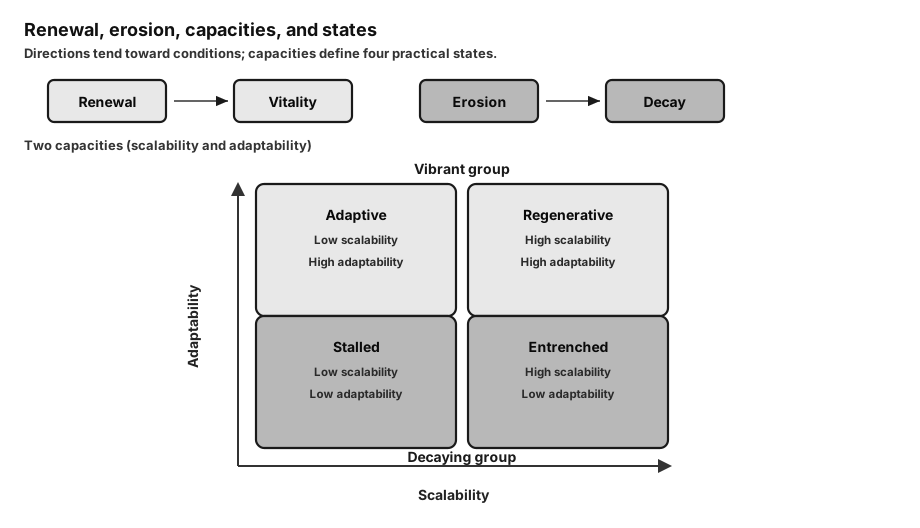
The first direction is renewal.1 Renewal names which way influence is moving. Vitality names how things tend to feel when that movement holds.
The second direction is erosion.2 Erosion names which way influence is moving when insulation builds and correction weakens. Decay names how things tend to feel when that movement holds.
Those are different questions. This is not a report card on character. Good intentions can still yield erosion, and flawed people can still sustain renewal. What matters is structure under pressure, not purity.
Two Capacities
Most of the story comes down to two capacities.
In the hospital scene, all three clinics took up the protocol—scalability looked strong. The dosage risk showed where adaptability did not move together. Reach held. Local course change did not.
In another network, each clinic already interprets the protocol differently, so priority decisions drift by location. The dosage warning is passed up, but leadership delays changes until the next monthly review. Here both capacities are under strain, and the strain shows first where the work is farthest from the center.
Scalability asks whether coordinated action can grow in reach—whether more people, sites, or layers can stay coordinated without the center holding every thread by hand.
Adaptability asks whether the work can still change direction when reality pushes back—whether plans stay open to revision after they are in motion.
The four states show how the capacities combine. The decisive signal for erosion is whether adaptability shrinks—whether the group can still change course when reality pushes back. Scalability then tells whether that weakening remains coordinated or whether coordination is fraying too. Reduced scalability alone does not mean erosion: a group may still renew while struggling to coordinate at scale, just as it may stay highly coordinated while losing the ability to change course. That is why one organization can look renewing on paper while a site or function is already eroding.
At the third clinic, the old dosage order can still be on the wall when the monthly review finally opens. The protocol traveled. The revision did not.
The Vibrant Group and the Decaying Group
In one school district, new campuses open and still run the same attendance intervention protocol. When weekly absence data shifts, most principals adjust quickly and the change spreads—until one campus, under a different enrollment pressure, keeps the old thresholds to protect its reported numbers. The district still looks coordinated from the center. Locally, renewal and erosion are already sharing the same map.
In another district, the picture splits more openly. Some campuses still look coordinated, but local teams stop changing course when warning signs surface. In other campuses, coordination itself frays as each team improvises around unresolved gaps.
Those are the patterns. Together scalability and adaptability produce four combinations worth naming once for the diagram: regenerative (reach holds and plans still adapt), adaptive (adjustment holds while reach is still narrower), entrenched (reach holds but change gets hard), and stalled (coordination and course change both weaken). You do not need to keep the four labels in working memory. The useful read is simpler: are we still able to change course as reach grows? These are not personality types. They describe how the work is set up when pressure hits. The setup can differ by domain, site, or season.
The decisive split is whether adaptability stays high or falls low.
The vibrant group is the renewal side: regenerative and adaptive. Taken together they cover high or low scalability as long as adaptability stays high. The group can still change course when reality pushes back, whether reach is broad or still thin.
The decaying group is the erosion side: entrenched and stalled. Taken together they cover high or low scalability when adaptability is low. Changing course gets hard or disappears. The group may still look coordinated for a long time, or coordination itself may be coming apart. A single organization can hold both tendencies at once.
Direction and day-to-day feeling are not the same thing.
Footnotes
AI-generated narration
About 381s